need strong shipping law
pp. 71-73 · Read in the full issue

Ships
Flag of convenience will need strong shipping law
Newly-independent Vanuatu announced recently (PIM, Mar p7l) that it will set up a free flag shipping register, a ‘flag of convenience’, for shipowners and ships on international routes. Similar arrangements by some other countries have earned bad reputations, and here a special shipping writer discusses the safeguards Vanuatu will have to adopt if the scheme is to succeed.
Vanuatu has decided to establish a Liberian-style free flag ship ping register or a flag of convenience as it is known in shipping circles for obvious economic reasons. The arrange ment will fit into Vanuatu’s tax haven economic policy and will be a source of foreign exchange through registrations involving ships, officers and crews. But the consequences of establishing a maritime flag of convenience can be extremely serious, nationally
and internationally.
Why does a shipowner register his ships under other than his own flag? The answer is simply economics in most cases. Flags of convenience invariably attract little or no taxation on shipping operations, beyond annual regis tration fees, which are the justification in turn for establish ing such registers. This economy alone is no bad reason for registering ships under a flag of convenience. However, flags of convenience have earned them selves a bad reputation through other economies which unscrupu lous owners have made exploiting the lower ship operating stan dards which some flags have tolerated or have been unable to control. Herein lies the real evil of a free registry.
Characteristically, flag of con-
venience shipowners have been: • Free from union dominance, leading to their being able to employ lowly paid crews, with consequent poor crew standards; • Able to effect cut-backs in safety standards because of the inability or lack of intent of the host nation to police safety standards; and • Able to employ marine per sonnel with indifferent qualif ication standards.
There are other economic reasons for using a flag of convenience. For many years, for instance, US owners couldn’t register under their own flag unless their ships were US-built.
Because it was often cheaper to buy ships from other countries, this forced some US owners to use flags of convenience.
The majority of flag of coven ience ships operate to good standards. Some highly repu table owners have been forced into free flag registration as a means of survival in the face of manning costs thrust upon them by their national unions, in terms of pay, conditions and crew size.
The older established free flags, notably Liberia, have in recent years made strides towards enforcing higher stan dards. There is some reticence amongst other flags to introduce legislation which might detract potential owners. Vanuatu has stated that its registry will be of the finest standard and will come under impeccable management.
This is heartening, but Cyprus once made a similar pronounce ment, and the safety record under the Cyprus flag became one of the worst in the world.
If Vanuatu is to achieve a good reputation as a free flag and thereby attract the right ship owners, she must from the outset establish her standards and the mode of policing these standards.
The international governing stan dards are those set down by the
members of the Safety of Life at Sea Convention. Presumably, Vanuatu will sign the convention if she has not already done so.
Certainly, any owner registering his ship under a non-convention flag could find himself in difficulties attempting to operate into some countries. Australia, for instance, insists on com pliance with its own laws before it will clear a ship registered under the flag of a non convention country.
Vanuatu will have two possible ways of policing convention re quirements. One is to establish a full-scale shipping inspectorate capable of dealing with Vanuatu registered ships anywhere in the world. The other is to contract out the responsibility to a recog nised international classification society, such as Lloyd’s. The contracting of responsibility is the most likely solution for Vanuatu, because of the sheer size and difficulty of attempting to set up an independent world wide inspectorate.
Accordingly Vanuatu is likely to empower existing international societies, or a single society, to issue international certificates of convention standard on behalf of the Vanuatu government. This is a broadly satisfactory system, and one which is used either exclusively or to augment national inspectorates by most maritime nations. The use of classification societies for inspec torate functions would not excuse the Government of Vanuatu from establishing an inspectorate service to carry out spot checks
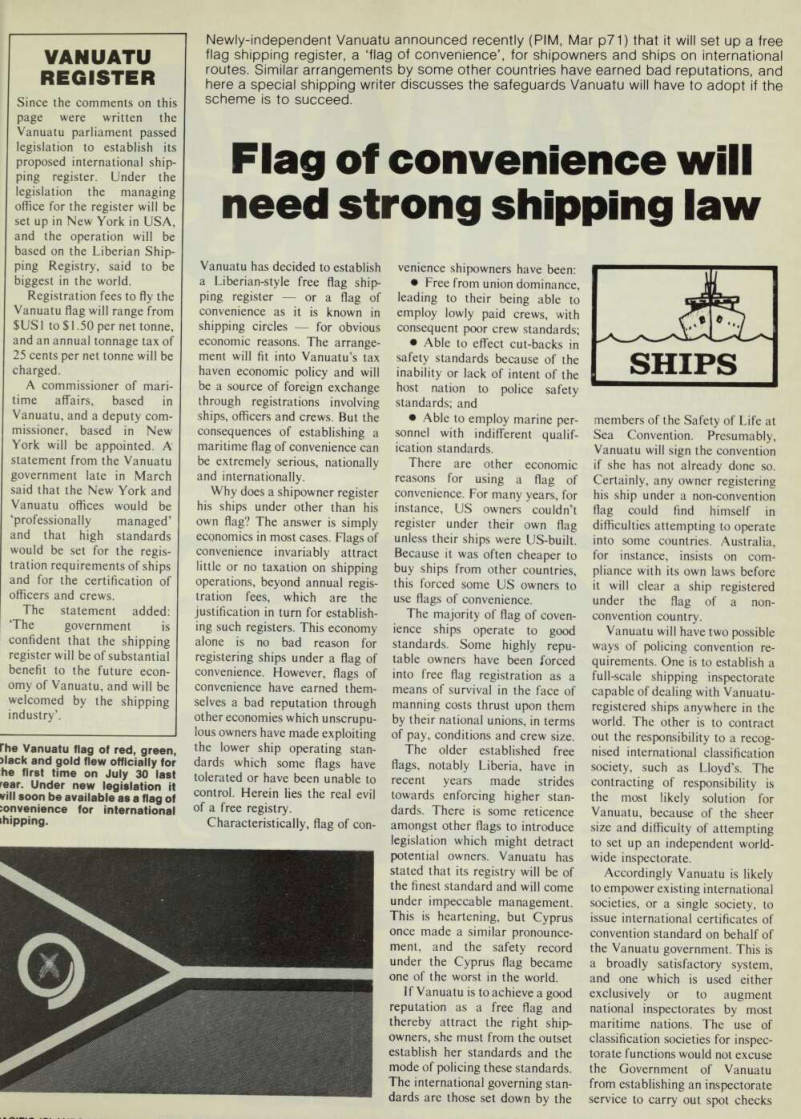
The Vanuatu flag of red, green, Black and gold flew officially for [?]he first time on July 30 last [?]ear. Under new legislation it will soon be available as a flag of [?]onvenience for international [?]hipping.
internationally and to conduct marine enquiries.
The question of cheap mann ing need not necessarily pose a problem to safety at sea. For years, Indian, Chinese, and more recently Kiribati and Papuan crews have effectively manned European flag ships to very high standards. However these crews have been certificated, and have been administered by high cal ibre officers.
One of the greatest dangers to the safety of life at sea created by flags of convenience has been the indifferent licensing of officers.
Established free flag nations such as Liberia and Panama, with no examination service of their own, issue certificates of competency at worldwide embassies against the production of an equivalent certificate from a non-free-flag nation. Thus, a British master mariner can produce his certificate of competency at a Liberian embassy and be issued with a Liberian certificate. The system has been subject to abuse.
Further, not all examining mari time nations require the same standards of competency and experience for examination for a certificate acceptable for free flag certification.
If Vanuatu adopts the Liber ian system, and if she is to naintain standards at a level vhich will attract responsible )wners, then she must be ex remely careful in defining the countries which have certificates )f competency considered icceptable for the issue of /anuatu certificates.
In summary, Vanuatu’s pro ved establishment of a free flag egistry is in line with the tax laven economic policy of the lation. It could afford substantial conomies to shipowners seeking □ register their vessels under flag f convenience. However, if Vanuatu’s ambitions for an npeccably managed free flag egistry of the highest standards re not to founder under the xploitation of unscrupulous hipowners seeking an alternative 3 the tightening standards of iberia, then the country will ave to implement stringent ship ing law and establish an
ffective professional shipping
ispectorate from the outset, liven such, Vanuatu would robably attract the right sort of igh calibre owner.
Repairs For
Mv Tokera
After nearly four months of uncertainty about the future of the damaged Cook Islands ship MV Tokerau , the ship’s owners are now calling tenders for its repairs and return to service.
Tokerau was delivered to its owners. South Pacific Import Network Company, only last August (PIM, Oct p7l). Al though 40 years old the ship had been refitted and classed by Lloyd’s, and its owners put it into service on cargo routes to Western Samoa, Fiji and Tuvalu.
In December the ship struck a reef northwest of the Fiji island of Viti Levu while mak ing for Suva on a voyage from Tuvalu. No one was injured, but the ship was hard on the reef with damaged plating, some holing and severe damage to propeller and rudder. The en gine room flooded 12 hours after the grounding. Six days after the grounding the hull was patched and a salvage tug refloated the ship and towed it to Suva.
Since then the ship has been in Suva while financial and insurance matters affecting its future have been under inquiry.
The owners now believe it will be possible to return the ship to service later this year.
Paul Rysavy in Rarotonga.
Png Affirms
Forum Aid
Papua New Guinea has com mitted itself to the continued support of the Pacific Forum Shipping Line despite con tinued losses by the line and despite Australian questioning of the viability of the operation.
Last year Australia told heads of Pacific Island govern ments that it would support the line if this was the wish of the Islands, but the support could be at the expense of Australian general aid to the region. New Zealand clashed with Australia over the issue and said it would continue to aid the line in the interests of developing the ex port economies of the smaller Pacific countries (PIM, Mar p 67).
The Papua New Guinea Prime Minister, Sir Julius Chan, has now reaffirmed his
country’s support to moves to keep the line alive. PNG itself, Sir Julius said, would continue to participate in the line and to provide budget support but he added that the extent of the budget support would depend on PNG’s aid received from Australia.
Sir Julius said ‘By supporting the line we see ourselves helping the smaller Island nations such as Tonga, Kiribati and Niue.
We can’t deny services to these places’.
He said that a prime respons ibility to revive the line and turn its losses into profits rested with the governments of Australia and New Zealand in the inter ests of the Pacific community.
He welcomed the New Zealand commitment to contribute to the line.
Police Party
Nabs Ships
Yap, in the Federated States of Micronesia, is adopting an in creasingly tough attitude to foreign fishing ships which en ter its territorial waters without clearance, even if there is no evidence that the visiting ships are taking fish.
In a recent incident off the south coast of Yap police im pounded three ships which had hove to and were apparently transferring fuel. One was the 3900 tonne fisheries vessel Reefer Star which is registered in Panama but is owned by the US firm Star Kist which has fishing agreements with the Papua New Guinea govern ment. Its crew of 45 officers and
men included Koreans, Papua New Guineans, Filipinos and Japanese. The two small ships which were alongside it were owned by Japanese interests and were manned by Okinawan crews.
Police on Yap used two prisoners from a local gaol to crew an open dinghy which went out to the three ships. The three police who travelled in the dinghy questioned the masters of the ships, and instructed the ships to follow them The ships obeyed the instruc tion after some argument and were later fined a total of $5OOO on charges relating to unauthor ised entry to territorial waters and spilling diesel fuel. The ships were allowed to leave several days later after the fines were paid.
A spokesman for the Yap attorney-general’s office said that fisheries were an important resource for Yap, and although the state was ill-equipped to deal with breaches of its terri torial regulations it would spare no effort to act against the presence of unauthorised ships.
Eight Saved
From Wreck
Eight Japanese crewmen were rescued unharmed by a sister ship after their fishing ship Tokusho Maru 5 struck a reef east of Truk Island in the Federated States of Micronesia in February. The ship has remained firm on the reef, and the damaged hull is now con sidered to be beyond salvage.