Polynesia
pp. 7-10 · Read in the full issue

Letters
‘Wrong way’ in French Polynesia
From conversations during a recent visit to Europe with people from former French colonies in Africa, I am con vinced that President de Gaulle’s action in granting them self-rule was a mistake.
The same mistake has been made in the Pacific. Pretending to grant the Polynesians internal autonomy’ the French then used all possible means Haltering the elected people and :orrupting as many of them as possible, and making as big a Dunch of accomplices as poss ble of the local fonctionnaires 'civil servants) by overpaying hem to go back on the principle of ‘internal auton )my’.
The mistake has been made vorse by the so-called energy crisis, since the cost of trying to :eep all these small islands in he French orbit by buying their avours through so-called social >rogress a lot of schooling, a ot of hospitals, a lot of enter ainment and a lot of propa ;anda on the TV screens and in he local press for local portsmen and women has rown enormously. Such efforts ave certainly swollen the egos f certain people with very little ritical sense, but they have also fft many of them unemployed, nd most of them totally unpro uctive.
These people, who call them ;lves ‘Tahitians’, are by now a fixture of ancestral Malay and lelanesians, cross-bred with 'hinese, Whites and a tiny Drinkling of Indians (from ondicherry, mostly), and some lack people from the French lands in the Caribbean. In ion they are of a great variety, ome of them are quite nice, ut most are extremely primi ve and are quite unbearable hen given any sort of official
authority. If they were given the opportunity to live a hard life again they would revert to their former ways, which were quite pleasant.
But too many of them have been transformed by the French into spoilt brats. And it is evident that the French Govern ment wants them to stay that way. This I wrote as far back as 1967, hoping to stop the trend, but the trend was the will of the French Government, and could not thus be reversed. I only made more enemies than ever, both among the overpaid mixed-race civil servants and among representatives of the French Government, all the way up to the rue Oudinot, headquarters of the so-called Overseas France Sub- Secretariat of State.
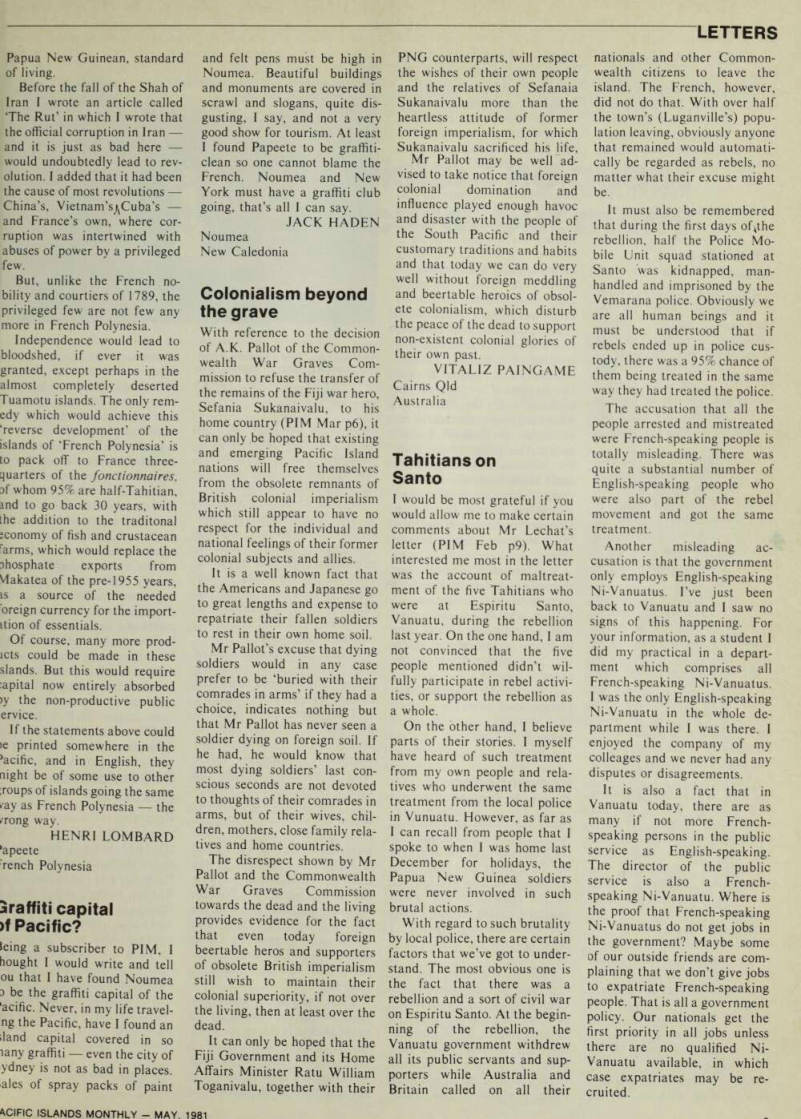
The main job of Paul Dijoud, the present State Sub-secretary for the Overseas Departements and Territories, is to weave a spider’s web around the so called freely elected representa tives of the Tahitian people through cajoling, granting credits, refusing credits, accept ing with official congratulations the incredible squandering of the taxpayers’ money if the author or authors of the venture happen to be UDF (Mr Giscard’s party), or refusing essential credits where they might allow economic develop ment in an island or a group of islands.
There is one thing that the present French Government wants to avoid at all costs, and that is to find itself with an economically self-sufficient archipelago (like the Maldives, southwest of Sri Lanka), in which the French would only have their bases of Moruroa and Hao.
It is clear, moreover, that the only part of the local population that could run this group of islands are the quite numerous Chinese descendants of the first coolies imported by France to plant and cut sugar cane, and also to pick the cotton formerly grown in Atimaono and in Raiatea. Because they were hard-working, shrewd, and not money-squandering, childish, whimsical people like the natives, they put up small bazaar-like stalls everywhere, grew vegetables, and slowly became the dominant factor in trade, speculation in vanilla
beans preparation and export, baking bread, roasting coffee, opening restaurants, and even acting as bankers. Two families, the Chin Foo and the Siu, started a bank, called the Banque Kon Ah, which failed.
But only after its founders had bought a lot of land with the depositors’ money. They kept the land, and one of the two prospered under the very cun ning guidance of Mr Ah You Siu. One of his sons is today the agent for Mobil Oil, as well as having the Mercedes-Benz and Ford agencies. Other offspring have entered the administration (Fisheries), after gaining de grees at US universities.
Having a French (or for that matter one of any other nation ality, like British or German) Governor who avoided getting the local people into ‘politics’ whatever that meant in the conception of the natives was by far the best, and even the only, possible way to run the
archipelago properly.
Here we are now with a greedy, incompetent, dishonest, irresponsible, corrupt and inefficient administration, which has stifled and will stifle any attempt at economic devel opment made by anybody in this archipelago, except if one bribes them all, which is only possible if you are an importer and have some sort of a mon opoly.
Finally, regarding the police: there is nowhere in the Pacific with as many policemen, as high a percentage of traffic accidents, and such a display of military force to keep such a small population from starting any meeting or rally to ask for complete independence.
This in fact is not even necessary, since the average Tahitian has become too lazy to request independence, which some understand as meaning doing away with luxuries like running around in a big car, even to cover no more than 80 metres in 10 minutes due to traffic jams, watching TV until one falls asleep, buying too much food (imported of course) in supermarkets, eating too much, drinking too much, and finally dying around 55 of heart failure, or other conditions com ing from over-indulgence in banqueting, cocktail parties, and never a day of hard work.
Extracting enough money from the working classes be they owners, bosses, or em ployees will become more difficult as lime goes by until only about half of the people in the ‘private sector’ are left.
They will only survive through bribery of the bureaucracy, very hard work, and employing only members of their families to avoid the very high cost of that other pork barrel ‘social security’.
Only monopolies will survive, for some time at least, and they will all be French ethnic Chinese. The latter have been all naturalised French because they were known to vote for ‘the French presence’, and because they all know that if the Tahitians attained indepen dence, the standard of living would revert to what it was 40 years ago a Western Samoan, Tongan, Vanuatuan,
Paul Dijoud - ‘his main job is to weave a spider’s web around the so-called freely-elected representatives’.
Papua New Guinean, standard of living.
Before the fall of the Shah of Iran I wrote an article called ‘The Rut’ in which I wrote that the official corruption in Iran and it is just as bad here would undoubtedly lead to rev olution. I added that it had been the cause of most revolutions China’s, — and France’s own, where cor ruption was intertwined with abuses of power by a privileged few.
But, unlike the French no bility and courtiers of 1789, the privileged few are not few any more in French Polynesia.
Independence would lead to bloodshed, if ever it was granted, except perhaps in the almost completely deserted Tuamotu islands. The only rem edy which would achieve this
‘reverse development’ of the
islands of ‘French Polynesia’ is to pack off to France three quarters of the fonctionnaires, 3f whom 95% are half-Tahitian, and to go back 30 years, with the addition to the traditonal sconomy of fish and crustacean r arms, which would replace the Dhosphate exports from Vlakatea of the pre-1955 years, is a source of the needed breign currency for the import ition of essentials.
Of course, many more pred icts could be made in these slands. But this would require :apital now entirely absorbed >y the non-productive public ervice.
If the statements above could »e printed somewhere in the Acific, and in English, they night be of some use to other ;roups of islands going the same /ay as French Polynesia the /rong way.
Henri Lombard
‘apeete rench Polynesia
araffiti capital
>f Pacific?
leing a subscriber to PIM, I bought I would write and tell ou that I have found Noumea 3 be the graffiti capital of the ’acific. Never, in my life travel ng the Pacific, have I found an ;land capital covered in so lany graffiti even the city of ydney is not as bad in places, ales of spray packs of paint
and felt pens must be high in Noumea. Beautiful buildings and monuments are covered in scrawl and slogans, quite dis gusting, I say, and not a very good show for tourism. At least I found Papeete to be graffiti clean so one cannot blame the French. Noumea and New York must have a graffiti club going, that’s all I can say.
Jack Haden
Noumea New Caledonia
Colonialism beyond
the grave With reference to the decision of A.K. Pallot of the Common wealth War Graves Com mission to refuse the transfer of the remains of the Fiji war hero, Sefania Sukanaivalu, to his home country (PIM Mar p 6), it can only be hoped that existing and emerging Pacific Island nations will free themselves from the obsolete remnants of British colonial imperialism which still appear to have no respect for the individual and national feelings of their former colonial subjects and allies.
It is a well known fact that the Americans and Japanese go to great lengths and expense to repatriate their fallen soldiers to rest in their own home soil.
Mr Pallet’s excuse that dying soldiers would in any case prefer to be ‘buried with their comrades in arms’ if they had a choice, indicates nothing but that Mr Pallot has never seen a soldier dying on foreign soil. If he had, he would know that most dying soldiers’ last con scious seconds are not devoted to thoughts of their comrades in arms, but of their wives, chil dren, mothers, close family rela tives and home countries.
The disrespect shown by Mr Pallot and the Commonwealth War Graves Commission towards the dead and the living provides evidence for the fact that even today foreign beertable heros and supporters of obsolete British imperialism still wish to maintain their colonial superiority, if not over the living, then at least over the dead.
It can only be hoped that the Fiji Government and its Home Affairs Minister Ratu William Toganivalu, together with their
PNG counterparts, will respect the wishes of their own people and the relatives of Sefanaia Sukanaivalu more than the heartless attitude of former foreign imperialism, for which Sukanaivalu sacrificed his life, Mr Pallet may be well ad vised to take notice that foreign colonial domination and influence played enough havoc and disaster with the people of the South Pacific and their customary traditions and habits and that today we can do very well without foreign meddling and beertable heroics of obsol ete colonialism, which disturb the peace of the dead to support non-existent colonial glories of their own past.
Vitaliz Paingame
Cairns Qld Australia
Tahitians on
Santo
I would be most grateful if you would allow me to make certain comments about Mr Lechat’s letter (PIM Feb p 9). What interested me most in the letter was the account of maltreat ment of the five Tahitians who were at Espiritu Santo, Vanuatu, during the rebellion last year. On the one hand, I am not convinced that the five people mentioned didn’t wil fully participate in rebel activi ties, or support the rebellion as a whole.
On the other hand, I believe parts of their stories. I myself have heard of such treatment from my own people and rela tives who underwent the same treatment from the local police in Vunuatu. However, as far as I can recall from people that I spoke to when I was home last December for holidays, the Papua New Guinea soldiers were never involved in such brutal actions.
With regard to such brutality by local police, there are certain factors that we’ve got to under stand. The most obvious one is the fact that there was a rebellion and a sort of civil war on Espiritu Santo. At the begin ning of the rebellion, the Vanuatu government withdrew all its public servants and sup porters while Australia and Britain called on all their
nationals and other Common wealth citizens to leave the island. The French, however, did not do that. With over half the town’s (Luganville’s) popu lation leaving, obviously anyone that remained would automati cally be regarded as rebels, no matter what their excuse might be.
It must also be remembered that during the first days rebellion, half the Police Mo bile Unit squad stationed at Santo was kidnapped, man handled and imprisoned by the Vemarana police. Obviously we are all human beings and it must be understood that if rebels ended up in police cus tody, there was a 95% chance of them being treated in the same way they had treated the police.
The accusation that all the people arrested and mistreated were French-speaking people is totally misleading. There was quite a substantial number of English-speaking people who were also part of the rebel movement and got the same treatment.
Another misleading ac cusation is that the government only employs English-speaking Ni-Vanuatus. Eve just been back to Vanuatu and I saw no signs of this happening. For your information, as a student I did my practical in a depart ment which comprises all
French-speaking Ni-Vanuatus.
I was the only English-speaking Ni-Vanuatu in the whole de partment while I was there. I enjoyed the company of my colleages and we never had any disputes or disagreements.
It is also a fact that in Vanuatu today, there are as many if not more French speaking persons in the public service as English-speaking.
The director of the public service is also a French speaking Ni-Vanuatu. Where is the proof that French-speaking Ni-Vanuatus do not get jobs in the government? Maybe some of our outside friends are com plaining that we don’t give jobs to expatriate French-speaking people. That is all a government policy. Our nationals get the first priority in all jobs unless there are no qualified Ni- Vanuatu available, in which case expatriates may be re cruited.
We are Ni-Vanuatus, not Francophones or Anglophones, as some people would want to call us in their divide-and-rule tactics. Despite outside inter ference, we are now one people and will always be one people, looking into the future as one nation.
Ni-Vanuatu
(Name and address supplied.) What’s in a name?
It would be a pleasure to reply to comments made by my Melanesian brother, Vitaliz Paingame, to my letter in PIM (Nov 1980 p 9). Honestly, I don’t see any logic in him dictating to me what name I should use. He has no right to do this. Besides, my name has nothing to do with the issue in my letter.
Congratulations on the fact that my brother admits being a true West Irianese who will always remain one. I believe in the decolonisation of the Pacific and I am committed to assisting this cause as long as I am a Pacific Islander and a son of Melanesia.
It is very sad and also offensive to see that my brother Melanesian mistook both my nationality and my country of origin and birth. He seems to argue his points as though I am a Papua New Guinean by attacking certain customs of the people of PNG. For his infor mation, I am a Ni-Vanuatu and my country is the Republic of Vanuatu. I will always remain a Ni-Vanuatu.
There are a few questions that I would like to ask my Melanesian brother. Firstly, since when has Vanuatu sold any of their Melanesian brothers to imperialism and colonialism? Secondly, when has Vanuatu aided in the exter mination of any of its Melanesian brothers? If my Melanesian brother is referring to his homeland, West Papua (Irian Jaya), I am sorry to say that we do support the Irianese people in their struggle for freedom but we will never, as long as we are a nation, play a part in the destruction of our Melanesian brothers. For my brother’s information, we have today, living with us in our
country, leaders of the West Papua freedom movement and we don’t put them in refugee camps as some other nations do.
With regards to comments about white handouts, that is a fact of life today in most Third World countries. You don’t expect to be independent today and tomorrow you have all that you need. There is also the fact of interdependence among nations of the world in order to survive. There is no such thing as being fully independent. A country can always be politi cally independent but never fully economically independent.
In reply to comments that we might be exterminated in a fraction of a second, I would like to say that I believe this will not happen if we played our cards right. On the other hand, why should we be scared to suffer for our beliefs? I don’t accept this petty advice from my Melanesian brother and I don’t think he really has any thing constructive to offer as an alternative to my first letter.
Destructive comments will not bring anybody progress in any thing.
It is far better to understand things fully before making wild comments and valuations. I believe what I am doing and saying is right and 1 don’t have to listen to comments unless they are constructive to my cause.
C. M. Lawrence
University of PNG Port Moresby Papua New Guinea
Remembering
Captain Cook
Amid the mounting interest in Australia in matters concerning the bicentenary of the arrival of the First Fleet in 1788, let us not forget the man who sparked off the train of events which headed Captain Arthur Phillip and his colonising fleet of 11 ships towards this continent in 1787.
Had it not been for the expertise of Lieutenant James Cook RN in navigation, his skill as a seaman and perseverance as an explorer, it is probable that this country would have been a French possession.
Cook’s landing on an island off Cape York in Torres Strait,
proclaiming the East Coast of Terra Australis as a British possession was a moment of destiny for millions of this country’s future inhabitants.
My first 25 years were spent on the South Coast of New South Wales among topographical features sighted, named and charted by Cook such as Mt Dromedary near Tilba, Pigeon House behind Milton, Pt Perpendicular at Jervis Bay and Hat Hill over looking Wollongong.
In later years as a resident of New Guinea and travelling periodically between there and Sydney by steamer I became well acquainted with many of his further sightings such as Smoky Cape, Pt Danger, Mt Warning, Glasshouse Moun tains, Whitsunday Passage and Lizard Island, to name a few.
It was therefore a fitting sequel and a moving experience recently for me to visit Kaelakekua Bay on the Island of Hawaii and to stand at the cairn of volcanic rock marking the burial place of William Hayman, a seaman gunner from one of Cook’s two ships. The burial service, read by Cook, was the first Christian service performed in the Sandwich Islands.
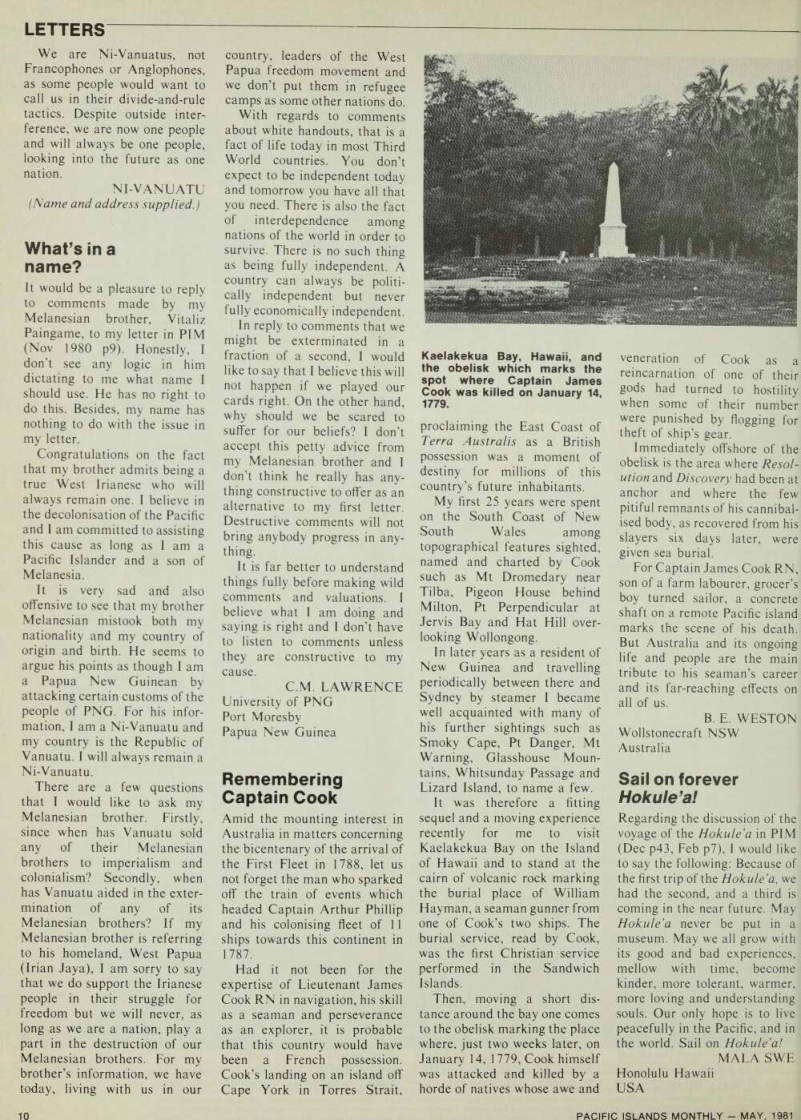
Then, moving a short dis tance around the bay one comes to the obelisk marking the place where, just two weeks later, on January 14, 1779, Cook himself was attacked and killed by a horde of natives whose awe and
veneration of Cook as a reincarnation of one of their gods had turned to hostility when some of their number were punished by flogging for theft of ship’s gear.
Immediately offshore of the obelisk is the area where Resol ution and Discovery had been at anchor and where the few pitiful remnants of his cannibal ised body, as recovered from his slayers six days later, were given sea burial.
For Captain James Cook RN, son of a farm labourer, grocer’s boy turned sailor, a concrete shaft on a remote Pacific island marks the scene of his death.
But Australia and its ongoing life and people are the main tribute to his seaman’s career and its far-reaching effects on all of us.
B. E. Weston
Wollstonecraft NSW Australia
Sail on forever
Hokule’a!
Regarding the discussion of the voyage of the Hokule’a in PIM (Dec p 43, Feb p 7), I would like to say the following: Because of the first trip of the Hokule’a, we had the second, and a third is coming in the near future. May Hokule’a never be put in a museum. May we all grow with its good and bad experiences, mellow with time, become kinder, more tolerant, warmer, more loving and understanding souls. Our only hope is to live peacefully in the Pacific, and in the world. Sail on Hokule’a!
Mala Swe
Honolulu Hawaii
Usa
Kaelakekua Bay, Hawaii, and the obelisk which marks the spot where Captain James Cook was killed on January 14, 1779.