Yachts
pp. 65-69 · Read in the full issue
their eyes the other day when they saw Cloetta sail by them at Crams Marina in the Whangarei River. • PISAGO: We talked to Canadians Gordon and Car men Heath just as they were preparing to enter the Russell Tall Ships Race. They took delivery of their 14.76 m Taiwan-built CT4B in Singa pore and cruised Indonesia following the west Malaysia coast to Penang, before cross ing to Darwin. They hugged the northern Australian coast and are enthusiastic about Arnhem Land’s beauty - the deserted beaches, the Aboriginal re serves, the ranger stations where they obtained info on the flora and fauna. They were the only cruising boat in the area. Shena, aged eight, has completed her second and third years of schooling using the Alberta correspondence lessons. Four-year-old Noah, who can clamber about the ratlines like a monkey, is work ing with pre-school lessons obtained in Australia. The Edmonton couple, Gordon is an engineer, Carmen a lawyer,
• CLOETTA: Back in New Zealand after a seven-year interval, the 10.76 m ‘Lion’ class yacht Cloetta cleared customs in Whangarei, after a ‘foul’ 30-day passage from Suva, reports Jane Deßidder.
Peter Roqara of Suva made the trip with longtime blue water voyager, Jim Mayo.
Mayo describes his Arthur Robb-designed 30-year-old vessel as being a ‘good strong sea boat though a bit of a submarine at times’. Built of mahogany on oak in Burnham on-Crouch, she is of British registry, her home port Malden. Jim, who has sailed Cloetta one and a half times around the world, reckons he’ll now be content to remain in the South Pacific. • TUFFIE: Red and Ruth Brooks from West Palm Beach. Florida, USA say that they too had a difficult crossing from Suva. Tuffie, their cruising lome is a 10.61 m ketch. Red Brooks always wanted wo things - to fly an aeroplane jnd sail around the world - so le joined the air force and flew jvery plane he could, ending
jp piloting Boeing 747
econaissance planes. When Brooks retired from the air orce, he and Ruth bought r uffie and girdled the globe.
Jow on their second circum
lavigation following more or
sss the same route but with lifferent stopovers, (e.g. first me Raratonga, this time luwarrow), they say there are t least three times as many ruising yachts as there were even years ago. The Brooks rst met Jim Mayo and Cloetta i 1973 on the Atlantic side of le Panama Canal when both achts were waiting to make ie canal transit to the Pacific, xactly seven years later to the 2ry day, Cloetta and Tuffie gain anchored together on ie same flats off Cristobal, ed and Ruth could not believe
agree that cruising is a great way of life. They hope to stay in New Zealand for the better part of the year before heading back to the Philippines and Canada. About the name Pisago, Gordon explained, Tm a Pisces. Carmen a Sagittarius’. • SEA SWAN: Artist Miles Cortner built his 15.46 m gaff headed fors’l schooner (for merly a hermaphrodite brigan
tine) on Long Island, New York, a one-man, eight-year project. He cut the trees to build her in Connecticut. His own design, the sturdy vessel draws 2.46 m (eight feet) and has a beam of 5.45 m. With a gold earring in his left ear, Miles looks the part of the salty sea dog. He spent six years in the Caribbean based on Tortola in the British Virgin Islands, where he was shipwright for the CSY charter fleet, before entering the Pacific four years ago. Sea Swan arrived in Opua from Sydney after an easy 13-day passage with winds averaging five to eight knots. Miles and his first mate, Beth Man chester. will carry on with Sea Swan to Tahiti next,‘at least these are today’s plans . ..’
They prefer to have two ad ditional crew members for long passages. Cortner got rid of Sea Swan’s original square sails two years ago in Fiji because so few of his crew knew how to handle such a rig.
Useful for downwind sailing only, the yards caused chafing to the rig on the other points of sailing. • SPINDRIFT: Also in the Bay of Islands for hurricane season, George Budd is thankful to be still sailing his 9.84 m wooden Colin Archer double-ender.
Spindrift was one of the two yachts saved out of the 26 that went on Fijian reefs last year.
The rest were total losses.
George and his ’43 built Spin drift weathered Cyclone Wally on the way to Suva from Noumea. After five sleepless days and nights, he sighted the Yasawas and was able to determine his position. He was
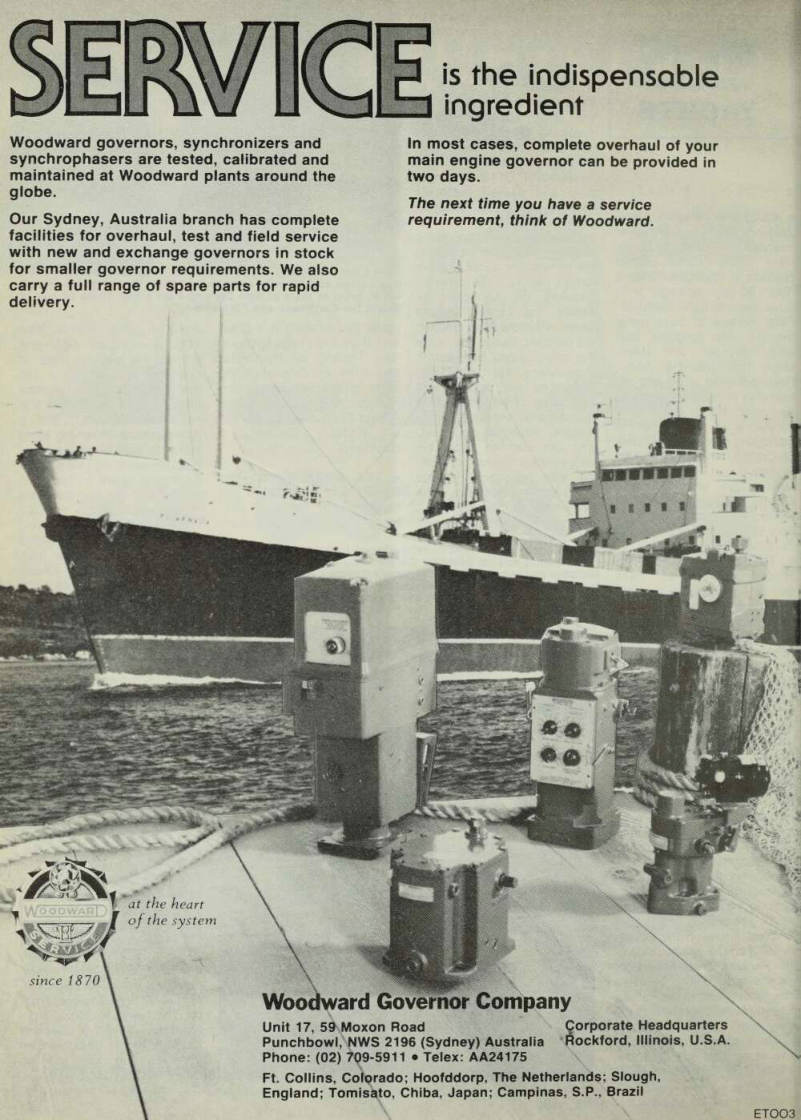
Aboard their ‘River’ 14.02 m ketch-rigged trimaran Antigone are Harry Abbott and his daughter Carleen. Accompanied by his wife Maradee and two daughters (the other’s Simone), Harry headed out to the South Pacific in 76 because he could no longer stand the tense atmosphere in the Panama Canal Zone where he’d been W orking. Jane DeRidder picture.
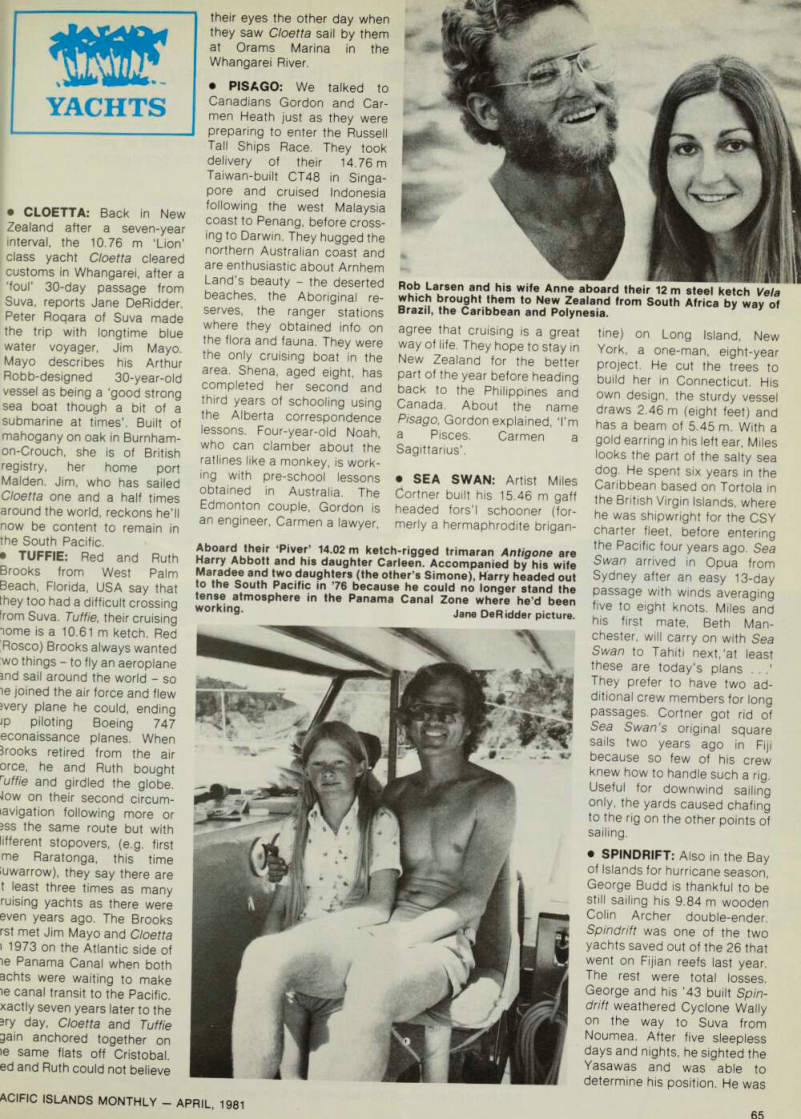
Rob Larsen and his wife Anne aboard their 12 m steel ketch Vela which brought them to New Zealand from South Africa by wav of Brazil, the Caribbean and Polynesia.
talking on his radio when Sprindrift hit the reef south of Likuri Islands about six miles , north of the Fijian Hotel.
George feels the salt-clogged auto pilot may have packed up and turned the yacht off i course. Apparently, no one reported his distress flares.
George is an amateur radio ; operator whose call sign is N4DMP. He contacted Sydney ham, Bruce Henderson, IVK2DFH, who called Can i berra. Canberra contacted Nadi. Nadi notified Suva. Three ' hours later a tug was on its way. Spindrift uninsured as are so many cruising yachts was pulled off the reef to the tune of $3OOO, unholed but with 15 broken ribs and a smashed rudder. Budd has decided to give up single handed sailing. His present crew, Jim Ray of Bend, Oregon, is the son of friends.
Rotarian George Budd addresses Rotary Clubs as he travels, encouraging and in spiring IYFOR groups Inter national Yachting Fellowship of Rotarians.
• SHADOW of Los Angeles is a ‘Cal 36’ glass production racing sloop. Dick Lubke reckons the 11.05 m yacht makes a great cruising vessel, consistently able to beat other cruising boats for elapsed time. Lubke, computer engin eer, and his younger brother Hank left Marina Del Rey, California, in July ’79, spent two months in Hawaii, then sailed the 1200 miles to Christmas Island, where they spent several weeks. ‘I have never seen such prolific sea life. And the bird life was fantastic, the diving the best yet. Shy friendly people and only twelve yachts or so a year.’ The other island the Lubke brothers enjoyed above all others was Suwarrow. Dick reports that Sir Tom Davis, the Cook Islands premier whom he met in Rarotonga, is talking of making Suwarrow a national park. ‘Tom Davis’s association with yachting goes back a long way, for he sailed around the Horn and back to attend Harvard University.’ Hank left Shadow in Fiji, and Dick car
ried on solo. Dick says single handing has its own rewards. ‘lt gives confidence to know you can do it yourself, but I am sure that most cruising people could do it if they wanted to.’ • TAKANUPI: Single-hander John Dunlop’s Van de Stadt designed Port Adelaide registered half-tonner was named after a small island off Bougainville. (John worked for Bougainville Copper as mining engineer until 1977.) Dunlop has sailed his Aussie-built yej low and blue ‘Pion 30’ 11 000 miles to date, up and down the Australian coast and to Noumea and back. John’s latest voyage brought him to New Zealand from Coffs Har bour via Lord Howe Island which he says is a paradise.
His next passage will perhaps take him to Tahiti. The 9.23 m glass yacht is one of a Dutch national class which John has modified somewhat for cruis ing, adding extra storage and gear. He converted Takanupi to masthead instead of 7 / 8 rig, adding preventer back stays.
The cast iron bolt-on keel means the half-tonner can take the ground without structural damage. Takanupi draws 1.89 m (six feet). • MINTAKA is the name of Nita and Charlie Martin’s 9.8 m Atkins double-ender now in the Kerikeri River taking time off from ocean voyaging. It is also the name of the northernmost star in the belt of Orion, a handy star for navigators, Charlie explained, for since it is so close to the celestial equator it can be used as a compass check when rising or setting, to determine true east or west. Charlie and Nita are sailing round the world with their two cats. ‘We just couldn’t leave them behind.’
Coco the Siamese is 13, Callie the calico cat is nine. The Martins are the only cruising people from Montana as far as they know. They write of their adventures for the Sunday edition of a Montana news paper. Mintaka has a glass and balsa core hull. Charlie finished
off the interior in a mere three months, launching the 11-ton . vessel in the Snake River in Idaho. They descended eight sets of locks to reach Portland, j Oregon, through the river sys i tern that is now silted up as a I result of the Mount St Helen eruption. This is by no means ' the Martins’ first boat, though it is their first sailing yacht.
They had nine power boats of various lengths over the years prior to setting off to sea in June ’7B in Mintaka. While in New Zealand Charlie and Nita will rent a house overlooking the Kerikeri River so as to be able to redo the interior of the boat. The cats will stay aboard to mind the ship, and to satisfy agricultural regulations. • XIPHIAS is the zoological name for swordfish. Roger Olson has fittingly named his dinghy Fillet of Xiphias Xiphias is an 8.61 m Bristol Channel Cutter. The Lyle Hess designed yacht is 11.07 m overall with bowsprit. She’s a larger sister ship to Lynn and Larry Pardy’s famous 7.38 m circumnavigator, Seraffyn.
Jim Polkinghorn, Roger’s for mer crew member from Malibu, California, joined Jim and Cheri Lowden on Canadian yacht Feng Shui in Suva when Celia Vanderpool rejoined Xiphias with her children, Amy, 11, and Nathan, four. (Feng Shui is now in Australia.) With her enlarged crew, the character ship carried on to New Cal edonia for a few weeks, then made an eight-day passage from the Isle of Pines to Opua. • COQUETTE, a Lidgard 34 built in Auckland in 1972 of double diagonal kauri with dynel sheathing, has been bought by Tasmanians Philip and Pamela McLure with a view to blue water cruising.
They became interested in cruising as a way of life after chartering a ‘Davidson 20’ in 1977 from Rainbow Charters in Opua. The McLures returned in August ’BO to charter a larger vessel, a 7.7 m ‘Tracker’.
Philip, antique dealer and re storer, and Pamela, owner of a ladies’ sportswear shop, both sold their Launceston bus-
inesses to move aboard their kauri cruising home. • ZEPHYR V: Lorna and Jon Hunkin arrived back in Kerikeri in the Bay of Islands, New Zealand, after their third major offshore cruise, this time to Tasmania and New South Wales for a year. Their home is a ‘Brandlmyer 41’ cruising ketch of Vancouver registry which they built in Tauranga, New Zealand ‘Everything but welding the keel’. She is of triple diagonal kauri construc tion. Jon describes her as an amazingly trouble-free boat, very simple, and well balanced. ‘We never have crew.’ For the
last several years they have been based in Kerikeri, work ing ashore off and on and ‘houseminding’ when the oc casion arises. ‘We’re happy to live on board and want to continue,’ Lorna said. • REPINA, a steel ‘Nordia 45’, Dutch-built for Kurt Preister, journalist from Dusseldorf, was in Oram’s Marina in Whangarei for general refit and some rigging changes. Repina is a well found ship outfitted with such luxuries as Omega and computer navigational sys tems. Preister took the oppor tunity to fly back to Germany while the work was underway.
Bill and Janet Baker and baby Noah aboard their steel ketch An Den Sioul. They found the boat in Papeete, had the chance to buy her and sailed straight to New Zealand where Noah was born 27 days after their arrival. j an e DeRidder picture.