Chan Govt licks
pp. 31-32 · Read in the full issue
Political
Currents
Chan Govt licks no confidence move
Papua New Guinea’s Chan government easily survived a test of strength in February when it • defeated a no confidence motion in its police minister. The motion was moved by the opposition over the alleged inefficiency and incompetence of Police Minis ter Warren Dutton, in solving law-and-order problems ir. the highlands. A prediction that the motion would be supported by one of the government’s co alition partners, the National Party, proved wrong.
Speculation that this would happen followed recent National Party criticism of Mr Dutton, and a political demand by the party’s leader and Deputy Prime Minister lambakey Okuk that the minis ter be moved to another port folio.
There was also speculation that a no confidence motion in Prime Minister Sir Julius Chan would follow a successful vote against Mr Dutton.
However, in a last-minute change of tactics, the National Party swung its numbers behind Mr Dutton and voted with the government, defeating the mo tion 57 to 40.
Opposition front-bencher Sir Pita Lus, in moving the motion, told parliament that no initiat ive had been taken by the government, and particularly the police minister, to curb tribal fighting in the highlands.
Sir Pita said his motion followed a call from the high lands’ Premiers for a state of emergency in their provinces and the appointment of a high lands police minister.
Sir Julius attacked the mo tion as a political tactic ‘to test the wind for a vote of no confidence against myself.
He told parliament that Mr Dutton was strongly supported by the Police Association. ‘He is a very responsible member of this government,’ Sir Julius said.
Sources later described the motion as a major test of strength for Sir Julius and his 11-month-old government. ‘The government’s path should be fairly clear from interference
like this until the election next year,’ one source said.
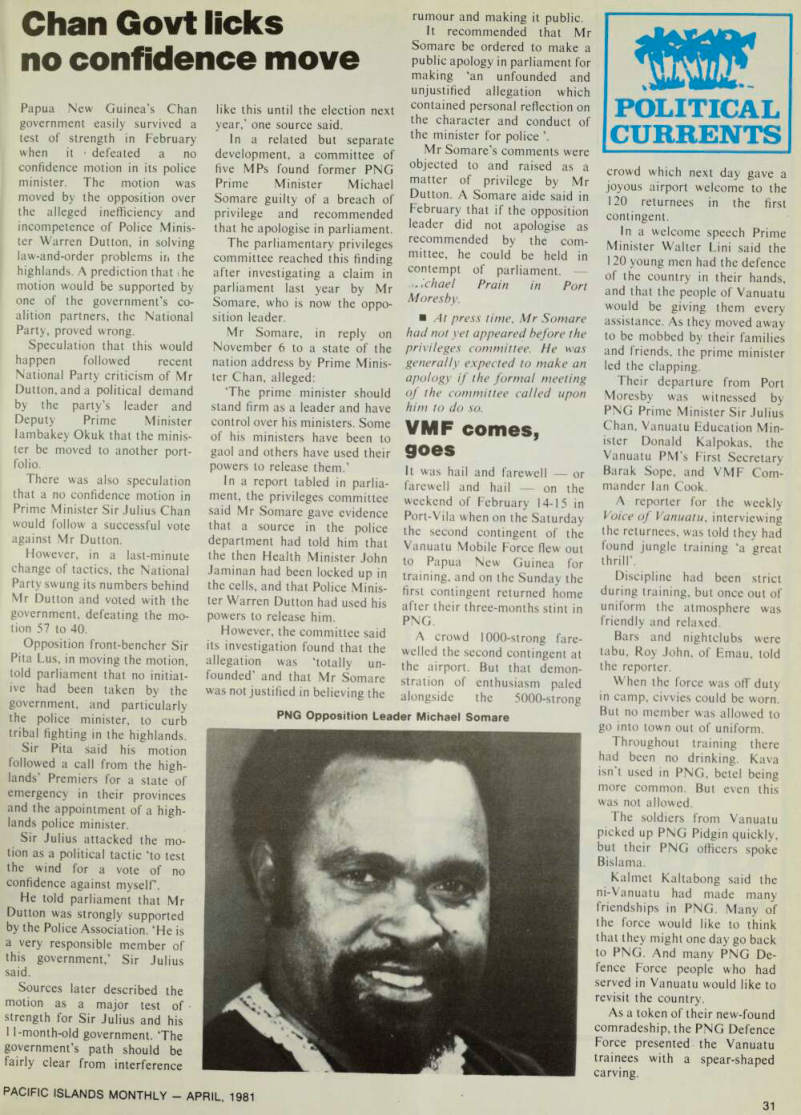
In a related but separate development, a committee of five MPs found former PNG Prime Minister Michael Somare guilty of a breach of privilege and recommended that he apologise in parliament.
The parliamentary privileges committee reached this finding after investigating a claim in parliament last year by Mr Somare, who is now the oppo sition leader.
Mr Somare, in reply on November 6 to a state of the nation address by Prime Minis ter Chan, alleged; ‘The prime minister should stand firm as a leader and have control over his ministers. Some of his ministers have been to gaol and others have used their powers to release them.’
In a report tabled in parlia ment, the privileges committee said Mr Somare gave evidence that a source in the police department had told him that the then Health Minister John Jaminan had been locked up in the cells, and that Police Minis ter Warren Dutton had used his powers to release him.
However, the committee said its investigation found that the allegation was ‘totally un founded’ and that Mr Somare was not justified in believing the
rumour and making it public.
It recommended that Mr Somare be ordered to make a public apology in parliament for making ‘an unfounded and unjustified allegation which contained personal reflection on the character and conduct of the minister for police Mr Somare’s comments were objected to and raised as a matter of privilege by Mr Dutton. A Somare aide said in February that if the opposition leader did not apologise as recommended by the com mittee, he could be held in contempt of parliament.
Prain in Port M ores by. ■ At press time, Mr Somare had not yet appeared before the privileges committee. He was generally expected to make an apology if the formal meeting of the committee called upon him to do so.
VMF comes,
goes
It was hail and farewell or farewell and hail on the weekend of February 14-15 in Porl-Vila when on the Saturday the second contingent of the Vanuatu Mobile Force flew out to Papua New Guinea for training, and on the Sunday the first contingent returned home after their three-months stint in
Png.
A crowd 1000-strong fare welled the second contingent at the airport. But that demon stration of enthusiasm paled alongside the 5000-strong
crowd which next day gave a joyous airport welcome to the 120 returnees in the first contingent.
In a welcome speech Prime Minister Walter Lini said the 120 young men had the defence of the country in their hands, and that the people of Vanuatu would be giving them every assistance. As they moved away to be mobbed by their families and friends, the prime minister led the clapping.
Their departure from Port Moresby was witnessed by PNG Prime Minister Sir Julius Chan, Vanuatu Education Min ister Donald Kalpokas, the Vanuatu PM’s First Secretary Barak Sope, and VMF Com mander lan Cook.
A reporter for the weekly Voice of Vanuatu , interviewing the returnees, was told they had found jungle training ‘a great thrill’.
Discipline had been strict during training, but once out of uniform the atmosphere was friendly and relaxed.
Bars and nightclubs were tabu, Roy John, of Emau, told the reporter.
When the force was off duty in camp, civvies could be worn.
But no member was allowed to go into town out of uniform.
Throughout training there had been no drinking. Kava isn t used in PNG, betel being more common. But even this was not allowed.
The soldiers from Vanuatu picked up PNG Pidgin quickly, but their PNG officers spoke Bislama.
Kalmet Kaltabong said the ni-Vanuatu had made many friendships in PNG. Many of the force would like to think that they might one day go back to PNG. And many PNG De fence Force people who had served in Vanuatu would like to revisit the country.
As a token of their new-found comradeship, the PNG Defence Force presented the Vanuatu trainees with a spear-shaped carving.
PNG Opposition Leader Michael Somare
NZ improves
its aid
New Zealand officials say that if they can’t get all the money they need to finance Pacific aid programmes, they hope to improve the quality of the available aid.
They are using the current lull in new aid projects crea ted by economic conditions in New Zealand to review the aid programme and to be more selective and flexible.
They realise at the same time that the Island governments have their problems too. The Islands want to accelerate developments and cannot afford the time for reviews and debates. They want action.
New Zealand believes it is giving all it can in a straitened economy. In the last budget, aid to the Pacific Islands rose by $1.5 million to $29,765 million which represented 69% of total bilateral aid. The per centage figure rather than the dollar figure represents the measure of New Zealand interest and involvement in the Islands. Where money might
be lacking for capital develop
ments officials point to the wealth of expertise and advice
in the agricultural, engineer
ing, forestry, building and fish
ing fields that can be drawn on by Island governments.
Improvements in New Zealand’s approach to aid pro
jects include inviting Island
officials to Wellington so they can be involved directly in the selection of aid people
appointed to key development
areas in the Islands. Another improvement is New Zealand’s readiness to meet recurrent costs in a project to ensure that it gets off the ground. Pre viously aid money was primar
ily for establishing the project
before handing it over to Island governments.
New Zealand is also looking at ways to help find alternative sources of energy in the islands, and to plan studies for alterna tive energy sources. This may not emerge as bilateral oper ations but through an inter
national approach to develop
ing countries. With New Zealand itself studying various energy alternatives, any
developments must also help
the Islands.
The aid projects are varied.
From providing technical advice in Solomon Islands for
building 21-metre long skip
jack tuna vessels and on the job
training to morse-key instruc
tion for Suva post office staff; from providing an economic
planning officer to building
village water schemes and bridges for the Solomon Islands.
At the same time New Zealand’s Pacific Islands
Industrial Development
Scheme (PUDS) is accelerat
ing. according to enthusiastic
officials. They claim that 27 projects are in operation throughout Forum Island members with another 23 ap plications under consideration while 23 more companies have made firm enquiries. Since the scheme began in 1976, one pro ject has collapsed and another looks shaky but officials insist that the momentum is increas ing and they point to the almost 400 jobs the PUDS projects have created among the Islands.
Tonga claims 112 of those jobs which, for the size of the country, represents a fair im
provement in employment fig
ures. The cost so far to New Zealand in providing firms with incentives to develop industries in the islands totals $647 000. Officials are unable at this stage to measure the level of export earnings for the Islands from these industries or the savings from import substi tution operations. They also cannot measure the service industries that expand with the
growth of manufacturing
plant.
Industries introduced range from the production of soccer balls and jewellery to proces sed foodstuffs and buckets, from ballet shoes and indus trial gases to adhesives and sausage casings.
PUDS projects in the pipe line include manufacturing footwear and a tropical plant nursery in Fiji, egg and poultry
production and fibre glass
tanks in the Cook Islands and coconut timber projects in a number of islands. William Gass on in Wellington