New Caledonia
p. 17 · Read in the full issue
Whitlam urges U.N. moves on New Caledonia
South Pacific nations must speak out with a strong and united voice in order to get the situation in the French colony of New Caledonia on the agenda of the United Nations Decolonisation Committee, according to Gough Whitlam.
Speaking at a press conference in Honiara, Solomon islands, in February, the former prime minister of Australia said the majority of Melanesians in New Caledonia wanted independence from France.
Mr Whitlam, a fellow of the Australian National University, Canberra, stopped a few days in Honiara where he met government officials including Prime Minister Peter Kenilorea.
Mr Whitlam was on his way back from Canada where he presented a paper on political
science at a constitutional con ference.
Mr Whitlam said it had become urgent that the major ity of Melanesians in New Caledonia who had voted for independence should make known their plea to the world. ‘lt is the biggest problem,’ he said.
Mr Whitlam said the indigen ous New Caledonian people could not take this problem direct to the UN unless it has been placed on the Decolon isation Committee’s agenda.
To do this, it must first win two-thirds of the votes of nations on the committee, in which the Pacific is represented by Australia and Fiji. This could only be achieved if South Pacific nations like Australia, New Zealand, Fiji, Tonga, Samoa. Solomon Islands and
others speak out clearly in support of such a move.
Mr Whitlam said Papua New Guinea was the only country in the South Pacific region which had made it plain to France that her colonies in the South Pacific must be given self-determin ation and independence.
Mr Whitlam said some African nations for sure will not give their support for an inde pendent New Caledonia at the UN because of strong French influence.
Mr Whitlam said he was glad to hear that the Solomon Islands government had asked the United States of America to renew an undertaking concern ing aid.
He said the Asian Develop ment Bank, from which the Solomons and other nations get most of their loans for big projects, is helped and financed by the USA.
Mr Whitlam said that the world’s economic centre of gravity is moving in favour of the Pacific, just as it did in favour of Western Europe dur ing the industrial revolution. ‘South-east Asia and Oceania are the most dynamic and rapidly developing areas of the world,’ he said.
He said at this stage Aust ralia ‘should relax’ the tra ditional tendency to depend on United States and European investments but move more
actively in her immediate en vironment.
Mr Whitlam said the biggest resource the Pacific Island countries have is the sea and they should ensure that they (Island nations) receive a fair return for fish caught in their waters.
He suggested that they form a ‘Pacific Fisheries Convention’ which would look after Pacific nations’ fishing interests. He noted that the United States and South Korea at present say no nation owns tuna, because it is a highly migratory species.
According to their view the fish could be caught within any country’s 200-mile exclusive economic zone. This rep resented a major problem for Pacific Island countries.
On Australia’s helping Vanuatu to build the latter’s police force, Mr Whitlam said ‘the British and French had conducted themselves in the most irresponsible manner by leaving Vanuatu without a police force’.
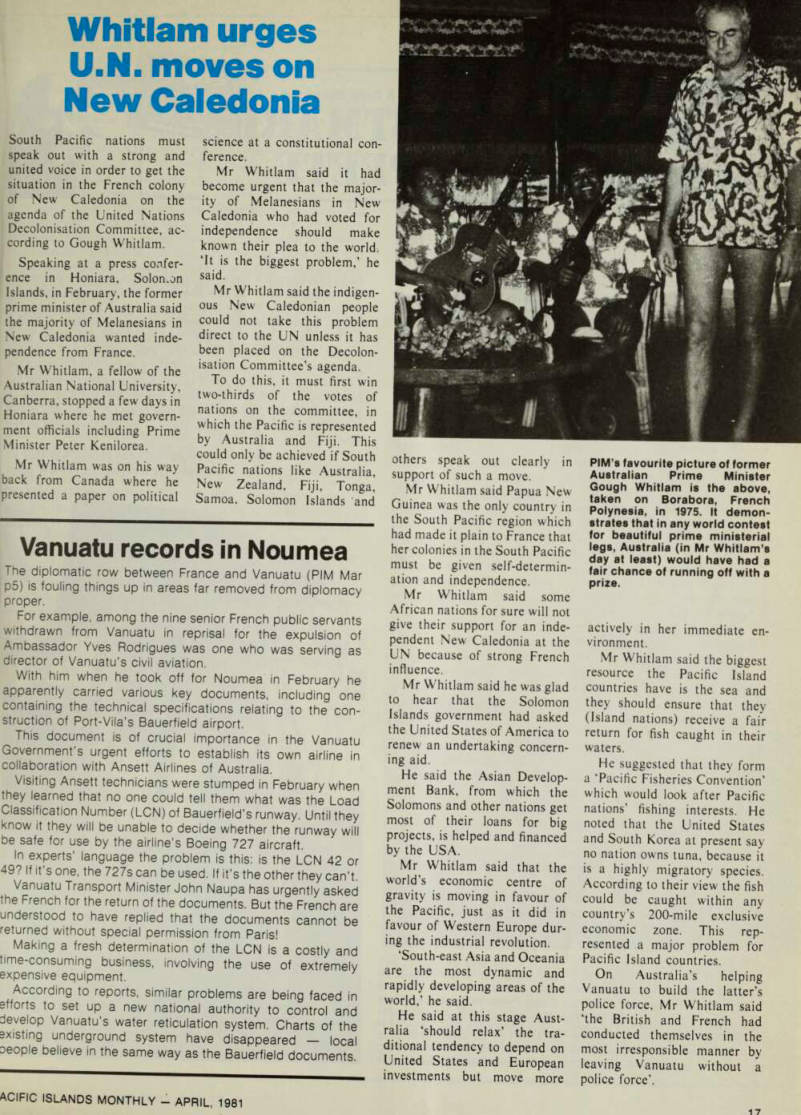
PIM’s favourite picture of former Australian Prime Minister Gough Whitlam is the above, taken on Borabora, French Polynesia, in 1975. It demon strates that in any world contest for beautiful prime ministerial legs, Australia (in Mr Whitlam’s day at least) would have had a fair chance of running off with a prize.