Cannibalism,
pp. 5-7 · Read in the full issue
Letters
facts and
fictions
In the January issue of PIM, Brett Hilder reviewed James Siers’ most recent book, Taratai II; A Continuing Pacific Adventure, praising the author’s skill as both writer and photographer. Like Brett Hilder, I have had a great deal of pleasure from James Siers’ other books and the criticism I feel obliged to make of one aspect of his new book is made with a certain reluctance.
The author recounts a story at the beginning of Chapter Fwo which your reviewer obvi ously accepted at face value as would most Europeans and, •egrettably, a great number of Pacific Islanders. The story is one of those seemingly endless lumbers of tales about canni lalism which one and all hap )ily believe are true stories, and lowever horrific and vile need lot be questioned. Let me show »ow misleading one of these iccounts can be.
Here is James Siers’ tale: The Mamanuca Islands were lot always so friendly. In the 840s the United States Ex iloring Expedition to the ‘acific anchored near what is ow Plantation Village. The rew became friendly with the ocal people. But Fiji was a urbulent place in those times nd the natives were fond of ating humans (italics are line). They unwisely sampled ome of the Americans and the ill fury of Commodore Wilkes irned upon them. ’
The journals of the Exploring xpedition give quite a ifferent description of the ime incident; On or about the 3rd July, 1840, a launch and a utter from the expedition ar ved at the southern end of lalolo (in the Mamanucas) to mdezvous with Commodore /ilkes. The day before an
armed party from the launch had gone ashore and while there had seized a boy ‘with an armload of war clubs’, and forced him to accompany them back to the beach in spite of protests from a crowd of other Fijians. The consequence of this action was an attack on a small party of Americans who landed on the following day hoping to pick up badly needed provisions. Two Americans were killed in the attack: one, Joseph Underwood, a man popular with his shipmates, the second, Wilkes Henry, even more unfortunate for the Fijians, nephew of the ex pedition’s commander.
As soon as Commodore Wilkes was told of the incident, he ordered a full-scale attack. ‘Destroy everything except women and children’, were his orders. The Fijians fought valiantly but were soon over come by ‘the irresistible force of the white man’s arms’. Their village was razed, many vil lagers were killed or wounded and the Americans sailed away with most of the island’s store of yams and coconuts.
Nowhere is there any men tion of Maloloans having ‘sampled some of the Amer icans’ and one would hardly describe any of the Americans’ actions as ‘friendly’.
I don’t mean to single out James Siers as the only Pacific writer whose preconceptions about cannibalism lead him to accept as authentic question able, even erroneous, accounts of the eating of human flesh as a common practice among cer tain Pacific Islanders; they all do it. Shirley Maddock, another New Zealand writer, in her newest book, These Antipodes, A New Zealand Album 1814 to 1854 , repeats verbatim sev eral second- or third-hand re ports of man-eating by New Zealand Maoris during the 19th century.
The author entertains not the slightest doubt about the authenticity of her sources. The book is sprinkled throughout with phrases like ‘killed and eaten’, ‘cannibal feast’ and ‘gnawed and mangled remains’.
A drawing of an eccentric 19th century trader-settler, Barnet Burns, sketched where or by whom we are not told, illus trates the subject in bizarre dress with a large bone of
doubtful type or origin, lying behind one of Burns’s feet.
Shirley Maddock’s flippant comment on this rather obvious ‘prop’ is that ‘tossed non chalantly behind one of Mr Burns’s feet is a human shin bone, picked clean’.
Fictional writing on this sub ject exercises no restraint what soever, just as one might expect.
Only last year, The Elizabeth Affair, a novel written by Robert Barry Holmes and set in early New Zealand tells us, ‘based on historical fact’, on pages 144 and 145 a dreadful tale of a cannibal orgy that allegedly followed a raid on a Maori village led by a devious and bloodthirsty chief named Te Rauparaha. Te Rauparaha was a real 19th century Maori chief of some renown. Presum ably this is one of the book’s ‘historical facts’. The orgy is described in almost loving de tail: ‘Though ... all from Elizabeth (an English ship) knew the Maoris were canni bals, the actual sight of human bodies being baked for eating was repulsive . . . They stood there staring at the Satanic scene’. And, further on, ‘The victorious raiding party were left on their own to enjoy the cannibal feast ... As they gnawed at the bones of dead Ngaitahu, the human fat dripped from their lips . . .’
This is not fiction based on ‘fact’ but the worst kind of purple prose calculated to ap peal to the lowest common denominator.
Unfortunately, many Pacific Islanders have come to believe what was originally an almost exclusively European preoccu pation, undoubtedly influenced by the sheer weight of the kind of evidence I have been examin ing. I recall two examples of this in letters from Papua New Guinea to PIM. One reader appeared to accept that the Fore of PNG are or were
cannibals who transmitted the fatal disease Kure throughout their tribe by eating contami nated flesh. There is no ‘hard’ evidence that either hypothesis is true. Another PNG reader wrote in the October issue deploring the misrepresentation of PNG society by foreign correspondents and then added ‘Cannibalism, which hardly exists today, was once a ritual practice’. Where is it still in existence? Where and by whom was it a ritual practice? What are the sources of these beliefs?
I have yet to turn up one story of cannibalism in the Pacific as a widespread, common practice which could be authenticated.
Like the old philosopher, I tend to regard belief in cannibalism as just another example of, ‘the trouble with most folks ain’t what they don’t know, but what they do know that ain’t so’.
Guy Bartell
Auckland New Zealand The work of Sir
Harry Luke
Malcolm Salmon’s article on Australian gunboat diplomacy in New Caledonia before the Pacific war (PIM Jan p 59) interested me, but I felt it didn’t do full justice to the part played by the late Sir Harry Luke and the small (900 tonnes) ‘gunboat’
HMCS Viti. I feel Sir Harry was the real diplomat who
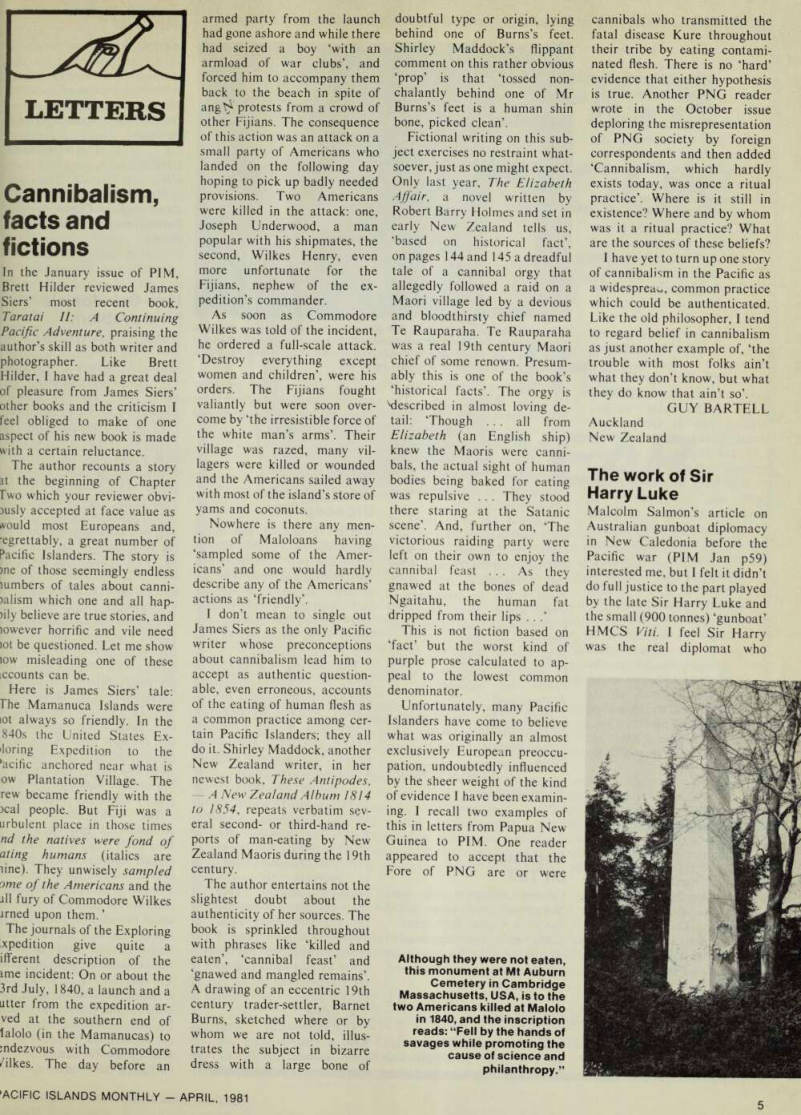
Although they were not eaten, this monument at Mt Auburn Cemetery in Cambridge Massachusetts, USA, is to the two Americans killed at Malolo in 1840, and the inscription reads: “Fell by the hands of savages while promoting the cause of science and
philanthropy.”
cleared the decks in Noumea itself, to the chagrin of the astute Japanese Consul- General and his 1200 men who were readv to take over New Caledonia from the pro-Vichy French. Had this happened, the Japanese would have had the way open for the fall of Aust ralia and New Zealand with a two-prong thrust through Port Moresby and New Caledonia.
The way things moved is told by Sir Harry Luke in the third volume of his autobiography Cities of Men, in which he uses Mr Burchett’s account (which your article quotes) but adds detail.
I had more than a general interest in Sir Harry Luke’s sudden visit to Noumea. I have on my files a telegram from Suva to me (I was in Lautoka) in which his ADC advises ‘Expect you at Government House, Tuesday afternoon’.
On the day before, or at the weekend, HMCS Viti had ar rived in Suva where Sir Harry Luke was in residence at Government House as High Commissioner for the Western Pacific. Luke told me they intended leaving port quietly for Noumea and I would be left in Government House to give some semblance of life attended by the butler. It seemed almost a dispensation of Providence that Luke, who had spent most of his life in the Mediterranean and who spoke French fluently, with all its idioms, should have been on hand at such a time. (The Ven)
C. W. Whonsbon-Aston
Castle Hill NSW Australia A Micronesian poser I really wish that I could answer Professor Donald Topping by simply saying ‘nobody’s’ in re sponse to his article on Micronesia, ‘Overview: Whose Defence Needs?’ (PIM Jan pi 3). In that way everything would have been just fine, if not perfect. Unfortunately, I just can’t.
The question is a gigantic one. So big that when it is raised in the United Nations Security Council, its effects could rewind time back to World War 11, and
stretch out to distant lands as far as Afghanistan. The Micronesians, who have been the wards of other nations, could only sit and watch as their fate is once again pingponged between two super-powers in an institution that preaches human freedom and dignity.
I would not even think of what will happen during and after the Security Council’s discussion on the termination of the Trusteeship Agreement.
What I will be pondering is what would have happened if there wasn’t any designated strategic trust, no Cold War, no nuke testing in the Marshalls, no Vietnam War, and no in vasion (or occupation) of Afghanistan?
Does the super-power’s national interest surpass our human interest? Please give us a break.
Lorin Robert
Washington DC
Usa
Sad tale of Mr Tall Further comment on your November 1980 cover (PIM Jan pi 1) is quite impossible.
My wife has suggested I should leave the house and my best friend is not talking to me.
In sorrow.
Alex Tall
Brisbane Qld Australia Mr Tall had remarked that one of the girls on our November cover was ‘under the
age of consent’, and we then sought clarification from him of just what he meant by the remark. Editor.
Weslipped on
the soap I refer to one of the items contained in Pacific Report (PIM Jan p 6). This described the market survey then in progress designed to identify and investigate export market opportunities for coconut oil based soaps produced in Fiji and Western Samoa.
This project was one of a series of technical assistance projects commissioned by the Export Market Development Programme of the Common wealth Secretariat and funded by the Commonwealth Fund for Technical Co-operation.
A number of projects are currently underway for Pacific Island developing countries which are designed to help increase these countries’ export capability and thus enable them to increase their foreign exchange earnings. Funds for these projects are provided by the Commonwealth Fund for Technical Co-operation whose resources are contributed volun tarily by all member nations of the Commonwealth, not just by Britain alone as was implied in your report.
Commonwealth countries have a long-standing commit ment to work together to raise living standards through devel
opment. The Commonwealth Fund for Technical Co operation is their main instru ment for collective effort utilis ing Commonwealth expertise and paid for by Commonwealth resources.
D. A. Anderson
London UK Mr Anderson is managing director of the Commonwealth Fund for Technical Cooper ation.
New Caledonia’s
land problem
Daniel Tardieu’s statistics on land distribution in New Caledonia (Noumea Notebook PI M Feb p2l) are incorrect. He states that the Melanesian population of New Caledonia (43% of the total population of 140 000) ‘own 60% of the total land area, both on the main island and in the Loyalties group’. In October 1978 the then High Commissioner, Mr Eriau, released figures (to the nearest thousand hectares) stat ing that 950 000 ha were held by the Territory as domaine land, 372 000 ha were reserve autochtone (163 000 ha on the main island and 209 000 ha comprising the Loyalty Islands, Isle of Pines etc), and 380 000 ha were proprietes privees.
Since only a tiny fraction of the proprietes privees are held by Melanesians it is difficult to see how Tardieu got his figure of 60%, even without considering the domaine land in the non- Melanesian total. Nor does the 1 5 000 ha transferred mainly to Melanesian hands in 1979-80 greatly affect the proportion.
The Independence Front published its own statistics in May 1980. They are broadly in accord with the official figures except that they mention 150 606 ha of locations (leases) of domaine land (the total of which should be 1 100 000 ha).
About 100 000 ha of these locations are held by non- Melanesians. In addition about 110 998 ha of mining con cessions, in domaine land, had been granted to non- Melanesians. This made a total of approximately 650 000 ha held by non-Melanesians, (still excluding the residual domaine
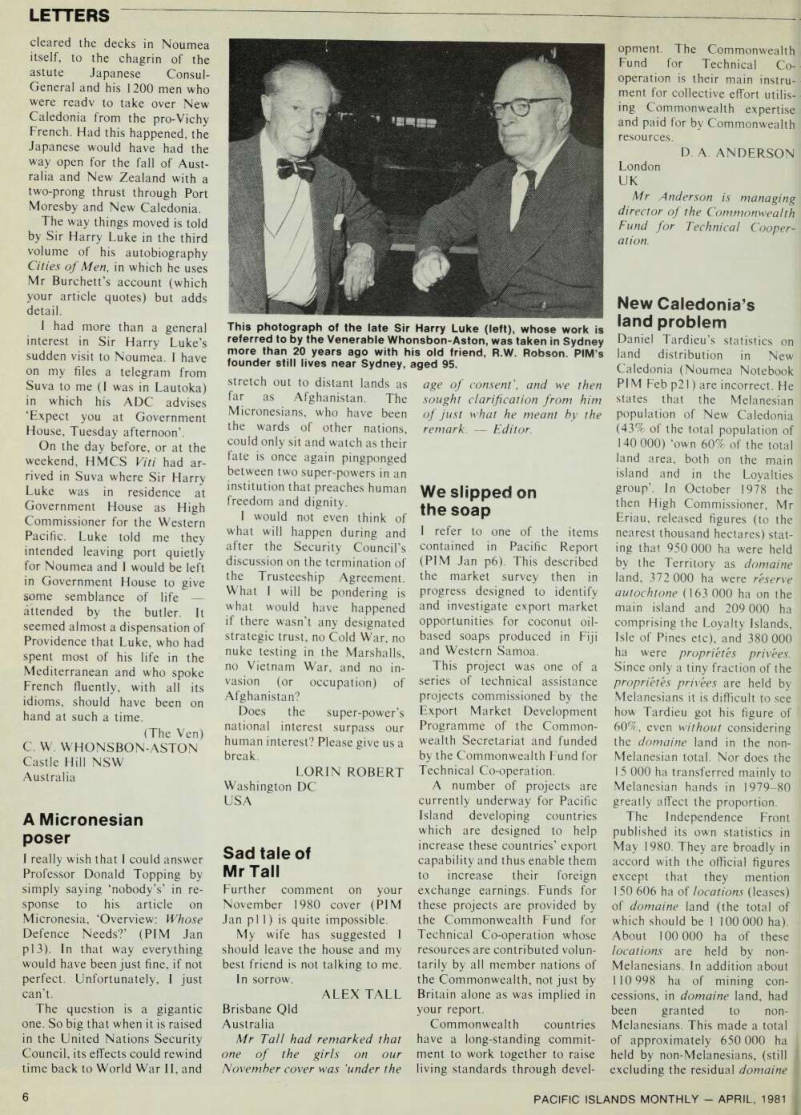
This photograph of the late Sir Harry Luke (left), whose work is referred to by the Venerable Whonsbon-Aston, was taken in Sydney more than 20 years ago with his old friend, R.W. Robson. PIM’s founder still lives near Sydney, aged 95.
land held by the Territory and the French state) as against about 422 000 ha held by Melanesians.
Moreover official statements (the 1974 census and the devel opment plan known as the plan Dijoud) point to the maldistribution of population to land area. Outside the town ships there are only about 2700 settlers, while on their, lesser, proportion of the non -domaine land live some 40 000 Melanesians. (About 20 000 are in Noumea and the small town ships.) It is this maldistribution between settlers and Mela nesians which the land reform referred to by Tardieu is trying to correct. If the authorities continue to transfer to Melanesians 10 000 ha per year for 10 years the total pro portions of land held by Melanesians and non- Melanesians (still excluding the reserve of domaine land) will be approximately equal, (or a little in favour of the Melanesians if it is taken largely from proprietes privees rather than from domaine ). The per capita holdings of rural land will still, however, be vastly greater for non-Melanesians than for Mela nesians.
None of this, of course, addresses the larger Kanak claim referred to by Tardieu, to all New Caledonian land. Nor does it fully address the
naldistribution among
Vlelanesians with some re serves on the main island being grossly over-crowded and much and on the islands remaining
mder-used.
Alan Ward
Reader in History
.a Trobe University
delbourne Vic Australia.
Jride Price
Reference the cost of bride rice (your quote from The imes of Pap.ua New Guinea, dands Press, Feb, p 23). Papua Jew Guinea is enriched with ultural values, and what is true f one province or clan is not ecessarily practised by nother. Bride price should be sported on with specific refer nce to the locality, rather than ith a generalisation.
Ottor Mbark
lational Planning Office, ort Moresby, PNG