Yachts
pp. 73-76 · Read in the full issue

• POTPOURRI. Al and Karen Huso are back in their home port of Oxnard after a two-year cruise in their Islander 32 around the Pacific Basin. The final leg of their return voyage from New Zealand was ‘defi nitely our most pleasant long voyage. We never did get round the Pacific High’. It took them 25 days to sail 3200 nautical miles from Kaneohi Bay in Hawaii to their California landfall. They tell of flat glassy seas and warm days with a jreat deal of hazy overcast.
Fhey caught mahi mahi and albacore, and had fresh fish learly every day, finally resort ng to drying some tuna after narinating it in equal parts soy, 'inegar and water. At about 36 o 37° north latitude, 157° vest longitude. Karen and Al >icked up two glass floats,
using a large fishing net to salvage their valuable finds.
Several other yachts report finding them in the same gen eral area. Karen writes that she is back in the classroom and Al is studying for his Ocean Skip per’s licence. • ISLE OF FLIGHT. A 7.6 m yawl from San Diego, Isle of Flight spent the southern win ter in the Waikere Inlet in the Bay of Islands, New Zealand, an estuary appearing utterly remote and untouched. Here Jon Powers and Connie Nypen from Mono County, Cali fornia, and Washington’s Skagit Valley respectively became involved in the pro duction of Soma Windmills, wind generators designed for use both on yachts and in land installations. Isle of Flight, a one-off yawl built by Okomoto & Son, Yokohama, shares certain characteristics with the well-known Maya class by the same designer. When they found the 17-year-old double skin wooden yawl in 1976, their only previous experience had been sailing their 2.7 m lapstrake cedar dinghy in San Diego Bay, After a cruise to
Coho Point and the Channel Islands and a new set of sails, Jon and Connie set off for the Marquesas. Thirty-nine days later they made their landfall on Hiva Oa. They spent two and a half months in the Marquesas, and a full year in the Society Islands, circum navigating Tahiti, exploring the Leeward Islands, and surfing their two surfboards. Borabora to Rarotonga was an idyllic tradewind passage. The first day the 6.4 m waterline yacht reeled off 128 nautical miles.
Aitutaki was Connie’s and Jon’s favorite Pacific island ‘a good combination of barrier reef, motus, and high island’.
Isle of Flight carried on to the Samoas in Force 6-7 trade winds, then to Fiji by way of the Nanuku Passage and the Koro Sea, entering at Levuka. They then sailed inside the reef to the Rewa River, which they navigated across the island of Viti Levu to Suva, a distance of about 50 km negotiable by vessels up to 1.8 m draft de pending on tide. During their past year in New Zealand, among other adventures, they hitch-hiked down to the south
of the South Island. In the Bay of Islands, Isle of Flight took part in the Russell Tall Ships Race. ‘We placed 21st out of 29 entrants but were disquali fied as not being long enough, in spite of a bowsprit we jury rigged for the occasion.’
• Windward. An 11M
German Hanseat racing sloop limped into Whangarei jury rigged after having been dis masted several months pre viously. Austrians Ossi Gasser,
professional photographer,
and his wife Gerlinde, with their English bull terrier Bonita and three Hasselblad cameras, are making a round-the-world voyage to photograph for a book all the islands they visit.
Their 18-year-old son Michael leaves Windward in New Zea land. He will fly to Florida to join his sister Karen as fellow photographer on the Nor wegian-American Line cruise ship Sagafjord. Apparently Windward’s mast carried away in 30-knot winds 400 nautical miles from Tahiti when two lower shrouds parted. Michael dived over to attach a line to the masthead. As a result, they were able to salvage the alu
minium spar and its rigging.
The Gassers motored to Aitutaki to obtain extra diesel fuel, then powered the 120 nautical miles to Rarotonga where friends helped them to erect a stub mast, enabling them to carry on with their cruising itinerary regardless.
The strongest wind they ex perienced was between Niue and Tonga when it blew 55, gusting 60, for 24 hours. ‘lt was good sailing. We surfed!’ says Michael. It’s been slow sailing since an average of only three knots to Fiji, slow going for a yacht designed for North Sea racing. (The German navy bought eight Hanseats for offi cer training.) On the Lautoka- Whangarei leg there was very little wind and Windward belied ts name, able to make good 3nly 80° into the wind instead Df the normal 30 °, so they jailed just 300 nautical miles, md powered the rest of the vay. Ossi says: ‘We hear New Zealand is the best country for i new mast. That’s why we :ame.’
THORFINN. A 13 m steel utter from Cairns brought an Australian family to New Zea md for a six-month stay. They re Kay and Dick Turpin, for ierly of Adelaide, Dwayne ged 15, and 14-year-old Fel ity. The Adams-designed Jtter was built in Cairns. A Dilermaker buddy did the hull, joiner friend helped with the terior. The Turpin family uised down the Oueensland )ast and cleared from 'isbane. They were able to >end several days at Lord Dwe Island during a spell of >od weather. The Tasman )led out either calm or storm, >t much in between. Dwayne >inted out that they made the stake of leaving on a Friday lich perhaps explains the )rms on the first and third jhts. They entered at nangarei after a wonderful i down from North Cape, ked where they are heading xt, Felicity said; ‘We’re going vote soon. My father likes to nk the future is free, with no ms. We may head for Van jver. Or Fiji.’ Dwayne and icity are doing their school by correspondence. (ATIKA 11. Owned by Les J Gloria Whiteley, arrived in
Tahiti last June after a leisurely sail from San Francisco, Cali fornia, reports Joan D. Pease from Papeete. The Tiburon 36 is now in Moorea where the Whiteleys may eventually build a house. They now have resi dence papers for French Polynesia. They left northern California in December, 1979, stopping at Half Moon Bay, Monterey, Morro Bay and San Diego. The highlight of their trip along the Baja coast was watching the grey whales breeding, but the experience they’d like to forget was drying out on a sandbar in San Carlos. However, as Les says, it gave him a chance to scrub the bottom and change the zincs. Katika II is a W. 1.8.
Crealock design built in San Jose, Costa Rica. She’s fibreglass with a balsa core hand-dipped in resin. Her pre decessor, Katika I, was an Atkins 33 sloop which was in French Polynesia in 1975-76.
Les is an amateur radio buff who can be heard on the ham radio maritime nets. His call signs are FOB GZ and
Ka6 Fhh.
• Amadon Light. A Well
found Luders 36, has com pleted two South Pacific cross ings and is now in French Polynesia. The owners, Bill Healy and Gary Walls, sailed from Santa Barbara, Cali fornia, to Hawaii in 15 days on the boat’s first cruise. The Hawaii-Tahiti leg took 21 days.
The 11 m fibreglass sloop was built by Cheoy Lee in Hong Kong to the owners’ specifi
cations. After delivery, they spent two years in Santa Barbara, California, fitting her out for cruising. Bill and Gary plan to see the Tuamotu chain and the Leeward Islands and then leave in March for the Cooks, Tonga and the Samoas. • LEDA. A 16 m ketch from Seattle, Washington, is now in Opunohu Bay, Moorea, in French Polynesia, where her owners Bee and Frank Hyland are spending the hurricane season.
They bought Leda in 1975 and cruised in the Pacific north-west before embarking on their first blue water experi ence in September 1979. Their trip down the west coast of the
United States included stops in San Francisco, San Diego, Cabo San Lucas and Socorro Island. They made the 4300 km crossing from Socorro to Hivaoa in the Marquesas Islands in 17 days.
Built of kauri pine in New Zealand, Leda was launched in 1950. The following year she was entered in a race across the Tasman and finished in first place. She was also a competi tive boat on San Francisco Bay from 1954-1962. Her fame lingers in New Zealand, how ever. because The Story of Leda, written by one of the two original owners, has been pub lished by the New Zealand education department as a book for school children. • SHAMMY. From San Francisco, is anchored in Opunohu Bay, Moorea, in the Society Islands. Dr H. William Shamhart, wife Carol and 12year-old David, sailed down the California coast to San Diego and called at Cabo San Lucas and Socorro Island be fore arriving in the Marquesas Islands in May last year.
Shammy is a 15 m wooden ketch built in San Diego in 1965 to the original owner’s specifications and named Lazy L. Dr Shamhart pur chased her in 1970 and sailed to Hawaii and along the Cali fornia coast. When Shammy leaves French Polynesia in April, she will continue west to the Cook Islands, Tonga and Fiji.
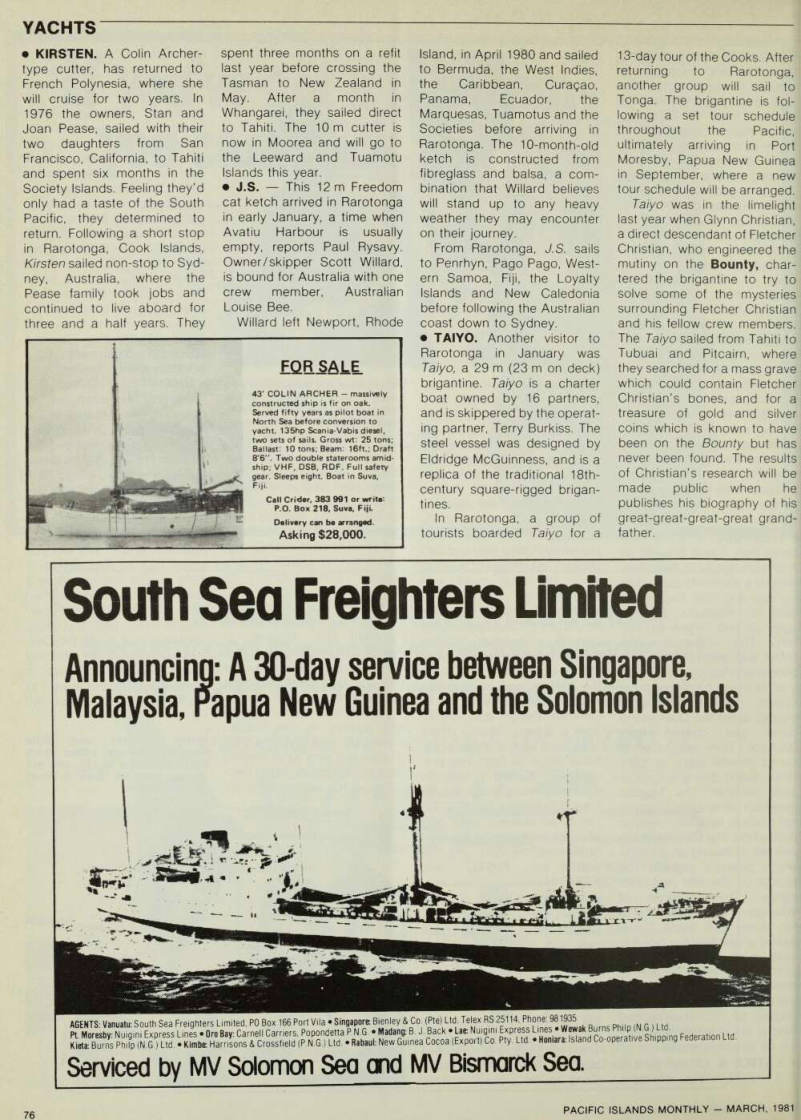
Marty, Janette and little Engelene Doody sailed from New Caledonia to Fiji, and are shown here on deck in their yacht Sumpoi.
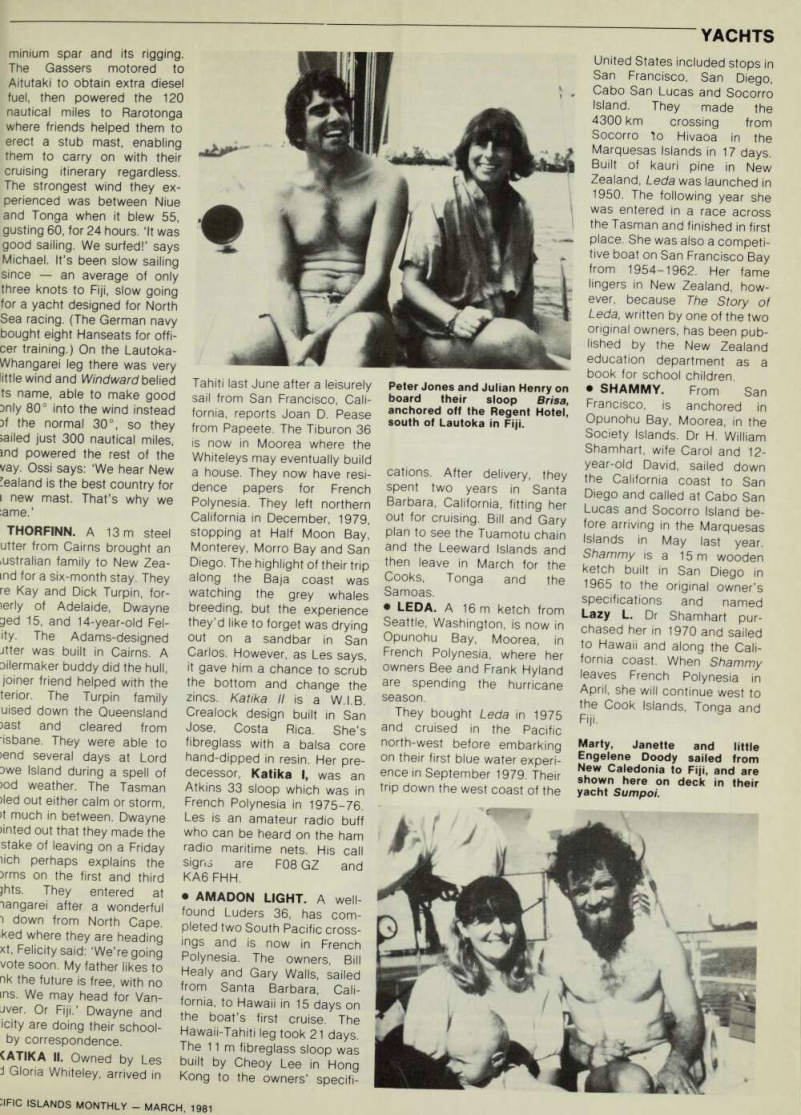
Peter Jones and Julian Henry on board their sloop Brisa, anchored off the Regent Hotel, south of Lautoka in Fiji.
• KIRSTEN. A Colin Archer type cutter, has returned to French Polynesia, where she will cruise for two years. In 1976 the owners, Stan and Joan Pease, sailed with their two daughters from San Francisco, California, to Tahiti and spent six months in the Society Islands. Feeling they’d only had a taste of the South Pacific, they determined to return. Following a short stop in Rarotonga, Cook Islands, Kirsten sailed non-stop to Syd ney, Australia, where the Pease family took jobs and continued to live aboard for three and a half years. They
spent three months on a refit last year before crossing the Tasman to New Zealand in May. After a month in Whangarei, they sailed direct to Tahiti. The 10 m cutter is now in Moorea and will go to the Leeward and Tuamotu Islands this year. • J.S. This 12 m Freedom cat ketch arrived in Rarotonga in early January, a time when Avatiu Harbour is usually empty, reports Paul Rysavy.
Owner/skipper Scott Willard, is bound for Australia with one crew member, Australian Louise Bee.
Willard left Newport, Rhode
Island, in April 1980 and sailed to Bermuda, the West Indies, the Caribbean, Curagao, Panama, Ecuador, the Marquesas, Tuamotus and the Societies before arriving in Rarotonga. The 10-month-old ketch is constructed from fibreglass and balsa, a com bination that Willard believes will stand up to any heavy weather they may encounter on their journey.
From Rarotonga, J.S. sails to Penrhyn, Pago Pago, West ern Samoa, Fiji, the Loyalty Islands and New Caledonia before following the Australian coast down to Sydney. • TAIYO. Another visitor to Rarotonga in January was Taiyo, a 29 m (23 m on deck) brigantine. Taiyo is a charter boat owned by 16 partners, and is skippered by the operat ing partner, Terry Burkiss. The steel vessel was designed by Eldridge McGuinness, and is a replica of the traditional 18th century square-rigged brigan tines.
In Rarotonga, a group of tourists boarded Taiyo for a
13-day tour of the Cooks. After returning to Rarotonga, another group will sail to Tonga. The brigantine is fol lowing a set tour schedule throughout the Pacific, ultimately arriving in Port Moresby, Papua New Guinea in September, where a new tour schedule will be arranged.
Taiyo was in the limelight last year when Glynn Christian, a direct descendant of Fletcher Christian, who engineered the mutiny on the Bounty, char tered the brigantine to try to solve some of the mysteries surrounding Fletcher Christian and his fellow crew members.
The Taiyo sailed from Tahiti to Tubuai and Pitcairn, where they searched for a mass grave which could contain Fletcher Christian’s bones, and for a treasure of gold and silver coins which is known to have been on the Bounty but has never been found. The results of Christian’s research will be made public when he publishes his biography of his great-great-great-great grand father.