Tonga shipping disaster
pp. 67-71 · Read in the full issue
Ships
Tonga shipping disaster brings new safety call
The capsize of the Tongan inter island ferry Fetu’umoana with the loss of 11 lives has renewed pressures for a revised code of marine safety regulations in Tonga. A new code has been under preparation for some time, but is not yet ready. It is still at the ‘translation’ stage according to a government official.
Although Tonga has been a party, since 1977, to the 1960 International Convention for Safety of Life at Sea, there is still no strict observance in Tonga to the convention pro visions relating to seaworthi ness, radio equipment, life saving equipment and passen ger and cargo loading limi tations. The Tongatapu-Eua ferry, which is operated under strict control by the Shipping Company of Polynesia, is an exception in a general situation which raises the question of why accidents don’t happen more often.
The Fetu’umoana capsize was the first accident for three years. In December 1977, 66 lives were lost when MV Tokomea disappeared without trace in treacherous waters be tween Vavau and Niuafoou.
The ship was alleged to have been operating at the time with an inadequately-plugged gash more than a metre long below the waterline and with unser viceable radio equipment.
Three factors highlight the safety problem facing inter island shipping in Tonga. They are: • The homing instinct which draws Tongans in their hun dreds, and sometimes thou sands, to head for their islands of origin, especially at peak periods such as Christmas, Easter and the beginning of school holidays, • The lack of sufficient inter island shipping to cope with the demand, and • The failure of existing legislation to give to any clearly designated authority the res ponsibility and the facilities for policing maritime safety as set out in the regulations annexed
to the 1960 International Con vention.
According to the Crown Sol icitor, Mr Tevia Tupou, the Collector of Customs, under the Minister of Marine, is respon sible as Registrar of Shipping for registering all Tongan vessels and fixing their maxi mum passenger and cargo loads.
The ministry is also respon sible for policing the limits, but it has no staff to carry out the functions. Mr Tupou said that police and staff from harbourmaster offices in the various ports were attempting to supervise the situation, par ticularly at peak periods. How ever they had no authority backed by legislation and could do little more than attempt a token measure of control. The proposed new code of marine safety regulations had stemmed from the Tokomea tragedy and was expected to be introduced this year.
He said that although this would pave the way for more control of seaworthiness and safety standards, truly effective implementation would remain a problem until the government was in a position to provide the Minister of Marine with an appropriately qualified staff.
The new 300-passenger vessel being built in Germany to replace the now defunct Olovaha is expected to relieve some of the pressure when it comes into service later this year. But supplementary ship ping (and perhaps the stagger ing of school holidays) will still be needed if the annual swarms of high school boarders are to travel to and from their outer island homes in safety. —
Penny Hodgkinson in Nukualofa.
NZ in defence
of Forum Line
Differences in opinion between Australia and New Zealand towards financial support for the Pacific Forum Shipping Line have been a controversial issue since last year’s confer
ence in New Delhi of the regional heads of Common wealth governments. New Zea land has consistently supported the line, despite heavy losses, on the basis that the operation of the line is a vital component of New Zealand regional aid and is enabling the development of Island economies. Australia took a harder line at the New Delhi conference, suggesting that the extent of the losses was so heavy that other issues were involved. Australia’s effective attitude was that if aid to the line were to be continued, such aid would be at the expense of other direct developmental aid.
New Zealand claims that it has been consistently misunder stood in its involvement with the line, and has been critical of the Australian approach.
In recent developments the New Zealand government con ceded that changes or shakeups might be necessary in its ap proach to support for Pacific shipping services. At the same time, however, the government issued a series of statements justifying the attitude it has taken and reaffirming its sup port for the concept of support ing Islands development through heavy shipping sub sidies. ‘Putting our money where our mouth is’ was the expression used by the Ministry of Foreign Affairs in Wellington in background papers for warded recently to PIM.
New Zealand this year is spending $l3 million on Pacific shipping subsidies, of which just over $7 million is going to the Forum Line. The Forum Line began operating early last year in the central and western Pacific, and uses three ships on continuous charter. They are Fua Kavenga (Tonga), Forum Samoa (Samoa) and Forum New Zealand (New Zealand).
Forum New Zealand is made available to the line through the Shipping Corporation of New Zealand at a charter rate significantly lower than ruling market rates, and this accounts
for part of the effective New Zealand subsidy. The remain der is New Zealand’s direct :ontribution to the Forum Line, fhe consolidated loss at the Deginning of this year for the -orum Line was estimated at $6 nillion.
The Forum Line ships service hree routes. Fua Kavenga oper ites into Australian ports from Fiji and Western >amoa. Forum Samoa operates nto New Zealand from Fiji, Vestern Samoa, American 'amoa and Tonga. Forum New Zealand links four New Zea ind ports with Fiji, Noumea, olomon Islands and Papua Jew Guinea.
The New Zealand Foreign affairs Ministry said in its icent statement that it re arded these services as vital )r overall Pacific regional de slopment, and that was the ;ason why it continued to Dmmit expenditure to the Fo im Line.
The statement continued: 'ou can’t have development ithout a decent shipping ser ce, and you can’t afford a ;cent shipping service until m have some economic devel )ment. This is a fundamental onomic “Catch-22” for many the smaller and isolated 'untries of the South Pacific, can only be broken if more veloped countries, like New jaland, are prepared to look yond commercial consider ions and to make a continuing ntribution to shipping ser ies in the region. ‘New Zealand’s wish to con
.tribute to economic develop ment in the Pacific is reason enough for our involvement in shipping, especially as econ omic prosperity can be regarded as a pre-condition for political stability in the region.
But especially in the case of the Forum Line, there have been wider political reasons for the establishment and the continu ing support of regional shipping services. Shipping in the South Pacific has long been a sensitive aspect of bilateral and regional relations. For many years indi vidual countries have had their own shipping ambitions based on a wish to control their own transport links with the outside world, a wish to provide their own people with maritime jobs and a certain measure of flag carrying nationalism. ‘lnevitably these ambitions in one country have run up against the same ambitions in others, creating a measure of jealousy and dissent. There have also been bitter and costly industrial disputes, largely involving mari time unions seeking to preserve their traditional jobs. In the tense climate created by these differences and disputes ship ping relations can become an important and unhappy part of bilateral and regional relations. ‘What the Forum Line has done is to provide a framework in which some of the more thorny problems can be talked over and worked out. Accord ingly New Zealand regards the line as making an important contribution to regional cooper ation and unity,’
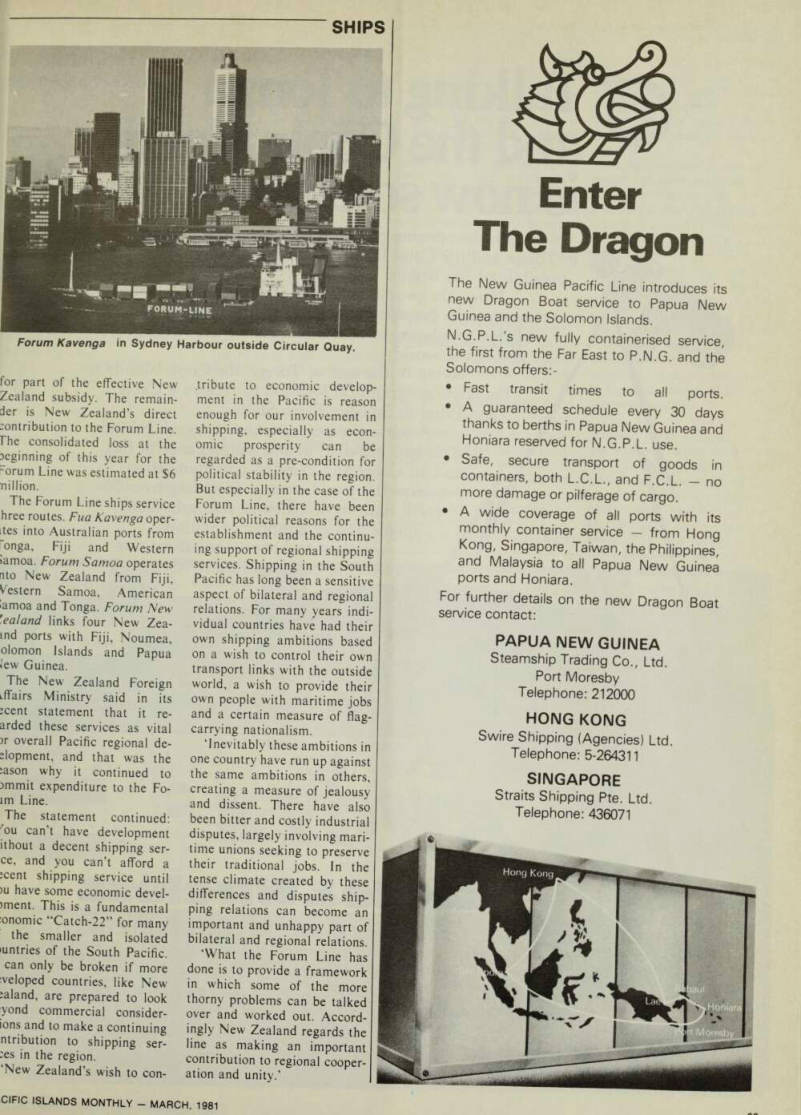
Forum Kavenga in Sydney Harbour outside Circular Quay.
Vanuatu plans
ships register
Vanuatu is to establish a Ship ping Register along the lines of the Liberian operation.
An official statement in January said: The government of Vanuatu has agreed in prin ciple to the establishment in Vanuatu of a Shipping Regis ter, and hopes to have the enabling legislation passed by Parliament before the end of February 1981.
The register will be similar to the Shipping Register in Liberia, and the maritime legis lation will be based on the latest laws of Liberia. ‘All registrations will be handled in New York as at present, and persons accus tomed to registrations under Liberian law will have no difficulty in effecting regis trations under the laws of Vanuatu. ‘Vanuatu is on automatic
;elephone dialling from most
countries in the world, and has iutomatic telex facilities, both
of which operate around the clock. ‘Experienced and capable personnel have already been engaged, subject to the com pletion of the necessary formalities.’
Commenting on the move to the Port-Vila weekly Voice of Vanuatu , the Vanuatu prime minister’s press spokesman said the announcement was being made simultaneously in New York by Gary Vandersluis, Vanuatu’s Registrar of Com panies, who was attending a conference on tax havens as a representative of the Vanuatu Government and Finance Centre.
The Voice of Vanuatu report said: ‘Following the recent coup in Liberia, the new government tripled the fees paid by ships using its register, and indicated that costs would continue to be increased steadily and significantly in the future. ‘These moves have angered shipping magnates. ‘The setting up of Vanuatu’s register is thus seen as timely. ‘lt is the intention of the
government that the Vanuatu shipping register shall be of the finest standard and come under impeccable management.
The present Finance Centre of Vanuatu, which has earned itself a sound worldwide repu tation since it was set up in 1971, the lack of foreign exchange controls, Vanuatu’s tax-free status, and the telecom munications facilities in exist ence, all provide an excellent framework for the proposed shipping register.’
PNG sells its
lights tender
The former lighthouse tender MV Noel Buxton , an indepen dence gift from Australia to Papua New Guinea, has been sold to a group of Australian businessmen for use as a cruise ship on the Great Barrier Reef.
The price which was paid to bring the ship back to Australia has not been disclosed.
For about 10 years before independence in PNG the Aust ralian lighthouse service used
the ship to service navigation lights on the north coast of the PNG mainland and in the PNG islands. The ship was based at Samarai, on the eastern tip of the PNG mainland, for much of this time.
At the approach of indepen dence Australia presented the Noel Buxton to the PNG government, but the Australian crew was gradually withdrawn in keeping with PNG’s wishes to maintain its own services.
Soon afterwards the ship be came the centre of a contro versy with allegations that it was not suited to the work it was doing. After only a short period of operation it was tied up at a wharf in Port Moresby where it remained for nearly five years.
It was badly damaged by van dals and squatters.
The ship is now in the Brisbane River in Queensland where its new owners are restor ing it for charter cruise work.
One of its first charters will be to take Australian ex-service men, former members of the 61st Battalion, on a cruise to Milne Bay and Bougainville.