‘Buy Pacific’ is
pp. 59-63 · Read in the full issue

Trade
Winds
‘Buy Pacific’ is Australian call
Australia has begun an active campaign to increase the value of its imports from Pacific Island countries. Despite the high level of Australian aid to the Pacific, there is some politi cal embarrassment in Australia over the fact that the value of its exports to the Pacific is much higher than the value of its imports. This is seen as a factor in renewed Australian attempts to foster Pacific imports.
A major part of the new Australian drive is publicity for the recently-introduced South Pacific Regional Trade and Co operation Agreement (SPAR TECA), SPARTECA aims to progressively widen the opportunities for Pacific Island countries to sell goods and produce free of duty and with unrestricted access to Australia and New Zealand.
In a recent statement from Fiji the Australian Trade Com missioner for the Pacific Islands, Mr Jack White, ap pealed to companies in the region to take advantage of export opportunities offered by the new trade agreement.
Under the SPARTECA pro gramme, he said, a wide variety Df exports from Island member :ountries of the South Pacific Forum now had duty-free ac cess to Australia, and other exports would be added to the ist progressively.
Mr White said that about 10 companies, mostly from Fiji, )ut including Tonga and /anuatu, had already inquired ibout exporting to Australia mder the terms of SPAR PECA. Several of the compan es manufactured products not isted under SPARTECA, but •fficial requests for the products o be included were being onsidered, he said.
Mr White said about 97% of Australia’s imports from Forum sland countries (excluding *apua New Guinea) currently ntered duty-free. These were alued at around $74 million in 979/80 of which phosphate ccounted for $5l million. The imainder consisted largely of old, vegetable oils, tropical 'uits and handicrafts.
Australia expects to ratify SPARTECA shortly.
Among Island products now listed for duty-free entry to Australia are fish (fresh, chilled or frozen), raw coffee, canned meat products, canned tuna, banana, taro and breadfruit chips, coconut oil, biscuits, soap, raw hides and skins, saddlery and harness, um brellas, raw cocoa beans, Portland cement, vanilla, cut flowers, broom millet, masi, leather goods, wood and wooden products.
Profit down at
Bougainville
Bougainville Copper Ltd, which operates one of the world’s biggest open pit copper mines in Papua New Guinea, has re ported a 14% drop in earnings for the year to December 31.
The report, issued in February, blames rising operating costs and a fall in the sale of concentrates for the situation.
The profit figure, in PNG cur rency, was K 71.534 million compared with K 83.917 million for the previous year.
Expressed in Australian dol lars, and taking into account the differing exchange rates for the two years, the profit was just over $94 million last year and nearly $ 110 million the previous year.
The directors reported that the profit would have been even lower last year but for the write back of earlier over-provision for tax. Not only did the write back affect the figure, but it also led to a significant reduction in super-tax provisions because of the lower pre-tax profit which it created.
The super-tax is part of PNG’s mining agreement poli cies under which companies have to increasingly share with the government as tax any earnings described by formula as ‘excessive’. The government also has a 20% equity in the
mine shareholding.
The final dividend declared by the board was 8 toea a share and a bonus distribution of 4 toea a share from accumulated
profits. This brought the total distribution for the year to 20 toea a share, and distributed 90% of the earnings.
Looking to the current year the report indicated that lower metal prices did not create profit confidence.
The company has already announced its intentions to in stall an additional crushing mill it will be the eleventh on the mine site to increase pro duction volume. The cost of the mill will be $4B million. The company is also renewing sub missions to the PNG govern ment to lift an embargo on exploration sites adjacent to the present mine lease.
Vanuatu flights
for Ansett?
Ansett Airlines of Australia appeared in February to be virtually certain to become the second designated flag carrier for Vanuatu. The other is the Fiji airline, Air Pacific.
A January report in the Sydney Morning Herald said: ‘Ansett will probably use Boe ing 727-200 s or 767 s on its Sydney (or Melbourne) to Port-
Vila flights. However, they may have to be refuelled at Tontouta (Noumea) as they must carry sufficient fuel to overfly Port- Vila if its strip is unusable. ‘While the Vanuatu Govern ment is still technically open to approaches from other airlines.
Air New Zealand has shown an interest.’
The report quoted a senior Vanuatu Government official as saying ‘the most attractive as pect to the Ansett offer is the airline’s huge marketing organ isation’.
He said; ‘Through Ansett we can reach an enormous tourist potential in Australia. Ansett can devise a package deal including hotels, tours and sightseeing. Last year we had about 25 000 tourists, of whom about 80% came from Aust-
ralia. We believe that we can easily lift that figure to 50 000 with proper marketing and air craft.’
Vanuatu’s Transport Minis ter John Naupa was in Aust ralia in January for discussions on the proposed deal.
Air Melanesiae
changes control
The consortium which has con trolled Air Melanesiae, Vanu atu’s internal airline, has been dissolved, by mutual consent of the two parties New Hebrides Airways and SFAH, a subsidiary of the French airline
Uta.
In a statement to PIM in January, the general manager of Air Melanesiae Ltd, Captain Helly Tschuchnigg, said; The directors of New Hebrides Airways and SFAH have agreed to discontinue the consortium as from January 1, 1981. New Hebrides Airways, which has changed its name to Mr Malanesiae Ltd, has been designated the internal carrier )f Vanuatu. ‘We are at present in the )rockss of liquidating the con sortium. This should be com peted within the next few nonths. Air Melanesiae Ltd vill purchase the aircraft >wned by SFAH namely, hree Islanders, and a half share n the Twin Otter, which is ointly owned by the two par ies.
There have been no changes
in the staff establishment and a cordial relationship exists be tween the two parties.
The first priority of both parties during the transition period has been to maintain air services to the public. This has been achieved not a single flight has been cancelled. ‘Air Melanesiae Ltd has offered the Vanuatu Govern ment the option of taking up an equity in the company. We are completely at the disposal of the government in all matters relat ing to air services within Vanuatu.’
PNG set to go
on new mine The Papua New Guinea govern ment plans to take up a 20% equity in the proposed gold and copper mine at Ok Tedi about the same equity which it holds in the existing gold and copper mine on Bougainville Island. This was indicated by the PNG Prime Minister, Sir Julius Chan, announcing re cently that financial agreement
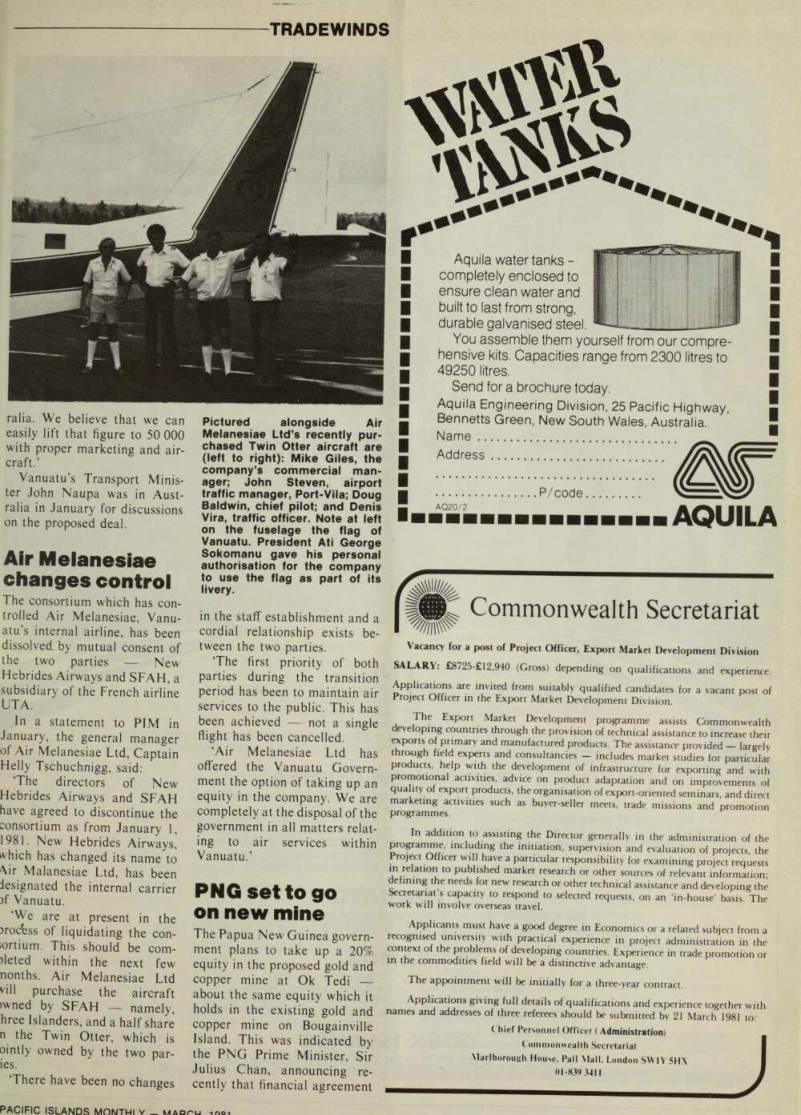
Pictured alongside Air Melanesiae Ltd’s recently pur chased Twin Otter aircraft are (left to right): Mike Giles, the company’s commercial man ager; John Steven, airport traffic manager, Port-Vila; Doug Baldwin, chief pilot; and Denis Vira, traffic officer. Note at left on the fuselage the flag of Vanuatu. President Ati George Sokomanu gave his personal authorisation for the company to use the flag as part of its livery.
had been reached in principle with partners in the project. At the time of Sir Julius’ an nouncement the government had still not indicated definite approval to proceed with the Ok Tedi mine. However it was generally anticipated in mining and government circles that approval was likely to be an nounced about the end of February (PIM Feb p 62).
Under its mining policy guide lines PNG does not insist on massive equities, but prefers to optimise the earnings it can make by using a sliding tax scale related to a profit margins.
It also keeps its capitalisation expenses to a minimum by buying equity where possible from future earnings and by providing infrastructure which is paid for in shares.
The specific terms under which PNG will obtain its equity in the Ok Tedi project were not announced at the time of Sir Julius’ statement, but the government’s effective capital isation share is expected to be close to SAIOO million. The government will launch its own programme of international borrowings to finance its com mitments.
The parent companies which are involved with the govern ment in the Ok Tedi project are Amoco (USA), BHP (Aust ralia) and Kupfer Explorations
(Germany).
Planning for the project was leld up late last year when PNG disagreed with some of he international borrowing )lans proposed by the partners, fhe plans were not in PNG’s )verall interests, the govern nent said, although details of he disagreements were not ;iven.
The recent announcement rom Sir Julius said that nego iations held in London had esolved all differences between *NG and its partners in finance rrangements.
Ok Fedi is in the Star /fountains in the far western iland of PNG and close to the ndonesian border. The con traction phase of the mine is xpected to occupy about four ears at a cost of about $715 lillion at today’s values. One of
ie biggest engineering projects
i the venture will be the anstruction of overland and
river transport facilities to shift copper concentrate from the mine to the coast 200 km away.
Agriculture to
get USA aid
Grants totalling $5.6 million are to be made by USA over the next five years under a scheme known as the South Pacific regional agricultural develop ment project. The scheme is designed to strengthen agri culture in the South Pacific countries served by the Univer sity of the South Pacific by assisting the university’s agri cultural programmes.
The funds will be used to expand agricultural research, extension and training pro grammes at the university’s campus at Alafua, Western Samoa.
At the end of the five years the university hopes to have helped degree and diploma graduates and to have provided higher training for staff mem bers, short courses and seminars on agricultural issues, a com munication network, scholar ships, library resources and
technology.
The US Agency for Inter national Development will man age the project from its South Pacific regional development office in Suva, the US Embassy in Wellington said. The pro grammes would be carried out in collaboration with the Uni veristy of Hawaii and Cornell University, New York, it added.
The Agency for International Development has also made a grant of $163 000 to establish a farm training centre at Moa moa on the island of Upolu in Western Samoa. The grant is to be applied by the American Catholic Relief Service. Ad ditional grants may be made later to support the project.
Catholic Relief hopes to pro vide two-year training courses at the centre, taking in small holding farmers from village communities.
About 30 farmers will attend each course, and will be given instruction in crop rotation,
planting and harvesting, mar
keting, farm budgeting, cattle
breeding, record-keeping and
pasture management.
Bill
Gasson in Wellington.