‘surviving colonial
p. 14 · Read in the full issue
Boulekone on ‘surviving colonial mentality’
I met Vanuatu’s leader of the Opposition Vincent Boulekone in his office in the Government Building in Port-Vila in January. Aged 37, the Pentecost-born politician is married, with three children.
He is handsome and articulate, and gives a strong impression of commitment to the unity and well-being of his country.
Vincent Boulekone was edu cated at a French-language primary school in Santo, got his secondary education in New Caledonia, and stayed on there to graduate with a diploma in law in Noumea in 1972. He speaks good English as well as excellent French.
He returned to the New Hebrides at the end of 1973 and worked for five years as an assistant judiciaire , represent ing indigenous people in the courts.
Active on the ‘francophone’ side of politics since 1974, Mr Boulekone in 1979 formed his own ‘Nakamal’ movement, which sought to stand aside from party politics and provide ‘an area of reflection’ on the country’s political problems. In this initiative he was joined by Father Gerard Leymang and the present Speaker of the Representative Assembly, Maxime Carlot.
Despite his lack of party backing, Vincent Boulekone has been regularly re-elected in his Pentecost constituency.
He is forthright about what he sees as the root of the country’s chief problem: the survival of a colonial state of mind among certain French men. ‘They want to hang on to the lifestyle of the colonial past,’ he said. ‘They don’t want change. Above all, they don’t want to see the Melanesians developing the country in their own way, in independence.’
About the Santo secession and its aftermath, he said; T saw it coming in 1979. I con stantly advised (former French Resident Commissioner) Rob ert and the leaders of the Moderate Party not to go too far, warning them that if they did they would compromise themselves as Frenchmen, and could also compromise the fu ture of the country. ‘But they didn’t want to listen to Melanesians. They thought their ideas would turn out right in the end. ‘So the French, supported by Robert, staged this secession in Santo. Everything that is hap pening now is a consequence of this state of mind. ‘The present danger is that these people still do not realise that what they did was wrong. It is not to my mind an imminent danger, but if the people in Noumea don’t change their ways of looking at things, our relations with big powers who could aid us, especially France, will be endangered. ‘lt’s high time that certain Frenchmen, whose names I won’t mention, put their trust in Melanesians. Because it is the ni-Vanuatu who are going to institute democracy in this country, and ensure respect for the Constitution. It is we alone who will protect the democratic system in our country.’
Other major problems touched upon in the interview were the land problem in particular the difficulty of identifying true custom owners of alienated lands and the problems of replenishing the
ranks of parliamentarians one of whom (Alexis Yolou) is dead, others (Georges Cronsteadt and Guy Prevost) deported from the country, and others again in prison for secessionist and other subversive activities. There is also the happier case of the need to elect a replacement for President Ali George Soko manu, who as George Kalkoa was previously an MP.
Of the strengths and the weaknesses of the government, Mr Boulekone said: T under stand that the present govern ment wishes to establish the peace and unity of our country, and especially to try to prevent foreign interference in our pol itical life. This is its sincere objective. ‘But the means it is using I disapprove. There were necess ary arrests of people who have damaged the unity of the country. ‘But in my view, after inde pendence, the government made the mistake of ignoring the law in the way arrests were made. I believe that the Police Mobile Units maltreated some people in the islands. ‘As Opposition Leader, I criticise these practices, al though I realise that the arrests were necessary. This is the major point I have against the government.’
Vincent Boulekone was also sharply critical of what he sees as a ‘bending’ of the Consti tution by the government in relation to the vital law relating to decentralisation, a sensitive issue in Vanuatu.
But, in a gesture which augurs well for the consoli dation of Vanuatu’s fledgling parliamentary system, he was still prepared to pay warm tribute to the work of the ruling Vanuaaku Party in the achieve ment of independence, saying: T must recognise and thank the government for having fought to achieve indepence. We are proud of that fight, in which I also took part. ‘The Vanuaaku Party was the first movement to demand the independence of the country. ‘Now that we have indepen dence, we must at all costs respect our institutions, our laws, and our Constitution all those things which guarantee our freedom.’
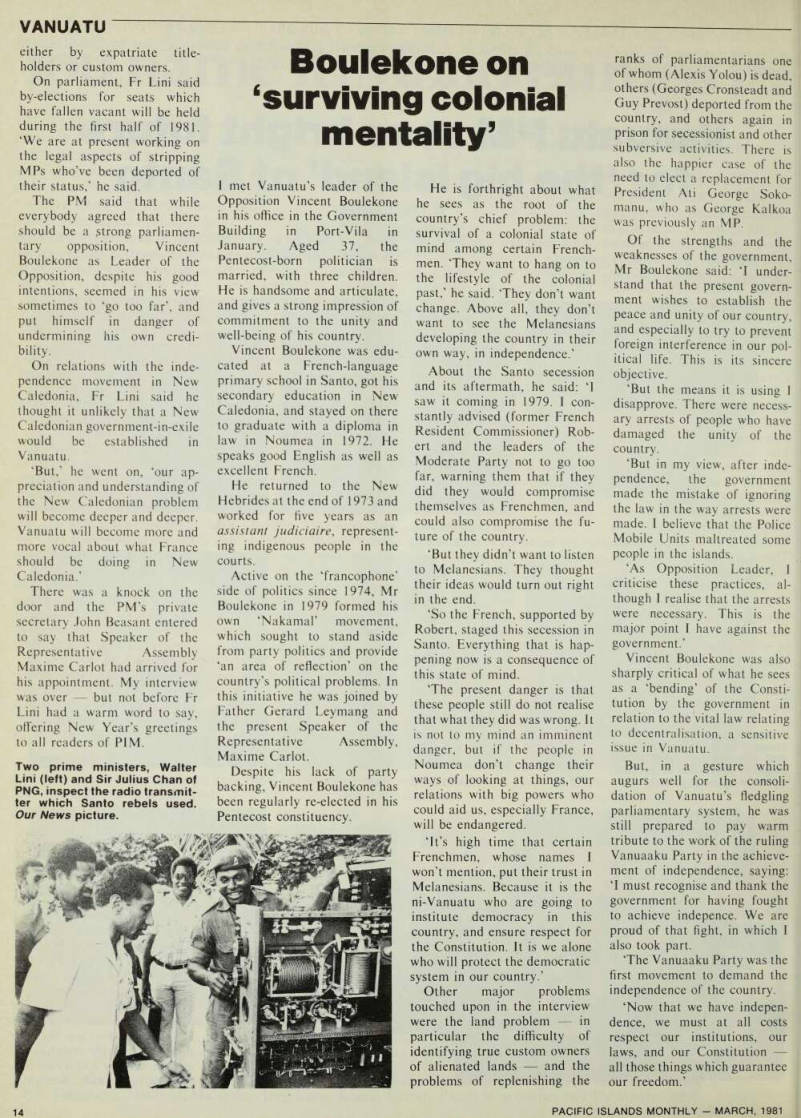
Two prime ministers, Walter Uni (left) and Sir Julius Chan of PNG, inspect the radio transmit ter which Santo rebels used.
Our News picture.