says designer
pp. 7-11 · Read in the full issue
Letters
Hokule’a is a culture pivot, says designer
In his December review of Ben Finney’s book Hokule’a, the Way to Tahiti, Bengt Danielsson’s information is in some respects incorrect because the book itself is a highly )ersonal view of events which iuffers from distortions and irrors of omission.
As co-founder of the Poly lesian Voyaging Society, gen :ral designer and construction upervisor of the double canoe Hokule’a, and skipper of a hakedown and training cruise hroughout the Hawaiian slands, I write to correct some lisinformation created by this ook and by the press during he few months that this project f as in some difficulties.
The design of the hull was not ill guesswork’. Hokule’a’s ulls have the convex V of the ahitian pahi, also seen in some irly drawings of some sections f Hawaiian sailing canoes, his V, not unlike that of the uamotuan hull Danielsson iggests we should have fol wed, enables the canoe to ork sufficiently to windward to il between Hawaii and Tahiti, his course is a close reach with beam current both ways )t with ‘favourable winds and irrents’ as Danielsson states.
Sail plan is similar to that ed throughout Eastern ilynesia and New Zealand at e time of European contact, fleeting general design fea res rather than some of the ecialised features which were
:al developments evolving
ler the era of long-distance yaging had ceased.
The hulls are not ‘plastic’ (a mour started by a reporter in hiti) but are built of lami led wood with a protective ating of fibreglass. We knew w the old canoes were built.
but we did not know how they performed; therefore our inter est was not in building a materials-accurate replica, but rather a replica which would be performance-accurate. Per formance of the hulls is not dependent on the materials used, but on the shape, surface, and assembly by flexible lash ings. The painted, highly glossed surfaces of Hawaiian canoes which excited admir ation from early European ob servers was not substantially different from a fibreglass sur face. And Hokule’a is lashed together by six km of line in flexible lashings which function admirably as ‘shock absorbers’.
Tests during the first cruise revealed that the canoe could sail into the wind sufficiently well to make it to Tahiti and back. Also, tests in the rough channel waters between the Hawaiian islands showed that Hokule’a would have no difficulty on the open sea in anything less than a survival storm.
Sentimentalists who chaffed us for not using traditional materials were invariably not sailors. Of the giant koa from which huge Hawaiian canoes were once made only a few remain of sufficient size, some being riddled with rot. It seemed better to leave these magnificent trees standing. In the old days a canoemaker would form and bend a hau branch with splints and lashings so that his grandson might someday be able to cut a perfectly-curved crossboom for a double canoe, but that tra dition had passed before our grandfathers were born. Thus
our crossbooms were made of laminated wood.
During the first cruise we tested the sail plan with heavy canvas while pandanus sail mat ting was being made. Pro fessional commitments forced me to take temporary leave from the project (entirely a volunteer project) after the first cruise; and much to my chagrin the pandanus sails were not used on the Tahiti voyage, and rotted because they were not properly aired. However, these mat sails weighed only 35 lb. each, and subsequent testing has shown that a pandanus sail doesn’t differ significantly in performance from a sail of heavy canvas. Being stiffer than canvas, it actually seems faster.
I named the canoe Hokule’a, the Hawaiian name for Arcturus, a zenith star (appear ing to pass directly overhead) of Hawaii, and thus a latitude indicator for ancient voyagers returning to Hawaii from the South Pacific. As a star that guided them back to Hawaii, it was aptly named Hokule’a (star of gladness).
The widely and inaccurately publicised difficulties we experi enced just prior to and during the first leg of the Hawaii-Tahiti round trip were due largely to a clash of objectives between those (like Finney) who were primarily interested in ‘scien tific’ objectives; those who were in it for simple adventure and ego gratification; and those who saw its potential as a cultural experiment. I was of the latter group. Recognising that no cul ture can exist without its ob jects, my hope was that by rebuilding what had been a
central object of the old culture and actively using it in Hawaiian waters, some revival of related elements of the old culture would be stimulated. I was pleased to see that the canoe ‘spoke’ to Hawaiians in all the islands, and that it did become a focus and stimulus for retrieval and revival of tra ditions in the arts and crafts of old Hawaii that are threatened with extinction.
Mistakes were made, as might be expected, for on the first time around a new track one is apt to stumble into the potholes. But things did get shaped up. The return from Tahiti to Hawaii (after Finney left the project) went well.
The recent (1980) round trip voyage to Tahiti logged 6000 miles perfectly navigated by Hawaiian Nainoa Thompson without charts or instruments.
Under skipper Gordon Piianaia, crew morale and efficiency was excellent.
We are now informed that a double canoe is being made at Pahiatua, New Zealand. A re surgence of interest in canoes and voyaging was seen at the recent South Pacific Arts Festi val. To all Pacific Islanders whose ancestors explored and settled this ocean world, the voyaging canoe is a common symbol. And any direct experi-
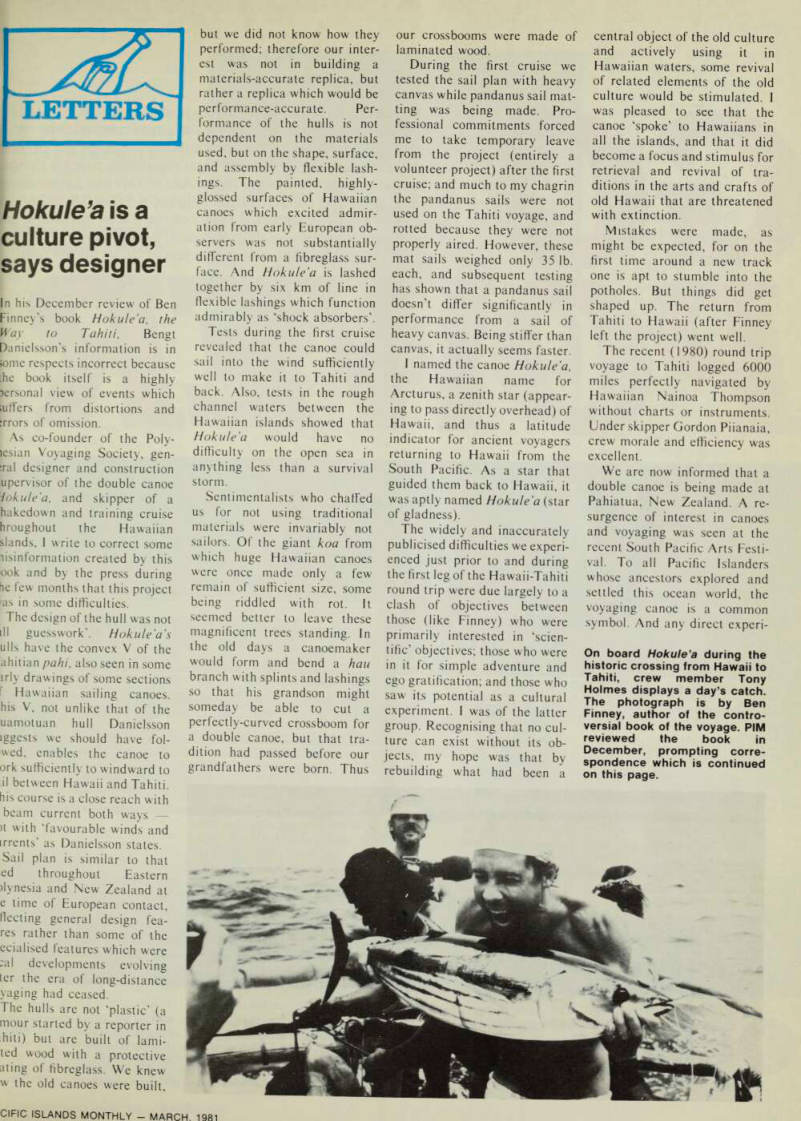
On board Hokule’a during the historic crossing from Hawaii to Tahiti, crew member Tony Holmes displays a day’s catch.
The photograph is by Ben Finney, author of the contro versial book of the voyage. PIM reviewed the book in December, prompting corre spondence which is continued on this page.
ence with canoe sailing and non instrument navigation must re mind us of the resourcefulness, inventiveness, and courage of those ancestors. Certainly they possessed qualities which we would do well to emulate today.
Herb Kawainui Kane
Kailua-Kona Hawaii USA Some new words on the wantok system Please excuse my southern Cali fornia ignorance of southern Pacific cultural systems, but the PI M article in November about books vanishing from the Uni versity of Papua New Guinea has me wondering as to the meaning and origin of the ‘wantok system’ said to be practised by library staff there.
I am interested to know if my staff at the Scripps Institution of Oceanography Library may be guilty of the same philos ophy, especially when our dis tinguished academicians here at SIO slip past our exit turn stile with non-circulating copies of PIM tucked under their coals.
Paul L. Leverenz
SIO Library La Jolla California USA Wantoks are people of the tame kin or from the same ! illage of origin. The word omes from the English ‘one alk' sharing a single anguage among the hundreds f PNG languages and dialects.
Jnder the want ok system pref rential treatment is given and xpected between wantoks, even f this sometimes means bend ng the rules. Unless reader .everenz can establish some ort of home-town link between ny of his staff and any of the V M-smugglers, then his rouble is definitely not >antokism. Maybe the mugglers just like reading TM. Editor. onga should move vith the times wish to write about the larriage of Tonga’s Prince Lla’ivahamama’o to Miss leimalaura Salmon Anderson PIM Nov pi 5 and Dec p 8). our magazine pointed out one nporlant fact; King
Taufa'ahau should have stopped this romance before the marriage. I, myself, believe that a high chief’s daughter has enough rank to marry a prince!
European monarchies see the necessity of keeping with the modern times. In Europe, many royals have married com moners. Even Britain’s Princess Anne married a commoner. In many countries, the people have fell closer to their royal family after a royal-commoner mar riage. This is a good example for Tonga!
One always hears that Tonga is moving toward development.
Yet the royal house is forced to live by traditions from the Middle Ages. Now we learn that King Taufa’ahau has with drawn his son from succession to the throne of Tonga. The King has made a move which is outdated and undemocratic.
Prince Ala’i should have sought his father’s permission for this marriage, because that is part of Tongan law. However, the King should set a new example by welcoming Miss Anderson (a commoner) into his family.
If the King will show kind ness and reconciliation toward his wayward son. His Maiestv
will be known as a good father and a wise monarch.
Randy Duff
Indianapolis Indiana USA Tuvalu secession call not official I refer to the letter written by Telavi Fali (PIM Oct p 11) under the title A Tuvalu Se cession so that your readers may not be misled into thinking that the writer has been author ised to speak on behalf of the people of Nanumea.
In fact although Telavi Fati writes that he is appealing on behalf of the Nanumea Com munity he has no right at all to do so. He is not an elected representative of the people either in the Parliament of Tuvalu or in the Island Council of Nanumea and he has not been asked by the Island to speak on its behalf either in making statements about the intentions of the community or in seeking loans.
I am sure that your readers and Commonwealth countries to which the appeals are ad dressed will ignore such wild and unrealistic statements and appeals until they are satisfied that they come not from some self-appointed spokesman but from someone who has been
given proper authority to rep resent the Island.
Maheu Naniseni
Funafuti Tuvalu Mr Naniseni is the Member of for the electorate of Nanumea.
An ‘absurd’ PNG
character writes Please allow me once more to reply to Ms De Montluc’s letter (PIM Oct 1980 plO). The kind lady accuses me of being a racist, nazi, and an ‘absurd’
Papua New Guinean. Before I answer these accusations, I would like briefly to make some comments on her second letter. (1) There was no misunder standing on my part on the main point of this kind lady’s earlier letter (PIM Dec 1979 pi 5). Her letter resulted from what Mr Ebia Olewale had said during a speaking engagement in which the former foreign minister of PNG was asked by the French Polynesian ‘nationalists’ to speak on the theme ‘internal autonomy and independence’.
Unfortunately, however, the kind lady went out of her way to bring in the issue of the ‘high standard of living’ in French Polynesia, the ‘lawlessness’ in PNG, and the Irian Jaya issue.
In so doing, she seemed to associate: (a) ‘dependency’ (of French Polynesia on France) as the key to the ‘high standard of living’; (b) ‘independence’ as leading to ‘lawlessness’ (the example was PNG); and then (c) the issue of Irian Jaya, suggesting that PNG had sold the birthright of Irian Jayans to the present colonising power.
I’ve been long enough in this world to understand that the kinds of assumptions, argu ments, and so on, that Ms De Montluc chose to use in her first letter are typical of the ‘colonial mentality’. With the best of intentions, my subsequent reply was directed to the author, who saw fit to air her views on the rights of French Polynesians. (2) The reference I made to ‘true’ French Polynesians in my earlier letter (PIM Jun 1980 p 6) stemmed from the theme of ‘internal autonomy and inde pendence’. Ms De Montluc agrees that this was the theme
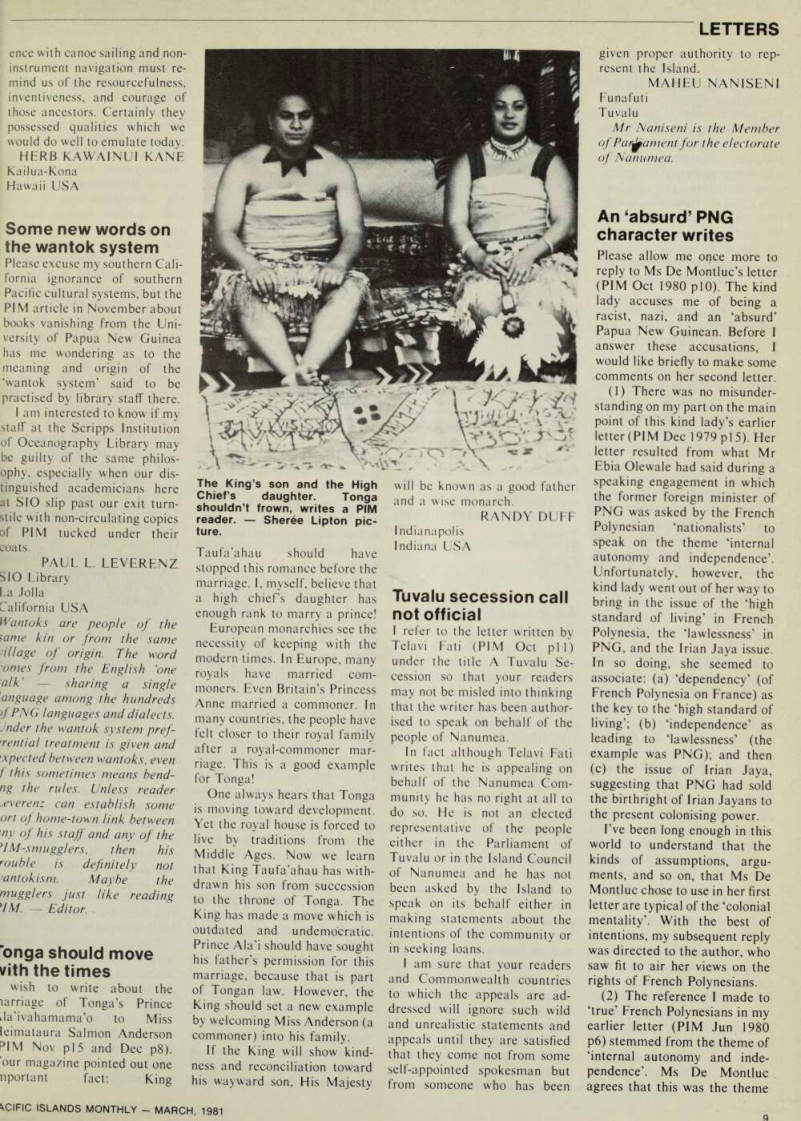
The King’s son and the High Chief’s daughter. Tonga shouldn’t frown, writes a PIM
reader. - Sheree Lipton pic
ture.
that prompted her to express her views about PNG and, in particular, Mr Olewale. Here, I associate ‘true’ French Polynesians with: (a) those who preach ‘independence’ and are not afraid of it; (b) those who see the ‘injustices’ of the colonising power (the prime example being the nuclear tests); and (c) those who, partly from experience elsewhere in the world, are concerned about the future of their children and are determined to make that future something to look for ward to.
These are some of the fea tures which I believe dis tinguish a ‘true’ French Polynesian or, for that mat ter, a Micronesian or Melanesian, whose interests are those of the people, and not those interests handed down by the colonising power.
In reading Ms De Montluc’s first letter, it occurred to me that the comments she made were those that I would associ ate with a colonising power, and any persons who share that power’s interests and, noting the surname, I felt this sup ported my assumption. Please note that, whatever her name, I would not have singled her letter out for reply if it had not been for the type of arguments she used.
As far as the other Pacific leaders to whom Ms De Montluc refers in her second letter are concerned, I cannot distinguish them any more than I could an American from a Canadian. The only way I could distinguish them would be from the types of responses they made to any questions I might possibly be able to put to them.
It would be quite dishonourable of me to accuse these gentlemen as being ‘totally unrepresent ative of their respective countries’, as Ms De Montluc suggests I might. (3) I am glad that Ms De Montluc ‘does not condone French nuclear testing’, but I am indeed sorry that she dis sociates independence for French Polynesia from nuclear testing in French Polynesia, regarding them as two separate issues. How different are they really? Am I wrong in assuming that for as long as French Polynesia is dependent on
France, the latter can manipu late the domestic and inter national policies of the former to suit its purposes?
The kind lady made refer ence to the fact that French Polynesia has chosen ‘internal autonomy’ over immediate in dependence until such time as French Polynesia is ‘economi cally self-sufficient’. Which country on the face of this earth is ‘economically self-sufficient’?
Would the USA, which imports a major part of its energy needs in the form of oil, think of reverting to its 18th century state of political dependence on Britain until such time as its economy is ‘self-sufficient’?
Truly, if we were to use Ms De Montluc’s yardstick, we’d all be colonies until kingdom come!
Finally, I would like to ex press my thanks to Ms De Montluc for promoting me from ‘primitive’ PNGean to ‘absurd’
PNGean. My sincere thanks to PIM readers for putting up with
my ‘absurdity’.
Samson M. Polume
Victoria BC Canada An invisible host on
Sudest Island
The article Through the Louisiades by Morning Star, written by Michael Adlington (PIM Aug p 59), is full of inaccuracies, omissions and in ventions. I know, because I am the ‘friend’ whom the author came to visit.
I am an anthropologist who lived for over a year in the home of Martin Peter, Nora Moses and their family in Jelewaga Village on Sudest Island, or, to use the island's true name, Vanatinai. Mr Adlington, an acquaintance who had learned of the very existence of the Louisiades from me, arrived unexpectedly by boat one day in June, 1978. Following local custom for even an unwanted guest, I gave up my room and slept on a pandanus mat with the children for the duration of his stay, even though I was then recovering from a severe ma laria attack. I provided the bulk of Mr. Adlington’s food from my own stores and by bartering with the other villagers so as not
to strain Marlin and Nora’s garden resources unduly. I translated conversations with the local people for Mr Adlington and explained to him the activities which he wit nessed.
Mr Adlington completely omits from his story the fact that his only prior acquaintance at Jelewaga was myself, a white woman who was living there and who was present in virtually every scene which he describes in the village. He pretends I do not exist and never mentions me in the article. He implies that Marlin Peter was the ‘old friend’ who greeted him June 13 by describing a garden tour with ‘my host and namesake’
June 14, but Martin Peter did not return home to Jelewaga until June 18 to find a stranger in his house. Mr Adlington freely uses my words of expla nation of village events verbatim throughout his story as if they were his own. But he still manages to get many facts wrong. For example, there were no ‘bamboo drums,’ or any drums, played at the aid post opening celebration, which took place on June 22 and not on June 15, as the article states.
Mr Adlington refused the vil lagers’ invitations to dance; perhaps that is why he failed to notice that the music was pro vided by tape recordings of string bands which had been specially brought for the oc casion by off-island visitors.
Also, the photograph of page 61 was taken off Sideia Island, near Samarai and the PNG mainland, and not in or near the Louisiades as the caption implies. The Louisiade peoples do not make or use long, outrigger-less canoes.
Why did Mr Adlington omit any reference to my presence in this purported eyewitness ac count? He thanked me in person at Jelewaga, saying, T would never have been able to come and stay in such a remote place if you hadn’t been living here’.
Why then was mentioning my existence so difficult for him to do in print? By contrast, in another recent PIM travel article describing a visit to Tubetube Island near Samarai, the authors felt no need to suppress the fact that they found an anthropologist living
on the island. PIM readers deserve accuracy as well as colourful stories about exotic places in a magazine which they trust. The reality of life on Vanatinai is far more interest ing than anything Mr Adlington could invent.
In any case, congratulations on your 50 years of publication!
My subscription copy of PIM used to arrive without fail at Jelewaga, albeit a month or two late. It usually came by canoe for the last leg of its journey or else was hand-carried by some kind person making the all-day walk to the village from the government station at Tagula.
Everyone at Jelewaga greatly enjoyed looking at each new issue. I know that on many other remote islands, PIM is one of the only publications which occasionally filters in providing local residents with a treasured link with the rest of the Pacific. Best wishes for the next 50 years!
Maria Lepowsky
Dept of Anthropology University of California Berkeley California USA In fairness to Richard Adlington regarding one aspect of the above letter, PIM takes responsibility for the pictures which were received from an independent source. They were included to indicate the general nature of the Milne Bay Prov ince coasts and islands, and not specifically Sudest Island. - Editor.
Will the French follow the rules?
The recent sale of Australian Northern Territory uranium to French interests brought shouts of glee and dollar signs to the eyes of the NT. government and to many people in the NT.
A local newspaper ejaculated to the Chief Minister of the Northern Territory, ‘Go to it, Mr Everingham’.
The uranium is sold subject to rules laid down by the Australian government, i.e. that no NT. uranium be used in nuclear tests.
We all know how the French will treat these rules once they have the NT. uranium.
I am sure that Mr Evering ham would like to hear the
I opinion of all the people and governments of the Pacific re gion concerning this sale of j NT. uranium to the French.
His address is: P. A. E.
I Everingham, Post Office Box [ 3146, Darwin, Northern Terri tory, Australia 5794.
T. A. Nalder
I Glencoe Crescent I Tiwi NT. Australia Thanks from a friend of 10 years I treasure every edition of PIM.
Your 50th anniversary edition was absolutely superb! Thank you for the 10 or so years I’ve known you.
(Ms) Mel Kernahan
Balboa Calif
Usa
Poetic points (1)
beautiful
I would be very grateful if you could pass my comment through your magazine to the poet of The Tidal Waves (PIM Dec p 9).
While enjoying the contents of the PIM December issue, I came to terms with a beautiful poem for a newly independent country which, among others, blamed the work of the missionaries and Christianity for diverging people from their traditional custom. As a Christian I know that one of the reasons why the Jews crucified Christ is because He did not conform to their national spirit and dreams, which are mani fested in their ideas of the coming Messiah.
I am not a fanatic Christian and I do not want to defend nissionary work since it is true hat many of our good customs lave been abolished. However, wouldn’t have blindly blamed Tristianity before taking in ventory of the benefits and costs )f the missionary work. I have io idea about missionary his ory in Vanuatu, but for us, Christianity has unified us, who nee lived scattered, as small solated communities. Unfor unately, tribe-oriented mind till persists among many of us indering co-operation at a time
/e desperately need unity.
If we have troubles, social efection, disunity, and the like,
it is because we haven’t submit ted ourselves fully to be led by that Kindly Light. I never find any defection in the type of social life recommended in the Bible. Do you regret having Christ as your saviour? I don’t.
To the editors 1 would like to express a very special thanks for the now and then pieces of news about Irian Jaya. It reminds me that you never forget us as a South Pacific folk.
Yan P. Karafir
(Irian Jaya) New England University Armidale NSW Australia
Poetic points (2)
hypocrisy
Might I ask Sampson Ngwele who wrote the poem for Vanuatu independence (PIM Dec p 9) upon which tidal wave he floated across to the Univer sity of PNG? His indiscriminate condemnation of all things foreign would not smack so much of hypocrisy were it launched from some jungle fast ness in his native Vanuatu and not the halls of an institution
that is as much an import to the Pacific Islands as are the things he condemns.
Mana does not inspire my poetry curiosity occasionally does. ‘My posterior pains with rage,’
Is what I think you said.
Does this mean.
My friend unseen.
That you sit upon your head?
Laurie Meintjes
Apia Western Samoa Mr Meintjes is a former District Officer in PNG and is now a teacher in Western Samoa.
Support for Maori
entry to games I would like to thank Dr H. R.
Broughton on his view seeking membership for the New Zea land Maori athletes to partici pate in future Pacific Games (PIM Jan p 23).
I, Tali Churton, second the proposal that we give the Maori people a chance to prove that they can participate in the games like any other country.
If all the other South Pacific nations are participating in the games, why not the Maoris?
After all they are very much part of the South Pacific.
We South Pacific people are a happy, fun-loving race and the main object of the South Pacific
Games is to create bonds of love, kindred, understanding, friendship and brotherhood, without any distinction whatso ever of race, colour, religion, politics etc., and to promote amateur sports in these South Pacific lands.
Tali Churton
Balmoral Street Essendon Vic. Australia
Australian role in
wartime Noumea
It has been drawn to my attention that a date is wrongly given in my published com ments (PIM Jan p 65) concern ing the Australian Govern ment’s role in assisting New Caledonia’s adherence to the Free French movement in 1940.
It speaks of the maintenance until November 9 of the policy of trying to co-operate with the Vichy governor of the colony.
The correct date is of course September 9.
Would you be kind enough to publish an appropriate correc tion, thus finally setting the record straight?
John Lawrey
Australian National University Canberra ACT Australia
Interest in Pacific
area newspapers
1 have been interested to read in PIM of the various newspapers within the South Pacific area which have commenced (and ceased) publication. I am a collector of newspapers, but my selection from the South Pacific Islands is very limited. I would ask your readers if they would like to send me copies of newspapers, both current and past, for which I am prepared to pay.
While preferring papers writ ten in English, no restrictions are placed on other language papers, privately or government published. Publications which have ceased are particularly welcome, as are Hawaiian and US papers. Papers I obtain are also used by students for school studies.
A. R. Webb
8 Petersen Street Sarina Qld. Australia 4737
Maori All Blacks Bill Osborne and Eddie Dunn at Cardiff Arms Park, UK, in 1978. A PIM reader supports the suggestion of Dr H. R. Broughton that Maoris, already known internationally in sport, should be considered Pacific Islanders eligible for the South Pacific Games.