In the Solomons today,
pp. 51-54 · Read in the full issue
Travel
In the Solomons today, ‘Only Vincent use the gun’
BRUCE ADAMS, official photographer of the Australian Department of Defence, travels to Solomon Islands, and revisits the scenes of the fierce fighting of the early 1940 s in what is known to history as the Battle of Guadalcanal. The excellent photographs illustrating his story are all from the camera of Bruce Adams.
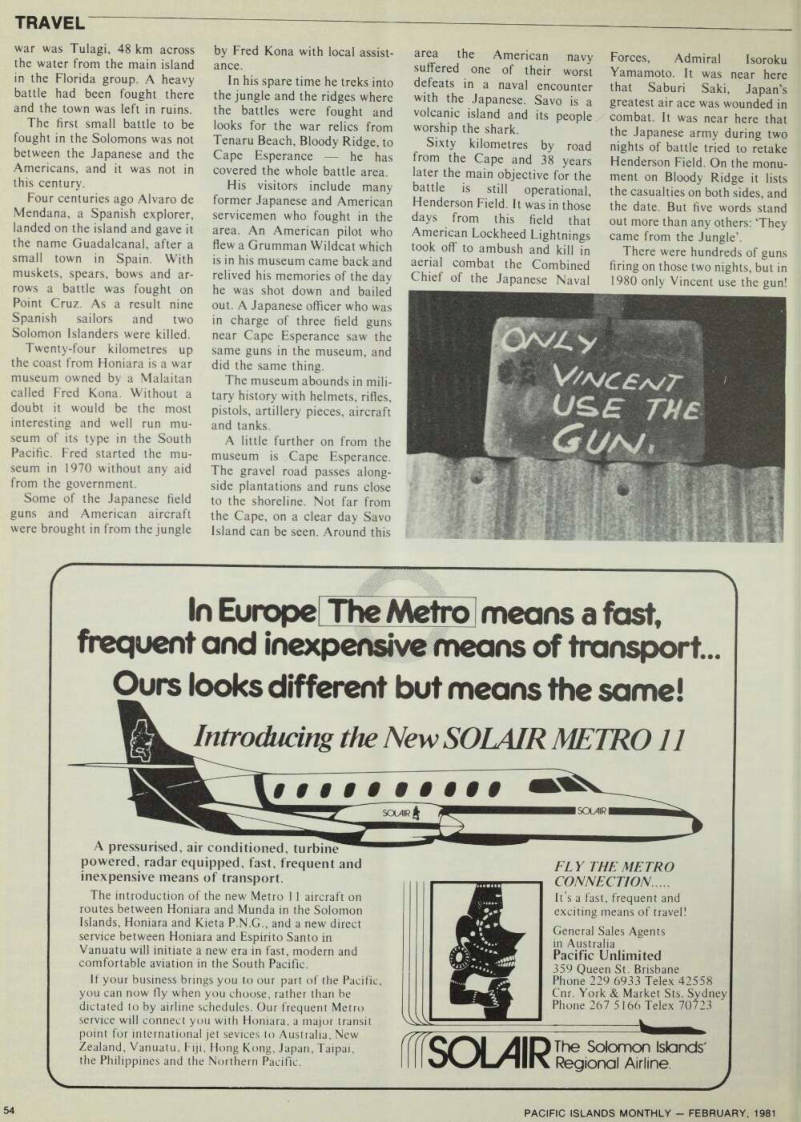
It’s a small slaughterhouse for cattle and the sign reads ‘Only Vincent Use the Gun’. The fences bordering the area are constructed from marsden mat ting . . . pieces of light metal about 1m by 6m, punched with holes. At first glance it looks like large pieces of a Meccano set.
Not far from the fence are crumbling aircraft engine test
stands which once roared with life; the smoother whine of the Lockheed Lightnings, the growl of the Grumman Avengers, and the roar of the Wildcats. The stands are caked with rust, some have fallen over and almost disappeared from sight beneath the tall grass.
It is now late afternoon but the tropical sun still produces unbearable heat. My clothing
shows dark patches of sweat and it clings to my body. My cigarettes are a pulpy mess. My legs below my shorts begin to bleed from the sharp slashes of the kunai grass. Standing on this small ridge overlooking an airstrip the wind blows through the grass and warms it to an unpleasant heat. In the distant sky I hear the monotonous drone of an aircraft engine and.
closer by, the sounds of young birds. The aircraft becomes larger and comes in to land . . . an aircraft from Solair. It taxis to the terminal, unloads its passengers and takes off again.
Once more there is silence.
My imagination goes back three decades. 1 can hear the metallic rattle of machine guns and automatic weapons, the heavy sounds of mortar fire, the cries of the wounded. I can smell the cordite.
This quiet knoll on which I stand is called ‘Bloody Ridge’ and the airstrip I can see was once a weed-pocked strip called Henderson. It still bears the same name but is now sealed well and serves as an inter national airport. It was named after Major Lofton Henderson, a Marine Corps hero who won the Congressional Medal of Honor flying an aircraft during the Battle of Midway. It was
awarded posthumously.
This airstrip that caused the bloody battle of Guadalcanal, name of the largest island of the Solomon group. It was here that the United States Marines and the Imperial Japanese Army were locked in mortal combat from August 1942 to February 1943.
From war wounds and sick ness the young men of both armies died in thousands. It was one of the decisive actions of the Pacific war.
This ghostly graveyard with its rusting relics of war still attracts those who wish to remember, and the tourists who come to hunt souvenirs. But for others it is a nostalgic trip.
The Solomon Islands are visited each year by hundreds of ex-servicemen from both armies who fought there. It is still all here on the beaches and in the jungles the oxidised frames of aircraft, pitted gun muzzles, disintegrating concrete under the weeds and, even now,
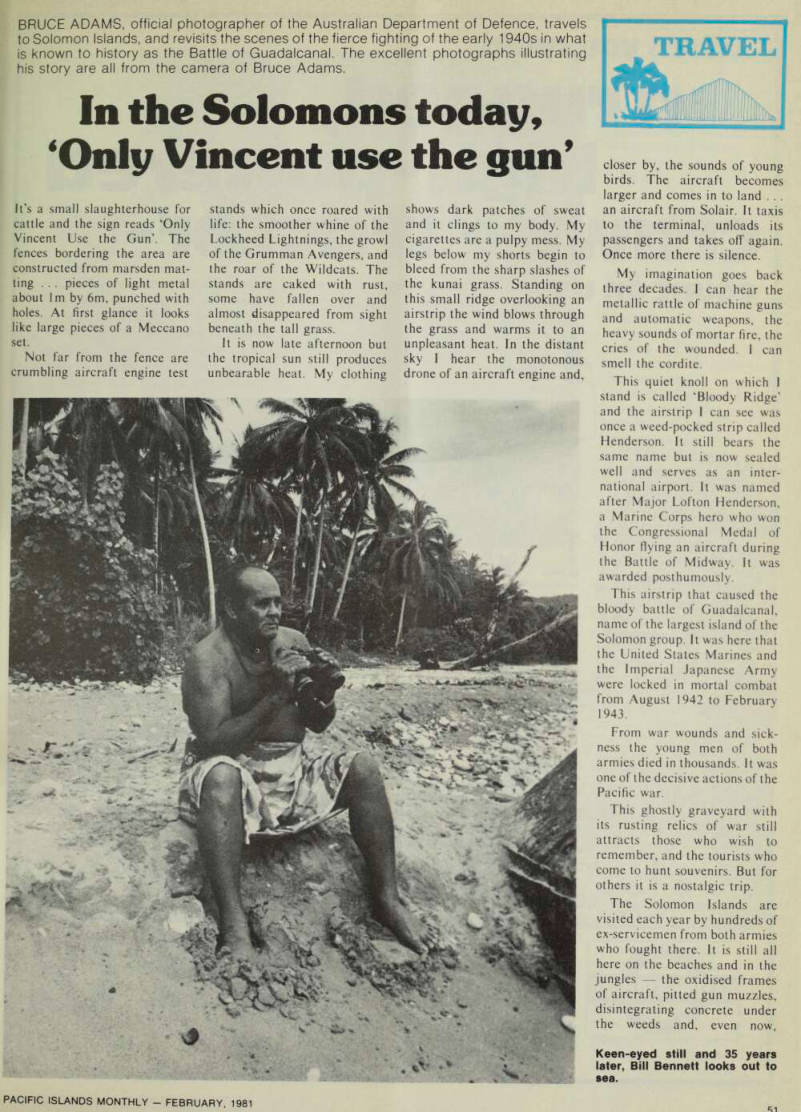
Keen-eyed still and 35 years later, Bill Bennett looks out to sea.
bleached skeletons that have yet to be identified.
Some of those who took part in the battle still live on the island. Among them are two Solomon Islanders, Sir Jacob Vouza and Bill Bennett both legends in their own times. Sir Jacob lives 35 km from the capital, Honiara, at California Village.
Vouza’s story is one of forti tude and bravery. Captured by the Japanese, several times bay oneted and left for dead, he crawled to the American lines to give them vital information.
Each year, he is visited by former Marines and has twice been invited to the United States as a guest of the Marine Corps Association.
Bill Bennett lives only eight kilometres from the capital of Honiara at White River. During the war he was one of the exclusive band of men known as the coastwatchers the men who dug in, while the islands were occupied by the enemy, to radio much-needed information to the Allies. Bill, a large Solomon Islander, runs a trade store and his house is only a metre or so from the water’s
edge. Although retired, he is still on the Board of the Solomon Islands Broadcasting Commission and the Board of Solair, the islands’ internal air line. He, too, receives many visitors newspaper men, for mer Marines, ex-coastwatchers, New Zealanders who fought there, and the Japanese sur vivors of the epic battle. Last year he was visited by a 70-year old former Japanese sergeant of a ‘rapid fire squad’ who took part in the struggle, He told Bill his squad used to sneak out of the jungle at night to catch fish and crabs on the same beach only a couple of hundred yards from Bill’s home. Some nights, the squad would chant and cry on that beach. Of the 300 men in the unit only 13 survived the battle. ‘He was an old man with a lot of dignity. I felt sorry for him,' Bill said. ‘After all, it’s not the ordinary people that make wars but the politicians and the generals.’
Bill Bennett told me he has received 12 wrist watches, a camera and a radio from the visiting Japanese, one of whom was the Emperor’s cousin; but,
ironically, only ‘kind words’ from visitors of the Allied side.
One Sunday morning, Bob Bird, an Australian member of the Honiara Underwater Diving Club, invited me to watch his friends dive into an old Japanese transport sunk during the war. It was a few miles up the coast from Honiara near a small beach called Doma Beach - still littered with massive chunks of rusting metal. In 1962, a Japanese salvage team lifted most of the wreck and dumped it on the beach. Some they took back to Japan.
It seemed a strange contrast to see all the multi-coloured suits on a beach which once had only known camouflage battle gear. After half an hour of probing the wreck they emerged with American jungle boots, a broken dinner plate and one coral-crusted artillery shell.
The boots, indented ‘Made in the USA’, were in perfect condition. The plate bore no
markings. All items had been under the sea for 38 years.
The old transport, originally Japanese, had, at one stage, been used by the Americans as a headquarters. Over the years, it had shifted off the reef on the ocean floor to a depth of 20 fathoms. ★ * * A river surrounded by lawns and palm trees where Solomon Islanders drive their Japanese cars down to the edge, drink Australian beer, and play their musical instruments on a Saturday afternoon its name is the Matanikau River.
Chinatown borders part of the river and the trade stores, houses, restaurants blend into the surroundings. On certain parts of the shore there can still be seen rusting water tanks and pontoons, reminders of a battle that took place so long ago.
On Saturday nights the tour ists and some of the European locals gather and dine at the Lantern Restaurant which is situated on the shore of the Matanikau. The conversation of the locals consists of politics, the tennis club, the yachting club and perhaps the following week’s parties. Although the Solomons gained their indepen dence two years ago, there are still quite a few Europeans living there.
In September 1942 Mata nikau was not a pleasant place for conversation not in terms of small trivialities. That Sep tember, a month after the in vasion, both armies were suffer ing heavy casualties. Not only battle casualties but sickness, disease and on both sides the affliction and loneliness of the jungle.
Several Japanese tanks had been destroyed in a battle at the mouth of the river that month. Soldiers on both sides had died in their hundreds, but the battle for Guadalcanal was not to end for several more months.
Honiara, the capital, stands on an old wartime ammunition dump. It is a delightful town with its clubs, lawns, hotels, gardens and one main street.
Point Cruz is the main centre of attraction with the Hotel Mendana, Yacht Club and the famous Guadalcanal Club.
The old capital before the
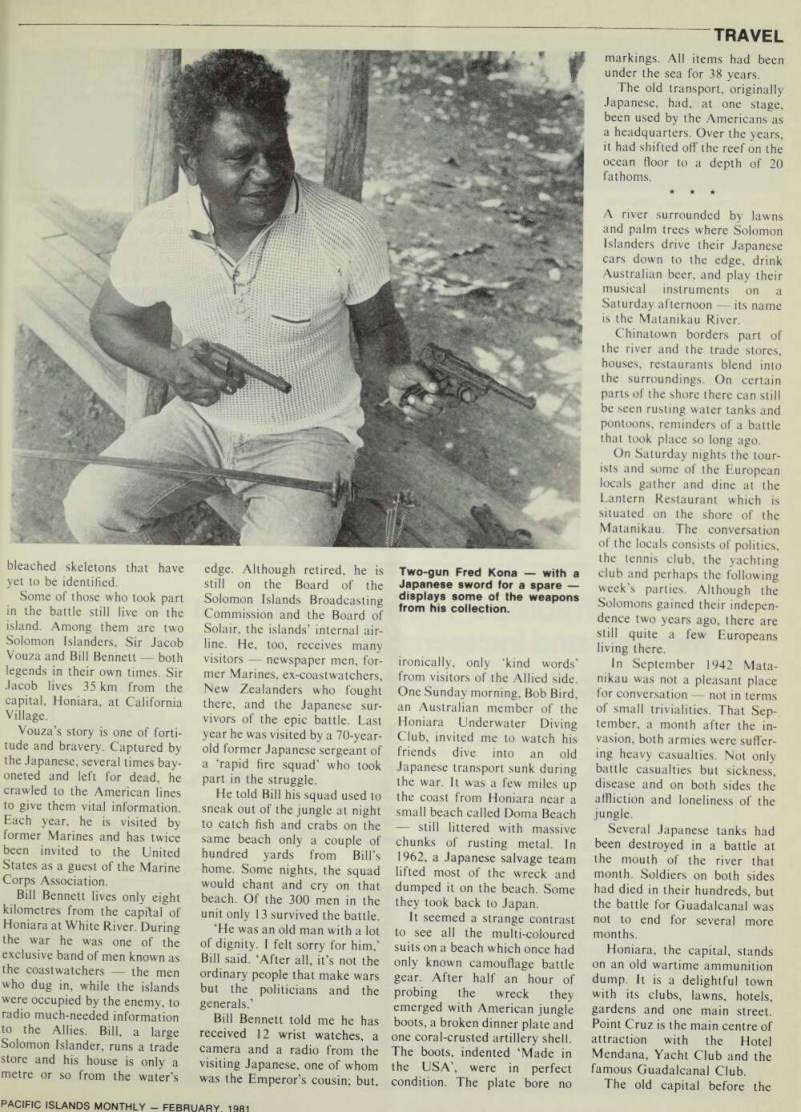
Two-gun Fred Kona with a Japanese sword for a spare displays some of the weapons from his collection.
war was Tulagi, 48 km across the water from the main island in the Florida group. A heavy battle had been fought there and the town was left in ruins.
The first small battle to be fought in the Solomons was not between the Japanese and the Americans, and it was not in this century.
Four centuries ago Alvaro de Mendana, a Spanish explorer, landed on the island and gave it the name Guadalcanal, after a small town in Spain. With muskets, spears, bows and ar rows a battle was fought on Point Cruz. As a result nine Spanish sailors and two Solomon Islanders were killed.
Twenty-four kilometres up the coast from Honiara is a war museum owned by a Malaitan called Fred Kona. Without a doubt it would be the most interesting and well run mu seum of its type in the South Pacific. Fred started the mu seum in 1970 without any aid from the government.
Some of the Japanese field guns and American aircraft were brought in from the jungle
by Fred Kona with local assist ance.
In his spare time he treks into the jungle and the ridges where the battles were fought and looks for the war relics from Tenaru Beach, Bloody Ridge, to Cape Esperance he has covered the whole battle area.
His visitors include many former Japanese and American servicemen who fought in the area. An American pilot who flew a Grumman Wildcat which is in his museum came back and relived his memories of the day he was shot down and bailed out. A Japanese officer who was in charge of three field guns near Cape Esperance saw the same guns in the museum, and did the same thing.
The museum abounds in mili tary history with helmets, rifles, pistols, artillery pieces, aircraft and tanks.
A little further on from the museum is Cape Esperance.
The gravel road passes along side plantations and runs close to the shoreline. Not far from the Cape, on a clear day Savo Island can be seen. Around this
area the American navy suffered one of their worst defeats in a naval encounter with the Japanese. Savo is a volcanic island and its people worship the shark.
Sixty kilometres by road from the Cape and 38 years later the main objective for the battle is still operational, Henderson Field. It was in those days from this field that American Lockheed Lightnings took off to ambush and kill in aerial combat the Combined Chief of the Japanese Naval
Forces, Admiral Isoroku Yamamoto. It was near here that Saburi Saki, Japan’s greatest air ace was wounded in combat. It was near here that the Japanese army during two nights of battle tried to retake Henderson Field. On the monu ment on Bloody Ridge it lists the casualties on both sides, and the date. But five words stand out more than any others: They came from the Jungle’.
There were hundreds of guns firing on those two nights, but in 1980 only Vincent use the gun!