books begins to flow
pp. 44-45 · Read in the full issue
Books
Vanuatu: The tide of books begins to flow
Vanuatu. Published by Insti tute of Pacific Studies, Univer sity of the South Pacific, and the South Pacific Social Sci ences Association. No price or ISBN given. Beyond Pande monium From the New Hebrides to Vanuatu, By Father Walter Lini. Published by Asia Pacific Books, PO Box 3978, Wellington, New Zealand, in association with the Institute of Pacific Studies, University of the South Pacific, Suva. 5NZ6.95 (hardback), $4.50 (softback). ISBN 0 908583 12 5 (hbkj, ISBN 0 908583 13 3 (sbk). The Coconut War The Crisis on Espiritu Santo By Richard Shears. Published by Cassell Australia. Price
5A6.95. Isbn 0 7269 7866 3.
Pacific buff's who index their libraries will need to make a new entry under ‘V’, for the predictable flood of books on the new nation of Vanuatu is now well underway.
Of the three books under review, Vanuatu was the first to be published. Already noticed briefly in PIM (Sep 1980 plO), the book is a series of 21 essays, mainly by leading Vanuatuans, on separate aspects of the country’s affairs. Lands Minis ter Selhy Regenvanu writes on the land problem. President Ati George Sokomanu writes on government, Grace Molisa writes on women, Mildred Sope writes on the people, Godwin Ligo writes on custom and culture, and so on.
As the book is printed in Bislama, French and English, and runs to fewer than 300 pages, some of the articles are necessarily fairly short. But they provide indispensable basic information for all who intend to follow closely the fate of the new republic as it strives to move forward following its painful and difficult accession to independence.
The book was prepared by a team at the University of the South Pacific at the express request of Father Walter Lini, prime minister of Vanuatu, ‘as part of our independence cel ebrations’. He says of the book in a foreword: ‘lt is as if it were the last chapter of our people’s struggle for independence in the last 10 years.’
All concerned with the proj ect are to be congratulated on a generous and wholehearted re sponse to Fr Lini’s request. The work amounts to a basic hand book that will serve interested inquirers for a long time to come.
Beyond Pandemonium From the New Hebrides to Vanuatu, is a slighter, but still valuable, exercise.
Its 63 pages contain a brief autobiography by Fr Lini (tran scribed by his sister Hilda from his dictation into a tape re corder), and, following each chapter, essays by other people amplifying the subject matter just dealt with by him.
This arrangement makes for rather jerky reading. But in
view of the fact that Fr Lini’s picture of his career is painted with an extremely broad brush understandable in a man who has been subject to the kinds of pressures he has suffered in recent times some means had to be found to depict matters in a little more detail.
A valuable aspect of the autobiographical section is the way it traces the origins of the National Party (later the Vanuaaku Party) in such bodies as the New Hebrides Cultural Association, founded by Fr Lini, and other present-day ministers such as Education Minister Donald Kalpokas.
Such an evolution from bodies designed to foster national cultural awareness to full-fledged political parties is to be seen in the growth of independence movements in many parts of the world.
The autobiography also re cords Fr Lini’s misgivings about aspects of his theological and other studies in New Zealand: ‘Towards the end of 1968 life in Auckland grew more and more frustrating for me because I felt that the Western ways and influence were almost over whelming me. I think I got away from New Zealand just in time,’ he says at one point. And again; T began to grow uneasy about the way New Zealanders and Pacific Islanders were forced to learn theology, ethical principles, and philosophies, ideas which were completely foreign to us. I felt that it was wrong for me to pursue my theological studies in this way.’
Here, clearly, one can see the genesis of Fr Lini’s ideas about the ‘Pacific Way’, which, how ever vaguely they may be defined, serve as one of the mainsprings of his activity. If he did not learn in Auckland just what was the ‘Pacific Way’, he obviously developed quite strong ideas about what it was not.
The book is valuable for another reason; it gathers together important historical documents, such as Fr Lini’s 1976 address to the United
Nations Committee of 24 in New York (on decolonisation), George Kalkoa’s speech ‘Devel opment the Pacific Way’, de livered at the ceremony at which he received his presiden tial title of Ati George Sokomanu, and Fr Lini’s July 30, 1980 Independence Day speech.
The two works just described may be regarded as semi-official Vanuatu documents, although of course formally they are not official government statements.
But they are close enough to being so for them occasionally to contain elements of the ‘triumphalism’ and the minimising of difficulties which seem to characterise the state ments of governments of every stripe, and wherever they may be.
The Coconut War The Crisis on Espiritu Santo, on the other hand, is thoroughly ‘unofficial’. English journalist Richard Shears was sent to the then New Hebrides in 1980 to cover the secessionist crisis on the island of Santo for the London Daily Mail. Although press presentations of his book have described it as a ‘light hearted, tongue-in-cheek’ ac count of the events, Shears in fact has done quite a bit of homework and his book con tains useful background on the history of Vanuatu from the days of Pedro Fernandez de Quiros and his ill-fated ‘New Jerusalem’ settlement on Santo in 1606, through the condo minium period, up to the pres ent day.
His account of the secession ist crisis is pretty ‘straight’, and includes accounts of his several interviews with Jimmy Stevens at Fanafo. But with one exception it adds little to what has already been pub lished. Its chief service from this point of view is that it pulls together, in thoroughly read able form, a story which until now has been accessible only in
newspaper files scattered across the globe.
The one criticism this re viewer would make of Shears’ account of the events is that he grossly under-estimates the seriousness of the incidents at the British Paddock during the Vemarana take-over at the end of May. Unless these acts of looting and violence on the part of Vemarana supporters are given due weight, certain sub sequent events, notably the viol ent reprisal actions of Vanuatu police against Vemarana people, simply cannot be under stood.
The ‘exception’, in which Shears (for me at least) definitely breaks new ground, is in his intriguing suggestion that the Australian Derek Hodding, known popularly as ‘Lord Paw Paw’ for his broadcasting activi ties on the Vemarana radio, may in fact have been a secret agent working for the Aust ralian Security Intelligence Or ganisation. If true, this would add a rare touch of piquancy to the story of the Santo secession.
Shears excels when writing about the physical difficulties faced by media representatives *vho decided to run the govern ment blockade to get to and rom Santo during the rebellion.
His opening chapter about a
crossing from Santo to
Malakula in the boat Kombito in filthy weather is a small
masterpiece of writing about
seafaring experience.
The account of a rough trip to Santo on the motor yacht Armagnac is also memorable.
Shears writes:
How the cook had managed was a mystery, but in he came from the galley bearing an aluminium dish full of sliced roast beef. He crashed it down on the table and returned with a large dish of peas, giggling as he staggered with the movement of the yacht. We all quickly agreed that when you are in a boat which is rolling alarmingly you do not put a plate of peas on the dining table. We lost most before we could get a spoon in them. Then (John) Lombard (of Agence France Presse), sitting opposite, col lected the entire contents of my plate gravy, peas, roast potatoes, beef and onions on his lap. He scooped my lunch back on the plate, and I was about to try a mouthful when 1 found my lap on the receiving end of his lunch. It was impossible. Lombard had also turned a ghastly green and beads of sweat ran down his face. ‘Are you all right, John?’ ‘Will be ... if I can eat . . . got to . . . get some food . . . down . . . need something solid ... in the stomach . . .’
He stabbed his fork at a roast potato and was about to consume it when we rolled violently, and the entire contents of the table landed on his lap again. He sat back in green surrender.
There are one major and two
minor niggles I’d like to have
about thjs book before I tune
out. The major one concerns the
fact that Shears has caught the
bad French habit of referring to
the Papua New Guinean
soldiers who put down the
secession simply as ‘Papuans’.
Now anyone with the smallest
understanding of Papua New
Guinea’s history could have
told him how sensitive an issue this is. To refer to a Papuan as
a Papuan is OK, and to a New Guinean as a New Guinean but it must be done with the knowledge that the individuals concerned do in fact hail from these two regions of the country. But to lump all Papua New Guineans together as ‘Papuans’, wherever they come from, is simply insensitive and wrong. This mistake will do Shears’ work no good in Papua New Guinea which, one would have thought, would be a major market for it, in view of local interest in events in Vanuatu.
The minor niggles are that
French Inspector-General Jean- Jacques Robert is referred to throughout as ‘Jacques Robert’, and that Shears apparently believes that the word ‘cache’ calls for an acute accent on the ‘e’. It doesn’t.
But the biggest niggle of all remains: It is that the book is not a serious analysis of the various local and international forces involved in the Santo crisis. Such a study awaits an author not in so much of a hurry as Shears.
Malcolm Salmon.
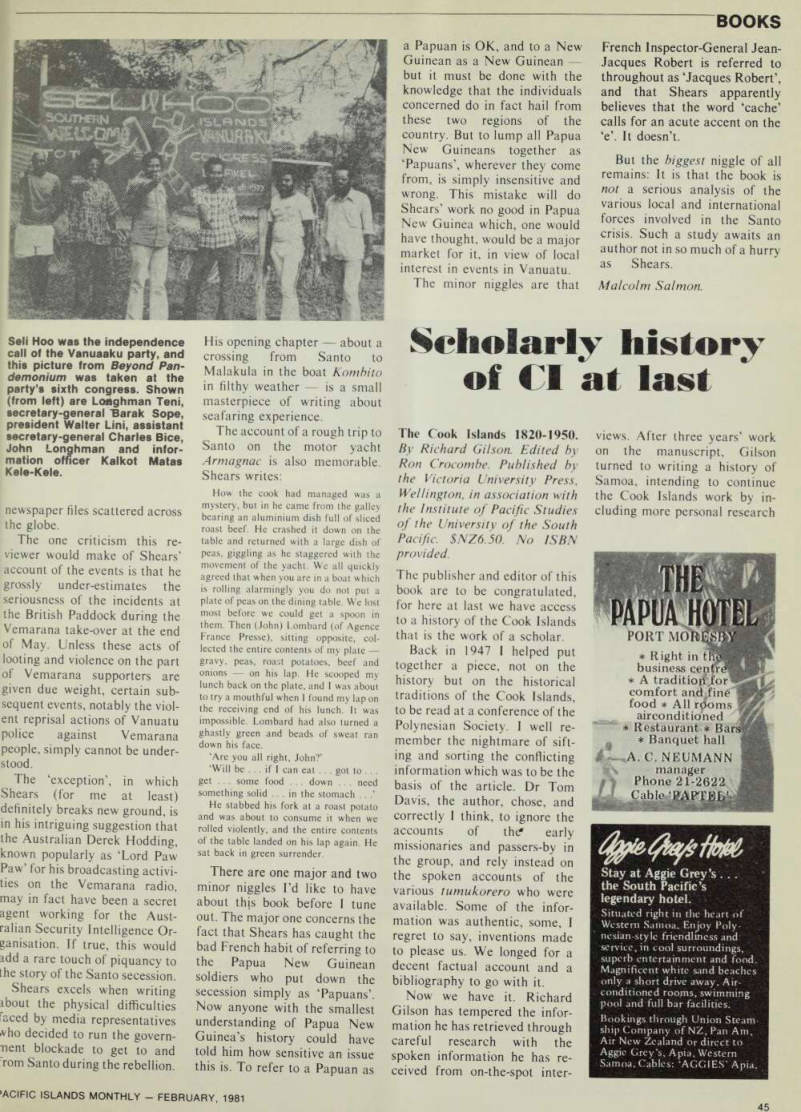
Sell Hoo was the independence call of the Vanuaaku party, and this picture from Beyond Pan demonium was taken at the party’s sixth congress. Shown (from left) are Longhman Teni, secretary-general Barak Sope, president Walter Lini, assistant secretary-general Charles Bice, John Longhman and infor mation officer Kalkot Matas Kele-Kele.