a-building
pp. 25-29 · Read in the full issue
Tropicalities
Giant Maori canoe is a-building
After the Hokule’a and her eventful 1976 Hawaii-Tahiti journey, it is the turn of the Maoris of New Zealand to essay a voyage in a traditional craft using only the means available to their far-wandering ances tors.
A group of carvers have been at work for more than a year at Pahiatua in New Zealand’s lower North Island shaping two 700-year-old totara trees into hulls. In its finished form the vessel they are making with enormous care and the most scrupulous respect for tradition will be a giant, double-hulled ocean-going canoe. Its carved 20 m hulls will be joined by 14 beams and a platform measur ing 12 mby4 m. Above the two 1.3 m deep hulls, two large masts and sails will rear up high towards the sky.
Aim of all this activity is to re-enact the kind of voyage which first brought the Maoris to New Zealand 1000 and more years ago: the plan is to sail the :anoe from New Zealand’s east -oast early next year bound for Tahiti, and returning to New Zealand by way of Rarotonga, "ook Islands. The pride and ;xcitement of the carvers and ill others involved in the project ire understandable: it is 600 'ears since such a canoe was milt and sailed.
The chief carver, Fred -lamp, expects most of the /ork to be finished soon. Then he builders will hold sea trials, nd a circumnavigation of New Zealand is planned before the )ig voyage’ is undertaken.
In a January Sydney Morn -7g Herald report, journalist hristopher Chalke reveals that icre will be a direct link etween the voyage of the (as et unnamed) Maori canoe and le Hokule’a venture.
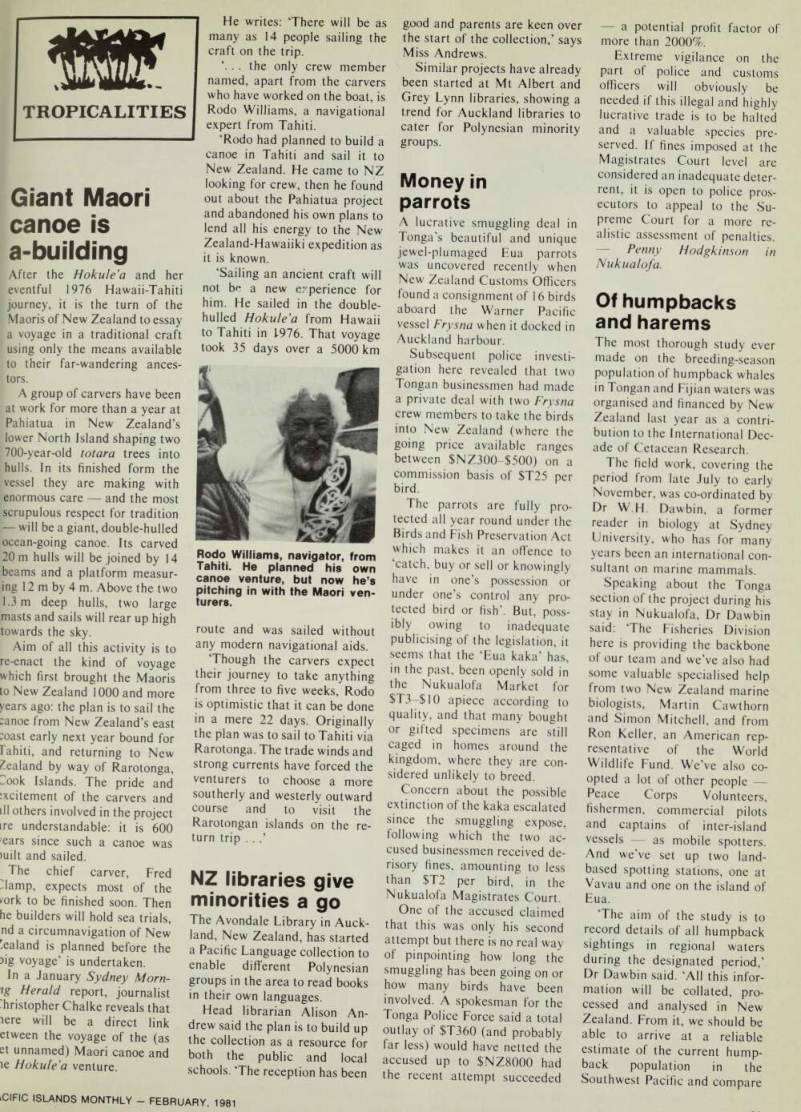
He writes: There will be as many as 14 people sailing the craft on the trip. ‘. . . the only crew member named, apart from the carvers who have worked on the boat, is Rodo Williams, a navigational expert from Tahiti. ‘Rodo had planned to build a canoe in Tahiti and sail it to New Zealand. He came to NZ looking for crew, then he found out about the Pahiatua project and abandoned his own plans to lend all his energy to the New Zealand-Hawaiiki expedition as it is known. ‘Sailing an ancient craft will not be a new experience for him. He sailed in the double hulled Hokule’a from Hawaii to Tahiti in 1976. That voyage took 35 days over a 5000 km
route and was sailed without any modern navigational aids. ‘Though the carvers expect their journey to take anything from three to five weeks, Rodo is optimistic that it can be done in a mere 22 days. Originally the plan was to sail to Tahiti via Rarotonga. The trade winds and strong currents have forced the venturers to choose a more southerly and westerly outward course and to visit the Rarotongan islands on the re turn trip . . .’
NZ libraries give
minorities a go
The Avondale Library in Auck land, New Zealand, has started a Pacific Language collection to enable different Polynesian groups in the area to read books in their own languages.
Head librarian Alison An drew said the plan is to build up the collection as a resource for both the public and local schools. ‘The reception has been
good and parents are keen over the start of the collection,’ says Miss Andrews.
Similar projects have already been started at Mt Albert and Grey Lynn libraries, showing a trend for Auckland libraries to cater for Polynesian minority groups.
Money in
parrots
A lucrative smuggling deal in Tonga’s beautiful and unique jewel-plumaged Eua parrots was uncovered recently when New Zealand Customs Officers found a consignment of 16 birds aboard the Warner Pacific vessel Frysna when it docked in Auckland harbour.
Subsequent police investi gation here revealed that two Tongan businessmen had made a private deal with two Frysna crew members to take the birds into New Zealand (where the going price available ranges between $NZ300-$500) on a commission basis of $T25 per bird.
The parrots are fully pro tected all year round under the Birds and Fish Preservation Act which makes it an offence to catch, buy or sell or knowingly have in one’s possession or under one’s control any pro tected bird or fish’. But, poss ibly owing to inadequate publicising of the legislation, it seems that the ‘Eua kaka’ has, in the past, been openly sold in the Nukualofa Market for $T3-$10 apiece according to quality, and that many bought or gifted specimens are still caged in homes around the kingdom, where they are con sidered unlikely to breed.
Concern about the possible extinction of the kaka escalated since the smuggling expose, following which the two ac cused businessmen received de risory fines, amounting to less than $T2 per bird, in the Nukualofa Magistrates Court.
One of the accused claimed that this was only his second attempt but there is no real way of pinpointing how long the smuggling has been going on or how many birds have been involved. A spokesman for the Tonga Police Force said a total outlay of $T360 (and probably far less) would have netted the accused up to $NZ8000 had the recent attempt succeeded
-a potential profit factor of more than 2000%.
Extreme vigilance on the part of police and customs officers will obviously be needed if this illegal and highly lucrative trade is to be halted and a valuable species pre served. If fines imposed at the Magistrates Court level are considered an inadequate deter rent, it is open to police pros ecutors to appeal to the Su preme Court for a more re alistic assessment of penalties.
Penny Hodgkinson in Nukualofa.
Of humpbacks
and harems
The most thorough study ever made on the breeding-season population of humpback whales in Tongan and Fijian waters was organised and financed by New Zealand last year as a contri bution to the International Dec ade of Cetacean Research.
The field work, covering the period from late July to early November, was co-ordinated by Dr W.H. Dawbin, a former reader in biology at Sydney University, who has for many years been an international con sultant on marine mammals.
Speaking about the Tonga section of the project during his stay in Nukualofa, Dr Dawbin said: The Fisheries Division here is providing the backbone of our team and we’ve also had some valuable specialised help from two New Zealand marine biologists, Martin Cawthorn and Simon Mitchell, and from Ron Keller, an American rep resentative of the World Wildlife Fund. We’ve also co opted a lot of other people Peace Corps Volunteers, fishermen, commercial pilots and captains of inter-island vessels as mobile spotters.
And we’ve set up two land based spotting stations, one at Vavau and one on the island of Eua. ‘The aim of the study is to record details of all humpback sightings in regional waters during the designated period,’
Dr Dawbin said. ‘All this infor mation will be collated, pro cessed and analysed in New Zealand. From it, we should be able to arrive at a reliable estimate of the current hump back population in the Southwest Pacific and compare
Rodo Williams, navigator, from Tahiti. He planned his own canoe venture, but now he’s pitching in with the Maori ven turers.
it with the figures recorded in the early 19505.’
Dr Dawbin said the whales migrate from Antarctica in ‘harem groups’ a bull ac companied by females and im mature males and begin appearing in regional waters late in July, so that the year’s crop of five-metre long ‘babies’ can be delivered in warmer latitudes. Calf sightings usually begin in September but last year a sighting was reported in late July a most unusual event.
Between 1950 and 1963, the : year when International Whal ing Commission signatories im posed worldwide protection, some 15 000 humpbacks were caught in the West Pacific-to- Antarctica area, and for years it was feared that the population had declined beyond the point of no return. ‘We’ll have a clearer picture when the analysis has been done,’ Dr Dawbin said, ‘but our results to date indicate that the numbers are still greatly de pleted compared with the 1950 level.’
During his first visit to Tonga in 1952, Dr Dawbin sighted between 10 and 12 whales a day off Haapai and Tongatapu. On charter flights during the pres ent study he counted himself lucky to spot three a day, usually in the vicinity of Haapai.
He congratulates the Tongan Government on the moratorium imposed since 1978 and de scribes it as ‘important, even though the numbers involved were small’.
Because Tongans had been limited to their equipment 'hand-held harpoons and small 3pen boats) they had tended to for mothers with calves, and, n a diminishing species strug gling for survival, the protection
)f breeding-age females and
heir progeny was of the utmost mportance.
The humpbacks have a ifespan of up to 50 years, left inmolested. They grow up to 3.5 m in length, measure iround 4.8 m across the tail lukes, and weigh up to 55 onnes. They are believed to )ecome sexually mature be ween the ages of eight and 12 'ears, and the observed ratio of alves to females indicates that
pregnancy occurs once in three years. The gestation period is 10 months and weaning takes place in the tenth or eleventh month of life.
Tagging programmes show that migration takes place mainly in the Pacific area bounded by the east coasts of Australia and New Zealand, Antarctica, Tonga and Fiji; but occasional instances have been recorded in which whales tagged in this area have been later sighted in Antarctic waters south of South America.
Recent population studies in the Indian Ocean, off the coast of Western Australia, revealed a significant increase in hump back population after years of severe depletion. This gives rise to hope that the numbers in the West Pacific will similarly in crease given time and continued protection of the species.
It is doubtful, however, that the original ecological balance will ever be fully restored.
Decimation over decades of the humpback population led to enormous increases in the seal and penguin population in the Antarctic. This means there is now three-way competition for the supply of krill, the small shrimps on which all these species heavily depend as a food-source.
The report prepared by New Zealand following the 1980 study will be distributed inter nationally for the information of scientific and conservation or ganisations. Penny Hodgkinson in Nukualofa.
Wendt for big
TV series?
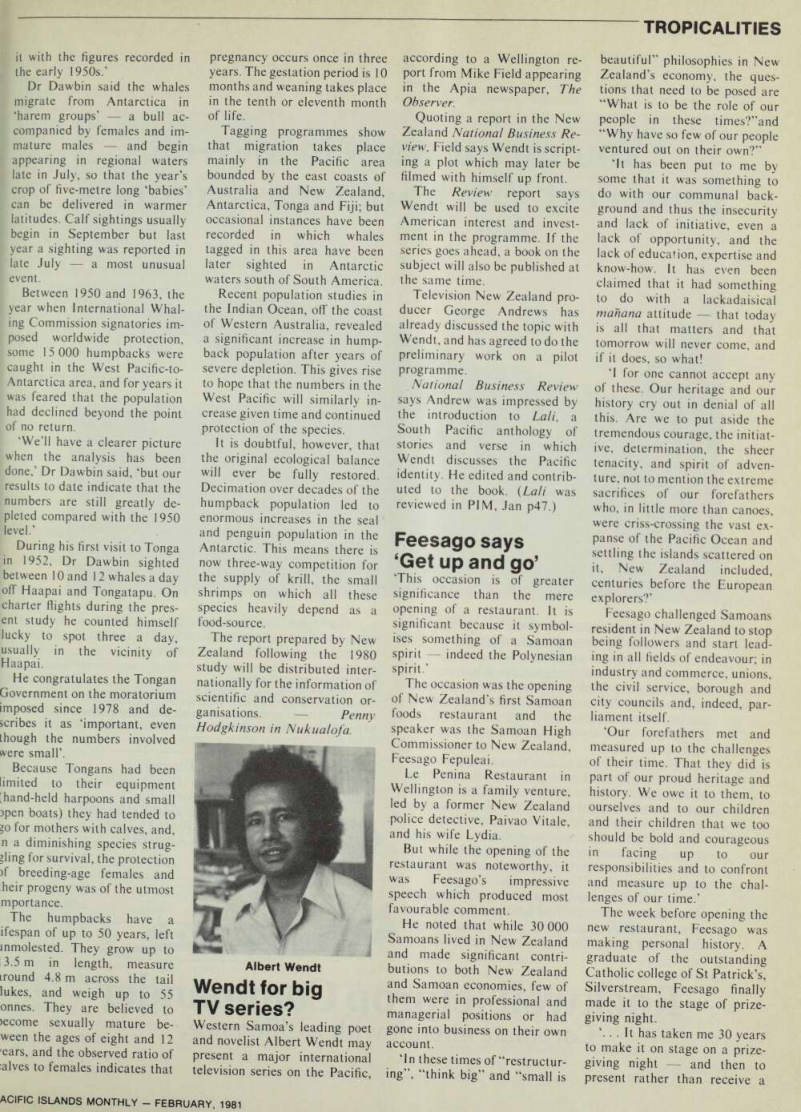
Western Samoa’s leading poet and novelist Albert Wendt may present a major international television series on the Pacific,
according to a Wellington re port from Mike Field appearing in the Apia newspaper, The Observer.
Quoting a report in the New Zealand National Business Re view, Field says Wendt is script ing a plot which may later be filmed with himself up front.
The Review report says Wendt will be used to excite American interest and invest ment in the programme. If the series goes ahead, a book on the subject will also be published at the same time.
Television New Zealand pro ducer George Andrews has already discussed the topic with Wendt, and has agreed to do the preliminary work on a pilot programme.
National Business Review says Andrew was impressed by the introduction to Lali, a South Pacific anthology of stories and verse in which Wendt discusses the Pacific identity. He edited and contrib uted to the book. ( Lali was reviewed in PIM, Jan p 47.)
Feesago says
‘Get up and go’
This occasion is of greater significance than the mere opening of a restaurant. It is significant because it symbol ises something of a Samoan spirit indeed the Polynesian spirit.’
The occasion was the opening of New Zealand’s first Samoan foods restaurant and the speaker was the Samoan High Commissioner to New Zealand, Feesago Fepuleai.
Le Penina Restaurant in Wellington is a family venture, led by a former New Zealand police detective, Paivao Vitale, and his wife Lydia.
But while the opening of the restaurant was noteworthy, it was Feesago’s impressive speech which produced most favourable comment.
He noted that while 30 000 Samoans lived in New Zealand and made significant contri butions to both New Zealand and Samoan economies, few of them were in professional and managerial positions or had gone into business on their own account. ‘ln these times of “restructur ing”, “think big” and “small is
beautiful” philosophies in New Zealand’s economy, the ques tions that need to be posed are “What is to be the role of our people in these times?”and “Why have so few of our people ventured out on their own?” ‘lt has been put to me by some that it was something to do with our communal back ground and thus the insecurity and lack of initiative, even a lack of opportunity, and the lack of education, expertise and know-how. It has even been claimed that it had something to do with a lackadaisical mahana attitude that today is all that matters and that tomorrow will never come, and if it does, so what! ‘I for one cannot accept any of these. Our heritage and our history cry out in denial of all this. Are we to put aside the tremendous courage, the initiat ive, determination, the sheer tenacity, and spirit of adven ture, not to mention the extreme sacrifices of our forefathers who, in little more than canoes, were criss-crossing the vast ex panse of the Pacific Ocean and settling the islands scattered on it. New Zealand included, centuries before the European explorers?’
Feesago challenged Samoans resident in New Zealand to stop being followers and start lead ing in all fields of endeavour; in industry and commerce, unions, the civil service, borough and city councils and, indeed, par liament itself. ‘Our forefathers met and measured up to the challenges of their time. That they did is part of our proud heritage and history. We owe it to them, to ourselves and to our children and their children that we too should be bold and courageous in facing up to our responsibilities and to confront and measure up to the chal lenges of our time.’
The week before opening the new restaurant, Feesago was making personal history. A graduate of the outstanding Catholic college of St Patrick’s,
Silverstream, Feesago finally
made it to the stage of prize giving night.
It has taken me 30 years to make it on stage on a prize giving night and then to present rather than receive a
Albert Wendt
prize. So much for my Silverstream academic achieve ments.’
Feesago, who was formerly the Clerk of the Legislative Assembly in Apia, is only one of a large number of Pacific old boys from St Patrick’s. His boss, Samoa’s Prime Minister Tupuola Efi, was also educated there. ‘ln its 50 years, Silverstream has already made a consider able impact throughout New Zealand and the South Pacific,’ said Feesago, commenting on the widespread involvement of Silverstream old boys in Pacific missionary fields, as well as in government and commerce.
Michael Field in Wellington.
N-test move by
victim’s daughter
A new foundation has been established in Denmark; The Copenhagen Foundation Against Nuclear Tests, whose purpose is to support and in itiate • dissemination of infor mation about nuclear tests, • investigations of their consequences for man and the environment, • campaigns for the abol ition of all nuclear tests.
A statement issued by the foundation said: ‘Nuclear tests are an important prerequisite of the nuclear arms race in the world. They are preparation for nuclear war. They are a threat to the environment and particu larly to the basis of life of the populations living near the test zones. ‘The foundation is now com posing an international panel dready counting Owen Wilkes, 3eace researcher from New Zealand, the former UN High commissioner for Refugees 3 rince Sadruddin Aga Khan, low president of the Bellerive jroup in Geneva who has varned against the dissemi lation of plutonium in the vorld, Bengt and Marie- Pherese Danielsson, authors of Moruroa, mon amour”, the Norwegian peace researcher ohan Galtung, and the inter ational editor of the American Bulletin of Atomic Scientists”
Valter C. Patterson. ‘The Danish board of the zmndation is composed of
Martine Petrod (founder), Kirsten Bruun, co-editor of the magazine “Forsvar” (Defence), Bent Sorensen, professor of physics, Ove Nathan, professor of physics and member of the Royal Danish Academy, and Jens Bilgrav-Nielsen, member of parliament for the centre party Det Radikal Venstre.
The Foundation’s initial capital consists of a sum paid by the French nuclear authorities as a kind of insurance policy when one of their employees (the father of founder Martine Petrod), who had taken part in the French nuclear tests in Polynesia, died recently.
The first activity of the foundation will be to inform public opinion about the French nuclear tests. They are carried out in French Polynesia, a colony, that has no represen tation of its own in international organs, and therefore particu larly needs international help. ‘Further information about the foundation can be obtained from Martine Petrod, S 0 Ivgade 86 st.th., DK-1307 Copenhagen K.’
Chan says ‘We’re
best mapped’
Papua New Guinea’s Prime Minister Sir Julius Chan last year described PNG as one of the best mapped developing countries in the world. He made the comment at a ceremony to mark the completion of the primary mapping of the nation by the Royal Australian Survey Corps.
Australian High Com missioner Gerry Nutter pres ented the prime minister with a bound, three volume set of the 180 maps which comprise the series, at a scale of one to 100 000.
Sir Julius told guests that the full value of the work per formed by the men of the survey corps was ‘immense’. He said good maps were a basic necessity for economic and social development. They were essential, for example, for the planning of agricultural, timber and mining projects, communi cation networks and transport systems.
Sir Julius said they had already been used to determine the Torres Strait boundary, the
Papua New Guinea/Indonesia Border Arrangements Agree ment and at the recent PNG/ Indonesia Maritime Boundary Talks. In future, the maps would help in the fixing of the boundary with the United States Trust Territory of the Pacific Islands and the median line boundary with Solomon Islands. They would also be used as the basis for redefining provincial boundaries.
The primary mapping task began at a relatively low level in 1954. Progress accelerated from late 1971 when the Aust ralian Army raised the 8 Field Survey Squadron at Popondetta under the command of Lt- Colonel Alexander Laing. The Royal Australian Air Force made a significant contribution to the project through its Oper ation ‘Skai Piksa’ between 1972 and 1975. RAAF aircraft were used to undertake high altitude aerial photography required by the cartographers.
Work is continuing in Aust ralia on a derived mapping programme to produce, from the primary coverage, ad ditional maps and aeronautical charts at scales of 1:250 000, 1:500 000 and 1:1 000 000.
The figurine in
the toolbox
One of only 11 known examples of carved ivory Tongan goddess figurines has turned up in a 19th century carpenter’s toolbox at Levuka, Fiji.
The carving, described by the Fiji Museum as ‘an exceptional rarity,’ dates from the 18th or 19th century and has been given to the museum by Mrs Regina Patterson, of Levuka, and her family.
Most of the other carvings were collected in Tonga by Captain James Cook 200 years ago and are in museums in Britain, America, New Zealand and Austria.
The museum’s 97 mm high acquisition has lost an arm and is damaged in other parts.
But the museum’s director, Fergus Clunie, writing in Fiji Heritage, describes the figurine as a ‘tremendous boost’ for its collection.
Her history is not known.
Only Mr Patterson, who died recently, would have known
how she came to be in the tool box, Mr Clunie says.
But she was carved from a whale’s tooth and in Tonga was probably kept as a fetish in the temple of a particular goddess.
Other figurines like her col lected in Fiji foreign mu seums were most likely traded in from Tonga or perhaps made in Fiji by canoe-builders from Haapai.
Mr Clunie says that accord ing to one of Fiji’s former governors, Sir Arthur Gordon, Fijians held such carvings in great superstitious awe, and were believed to be possessed by Fijian goddesses after they got to Fiji.
The ‘little Levuka lady’ says Mr Clunie, ‘probably was once possessed in a similar manner to the rather sinister Nalilavatu, (a very dangerous goddess of the Nadi area), losing her personality when her parents or priests abandoned the old re ligion’.
They’ll feast
with Falcam
The annual Ponape traditional feast to be hosted by Governor Leo A. Falcam and Mrs Falcam for all the Ponape Nanmwarkis (Chiefs) is scheduled for Feb ruary 28, 1981, at the Ponape Nahs (Community House) at 10 am in Kolonia, according to a December 1980 an nouncement by Mr Falcam.
The governor said that he has to do it because of his tra ditional title as Luhk Ponape, bestowed upon him by the five top traditional chiefs of Ponape. ‘lt is part of my responsibility as the bearer of this title,’ he said.
He went on to stress that he would like to have all traditional leaders assembled at the feast to discuss current issues.
A formal invitation had already been extended to the Nanmwarki of Net at Palias when Luhk Ponape (Mr Falcam) was attending a tra ditional feast there.
Mr Falcam said that invi tations to other Nanmwarkis would also be offered.
He concluded by saying that the invitation was also open to all the people of Ponape who could find time to attend the feast. ‘They will be most wel come,’ he said.