Intending canoe
pp. 48-49 · Read in the full issue
A 'must' for Intending canoe voyagers
Taratai II: A Continuing Pa cific Adventure. By James Siers. Published by Millwood Press, Wellington, New Zealand. ISBN 0 908582 28 5. $A 14.50.
This is very much a follow-up of the same author’s Taratai , which dealt with a previous voyage in a giant outrigger canoe, or baurua , built in Kiribati. Taratai II was built in Fiji for the author, to more modern plans and of modern materials, such as an extruded metal mast, and plywood and fibreglass. However this book is the mixture as before, teem
ing with glossy photographs
and maps, with a well-written text, which deals largely with personalities and the ports of call.
It is a tale of misadventures
really, for the design was faulty
in many regards, and had to be altered before the vessel got away from Fiji. The mast had bent too badly in a squall and had to be replaced by a lamina ted one made from Fijian hardwoods. The outrigger float was too high and had to have its struts shortened, and the
fibreglass split along the keel
and had to be replaced. The
giant hardwood steering oars
broke, and later in the voyage the wooden mast broke.
All these calamities appeared to stem from the vessel being driven too hard in
rough weather, apparently in
an effort to get to the next des
tination. Finally, the outrigger
booms broke and the hull lay on its side, presumably having no ballast to keep it upright without the outrigger, and was abondoned about 320 km east of Niue Island. This was per haps one of the gravest mis takes of the whole unfortunate adventure, as the hull found its way back to Fiji three months later, drifting ashore at Rabi Island, while the outrigger float landed at Gamea Island.
The author gives very few navigational details, nor much information about the object of the voyage, which was to sail to Rarotonga and thence all the way to New Zealand, the author’s homeland, to prove the ability of the ancient canoes of Polynesia to sail eastwards
against the prevailing winds.
The crew, including the author, consisted of six men and the author’s 10-year-old son, Conrad, obviously named after Joseph Conrad, the famous Pole who became a captain of British sailing ships, and then a famous author. Half the six men were Europeans, the others natives of Kiribati, Fiji and Tonga. There was a lot of
ill-feeling during the early part
of the voyage, mainly caused
by unsuitability and inef
ficiency, but this was largely overcome by some of the men leaving the expedition and bet ter men joining. There were some really hard workers with hearts of oak, and it was largely due to their strength of purpose that the adventure ended with out loss of life.
Being a continuing story
from the first book, the reader would have to refer back to it for a description of how Tara tai II was built, as the present book gives no plan of Taratai //, but begins with her sea trials and the initial disasters for the five weeks prior to the start of the real voyage, which began on June 29, 1977.
After six days at sea they reached Tonga, where there were some crew changes. After 17 days there they set forth for Niue, which took another six days. Leaving Niue on August 3 they headed eastwards for Rarotonga in heavy weather, the wooden mast broke, and was repaired. On the night of August 8, while driving hard for Rarotonga, the outrigger booms broke, and it was de cided to abandon the hull and all hands got into the rubber
' life raft with what water, food and necessities could be car [ ried. The raft was fitted with a ■ canopy, which kept out most of the waves, but the rubber floor ing developed holes which had to be stopped with makeshift plugs.
They had a radio distress beacon, with which they hoped to attract the notice of any air craft calling at Niue. The wind and currents took them west wards, but just north of Niue, and they were about I6okm north-west of the island when
they were most providentially
sighted at night by a passing
Chilean vessel, which landed them next day at Niue.
Since leaving Fiji they had spent 17 days at sea in Taratai 11, 14 days in the raft, and 23 days in port, having travelled perhaps 2000 km. There will doubtless be further adventures for the author, in large canoes from either Fiji or Kiribati. He was born in Poland in 1936, but left there at the start of World War II and eventually got to New Zealand, where he had his schooling. He is a fine photographer and author, and very honest about all the troubles and calamities which have marred his voy ages. He also publishes his own books, doing a very fine job of it, and even if he is not a boat builder or a navigator, nor ap parently a good seaman, he does write a very good book, which should be compulsory
reading for any intending
canoe-voyagers of the future. -
Brett Milder.
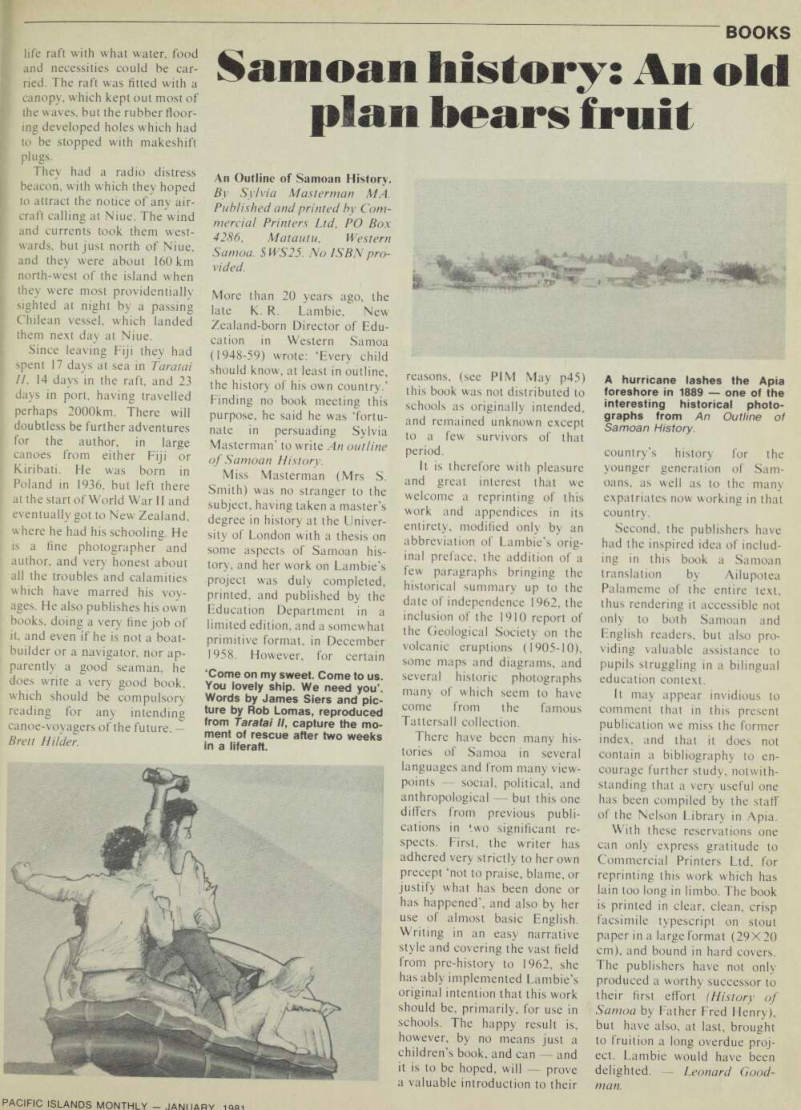
‘Come on my sweet. Come to us.
You lovely ship. We need you’.
Words by James Siers and pic ture by Rob Lomas, reproduced from Taratai II, capture the mo ment of rescue after two weeks in a liferaft.