Islanders' own gong
p. 47 · Read in the full issue
sounds at last
Lali: A Pacific Anthology. Edited and with an introduction by Albert Wendt. Published by Longman Paul, Box 4019, Auckland, New Zealand.
5Nz28.95. Isbn 0 582 717728.
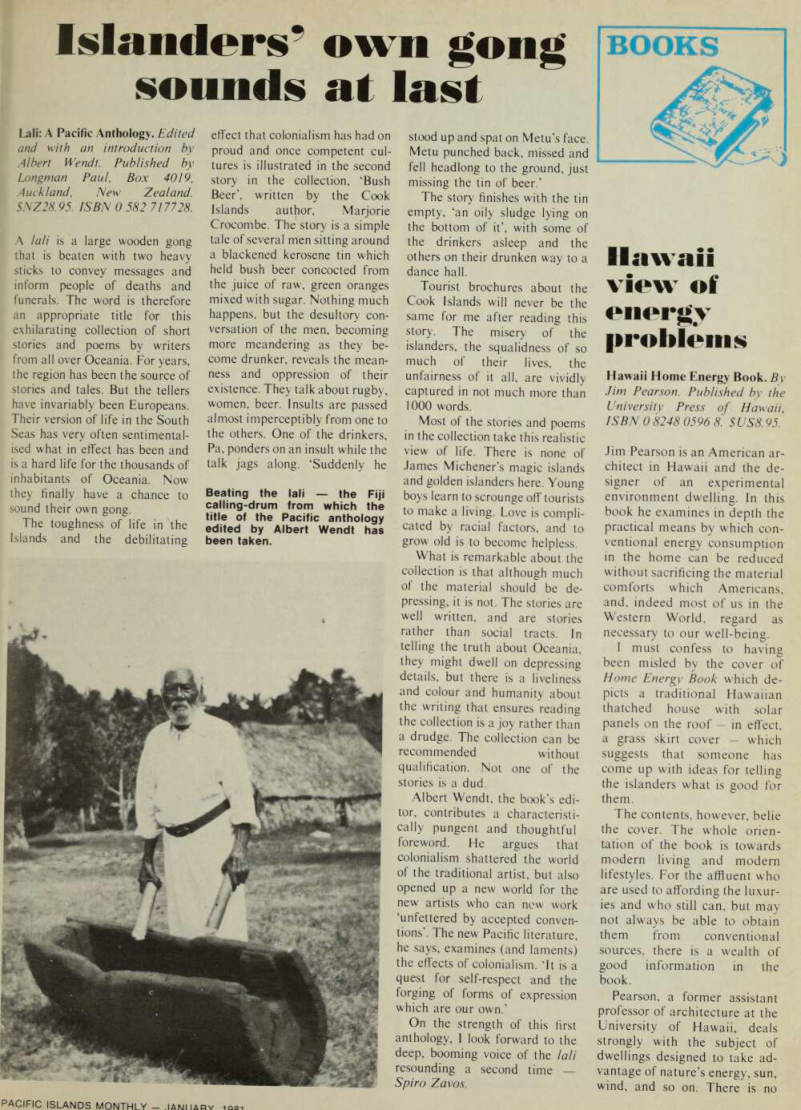
A lali is a large wooden gong that is beaten with two heavy sticks to convey messages and inform people of deaths and funerals. The word is therefore an appropriate title for this exhilarating collection of short stories and poems by writers from all over Oceania. For years, the region has been the source of stories and tales. But the tellers have invariably been Europeans.
Their version of life in the South Seas has very often sentimental ised what in effect has been and is a hard life for the thousands of inhabitants of Oceania. Now they finally have a chance to sound their own gong.
The toughness of life in the Islands and the debilitating
effect that colonialism has had on proud and once competent cul tures is illustrated in the second story in the collection, ‘Bush Beer’, written by the Cook Islands author, Marjorie Crocombe. The story is a simple tale of several men sitting around a blackened kerosene tin which held bush beer concocted from the juice of raw, green oranges mixed with sugar. Nothing much happens, but the desultory con versation of the men, becoming more meandering as they be come drunker, reveals the mean ness and oppression of their existence. They talk about rugby, women, beer. Insults are passed almost imperceptibly from one to the others. One of the drinkers.
Pa, ponders on an insult while the talk jags along. ‘Suddenly he
stood up and spat on Metu’s face.
Metu punched back, missed and fell headlong to the ground, just missing the tin of beer.’
The story finishes with the tin empty, ‘an oily sludge lying on the bottom of it’, with some of the drinkers asleep and the others on their drunken way to a dance hall.
Tourist brochures about the Cook Islands will never be the same for me after reading this story. The misery of the islanders, the squalidness of so much of their lives, the unfairness of it all, are vividly captured in not much more than 1000 words.
Most of the stories and poems in the collection take this realistic view of life. There is none of James Michener’s magic islands and golden islanders here. Young boys learn to scrounge off tourists to make a living. Love is compli cated by racial factors, and to grow old is to become helpless.
What is remarkable about the collection is that although much of the material should be de pressing, it is not. The stories are well written, and are stories rather than social tracts. In telling the truth about Oceania, they might dwell on depressing details, but there is a liveliness and colour and humanity about the writing that ensures reading the collection is a joy rather than a drudge. The collection can be recommended without qualification. Not one of the stories is a dud.
Albert Wendt, the book’s edi tor, contributes a characteristi cally pungent and thoughtful foreword. He argues that colonialism shattered the world of the traditional artist, but also opened up a new world for the new artists who can new work ‘unfettered by accepted conven tions’. The new Pacific literature, he says, examines (and laments) the effects of colonialism. ‘lt is a quest for self-respect and the forging of forms of expression which are our own.’
On the strength of this first anthology, I look forward to the deep, booming voice of the lali resounding a second time Spiro Zavos.
Beating the lali - the Fiji
calling-drum from which the title of the Pacific anthology edited by Albert Wendt has been taken.