style
pp. 33-39 · Read in the full issue
Tropicalities
uncertainly over the future control of the group, and then due to inaction by the French authorities whose resident set tlers were disadvantaged by the new convention’s more strin gent provisions in relation to the hiring of islander labour and the use of native lands.
All this worked fatally to the disadvantage of one isolated British settler, Clapcolts. The islanders on Santo were led in their revolt by a cargo cult-type figure who was variously re ferred to as a ‘prophet’ and who proclaimed himself the ‘Wiz ard’. Initially, he promised the islanders that for a certain consideration (not mentioned) he would raise all the natives’ dead. This he failed to do on several fixed dales.
To quote Wallace: ‘Then he said he could not do it till the whites were driven out and killed off.' He gave the order for Clapcolts’ murder ‘which was promptly carried out’. The act was not discovered for a week presumably when the government yacht arrived. The sight and smell must indeed have been unpleasant. Despite the natural decomposition that would have set in, the corre spondence goes on to record the grisly fact the ‘some of the body was eaten’.
The date of the routine ar rival of the Condominium authorities proved fortunate for the well-being of another European on Santo, a Mr Watson, for it was the date set by the Wizard for his murder.
The authorities successfully apprehended the leading offenders and returned them to Vila. ‘lf these men had not been caught,’ concluded Wallace, ‘it is certain that all whites would have had to leave Santo’, for the Wizard’s promise was that when all the whites were re moved and the dead natives raised, the natives would repos sess Santo forever.
The Wizard and his col leagues were unlucky to face an unusually speedy trial at Port- Vila. The Joint British-French Court in the usual Condo minium style had only recon vened in the previous June after three years in adjournment, and the new Native Court, before which they would have been tried, only came into operation on September 1 (with power from July 1), a few days after
Revolt on
Santo, 1923
style
‘We all think it is a great pity a warship small or large does not show the flag thro' the group once a year. It is possible. There is no doubt of its good effect.’
So wrote Frank Wallace, the Commonwealth legal adviser at the New Hebrides Land Court in late 1923.
The context in which he wrote, though, could well have been a far more recent one: Jimmy Stevens was not the first to attempt to lead the New Hebridean island of Santo in revolt aimed at secession from the rest of the group and freedom from the government at Port-Vila.
Wallace was writing in con nection with a native uprising on the island in which one European settler had been killed and another saved only by the fortunate arrival of the government yacht. He corre sponded frequently with Major E. L. Piesse, Director of the Pacific branch of the prime minister’s department in Aust ralia. From his letters, mainly notes on government memo paper, we can conclude that the government of the New Hebrides was far from effective in those days divided as it was between British and French officialdom at every level and in some outlying places, like Santo, barely governed at all as European and islander were left mainly free to survive by the laws of nature and the rule of the strong.
Government itself practi cally stopped in the group after 1914 when the Condominium Protocol was revised. The re vised protocol was not pro claimed because of the out break of World War I. After the war, it was still not pro claimed until September I, 1 932 initially because of
they had been apprehended in late August.
Their trial, we learn from a later despatch from Wallace to Piesse, began promptly on September 16. The Wizard and his accomplices were punished with the full might of the new administration. Six were sen tenced to death and another seven or eight to varying terms of imprisonment for the larceny of Clapcolts’ goods.
The severity of the sentences was referred to the British and French High Commissioneers for the region, who saw ‘no reason for any reprieves’.
Hence, in a further despatch from Wallace to Piesse, dated November 13, 1923, we read that three of the murderers had been executed that morning an event Wallace decided to miss and the remainder were scheduled for the following week.
A later note, however, dated December 7, reported that the remaining three had been re prieved by whom is not clear. The new administration, perhaps, felt that it had proved its point.
So ends a remarkable tale of thwarted revolt, murder and
bumbling government. Such bizarre stories are not in frequent in the earlier history of European involvement in the Pacific. Its significance for us lies in the fact that it occurred not yet 60 years ago, and that like events should happen even
in our own time.
Geoff
Provest.
A case for a
constitution
The Australian High Com missioner in Tonga, Miss Maris King, presented to Tonga, on behalf of the government and people of Australia, a display cabinet to hold the original document of the Constitution of Tonga. The cabinet was pro vided as a gift under the Australian Fund for the Preser vation and Development of South Pacific Cultures.
The 1875 constitution was drawn up under King George Tupou 1 who gave it to his people as a final confirmation of their independence and equal rights.
The parchment document was held for many years in a safe in a government office in Nukualofa and its whereabouts were forgotten. In 1960, the old safe, whose combination had long since been lost, was cut open. After sifting the contents
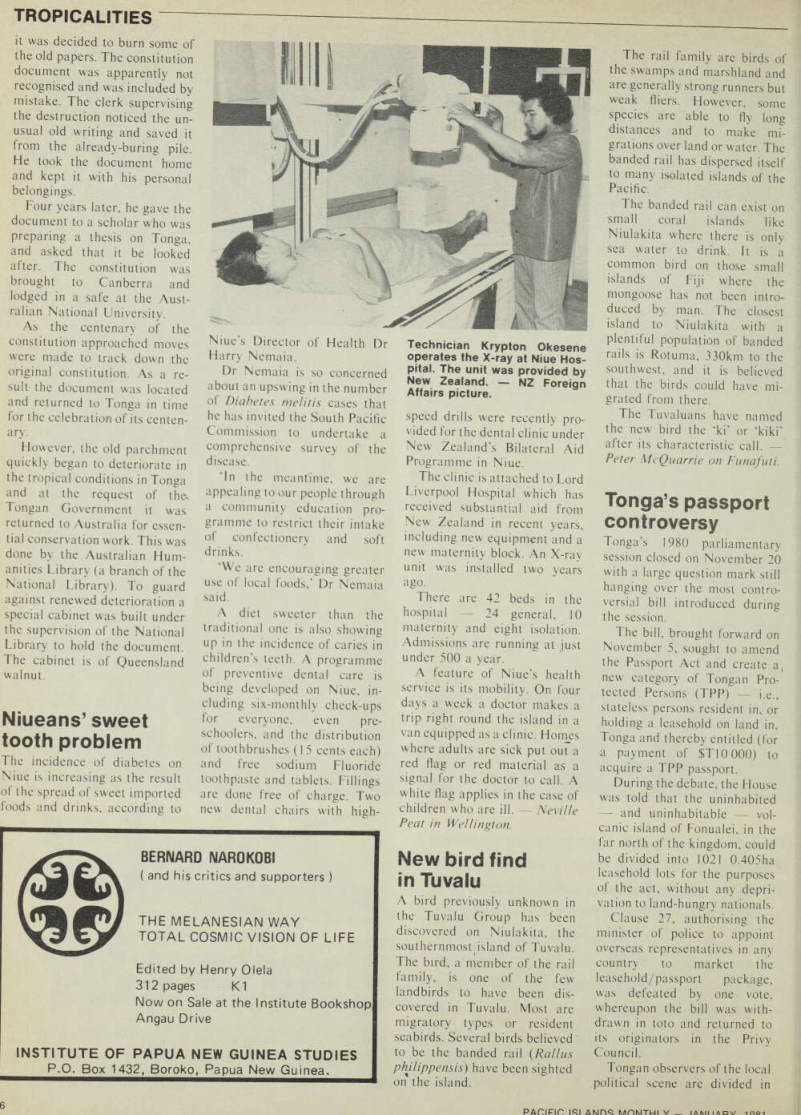
Two staff members of the Aust ralian National Library examine constitution and case before presentation. - National Lib rary picture, Hank Brusse.
it was decided to burn some of the old papers. The constitution document was apparently not recognised and was included by mistake. The clerk supervising the destruction noticed the un usual old writing and saved it from the already-buring pile.
He took the document home and kept it with his personal belongings.
Four years later, he gave the document to a scholar who was preparing a thesis on Tonga, and asked that it be looked after. The constitution was brought to Canberra and lodged in a safe at the Aust ralian National University.
As the centenary of the constitution approached moves were made to track down the original constitution. As a re sult the document was located and returned to Tonga in time for the celebration of its centen ary.
However, the old parchment quickly began to deteriorate in the tropical conditions in Tonga and at the request of the- Tongan Government it was returned to Australia for essen tial conservation work. This was done by the Australian Hum anities Library (a branch of the National Library). To guard against renewed deterioration a special cabinet was built under the supervision of the National Library to hold the document.
The cabinet is of Queensland walnut.
Niueans’ sweet
tooth problem
The incidence of diabetes on Niue is increasing as the result of the spread of sweet imported foods and drinks, according to
Niue’s Director of Health Dr Harry Nemaia.
Dr Nemaia is so concerned about an upswing in the number of Diabetes melitis cases that he has invited the South Pacific Commission to undertake a comprehensive survey of the disease. ‘ln the meantime, we are appealing to our people through a community education pro gramme to restrict their intake of confectionery and soft drinks. ‘We are encouraging greater use of local foods,' Dr Nemaia said.
A diet sweeter than the traditional one is also showing up in the incidence of caries in children’s teeth. A programme of preventive dental care is being developed on Niue, in cluding six-monthly check-ups for everyone, even pre schoolers, and the distribution of toothbrushes (15 cents each) and free sodium Fluoride toothpaste and tablets. Fillings are done free of charge. Two new dental chairs with high-
speed drills were recently pro vided for the dental clinic under New Zealand’s Bilateral Aid Programme in Niue.
The clinic is attached to Lord Liverpool Hospital which has received substantial aid from New Zealand in recent years, including new equipment and a new maternity block. An X-ray unit was installed two years ago.
There are 42 beds in the hospital 24 general, 10 maternity and eight isolation.
Admissions are running at just under 500 a year.
A feature of Niue’s health service is its mobility. On four days a week a doctor makes a trip right round the island in a van equipped as a clinic. Homes where adults are sick put out a red flag or red material as a signal for the doctor to call. A white flag applies in the case of children who are ill. Neville Peat in Wellington.
New bird find
in Tuvalu
A bird previously unknown in the Tuvalu Group has been discovered on Niulakita, the southernmostisland of Tuvalu.
The bird, a member of the rail family, is one of the few landbirds to have been dis covered in Tuvalu. Most are migratory types or resident seabirds. Several birds believed to be the banded rail (Railus philippensis) have been sighted on the island.
The rail family are birds of the swamps and marshland and are generally strong runners but weak fliers. However, some species are able to fly long distances and to make mi grations over land or water. The banded rail has dispersed itself to many isolated islands of the Pacific.
The banded rail can exist on small coral islands like Niulakita where there is only sea water to drink. It is a common bird on those small islands of Fiji where the mongoose has not been intro duced by man. The closest island to Niulakita with a plentiful population of banded rails is Rotuma, 330 km to the southwest, and it is believed that the birds could have mi grated from there.
The Tuvaluans have named the new bird the ‘ki’ or ‘kiki’ after its characteristic call.
Peter McQuarrie on Funafuti.
Tonga’s passport
controversy
Tonga’s 1980 parliamentary session closed on November 20 with a large question mark still hanging over the most contro versial bill introduced during the session.
The bill, brought forward on November 5, sought to amend the Passport Act and create a, new category of Tongan Pro tected Persons (TPP) i.e., stateless persons resident in, or holding a leasehold on land in, Tonga and thereby entitled (for a payment of STIO 000) to acquire a TPP passport.
During the debate, the House was told that the uninhabited - and uninhabitable vol canic island of Fonualei, in the far north of the kingdom, could be divided into 1021 0.405 ha leasehold lots for the purposes of the act, without any depri vation to land-hungry nationals.
Clause 27, authorising the minister of police to appoint overseas representatives in any country to market the
leasehold/passport package,
was defeated by one vote, whereupon the bill was with drawn in toto and returned to its originators in the Privy Council.
Tongan observers of the local political scene are divided in
Technician Krypton Okesene operates the X-ray at Niue Hos pital. The unit was provided by
New Zealand. - NZ Foreign
Affairs picture.
their views of what is likely to happen next. Some predict it will be legalised by special ordinance under the consti tutional machinery which oper ates to grease the wheels of government between parlia mentary sessions and re turned to the Legislative As sembly in 1981 for ratification at a time when the government is certain of the numbers.
Others believe that the unusually widespread public reaction against the proposal may well lead to its being dropped altogether.
The main discussion point among Tongan nationals at all levels hinges on concern that the scheme would debase the status of their own passports and increase the already con siderable difficulties encoun tered by Tongans seeking visas and work permits in Australia, New Zealand and the USA.
Another, more limited, school of thought was summed up by one Tongan pragmatist who characteristically quoted Scripture in his comment. ‘Our Government,’ he said ‘obviously sees this proposal as a painless way of solving some of the financial problems facing our small country with its very limited resources. But, if we have to sell our birthright in the effort to make ends meet, the mess of pottage should be a lot bigger. If Tuvalu turned down an offer of $5O 000 a passport and some South-east Asian countries fixed on a going rate of $3O 000, it would seem that the kind of people prepared to buy passports would be ready to hand over far more than a mere $lO 000.’
Expatriate comment centres in the main on the insuperable difficulties of controlling over seas agents, checking out infor mation supplied in affidavits, and screening out undesirables.
They fear that Tonga would buy into problems, both intern ally and internationally, which could far outweigh the revenue gain if some STIO million.
In particular, they quote re cent press and radio publicity, citing reports that the South Pacific is rapidly becoming the ‘in’ place for drug-runners’ staging posts on the way to Australia and New Zealand, and point out that TPP pass
ports could provide a useful cover for such illegal and lucra tive activities.
Meanwhile, parliament has squarely lobbed this hot potato back into the court of the Privy Council, the ultimate governing body which effectively formu lates all the kingdom’s national policies. Penny Hodgkinson in Nukualofa.
Ratu Mara and
the Queen Mary
The Fiji Prime Minister, Ratu Sir Kamisese Mara, revealed in a recent interview how he once wished he could have bought the liner Queen Mary when it was being sold comparatively cheaply at the end of its active life. The reason? To put on board all 15 000 people from the Lau Islands (his home province), to take them round the world, and to let them realise what a good place their home was.
Queen Mary, built and oper ated by Britain, was one of the world’s biggest and most famous passenger liners and once held the Blue Ribbon for the fastest sea-crossing of the Atlantic. The liner was com missioned in the 1930 s and after going out of service a quarter of a century later was sold to USA where it berthed as a tourist attraction.
Ratu Mara made his com ments in an interview with Deacon Ritterbusch from Im pulse, the magazine of the East-West Center Participants Association in Hawaii. He said it was a matter for regret that so
many Fijians listened to people who told them that Fiji was backward, or who believed that outside ways and places were better than those at home.
He said: ‘1 come from Lau which is interpreted by your colleagues as being a very poor country, but I keep telling my people that the resources here can give you better nutrition than anywhere else in the world. There is material for good housing, and you can learn a great deal on how to make a living through the knowledge that still exists among our people. It is a great irony for us to be told that ours is not the right way to live. We choose to live 55 years of our lives or I think our life span has risen to 65 years now divided alter nately for holiday, a little work, holiday, a little work. And then we see old people coming from all those developed countries, with walking sticks, after work ing for 55 years to earn enough to be able to come and enjoy the sun and the sand. ‘You know, when the Queen Mary was being auctioned off, I thought I would like to acquire that, put all the Lauans on board and send them around the world. Then when they come back home I’ll ask “Do you still want to go to the rest of the world, having seen it?”.’
Ratu Mara said that one of the greatest problems facing his country at present was over coming the political environ ment which was a heritage of colonialism. Under this en vironment bureaucrats, experts and civil servants saw them selves as slightly above the
elected representatives of the people. The result was that it was not always certain that policies adopted by the people were executed by the officials.
This was contrary to the effective administration which had existed before colonialism when the people themselves made the policies and carried them out.
Too many civil servants had also inherited ‘arrogant, domi neering attitudes’ from their predecessors, he said.
Tourist plan on
Robinson Crusoe
Robinson Crusoe Island is about to put an end to its isolation. The island where British castaway Alexander Selkirk ruggedly fought his lonely battle for survival, later inspiring Defoe’s immortal novel, is to be the site of a SUS 6 million tourist complex, to be completed this year.
Robinson Crusoe is one of the islands in the Juan Fernandez archipelago, off the central coast of Chile. The projected complex is being carried out by a company called Complejo Turistico Robinson Crusoe Ltd, working in technical partner ship with Sheraton Towers of Orlando, Florida.
The complex will feature a
Beach scene on Katafaga Island in the Lau Islands. ‘Our home, and as good as anywhere in the world’ says Fiji Prime Minister Ratu Sir Kamisese Mara whose
home province is Lau. - Fiji
Government official picture.
70-room hotel with tennis courts, water-skiing, yachting and other facilities.
The government of Chile has undertaken extension of the island's airstrip. Until this is ready, tourists will be ferried from Valparaiso either by sea plane or later, in a 500-tonne ship, with capacity for 100 passengers.
The Juan Fernandez archi pelago has been declared a Chilean National Park. The complex, therefore, must con form with the environmental characteristics of the island in its design. Materials to be used in building will be mainly timber and stone, both of which are locally available in abun dance. ‘We don’t want another Miami,’ say architects Boza, Luers and Muzard, who are responsible for the design. ‘The island should be kept as un touched as possible and should maintain its character through out.’
Prince Charles
on Fiji coin
The Fijian Government has produced a coin to commemor ate last October’s 10th anniver sary of independence.
With a limited production of 5000, the $2OO gold coin carries a likeness to Prince Charles on one side and the Fijian coat of arms on the other. Princess Anne, who attended the inde pendence celebrations in Fiji, was presented with the first gold coin bearing the portrait of her brother.
It is the first time the head of the heir to the throne of England has appeared on any coin in the Pacific region. A special portrait photograph was taken of the prince for the coin.
The coin is expected to arouse keen interest with both investors and collectors. It is a limited release and coins bear ing a likeness to Prince Charles are rare: only three coins featur ing Prince Charles are in circu lation all in the Caribbean.
The production of the coin was limited to 2500 proof coins and 2500 uncirculated. This compares with one recent gold coin issue of 300 000 by the Royal Mint.
The proof coins sells at $675
and the uncirculated coin at $550.
The demand for gold coins is still strong in both numismatist and investment circles through out the world. The new Fijian coin is expected to be of particular interest to American collectors who are always keen to have coins bearing a likeness to any member of the British royal family.
The coin, which contains 0.7 troy ounces of pure gold, is worth about $350 just in melt ing down value. It is a 22 carat coin, weighing 15.98 gr and has a diameter of 28.4 mm.
Laugh-and-learn
English in Tonga
The practical English course for the University of the South Pacific’s Tonga Centre Con tinuing Education Programme in the villages is going well after eight months of field-testing on 36 classes in 21 villages.
The idea of a laugh-and learn, informal English course for adults was developed by Centre Director Filimone Fifita from scratch in ’79 after
village-by-village research
based on the question ‘What do you most want to learn?’
I became personally involved when he challenged me to switch from English tutoring to preparing course material tail ored to local conditions and based on my knowledge of methods used in Australia’s successful English-as-a-second language programme for its migrant intake.
All the material is based on
the teaching and learning of simple English speech patterns, using pictorial readers, mime and class activities to reinforce student ability to use and com prehend everyday sentence and question forms.
As the situational teaching techniques employed are new to the Tongan primary school teachers who make up the teaching squad, the Teacher Texts are presented in a two column formal, with how-to teach-il instructions in the left hand column and examples of the relevant student exercise opposite. The course is divided into four parts and the teachers attend concentrated training sessions at the USP Centre in Nukualofa before tackling each section in the classroom.
An evaluation study conduc ted last September, and cover ing all 36 classes, revealed a most impressive grasp by the teachers of the new techniques involved, and a gratifying level of progress among the students, who range in age from late teens to late 60s.
About two-thirds of the 556
students (predominantly
women) who enrolled for the field-test classes have success fully completed part one of the course and moved enthusiasti cally on to the greater complexities of part two.
As the evaluation revealed that variable vowels and extra, unfamiliar consonants were something of a problem for teachers and students alike, a special section devoted to pronouncialion exercises was incorporated into part two with tongue-twisters like ‘Pul the big pig in the pink bag’ and ‘Hit the tin and make a din’ occasioning
helpless mirth as Tongan tongues struggle to differentiate between ‘p’, ‘b’, ‘d’ and ‘t’.
Filimonc Fifita reports that the centre is already planning to start new classes in many other Tongatapu villages, following receipt of a further 1000 student applications. Fie also has plans to bring the same course to villages in the outer island groups of Vava’u and Ha’apai in 1981. Penny Hodgkinson in Nukualofa.
First Solomons
novel sees light
The Solomon Islands Centre of the University of the South Pacific late last year announced publication of the first Solomon Islands novel. The Alternative, by John Saunana.
The dust jacket describes the book as ‘a thought-provoking work set in the period of decolonisation in Solomon Islands’.
It adds: "The Alternative is a story in which the undercur rents of a society in change are brought close to the deceptively placid surface through its characters and their conflicts.
At a lime when Solomon Islands writing is growing in scope and depth, this novel will stand as a signal achievement, as a challenge to other Solomon Islands writers’.
John Selwyn Saunana, born in Arosi (Markira) in 1945, was minister of education in the last Solomon Islands government.
After attending Pawa and King George VI schools at home, he graduated with a Bachelor of Arts degree from the University of Papua New Guinea in 1971.
Having worked in broadcasting, teaching and linguistics, he was elected to the Legislative As sembly in 1977.
His first published writings appeared while he was at UPNG. A collected edition of his poetry is planned for the near future.
The Institute of Pacific Studies and the South Pacific Creative Arts Society were associated with the USP SI Centre in publishing The Alternative. Copies may be obtained from the centre at 5512.50 for overseas orders, bulk orders of 20 or more 5512.00.
English language class - laugh while you learn in Tonga.