distinguished absent friends)
p. 21 · Read in the full issue
Jimmy Stevens tried (with some distinguished absent friends)
Vanuatu secessionist leader Jimmy Stevens received prison sentences totalling 14'/; years and fines of FNH22O 000 (or two years eight months in lieu) at the end of his day-long trial before Vanuatu’s Supreme Court in Santo Town on November 21.
But even as Stevens was lodging his appeal, speculation began that he would in fact serve only a small part of his sentence some suggested as little as six months. One source suggested that Prime Minister Father Waller Lini, aiming for the earliest possible national reconciliation in his divided country, would support an early exiling of Stevens to Fr Lini’s own home island of Pentecost but accompanied by only one of his alleged 29 wives.
Appearing before Mr Justice Cooke, Chief Justice, and two Vanuatuan assessors Chief Kalsakau and Mr Bolangoe Stevens faced 11 charges relat ing to his role in the May- August Vemarana secession.
He pleaded guilty to all except one that relating to damage caused by riotous secessionist elements at Santo’s British Pad dock late in May 1980. He was.
however, found guilty on this charge as well.
Summing up, Mr Justice Cooke said Stevens had been a representative of the people in his area for many years, and he considered Stevens’ attempts to help them as genuine. But events had occurred to make Stevens turn away from the country’s laws, he said. ‘lt gives us no pleasure to sentence a man so well known for the guidance, help and encouragement you have given to your people, but in the eyes of the law everyone is the same.
It has to be so or peace between the various people which make up this country would not survive.’
Perhaps the most sensational aspect of the trial was its revelation of the degree of encouragement offered to the secession by the former French Resident Commissioner Jean- Jacques Robert, and, still more
particularly, by one of his subordinates, lawyer Arnaud Lizop.
It was revealed in court that Mr Robert had assured Stevens and his associates that there would be no reprisals against people involved in the rebellion, and assured them: ‘We will have Mr Lini sign a letter saying that he abandons all reprisals against anyone.’
Outside the court, Stevens told an Australian pressman that his greatest regret was having been misled by French officials about the extent of their backing for the rebellion.
He said that Mr Robert had actively encouraged the se cessionists. ‘He said to me, “not to worry, we will support you but don’t make it violent”. ‘They didn’t supply what they promised they would give us,’ Stevens added.
The Vanuatu Government, shortly after the conclusion of the trial, announced that it intended to declare Mr Robert a prohibited immigrant.
Documents captured at the Vemarana headquarters at Fanafo provide still more con clusive evidence of French official complicity with the se cessionists. They centre on the activities of Arnaud Lizop, sent out from Paris by Minister for Overseas Departments and Territories Paul Dijoud to work as a constitutional adviser in the final days before indepen dence.
One of the Fanafo documents is a letter written by Lizop to Stevens’ deputy, Georges Cronsteadt, on June 10. Lizop wrote: ‘Here’s what seems im portant in Santo in my view; 1) The defence plan. 2) Keeping trade going. 3) Organising the referendum.’ (After driving government supporters off the island, Stevens planned a refer endum to demonstrate his popular support.) Lizop’s letter went on: ‘Stick it out, we’re on to it in Paris.’
The letter then named Jacques Piot, a deputy in the French National Assembly, and
another government legal ad viser, Georges Zorgbibe, and said ‘(we) are going to sabotage Uni’s co-operation agreements with Paris and get recognition for you. I’ll send you an adviser as soon as I get the ticket and I’ll be back in July. Up with Santo.’
Another letter found at Fanafo implicates Robert’s per sonal representative on Santo, Datchary, as a go-between in rebel planning.
Prime Minister Walter Lini is reported to be convinced that Robert deceived both him and British Resident Commissioner Andrew Stuart. ‘I could not really understand why Robert would agree to act against Stevens one day and then totally change it the next. ‘I suspect the British knew about him but they did not want to believe it.’
Reporting this statement in an article in The Times of Papua New Guinea (November 28) journalist Denis Reinhardt adds: ‘Which leads to the last remaining unanswered question about the Espiritu Santo affair.
Did France know what Robert was doing?’
In a separate interview with Stevens in gaol in Port-Vila, Reinhardt asked him: ‘Do you think you were wrong to lead the rebellion and establish your own government?’
Stevens replied; ‘Well, so far as it looks today, yes. But when we began to organise this Vemarana as a custom land, we had no thought that we would end up in a rebellion. This rebellion business is only some thing coming from outside the country, coming in, coming from some place like Noumea, coming in and pushing our people towards this damage. ‘But it was not our idea. We formed Vemarana because we wanted our own confederation system, running our own little self-government.’ ‘Do you think you were misled by the French?’ ‘Well, yes, because of the promises they didn’t fulfil . . .’
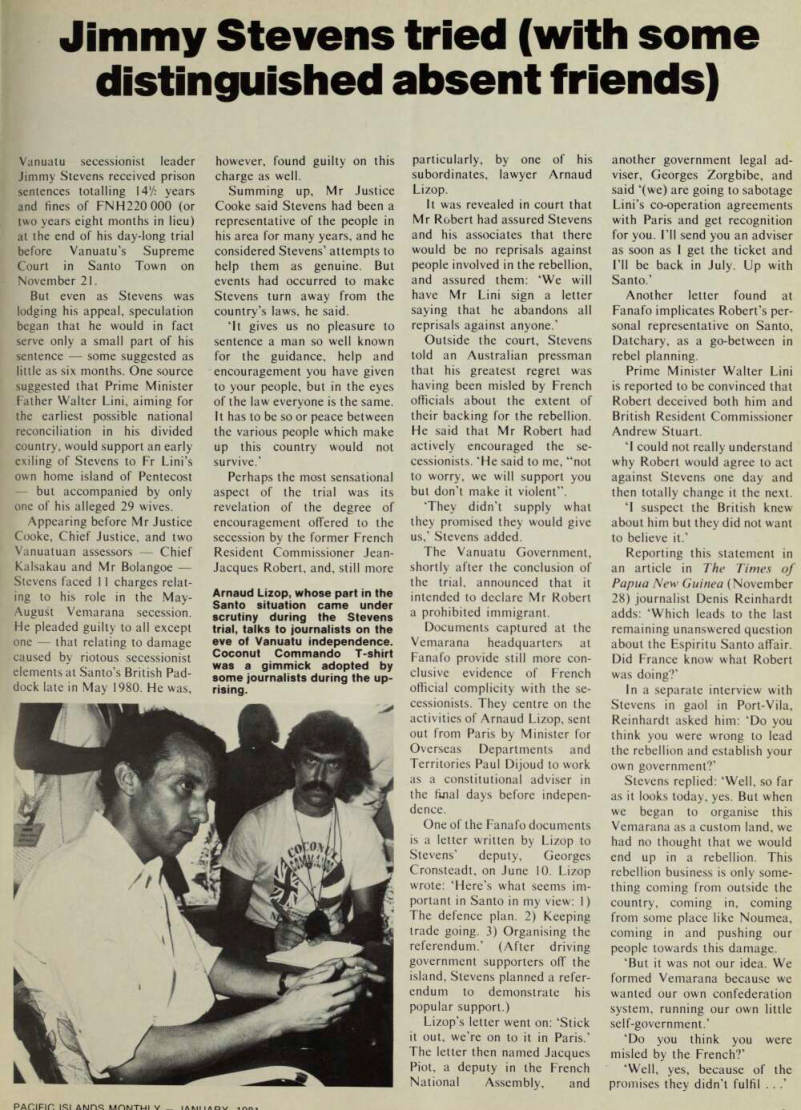
Arnaud Lizop, whose part in the Santo situation came under scrutiny during the Stevens trial, talks to journalists on the eve of Vanuatu independence.
Coconut Commando T-shirt was a gimmick adopted by some journalists during the up
rising.