Pacific Forum Line: It could be
pp. 67-69 · Read in the full issue
Ships
Pacific Forum Line: It could be later than they think ...
\ few bland-sounding words in in Australian Government Jtalemcnl on the future of the Pacific Forum Line could turn )ut to have a kick like a mule vhen their full implications itrike home with member governments of the Line.
As reported earlier (PI M Oct )71), Australia agreed at he September Commonwealth deads of Government Regional Meeting in New Delhi to con ribute about half of the $9 million required to keep the line iperating until the end of 1981.
'Jew Zealand would provide he other half.
But the Australians stipu ated that their contribution vould be subtracted from the ilready announced commit nent of $l2O million in aid over hree years to South Pacific rountries and from the aid :ommilmenl to Papua New juinea, and would in no way be in additional contribution.
The Australian attitude pro voked controversy in New Delhi, and some less than friendly remarks from New Zealand Prime Minister Robert Muldoon.
The Australian Government later issued a statement in which it said it ‘accepted the consensus’ of the New Delhi meeting, but ‘wished to record’ certain opinions. Among these were the following ‘bland sounding words’; ‘Australia is mindful of the possibility that in the light of experience, and in particular the impact of the proposed financial arrange ments on Australia’s aid to the Pacific Island states, island governments might well wish to reassess the decision taken at New Delhi. Australia stands ready to join in that reassess ment, which in any case should be no later than 12 months from now.’
In an earlier passage the
statement had made clear that while bilateral aid projects for 1980-81 would not be held back, ‘aid activities in 1981-82 and 1982-83 would inevitably be affected’.
Australia undertook to make contact with island govern ments to discuss the new ar rangements.
In the new, post-Delhi cir cumstances, a country like Fiji which does not see itself as particularly advantaged by the PFL anyway could well see itself losing up to $1 million in Australian aid.
Papua New Guinea, for its part, could face an aid cut of more than $2 million.
Other, smaller countries would face losses of smaller amounts, but these could prove equally devastating, in view of their meagre overall resources.
With hindsight, Solomon Islands and the Cook Islands were wise in their refusal to
accept the consensus. Their position was that they would make voluntary contributions of their own SSI 100 000 in the case of the Solomons, and SA2OO 000 from the Cooks on condition that the aid due to them from Australia was unaffected. The amounts prom ised arc substantially less than they would have had to pay under the consensus.
The question must arise as to whether the island governments will be prepared to accept such sacrifices in order to preserve what all are agreed is a losing proposition however desir-
able it may be in terms of regional prestige or whether they will, as the Australian Government statement sug gests, ‘wish to reassess the decision taken in New Delhi’.
It could appear that the Australians are attempting to
‘slrongarm’ island governments on the issue, but this impression does not square with the fact that they are also putting for ward positive and even generous proposals for alterna tive arrangements to the PFL.
The post-Delhi statement said that the Australian Government ‘was prepared to provide sums, additional to existing aid allocations, to sub sidise what would otherwise be inadequate services to island states’. It said the ‘offer was not reserved to those countries presently served by the PFL’ but ‘would encompass all disad vantaged states which could not attract an adequate commer cial service at reasonable rates’.
The statement provided a hard-nosed rundown of Aust ralia’s objections to the PFL operation. Points made include: • ‘. . . on the Forum’s own estimates, which in the past had always proved to be extremely optimistic, not less than SAI million in Australian aid funds could be needed in each con tinuing year of operation’. • ‘. . . the Forum Line is
benefiting only three of four island countries’, ‘there were no; plans for an extension of serH vices to other countries’, and ‘on every route on which the Line would be operating from November commercial services were also available’. • ' . . whatever the inten-| lions of management had been, Forum Line rates were below! economic rales, and in conse quence private operators had been driven off certain routes’.
If this went on. Forum Line' member countries, ‘instead of advantaging themselves, could be left with a reduced number of operators on routes, and a j Line which required massive and continuing subsidies’. • . . . based on recent Forum Line figures, 45% of cargo* loading were ex-New Zealand ports, 23% ex-Australian ports, and 17% ex-Fiji, which fell it did not need the Line to ensure adequate shipping service’.; Consequently, ‘very little benefit was provided to support ing the carriage of exports from island countries’. As a conse-! quence, ‘the Line was in effect
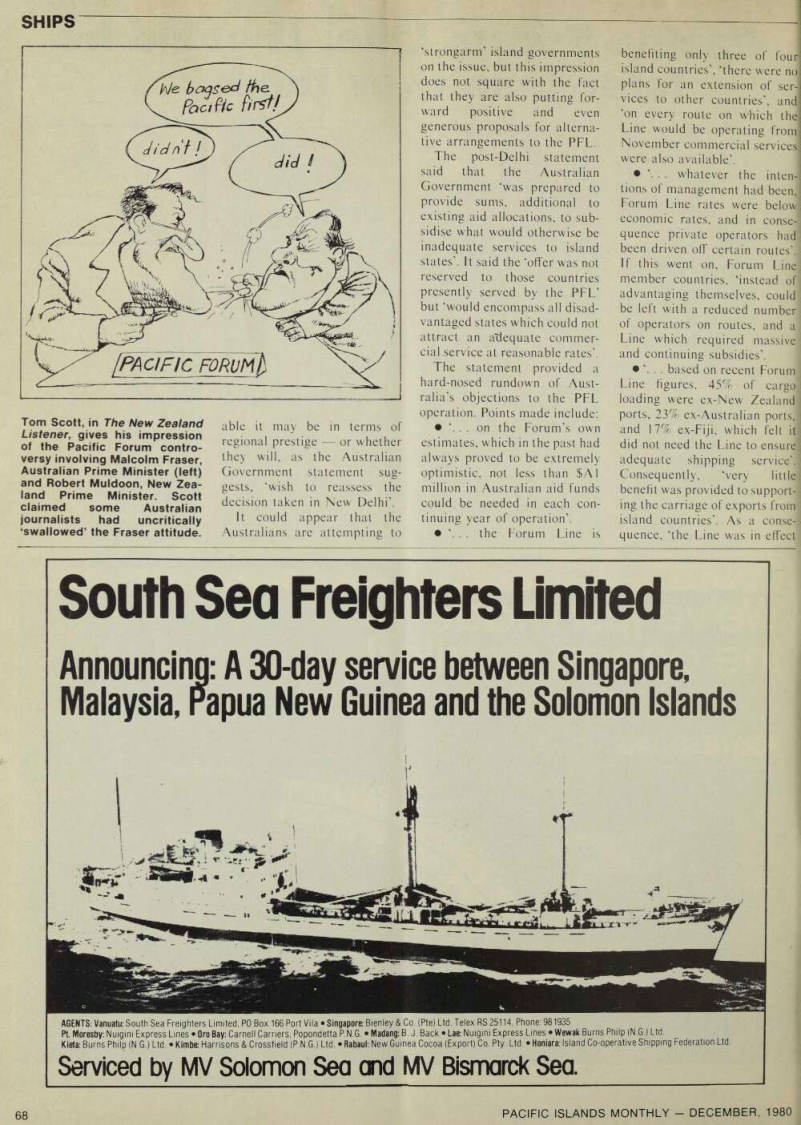
Tom Scott, in The New Zealand Listener, gives his impression of the Pacific Forum contro versy involving Malcolm Fraser, Australian Prime Minister (left) and Robert Muldoon, New Zea land Prime Minister. Scott claimed some Australian journalists had uncritically ‘swallowed' the Fraser attitude.
ibsidising exports from Aust ria and New Zealand’. • The statement said: ‘ln jmmary, the Australian lovernment had expressed its rm view that subsidised or nprofilable services should not e sustained out of Australia or Jew Zealand ports, and was oncerned that the operations f the Line provide so little enefit to geographically disad unlaged states.' It also noted ml the cost of liquidation of te Line was not the SUS2I.S lillion indicated by the Line’s lanagcmenl, but something lore like SUSB million.
Not mentioned in the state icnt. but referred to frequently y Australian Prime Minister rascr at the New Delhi meel ig was the PFL's NZ-PNG jrvice, which Mr Fraser laimed is losing more than 1.5 million a year, and apply ig freight rales below conven onal levels. Fie said such ncllicicnl cost-cutting’ was arcing other Pacific regional argo services out of business.
What he is not reported to avc said, but what was prob bly very much on his mind, is lal the NZ-PNG operation, eavily subsidised by Australia, ; strongly favouring the pres nt marked New Zealand push ilo a market which has long ccn largely an Australian pre :rve.
This factor is certainly one of tany which determine New Zealand's favourable altitude 3 the PFL.
Among others is equally cer linly the measure of relief IFercd by the Line to a country hich has for years been up for cavy shipping subsidies for ;rvices to the Cook Islands and okclau.
All in all, the positions adopted by the Australian Government could bring on the denouement of the Forum Line drama much sooner than many people now think.
PNG men get
UK training
Papua New Guineans are tak ing part in a series of training schemes which are being pro vided in the United Kingdom by the Mersey Docks and Harbour Company, operator of the Port of Liverpool.
The scheme, which involves government to government ar rangements between PNG and UK, is being used by the PNG Harbours Board to provide specialist training for some of its employees. In the past three years the Mersey Docks and Harbour Company has pro vided training for harbour tech nicians and executives from more than 20 countries, par ticularly from developing nations. The training is part of a consulting service which covers all aspects of port management, operations and training, includ ing instruction in modern port equipment and systems.
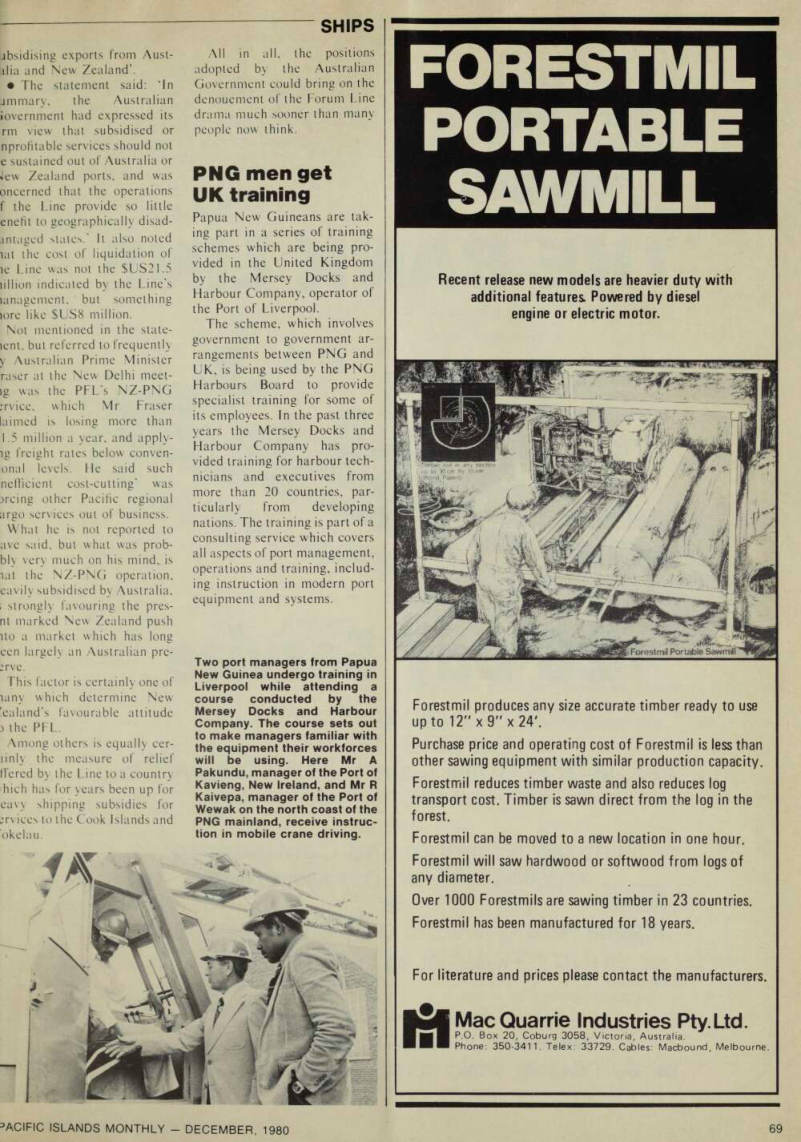
Two port managers from Papua New Guinea undergo training in Liverpool while attending a course conducted by the Mersey Docks and Harbour Company. The course sets out to make managers familiar with the equipment their workforces will be using. Here Mr A Pakundu, manager of the Port of Kavieng, New Ireland, and Mr R Kaivepa, manager of the Port of Wewak on the north coast of the PNG mainland, receive instruc tion in mobile crane driving.