Hokule'a: In pursuit
pp. 43-45 · Read in the full issue
Books
Hokule'a: In pursuit of an unlucky star
Hokule'a, The Way to Tahiti.
Sr Ben R Finney. Published by Dodd, Mead & Company, New York. 1979. (5U517.50). ISBN 1-396-07719-6.
Hokule'a, the name of the Jawaiian double canoe which n 1976 sailed the ancient ’olynesian route to Tahiti, neans ‘Star of Joy’. The name s terribly ironic, for from the >eginning to the end it was a lathetic enterprise from which oy was most conspicuously bsent.
In the opening pages of this •elated account, the leader of he expedition. Professor Ben : inney, who leaches anthro pology at the University of lawaii, declares that his main bject was ‘to demonstrate to he skeptics that the ancient ‘olynesians could have inten ionally sailed across vast iretches of open ocean’. Who /ere the sceptics, stupid nough to doubt such a vague nd therefore irrefutable state lenl? Ben Finney not only ingles out the late Andrew harp as their leader and num er one spokesman, but also educes the whole complex roblem of how the Polynesian Jands were settled to a choice etween only two possible ex lanalions; it must have hap ened either through accidental r through intentional voyages.
This is, of course, absurd, nee it is a well established fact lal both sorts of voyages did ccur, as they still do. It is also bvious that such clear-cut dta nclions cannot always be ap lied. For instance, Polynesian shermen blown out to sea have flen found their bearings and rganised their life so well that icy have eventually been able ) reach land. On other oc asions, sailors who try to reach well defined destination get >sl at sea and end up on an nknown coast.
Incidentally, there is no istification for postulating, as ;en Finney does, that all inten onal voyages were carefully lanned in ancient Polynesia, rophecies and dreams often jsulled in impromptu depar-
tures in the worst possible conditions, and we can find a fascinating example of this in The Marquesan Journal of Edward Roharts, I 797 1824 (Australian National Univer sity Press, 1974).
After having founded in 1973 a Polynesian Voyaging Society, which in a remarkably short lime raised SUS6O 000, Finney set out to build an 18.9 m canoe and collect a crew. The first questions that arose concerned the type of canoes used by the ancient Hawaiians during their long-distance voyages to Tahiti seven or eight hundred years ago if we are to believe the oral traditions. No such canoes have ever been found by the • archaeologists, and it was there fore all guesswork.
The most sensible solution would probably have been to make a faithful replica of a Tuamoluan sailing canoe with V-shaped twin hulls, a type of Craft which is well documented.
Instead, Ben Finney chose as his prototype the magnificent Hawaiian paddle canoe pic tured by John Webber in the atlas of Captain Cook’s third voyage. Compared with this unfortunate choice of a canoe model the vessel lacked a keel and operated only on inter island traffic the fact that the hulls were made of plastic and the sails of canvas mattered less, although it is somewhat surprising to learn that the main reason for not using wood
and pandanus leaves was lack of lime and money!
To make up for these com promises, Ben Finney did his utmost to find genuine Hawaiians to man the canoe. As everybody knows, this species is almost extinct today, but the
enterprising president of the Voyaging Society eventually succeeded in enrolling about a dozen men who were not only extremely good-looking but also looked as if they had stepped right out of the movie version of Michener’s historical novel Hawaii. Three or four of them had been near the water before, when working as beach boys in Waikiki. Some were unemployed or ‘drifters’. The rest of the bunch included a fireman, two cowboys, a carpenter and a college student.
In the eyes of Ben Finney and his fellow directors of the Voyaging Society, the crew members’ appalling lack of seamanship was compensated for by their strong interest in Hawaiian culture. Ben Finney had from the beginning seen the
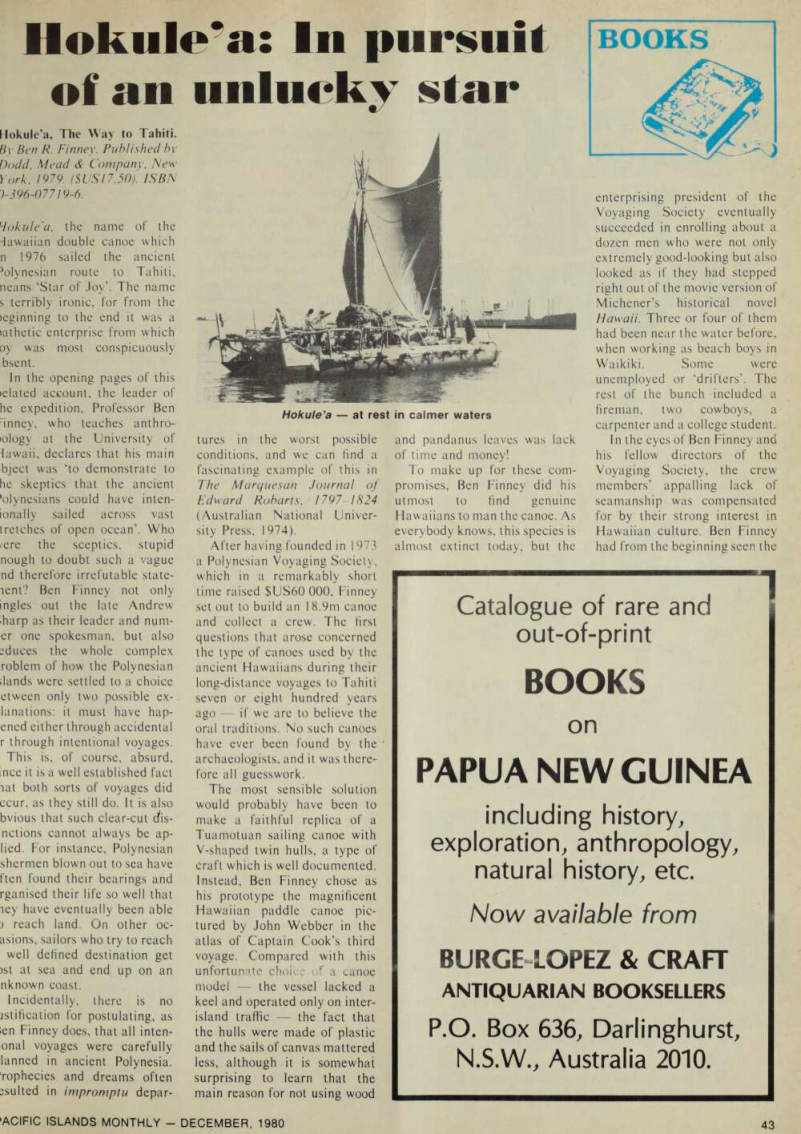
Hokule’a - at rest in calmer waters
whole enterprise as a powerful means to revive the ancient Polynesian culture. Among other things, he had organised a carefully researched and re hearsed canoe launching cer emony that made the pro fessional showmen in Waikiki green with envy.
As it soon turned out, the Hawaiian crewmen played their part only too well, for they constantly resorted to spells, incantations and all sorts of magic rites. Sometimes, at their request, a professional kahuna was called in, and although his magic, of course, was genuinely Hawaiian, his often exorbitant fees had to be paid in American dollars. Ben Finney went along with all this mumbo-jumbo but balked, quite understandably, when the crew tried to get rid of all their haole sponsors, includ ing the expedition leader him self!
Although this brash attempt should have served as a warn ing, Ben Finney kept his motley crew of rebellious landlubbers on the payroll, and after a few more disasters, including a swamping of the canoe, he eventually put to sea with eight of them on May 1, 1976. The captain he had chosen, a charming Hawaiian ‘sunset cruiser’ named Kawika (David), was even less able than himself to instil discipline and order. As if quantity could make up for quality, he signed on another four captains or navigators. One was the Micronesian master mariner Mau Piailug who was very popular but of little help, as he did not know this part of the Pacific and spoke no English.
The remaining three were all haoles and included Dr David Lewis, but in spite of their profound knowledge of ancient and modern navigation the Hawaiians refused to take any notice of them, or if they did so, were openly hostile.
With a mutinous crew, a weak leader and too many unpopular leaders, the great experiment in Polynesian sur vival technique which was to be undertaken during the trip nat urally came to nothing. Accord ing to the much-touted plans, the Hokule’a sailors were to live solely on dried bananas, pounded taro, salted fish, and
other Hawaiian delicacies.] Once at sea, however, the Hawaiian crew members den cided that cultural revival should stop at spiritual matters and categorically refused to touch the Polynesian foodstuffs] Their refusal no doubt had something to do with the easj] access they had to American! food and beer. They even got it free of charge. The generous purveyors were the captain and crew of the escort and rescue vessel Meotai, financed by the National Geographic Society] in exchange for permission to make a documentary film about! the expedition. A few of the haoles bravely kept chewing on the dried bananas, only to discover shortly afterwards that! most of these Polynesian pro-] visions had been spoiled by careless preparation.
In one respect, and not the least important, the trip was nevertheless an unqualified such cess: the prehistoric navigation! without charts, sextant,] compass and chronometer offered not the slightest difficulty. Favourable winds and currents carried the canoe
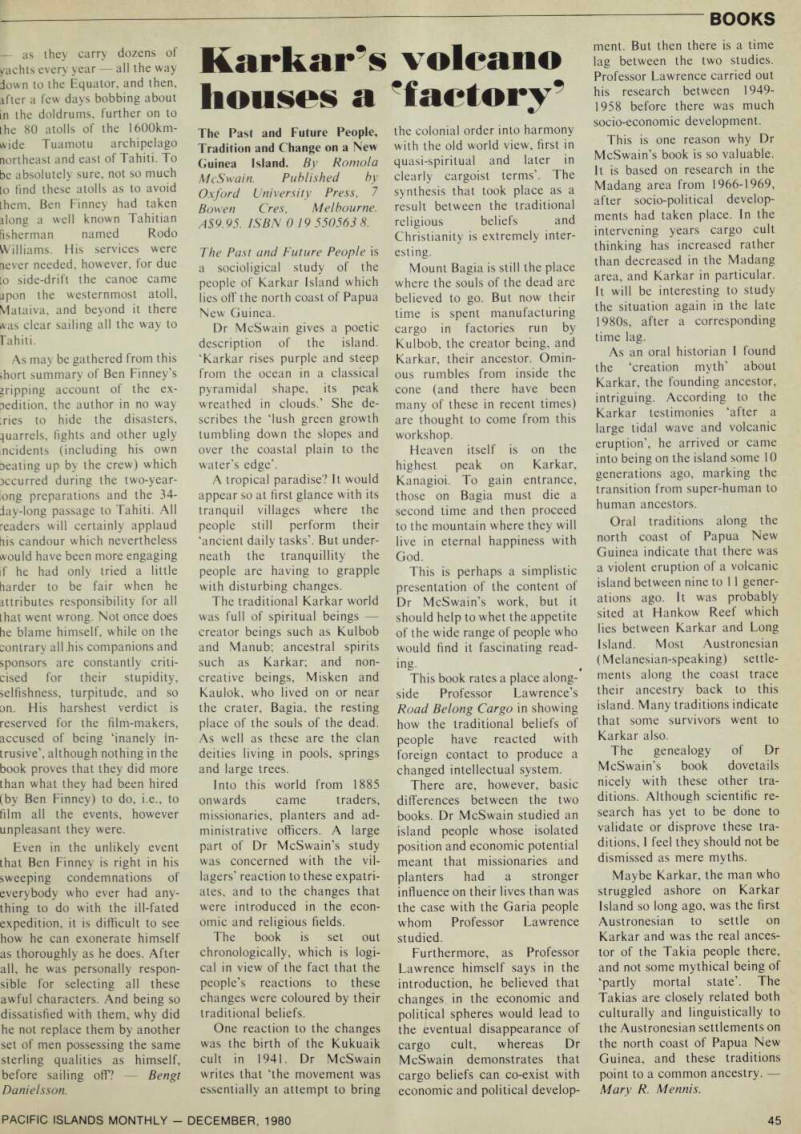
Political as well as cultural history went to sea with Hokule’a. Here the old flag of Hawaii, with the Union Jack in the corner, flies from the rig ging.
as they carry dozens of yachts every year all the way down to the Equator, and then, after a few days bobbing about in the doldrums, further on to the 80 atolls of the 1600km wide Tuamotu archipelago northeast and east of Tahiti. To be absolutely sure, not so much to find these atolls as to avoid them, Ben Finney had taken along a well known Tahitian fisherman named Rodo Williams. His services were never needed, however, for due to side-drift the canoe came upon the westernmost atoll, Mataiva, and beyond it there was clear sailing all the way to Fahili.
As may be gathered from this ihort summary of Ben Finney’s gripping account of the ex pedition, the author in no way tries to hide the disasters, quarrels, fights and other ugly ncidents (including his own beating up by the crew) which occurred during the two-year iong preparations and the 34day-long passage to Tahiti. All readers will certainly applaud bis candour which nevertheless would have been more engaging if he had only tried a little harder to be fair when he attributes responsibility for all that went wrong. Not once does he blame himself, while on the contrary all his companions and sponsors are constantly criti cised for their stupidity, selfishness, turpitude, and so on. His harshest verdict is reserved for the film-makers, accused of being ‘inanely in trusive’, although nothing in the book proves that they did more than what they had been hired (by Ben Finney) to do, i.e., to film all the events, however unpleasant they were.
Even in the unlikely event that Ben Finney is right in his sweeping condemnations of everybody who ever had any thing to do with the ill-fated expedition, it is difficult to see how he can exonerate himself as thoroughly as he does. After all, he was personally respon sible for selecting all these awful characters. And being so dissatisfied with them, why did he not replace them by another set of men possessing the same sterling qualities as himself, before sailing off? Bengt Danielsson.