Brand-new Pacific liaison office
pp. 17-19 · Read in the full issue

for ESCAP - and Nauru’s the host
PEJER CUMMINS* reports on the opening on Nauru in October of a new United Nations office, the Liaison Office for the Pacific of the UN’s Economic and Social Commission for Asia and the Pacific (ESCAP). He calls the office ‘a bridge’ ‘a bridge over which UN aid, technical assistance and transfer of technology will flow to the South Pacific, and a bridge for the flow of technical co-operation among the developing countries of the South Pacific themselves’.
Friday, October 3, 1980, was not a day like any other for the tiny island republic of Nauru.
At 10.30 am on that day, the President of Nauru Hammer Deßoburt and the Executive Secretary of the United Nations Economic and Social Commission for Asia and the Pacific (ESCAP) Mr J. B. P.
Maramis, raised the United Nations flag over the new ESCAP Liaison Office for the Pacific.
As the blue and white flag unfurled in the warm trade wind, the UN emblem symbol ised a promise to the peoples of the developing island states. A package of aid, spanning the vast fields of competence of the UN, would as a result flow into the region, affecting trade pro motion, natural resources, en ergy, shipping, population and related problems, training, offshore prospecting, industrial and social development, stat istics, food and agriculture, transport and communications, transnational corporations, the role of women in development, tourism and the transfer of technology.
The office will be the ‘bridge’ in the flow of technical co operation from the UN system to the region. It will also foster technical co-operation among the Pacific countries them selves, a prime goal of the UN development strategy for the 1980 s.
The liaison officer’s principal
tasks will be to improve link ages and maintain effective liaison between ESCAP and the countries of the Pacific, and to assist ESCAP’s executive sec retary in the programming and implementation of needed ac tivities.
The opening of the liaison office signifies an end and a beginning. It marks the end of an era which began 33 years ago in Shanghai when the United Nations Economic Commission for Asia and the Far East (ECAFE) was estab lished, with 10 original mem bers. Then, the islands of the Pacific were either under col onial rule or were trust territories won as ‘prizes’ in global conflicts.
It also marks the beginning of the Third Development Dec ade, a decade where phrases like interdependence, self-help, regional co-operation, new in ternational economic order, North-South and South-South dialogue, bridges across the South, and Brandi Commission will be key terms in the language of development. It is the beginning of an era of increasing assistance to the developing island countries of the South Pacific. As one Pacific Islander said during ESCAP’s annual session in Bangkok last March; ‘The Pacific Islanders’ call for assist ance has been heard’.
As the UN emblem flies for the first time in this northern area of the South Pacific, it flies in a region whose peoples have largely gained their freedom and independence. And, 33 years later, the commission, now called the Economic and Social Commission for Asia and the Pacific, has 35 mem bers and eight associate mem bers, covering a region which stretches from Iran to Indonesia, from Kiribati to
Korea. Almost half of the world’s surface and consider ably more than half the world’s population, including the world’s most populous countries, China and India, fall within ESCAP’s mandate for the 1980 s.
The Brandt Commission re port, otherwise known as North-South: A Programme for Survival, points clearly to the type of situation now exist ing in the South Pacific. In his introduction, Willy Brandt notes: ‘As a result of decolonisation in most parts of what came to be called the Third World, long established power structures crumbled or collapsed, leaving vacuums and giving birth to new political and economic groupings.’ Countries which thus were released from colonial dependence, Brandt goes on, ‘have been struggling to gain equality of opportunity in their development, (request ing) beneficial co-operation, as sistance and transfer of re sources . . . goods and techno logies ... to overcome their
poverty’.
There is a special significance in the opening of this office for the two principals involved, President Hammer Deßoburt and Executive Secretary J.B.P.
Maramis. Mr Deßoburt led his
Lilliputian-sized country’s
deputations to the UN Trusteeship Council, finally winning independence for Nauru on January 31, 1968.
He became the first president of the new republic, and he was elected chairman of ESCAP’s 32nd annual session, held in Bangkok in 1976, at which time he remarked that his election was ‘evidence of ESCAP’s in creasing involvement in the development of the Pacific Island states’.
It was at this same session that the first ‘special measures in favour of the least developed, land-locked and island countries’ were adopted.
Deßoburt has championed
*N. Peter Cummins MSc is Information Officer for the United Nations Economic and Social Commission for Asia and the Pacific (ESCAP).
Based in Bangkok, Thailand, he visited Nauru for the open ing of ESCAP’s new Liaison Office for the Pacific in October.
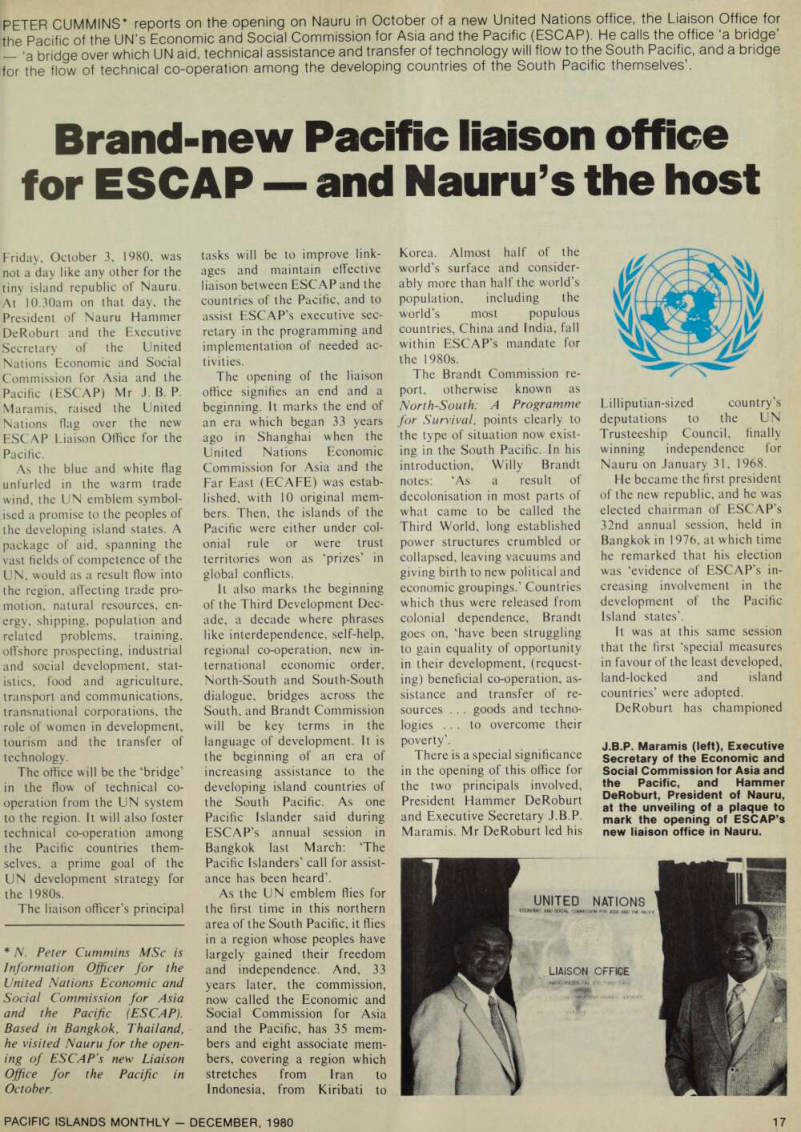
J.B.P. Maramis (left), Executive Secretary of the Economic and Social Commission for Asia and the Pacific, and Hammer DeRoburt, President of Nauru, at the unveiling of a plaque to mark the opening of ESCAP’s new liaison office in Nauru.
the cause of the developing island countries of the South Pacific. There is poetic justice in the liaison office being lo cated in his own island republic.
Mr Maramis was appointed as fourth Executive Secretary of ESCAP on 1 August 1973, after a distinguished career with the Indonesian Govern ment, during which he gained broad experience in inter national organisations. Fie came to ESCAP, in fact, from a posting as ambassador to Belgium and Luxembourg and head of the Indonesian Mission to the European Community.
One of the executive sec retary’s first acts was to change the name of the former Econ omic Commission for Asia and the Far East to Economic and Social Commission for Asia and the Pacific, ‘to reflect’, he said at the time, ‘the com mission’s new responsibilities to the people of the region, par ticularly in the South Pacific’.
The opening of the Pacific Liaison Office is a tribute to Maramis’ dedication to one of his goals: that the South Pacific area, particularly, which is among the most disadvantaged of the world’s least developed areas, should directly benefit from UN assistance pro grammes.
No doubt the influence of the president. Hammer Deßoburt, one of the South Pacific’s best known leaders, was a large factor in the choice of Nauru for the site of the office. As Deßoburt said in his address at the opening: ‘Earlier this year in Bangkok, the government of Nauru was pleased to be able to offer Nauru as a possible lo cation for the Liaison Office in the Pacific, and Nauru was supported in Bangkok, in the South Pacific Forum countries and in Micronesia. This morn ing sees the inauguration of the Liaison Office in premises which have been provided by the government of Nauru.’
A decentralisation of such offices is in any case desirable.
For example, Fiji to the south hosts a UN Development Ad visory Team, a UN Develop ment Programme (UNDP) office, the South Pacific Bureau for Economic Co-operation and its South Pacific Forum, the University of the South Pacific and a number of UN special ised agencies. Western Samoa
on the eastern periphery houses another UNDP office, and there is the South Pacific Com mission in New Caledonia on the western edge.
Mr Maramis summed up UN attitudes in his October 3 address; The role of Nauru in bringing about the establish ment of the ESCAP Liaison Office in the Pacific was demon strated in the active part that the delegation of Nauru played, and which led to the adoption by the commission of the two resolutions concerned. It was in recognition of this role that the Pacific Island countries agreed to Nauru as the site for the liaison office.’
Finally, the island has good telecommunications facilities, and Air Nauru offers frequent and efficient pan-Pacific air services.
Twelve Pacific Island States are members of ESCAP. Fiji, Nauru, Papua New Guinea, Western Samoa, Solomon Islands and Tonga are full members; Fiji, Papua New Guinea, Western Samoa and Solomon Islands are also mem bers of the UN. Cook Islands, Kiribati, Niue, Trust Territory of the Pacific Islands, Tuvalu and Vanuatu are associate members. Associate member ship could be regarded as ‘trial membership'.
ESCAP, often called the ‘Parliament of Asia and the Pacific’, is one of five regional economic commissions of the UN. It is administratively re sponsible to the secretary general of the UN, and, at the same time, it is responsible to its member countries and is subject to their guidance in policy matters under the overall supervision of the UN Econ omic and Social Council.
ESCAP’s primary role is to serve member countries by identifying areas of social and economic development prob lems; by providing a forum for debate on development issues, and by providing technical as sistance and advisory services and helping member countries to attract outside assistance. It does not itself provide capital resources but has helped to establish institutions to attract funds for regional and sub regional projects which, in turn, supply development aid.
Nine legislative bodies guide the work of the commission in
agricultural development, de velopment planning, industry, human settlements and tech nology, natural resources, popu lation, statistics, trade, shipping and transport and communi cations. Additionally, a number of special bodies report to the commission, such as the Com mittee for Co-ordination of Joint Prospecting for Mineral Resources in South Pacific Offshore Areas.
Even before the opening of the liaison office a large number of programmes for the island countries were under way, sup ported by the UN system and a number of the ESCAP member countries.
One example is the UN Development Advisory Team, created in 1971 and operated by ESCAP since 1977. Now based in Suva, it consists of a team of UN experts who advise island governments, on request, on almost every conceivable problem of economic and social development. The head of the team, Arthur McCutchan, who is well known around the Pacific, has been designated as interim head of the new Nauru
office until the appointment of an Islander is made.
There is also a combined ESCAP/UNDP three-year (1979-81) programme of about SUSI 2 million, being run in collaboration with the South Pacific Bureau for Economic Co-operation and the South Pacific Commission. With this programme past the half-way mark, planning for a new three year cycle is under way. Sea transport is expected to be its centrepiece.
A brief look at a selection of priority areas of aid both ongoing and planned seems in order here.
The problem of energy has been designated as the theme for the 37th commission session to be held in Bangkok in March 1981.
So acute is the energy prob lem in the Pacific Island
countries that Cook Islands Premier Dr Tom Davis recently appealed to the ‘corporate con science of the oil companies’ for relief against the crippling cost of commercial energy which, he said, ‘hits the island countries like a hurricane’.
The islands can expect special efforts on their behalf in the search for new, alternative and reusable sources of energy.
Closely allied to the energy crisis is that of the environment, and a South Pacific Regional Environmental Programme has been established. It will help island countries in many fields, including contingency planning for environmental disasters, such as oil spills.
The Natural Resources Div ision of ESCAP started a three year, SUS2.Sm programme in January 1979, funded by UNDP, to investigate the min eral potential of the South Pacific. Surveys have been car ried out in the waters of all member countries in a vessel chartered for six months each year by UNDP.
Transnational corporations are also of much concern to the Pacific and the ESCAP unit has undertaken studies of joint /enture agreements, examining ways to increase the negotiating capacity of host governments vis-a-vis transnationals. Mr Maramis, in fact, just before the opening of the Nauru office, attended a high-level Sub regional Training Workshop on Regulating and Negotiating with Transnational Corpor ations, in neighbouring Tonga.
There, the executive secretary observed: ‘The increasing inter dependence of the world econ omy is, to a great extent, associated with the activities of transnational corporations . . . in view of their global com mand over vast resources.
Pacific Island countries, and indeed host developing countries in general, must firmly and effectively exercise their sovereign rights over their national resources. This de pends significantly on the abil ities of Pacific Island govern ments to carefully regulate and effectively negotiate with transnational corporations’.
In social development, con siderable emphasis has been placed on the role of women in the development process, as the International Decade for
Women (1976-1985) reaches its half-way mark. For example, as a follow-up to the recently held World Conference on the UN Decade for Women; Equality, Development and Peace in Copenhagen last July, a sub-regional meeting of Pacific women was held in Suva in October-November.
Shipping is of vital concern to the Pacific Islands, with their enormous distances and lack of port facilities, and, as noted earlier, it will be a priority area for UNDP in 1982/1986.
ESCAP’s Division for Ship ping, Ports and Inland Water ways is bringing together ship pers and shipowners on the
European-Asia/Pacific trade
routes which represent half of the global international trade.
The South Pacific particularly stands to gain much from future co-operation and a grow ing interdependence between shippers and shipowners.
International trade is playing a strong role in development of the Pacific. A trade expansion and diversification programme, to be based in Fiji, is planned. It will assist countries in the region in their endeavours to increase trade and trade pro motion generally.
At a world conference on Technical Co-operation Among Developing Countries in Buenos Aires in 1978, UNDP Administrator Bradford Morse referred to this concept of co operation as a ‘bridge across the South’. Paraphrasing Morse at a meeting of senior planners from developing countries of the region in Suva last year, Mr Maramis added the word ‘Pacific’ to Morse’s ‘bridge across the South’ concept. ‘For I assure you,’ the executive secretary informed the senior planners from the Pacific, ‘of ESCAP’s assistance in your efforts to build a bridge across the Pacific, to facilitate the flow of technical co-operation among the developing island countries in the region, and between Asia and the Pacific’.
The ESCAP Liaison Office represents this bridge: the bridge over which UN aid, technical assistance and trans fer of technology will flow to the South Pacific, and a bridge for the flow of technical co operation among the develop ing countries of the South Pacific themselves.
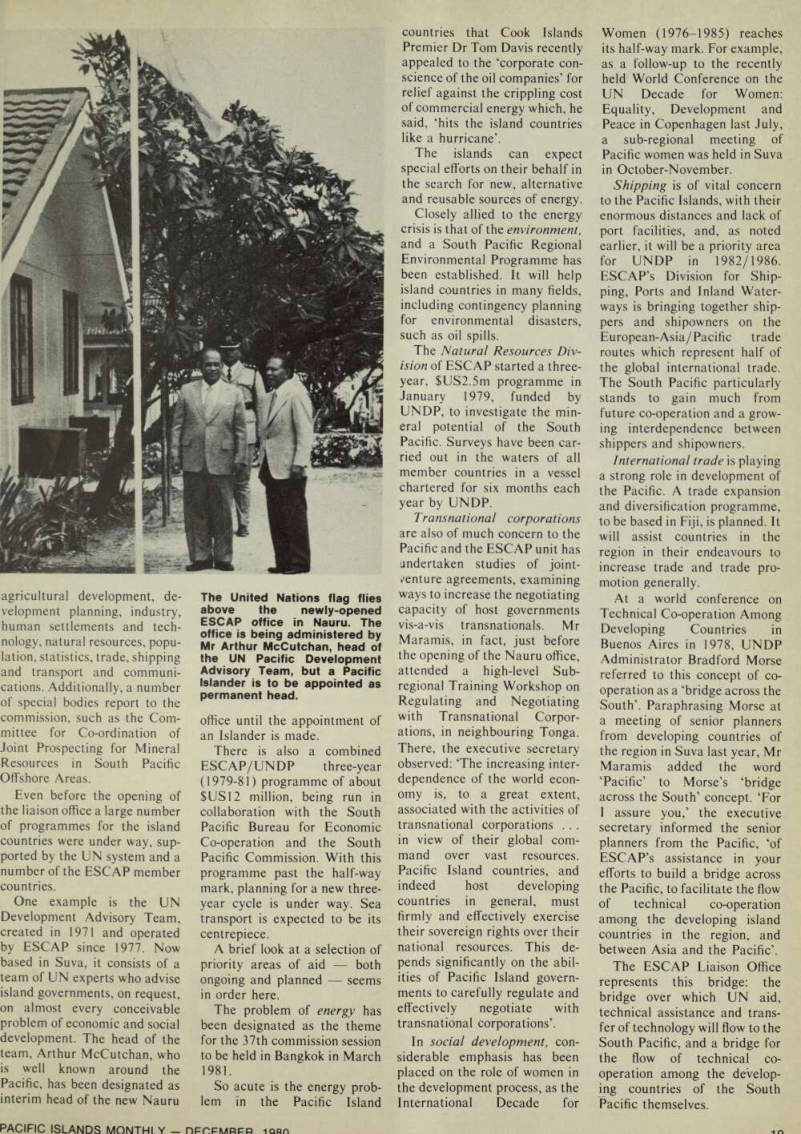
The United Nations flag flies above the newly-opened ESCAP office in Nauru. The office is being administered by Mr Arthur McCutchan, head of the UN Pacific Development Advisory Team, but a Pacific Islander is to be appointed as permanent head.