Politics without protest emerge
pp. 11-15 · Read in the full issue
from South Pacific Conference
delegates from 26 metropolitan and Pacific Island countries met in Port Moresby in October for the 21st South Pacific Conference hosted this year by the Papua New Guinea government. They approved a budget of SA3.B million for the ■ontinuing work of the South Pacific Commission, they debated the problem of nuclear waste in the Pacific environment, hev turned a deaf ear for the time being to a PNG proposal for a Pacific Island political alliance, and they heard lome strong words from women who want a bigger role in Pacific affairs. PIM Editor Angus Smales, who was at the ronference, writes this report.
i significant aspect of this ear’s South Pacific Confer nce in Port Moresby was the itrusion of political issues hthout protest. Traditionally tie conference is a non-political ffair in which delegates from articipating governments of tie South Pacific Commission )ok at their environment, their Dciety, their technology and tieir welfare. They share their ieas and concentrate on the imilarities of ambition and ackground which override tra itional, cultural and political inferences.
At earlier conferences there ave been walk-outs and pro mts over what delegates saw as olitical trends in discussion, ut this year two issues were eavily loaded politically with ut interrupting the work or the ow of the conference. The rst, and the most sensitive, ivolved the political tensions urrounding Japanese proposals 3 dump nuclear waste in the western Pacific. Diplomatic co xistence involving some of the letropolitan countries watered own the attitude of the confer nce but the important point /as the willingness of delegates d discuss the issue ispassionately and to accept he opinions of participating overnments despite wide pread objections by Island overnments themselves to /asle-dumping in the Pacific.
The second political issue /as a proposal by PNG to form political alliance of Pacific slands ‘so that we can talk with ne voice in the world forum, nd through United Nations if iccessary’. The proposal re eived an apathetic reception, ►ut no one became steamed up iver it on the basis of politics.
Speaking informally after he conference senior delegates aid that the emergence of ringe political issues was not
unexpected in the new nation atmosphere of today’s Pacific region. They believed that pol itical issues would increasingly intrude on general debates in volving the SPC, but did not see this as a threat to the tra ditional work or structure of the
Spc.
The inclusion of Micronesian countries in this year’s confer ence added to the scope of debates. The countries were the Commonwealth of the North ern Mariana Islands, the Feder ated States of Micronesia, Guam, Marshall Islands and the Trust Territory of the Pacific Islands. All are north of the Equator, leading to infor mal supposition that the names South Pacific Commission and South Pacific Conference are fast on the way to becoming outdated.
Nuclear waste
Unofficial reports from Japan last month suggested that the Japanese government may back down at least for the time being from its controversial intention to dump low-level encapsulated nuclear waste in the Western Pacific. The pro posed site is about 900 km from the Mariana Islands.
However the conference met earlier when Japan was still insisting that the dumping would go ahead, and delegates were presented with an im passioned plea from Governor Carlos Comacho of the Com monwealth of Northern Mariana Islands. He asked the conference to endorse a motion of protest, and delegates from seven Pacific Island nations voiced the opposition of their governments to the Japanese plan. Carefully avoiding any direct initial reference to Japan Governor Comacho said ‘We have been shown an arrogant and malicious disregard of our
rights as people of the Pacific.
We reap no benefits from nu clear energy but we are being forced to share its hazards.’
Other delegates spoke of ‘the untold dangers which are only now being revealed’ and de scribed the huge clean-up cam paign which USA ‘had been obliged to shoulder in an at tempt to bury the wastes from nuclear tests on Eniwetak Atoll’. (See PIM cover picture, this issue.) The leader of the PNG del egation to the talks, Primary Industry Minister Roy Evara, said the Pacific remained one of the few major areas of the world not generally polluted by the results of nuclear activity.
He believed pressures should be exerted politically to keep it that way.
Vanuatu told the conference through its delegate, Primary Industry Minister Thomas Seru, that nuclear powers should dump their waste in their own areas ‘and leave our areas alone’.
It was at this stage that Britain and US intervened in the talks with France show ing tacit acceptance of the intervention and won accept ance of a watered-down motion dictated by diplomatic con siderations. In its final form the resolution adopted by the con ference did not protest against the Japanese plan but merely ‘noted the concern expressed by Pacific Island countries’ over the Japanese plan. The resol ution also ‘noted the desire of Pacific Island countries that alternative means and areas should be used for the disposal of nuclear waste’.
Governor Comacho said after the debate he was disap pointed that the final resolution had not been more strongly worded but he believed the Islands people had made their
point and would continue their campaign to keep the Pacific nuclear-free.
Norfolk Island
In a statement issued outside the conference room the Chief Minister of Norfolk Island, Mr David Buffett, claimed that Australia was suppressing Norfolk’s role as a member of the Pacific community. Norfolk Island, off the east coast of Australia, is technically part of Australia but has been granted a degree of autonomy. Mr Buffett attended the conference as a member of the Australian delegation.
In his statement Mr Buffett said that Norfolk Island had attended last year’s South Pacific Conference as an ad viser to the Australian del egation. Since then, he said, Norfolk had evolved from ‘a colonial-type administration to a fully-elected legislative as sembly with legislative and executive authority.’ He said Norfolk had anticipated that this would empower it to exer cise a conference vote, taking up an unused voting potential nominally held by Australia on behalf of Norfolk Island.
He said he was deeply con cerned to find that as a result of Australian intervention a pro cedural meeting preceding the conference had excluded Norfolk Island from the oppor tunity to vote in its own right.
Norfolk Island had protested strongly to the Australian government on the grounds that it was preventing Norfolk from ‘drawing closer to the Pacific family and having a voice in Pacific affairs’. He said he had sought to address the confer ence on the issue but the leader of the Australian delegation, Senator J. P. Sim, had refused permission.
Senator Sim commented out
side the conference that he was aware of the Norfolk protest but he believed the basis of the protest was not valid. The simple legal fact remained that Norfolk Island was part of Australia and funded by Aust ralia although it had an auton omy within that structure. He said that it was unthinkable that different parts of a single country could have individual voting rights in an international body. Senator Sim said re search had failed to establish
why Norfolk had been listed several years ago as a potential voting entity, and Australia’s recent action had been to cor rect this anomaly. He believed that Norfolk Island political leaders had not been unaware of the anomaly despite their current protest.
Political bloc
A feature of the conference was a bid by Papua New Guinea to sponsor a political alliance which could speak in world forums with one voice on behalf of the Pacific Islands. PNG invited delegates from all Island countries to an unofficial meeting to discuss the proposal.
The meeting did not eventuate however, apparently from hesi tance rather than from outright opposition. There was a feeling
among some delegates that the matter was too political for association with an SPC oc casion. Some of the smaller nations appeared to have vague suspicions of PNG, possibly based on size and possibly fuelled by PNG’s recent mili tary intervention (although by request) in the affairs of Vanuatu. Whatever the reason, the PNG proposal received some token support but little more.
The proposal was made by the leader of the PNG del egation, Primary Industry Min ister Roy Evara, who praised the work of existing regional institutions but said the Pacific was too unco-ordinated in the way it faced the world at large.
The original text of his speech called for a ‘political alliance’, although in delivering it he changed the words to a ‘strong organisation’. Later in talks with newsmen and other del egates he confirmed that the real nature of his proposal referred to a political bloc.
By acting individually, he said, the Island countries lacked the strength to protect their region effectively against major international pressures and attitudes.
In his prepared speech for the conference Mr Evara had planned to suggest that his proposed organisation should be ‘structured along the lines of the Organisation of African Unity with similar goals and functions’. He obviously be came aware of the sensitivities which developed, and deleted this part of his speech. However the text had already been circulated and added to the reluctance of delegates to com mit their support. Mr Evara said later that his sole concern was for a unified Pacific, and PNG would continue to work in that direction.
Women’s role
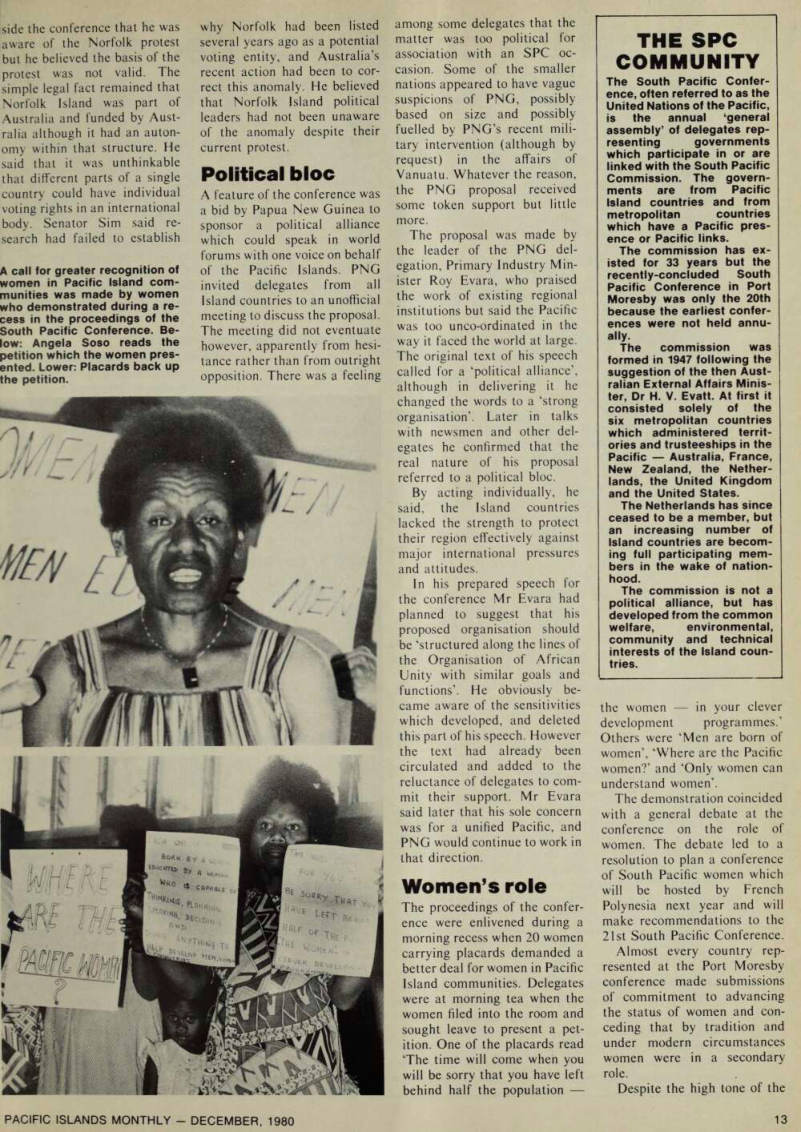
The proceedings of the confer ence were enlivened during a morning recess when 20 women carrying placards demanded a better deal for women in Pacific Island communities. Delegates were at morning tea when the women filed into the room and sought leave to present a pet ition. One of the placards read ‘The time will come when you will be sorry that you have left behind half the population
the women in your clever
development programmes.’
Others were ‘Men are born of women’, ‘Where are the Pacific women?’ and ‘Only women can understand women’.
The demonstration coincided with a general debate at the conference on the role of women. The debate led to a resolution to plan a conference of South Pacific women which will be hosted by French Polynesia next year and will make recommendations to the 21st South Pacific Conference.
Almost every country rep resented at the Port Moresby conference made submissions of commitment to advancing the status of women and con ceding that by tradition and under modern circumstances women were in a secondary role.
Despite the high tone of the
A call for greater recognition of women in Pacific Island com munities was made by women who demonstrated during a re cess in the proceedings of the South Pacific Conference. Be low: Angela Soso reads the petition which the women pres ented. Lower: Placards back up the petition.
reports and the sentiments ex pressed, many women were irritated by their nature, describing then as patronising and seeking to provide con cessions for women. ‘We want a position where we are recog nised as part of the community not concessions’ they said.
Mrs Kila Amini, Executive Director of YWCA in PNG, put it bluntly when she said ‘lt’s the attitudes that need to change. Why talk all the time about a role for women? Why not a debate on a role for men?’
But the women’s prize for annoyance went to the delegate who told the conference smugly ‘We recognise the position of women. We have a woman member in our delegation.
She’s sitting up the back there somewhere’.
Mosquito war
Fish, worms and artificially cultivated germs may be used in Island countries as part of an SPC campaign against disease carrying mosquitoes. Details of the biological control pro gramme against mosquitoes were reported to the Port Moresby conference by the SPC Secretary-General, Mr Young Vivian.
Mr Vivian said that biologi cal control of the mosquito population would be a new weapon in reducing the preva lence of at least five dangerous diseases carried by mosquitoes.
The diseases are malaria, dengue fever, Ross River fever, filariasis and encephalitis. The SPC, working in conjunction with the World Health Organis ation, will conduct a series of tests on a suitable small island which has yet to be selected and the results of the tests will be made available to SPC countries.
The standard method of con trol practised at present is to use chemical insecticides in either of two ways. One is spray fogging which indiscriminately kills mosquitoes in the immedi ate area, but which is impracti cal for the eradication of all mosquitoes. The other is re sidual spraying of vertical sur faces. Mosquitoes rest on verti cal surfaces immediately after biting people or animals, and the selective killing of these mosquitoes breaks the disease transmission cycle.
Mr Vivian told the confer ence that biological control was aimed at a significant reduction of the overall mosquito popu lation. This in turn would re duce the prevalence of diseases which were having a severe effect on the people and the economies of Island countries in the Pacific. The details of the preliminary programme were tabled at the conference in the SPC’s budget and works pro gramme for 1981. Conference delegates said that in many areas mosquitoes were develop ing a resistance to chemical insecticides, and there was also a risk to humans from the side effects of the insecticides. Con cern was also expressed that the continuing use of insecticides in large quantities could produce serious community health prob lems which might not become apparent for decades.
The ‘biological weapons’ which the SPC will use in its test campaign next year will include a nematode worm which will be placed in breed ing sites such as stagnant water, tree holes and coconut husks.
The worms are expected to eat the mosquito eggs, reducing breeding potential.
Another will be a bacterial agent which is harmless to people and animals but which can be placed in village water supplies to destroy the mos quito eggs. Other possibilities under consideration are types of fish which eat mosquito eggs in rivers and lakes.
The report said that the nematode worms and the bac terial agent had already demon strated an effectiveness in kill ing mosquito eggs, but full scale field tests were needed to demonstrate whether the prop osition was practical.
The report stressed that the necessary health assurances in relation to people has already been obtained, and there was also an assurance of environ mental protection. The ap proval on safety grounds had been provided by the World Health Organisation and by the United States Environmental Protection Agency.
If next year’s SPC tests are successful the project will be gradually extended to other islands and remote areas to develop a pool of information.
The cost of the immediate project will be about $2O 000.