Island empire
pp. 43-44 · Read in the full issue
Books
Australian dreams of Island empire
Australian Imperialism in the Pacific. By Roger C.
Thompson. Published by Mel bourne University Press. SA2S.
Isbn 0 522 84207 0.
In 1919 the Governor-General reported that William Morris Hughes was doing his best ‘to lash Australia into a desire to possess and administer the Pacific Islands, but the subject is not much mentioned at pub lic meetings'. As Roger Thompson's book shows it had been much the same for the preceding hundred years.
There has been no shortage of dreamers. If the colonial public had not risen to support an Australian empire in the islands, except for occasions when a fear of foreign attack was highlighted in debates, editorials and sermons, then it was not the fault of men like Hughes, Victorian Premier James Service and Queensland Premier Samuel Griffith.
The sub-title sets the author’s :anvas. ‘The Expansionist Era 1820-1920' allows Thompson o draw a distinction between he economic, evangelical and :olonising adventures of Aust rians in the islands, and the lalionalist-minded annex itionist schemes of mission tries. politicians and editors in Ylelbourne, Sydney and Brisbane.
The islands were known well mough by 1820 for colonial nerchanls and capitalists to tave been sailing east in search >f Tahitian pork, Fijian beche ie-mer. Rarotongan sandal vood, whales, seals, and, sev eral decades later, islanders hemselves to recruit for the
Queensland plantations.
Thompson does not go over he ground covered by Young,
Taude, Shineberg and
Bainsworth in detailing the
xtent of colonial economic nvolvement in the islands. He akes as his theme not the conomic and social expansion if Australians in the Pacific, »ut the expansionist, or nnexationist, doctrine es loused loudly, though not con istently, throughout the later
19th century. Australian im perialism appears as a series of campaigns liberally sprinkled with the names of known and lesser politicians, editors, col onial governors and secretaries of state. Despite this long roll call of expansionist-minded col onial Australians, the result is a book of events rather than of personalities. Characters like Hughes, Service and Griffith only rarely emerge from the lobbying, speeches, and policy debates.
Because few Australians bothered to take a stand on the future status of the nearby Melanesian islands, and be cause the Colonial Office in London was reluctant to allow the colonial, and later federal, parliaments to assume any sort of claim to the islands, this is record of stillborn plans and dreams.
There is little of the drama of Australians abroad in the islands. It is unfortunate that more space was not devoted to the personalities behind the events so carefully detailed. It was the men and women who moved in and out of the islands who gave weight to the doctrine that Australia had a natural right to claim the islands as theirs, and if not theirs, then at least Britain’s. By not extending the canvas to include the planter, trader, missionary and merchant the main theme re mains clearly stated but iso lated.
However, the documentation of colonising schemes and an nexation campaigns, of despatches to and from the Colonial Office, and of the parochialism and inter-colonial jealousies of the Australian scene mark this as a major contribution to the study of Australian foreign policy.
Thompson’s major theme is the development of an Aust ralian policy on the New Hebrides. Fiji, Papua, Samoa and New Guinea are presented as minor forays of Australian expansionism, usually linked with ulterior economic motives.
More than half the book is
given to recording the long running campaigns to deter France from, and push Britain into, annexing the New Hebrides. Hughes was able to claim success in 1920, for at least the condominium arrange ment stopped France from declaring a unilateral annex ation.
The Fiji question, formally settled by British annexation, is treated in a separate chapter, but the attempt of Fiji settlers (mostly ex-Australian colonists) to unite Fiji with New Zealand, Victoria or a Federated Aust ralia in the 1870 s and 1880 s deserves more attention in a book with this title. The same may be said regarding Papua, New Guinea and to a lesser extent Tonga and Samoa. It is a shame that Thompson did not weave more of the fruits of other research into this book.
The result would have been a detailed recounting of the New Hebrides story, but improved considerably by being set in the context of the full spectrum of Australian involvement and in terests.
Involvement and interest were not always related as motives for policies on island affairs. At times interest was strong and was expressed in well attended public meetings.
However, these were often kite flying exercises, lacking in volvement on the ground, and even in the New Hebrides, where missionary involvement
was already strong, planting and trading involvement had to be created to give weight to campaigns for Australian, and if not, British annexation. On occasions when Thompson es capes his rather analytical stance, it is possible to see how illusions of a ‘grand destiny’ and the broad sweep of beckon ing arms were used as vote attracting features of politics, then as now.
The fate of the islanders was secondary to the advancement of the white man and, as the Colonial Office pointed out, Australians did not have a good record of establishing harmony and rule among coloured peoples. By the author’s own admission much more needs to be said about events and personalities out in the islands.
Thompson does not seek to offer any analysis or description of relationships in the islands and this will be a disappointment for those familiar with the
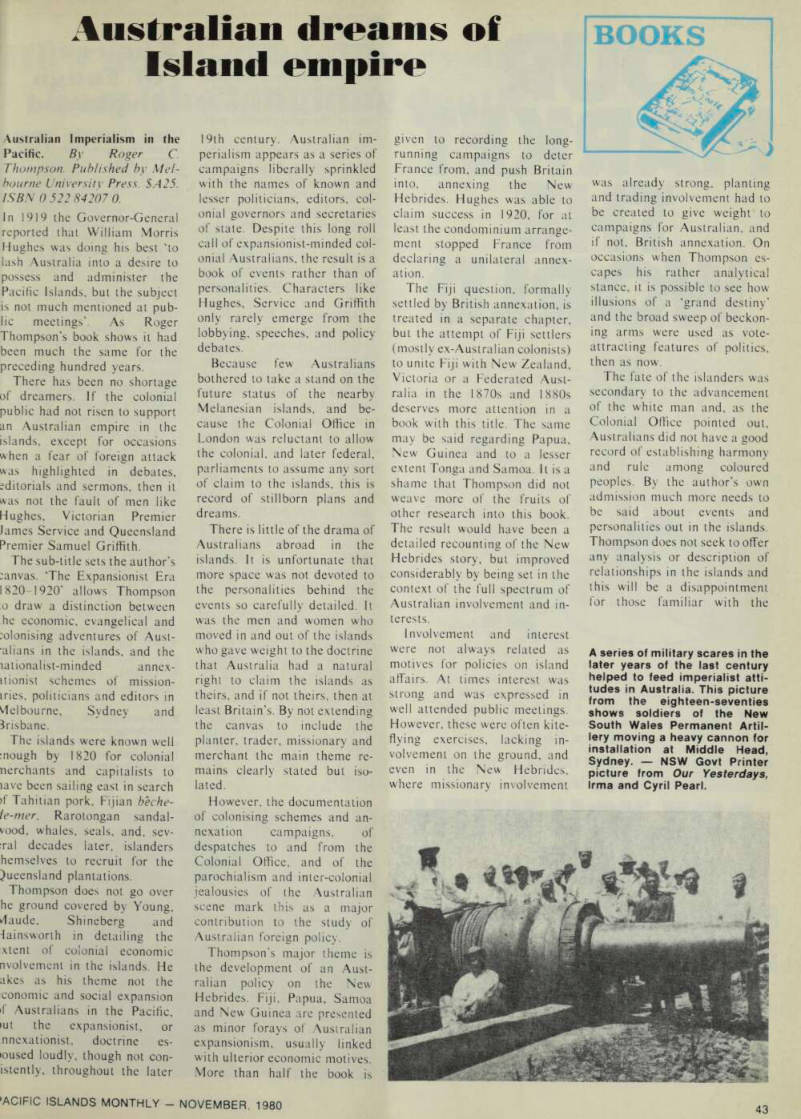
A series of military scares in the later years of the last century helped to feed imperialist atti tudes in Australia. This picture from the eighteen-seventies shows soldiers of the New South Wales Permanent Artil lery moving a heavy cannon for installation at Middle Head,
Sydney. - NSW Govt Printer
picture from Our Yesterdays, Irma and Cyril Pearl.
chronology of Australian in volvement, and who now seek more detail on the interaction occurring on the beach, in the village, and along the water front of the early Pacific port towns.
This will inevitably be shelved beside Angus Ross’s work on New Zealand’s aspir ations in the Pacific in the 19th century. Together they capably record how the two perimeter nations assumed a self-imposed, though on some grounds well deserved, overlordship of affairs in the Southwest Pacific region.
Thompson has filled a long standing gap in the history of Australian interest, if not in volvement, in the islands. The debate over the origins of the founding of Botany Bay con tinues and the trading activities of the penal colony period have been well covered. Recent studies have focused on the defence-conscious Pacific foreign policy rhetoric of the early twentieth century. This study of Australian imperialism during the expansionist period 1820-1920 bridges these two, and at the same time highlights the need for a history written about Australians out in the islands.
At such a high price and short length, one should be careful not to be misled by the title. The 50 pages of footnotes and bibliography testify to the scholarship, but while offering a fine history of the New Hebrides question, it falls short of the mark in recording the full story of Australian expansion ism in the islands. Max Quanchi.