Opposition to nuclear dump
pp. 34-37 · Read in the full issue


nuclear dump
Opposition is growing in Pacific Island countries to a Japanese plan to dump low-level nuclear waste in the Pacific. Here BILL GASSON in Wellington and MICHAEL PRAIN in Port Moresby report on the situation.
Over the next two years or so Japan plans to dump up to 10 000 200-litre drums of low level nuclear waste into inter national Pacific waters south east of its own marine bound aries. The operation is de scribed as ‘experimental’ and it could lead to the dumping of even greater quantities of waste in subsequent years.
Conscious of the sensitivity of the plan among Pacific countries and islands, a four man scientific team from Japan’s Science and Tech nology Agency has toured the South Pacific on a public re lations trip to explain Japan’s plans and to give assurances that all will be well.
In Guam they ran into some blunt questioning from Micronesian leaders who had gathered there for their Pacific Basin summit conference.
These island nations that rely on the sea for their riches wanted no part of any dumping scheme and said so. ‘We couldn’t conquer the emotional approach,’ said Horishi Goto, the deputy Director General of the Agency who led the mission. He was speaking in Wellington when the mission arrived in New Zealand.
In Wellington however the Japanese believed they had succeeded in their objective to explain and to reassure. They based this view on comments by Prime Minister Robert Muldoon who opposed indiscriminate and uncon trolled dumping of nuclear waste.
However Mr Muldoon then added that the Japanese had given an assurance that their dumping programme would be carried out strictly in com pliance with all applicable in ternational agreements. ‘We welcome that assurance,’ he said. The Japanese delegation took this to mean approval, or
at least understanding of their proposal. Mr Muldoon also made the point that the Japanese had emphasised that their experimental programme would be monitored for safety for two to three years before full scale dumping proceeded.
The site for the dumping ground is about 900 km southwest of Tokyo and 1100 km north of the Mariana Islands in water 600 m deep.
Armed with colourful bro chures that carefully explained the exceeding low limits of radiation expected to escape from the cement-filled stainless steel drums, the Japanese ex plained the trouble they went to in selecting the right spot that was free from volcanic disturb ances and lacked seabed re sources. The Japanese said they had detected manganese nod ules there but the depth was too great for recovery and the manganese could not be con sidered a resource.
The Japanese said that if any governments sought the pro gressive results of monitoring the experimental dumping pro gramme, the information would be freely provided.
Despite the repeated assur ances that Japan believed it had the experience to guarantee the safely of the operation and to avoid uncontrollable pollution of the sea, the scientists admit ted to some areas of doubt.
These included projections on how far radiation might spread throughout the Pacific from the drums and how many drums of waste Japan expected to be dumping in the sea by 1990 when it would have trebled its nuclear power generation ca pacity. At present Japan gener ates 12% of national electric power from its 21 reactors.
Questioned about the dis covery of marine mutations near the United States former dumping area in the Pacific, the
Japanese said that the Americans had used a different type of radioactive material and had simply pushed it into drums that had not been able to resist pressures in deep water.
For those still unconvinced by Japan's reassurances that no harm could come from dump ing radioactive waste in the sea, the Japanese emphasised that maximum radiation from the drums would be only 1% of the concentration permitted by the 1972 London Dumping Con vention as set out by the International Atomic Energy Agency.
Japan plans to become a signatory to the convention later this year and then to start its experimental dumping in July next year.
In Port Moresby, the Papua New Guinea government made a request to Japan to discon tinue its plans to dump nuclear waste in the Pacific. The re quest was issued soon after the four-man delegation arrived to explain the dumping operation and to give reasons why it would not be harmful.
The PNG Foreign Minister, Mr Noel Levi, said no amount of scientific evidence could convince his government to change its policy on a nuclear free Pacific. The Pacific was one of the world’s last unspoiled environmental areas and the PNG government would never agree to its being used as a nuclear testing or dumping ground, he said.
Mr Levi said the environ mental effects of nuclear waste dumping would not be known for many decades. The Japanese had said the dumping of the radioactive waste was experimental, a test to deter mine whether the system was safe and proper for future use.
The government would greatly prefer that Japan indicate its confidence in the success of these tests by conducting the tests within its own 200-mile limit,’ he said.
Mr Levi said all countries in
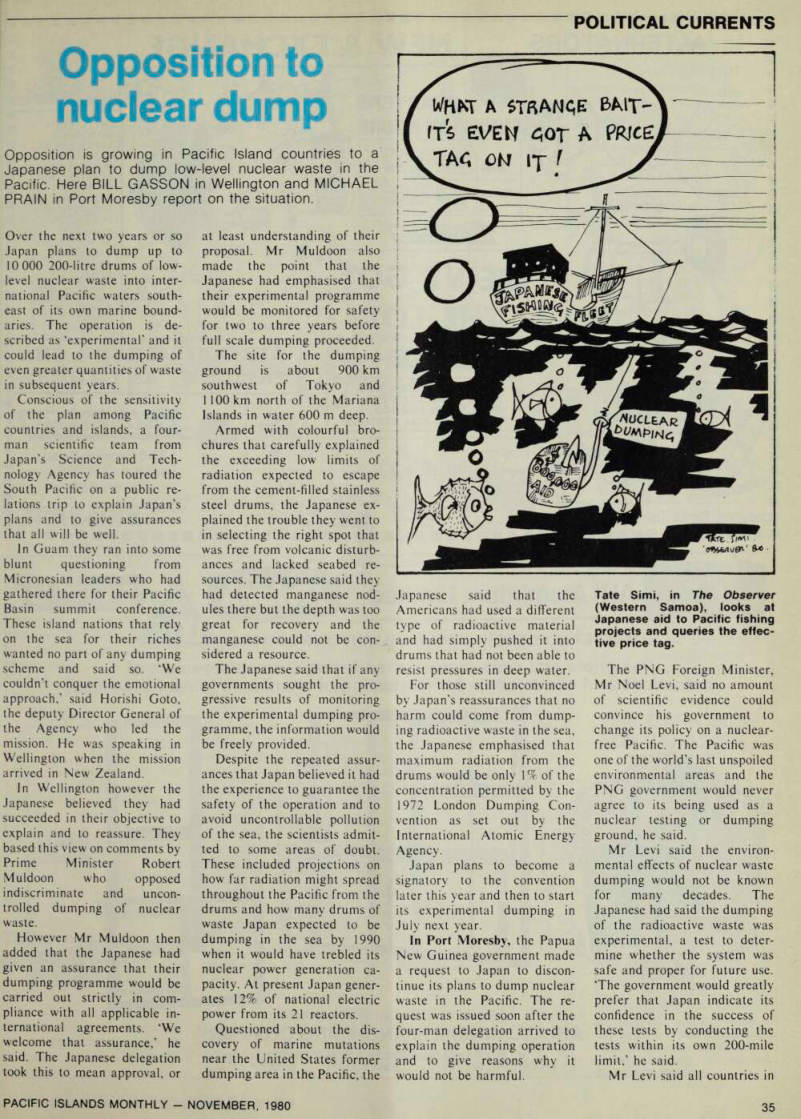
Tate Simi, in The Observer (Western Samoa), looks at Japanese aid to Pacific fishing projects and queries the effec tive price tag.
the region had openly expressed opposition to the tests. ‘ln the face of such total opposition, the Japanese should abandon their plans,’ he said.
The Japafiese dumping plans have also raised high emotions among PNG university students. A group of placard waving students staged a demonstration outside the Japanese embassy in Port Moresby where they handed a protest letter to a Japanese diplomat who assured them it would be conveyed to his government.
From Saipan a recent report indicates that the Yap legis lature has adopted a formal motion of protest against the Japanese intentions and the Truk legislature has reinforced an earlier protest. The two legislatures are requesting the Federated States of Micronesia to boycott Japanese goods.
They are also appealing for similar action from countries throughout the Pacific.
Talks oppose
nuclear power
Members of private delegations from five Pacific Island countries have appealed to Australia to end all alignments with nuclear-orientated powers in a bid to keep the Pacific nuclear-free.
The decision was taken at a Sydney conference late in September. The conference, named the nuclear-free Pacific forum for independence and peace, was sponsored by the Association for International Co-operation and Disarma ment. The five Pacific Island areas from which delegates came were Micronesia, Papua New Guinea, Fiji, Vanuatu and Hawaii. Australia and Japan also had representatives. Del egates from New Caledonia and French Polynesia had been invited but did not attend. They were to have been Marc Pomare from French Polynesia who said that his passport and visa application disappeared in the mail, and Jan Uregi from New Caledonia who had insufficient time to make ar rangements.
The conference followed similar anti-nuclear talks held in Hawaii in May, but it also took in wider discussions which the organisers described as ‘helping to develop awareness and support in Australia for Pacific people’s movements for independence and peace’. This aspect of the talks created some criticism from hard-core anti nuclear activists who claimed that discussions had been too far-reaching and vague and had watered down the central pur pose.
The anti-colonial aspect of the talks was a direct sequel to a series of meetings with Pacific liberation groups held in Vanuatu during independence week late in July.
The Sydney conference drew up working policies for future anti-nuclear activities. It also made plans to provide infor mation networks and the greatest possible publicity for what the delegates described as liberation movements in French Polynesia, New Caledonia, West Irian, Okinawa and the Southern Philippines (the Moro movement).
The forum called for the immediate release of Tahitians in gaol in France. It was requested that direct material aid be sent to Vanuatu because of the enormous cost of ending the Santo rebellion. At the forum $7OO was collected for the Vanuatu delegate, Hilda Lini, to take back with her to Port-Vila.
The Japanese delegation of 20 included a survivor of Hiroshima and a spokesman for the little-known Okinawa Lib eration Front. The Japanese offered their expertise in the study of waste disposal and in
the provision of medical treat ments.
The forum called for a non aligned Australia with a reformulated foreign policy advocating a halt to further testing and stock-piling of nu clear weapons and dumping of nuclear waste. It also called for a decrease in nuclear submar ine activity, the independence of French colonies and the withdrawal of support for U.S. bases in the area. Speakers stressed that there can be no technical distinction between nuclear power programmes for peaceful purposes and for weapons production.
The conference endorsed plans for a New Zealand peace ship to go to Bangor in Washington State when USA launches its next Trident nu clear submarine there in August 1981, and for an invi tation for the peace ship Fri to return to the South Pacific.
Support was also expressed at the forum for the General Workers Union strike in Kiri bati.
Many motions put to the forum were idealistic and naive having little to do with a nuclear-free Pacific. For the visiting delegates, the forum acted mainly as a platform to air their views and frustrations to the political left in Australia.
Very little was communicated to the Australian public be cause of poor media coverage.
Tony Cole
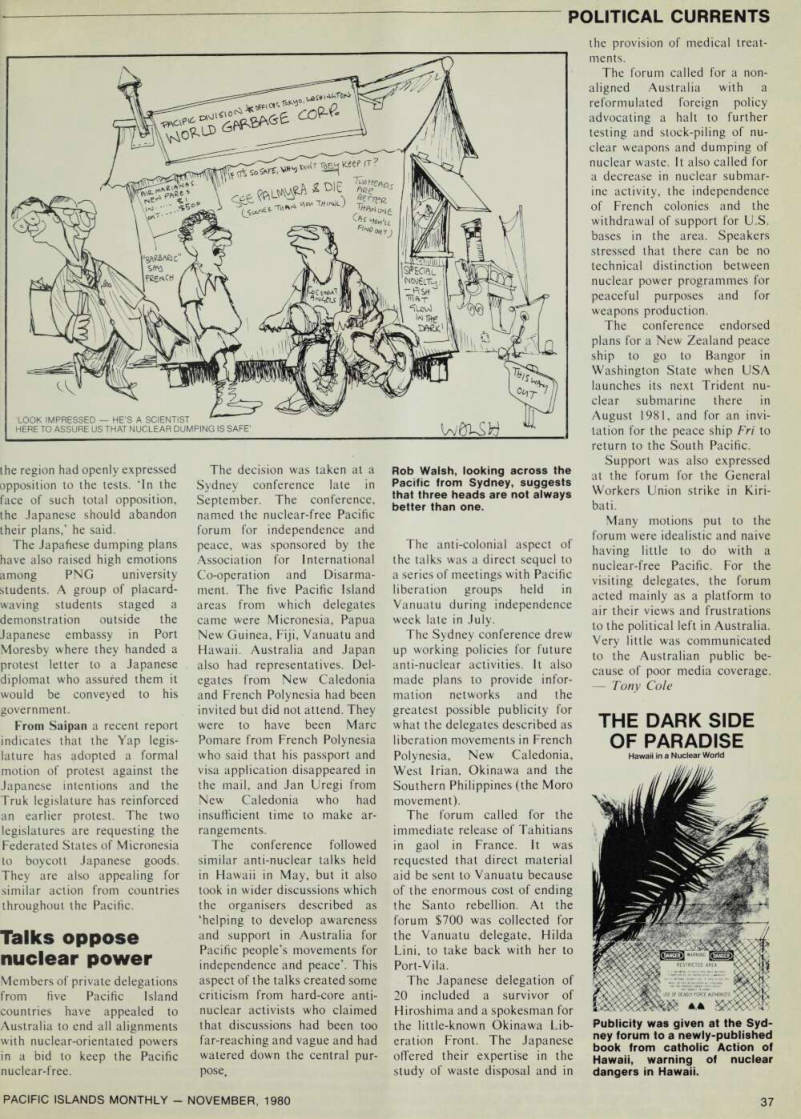
Rob Walsh, looking across the Pacific from Sydney, suggests that three heads are not always better than one.