Yachts
pp. 74-77 · Read in the full issue
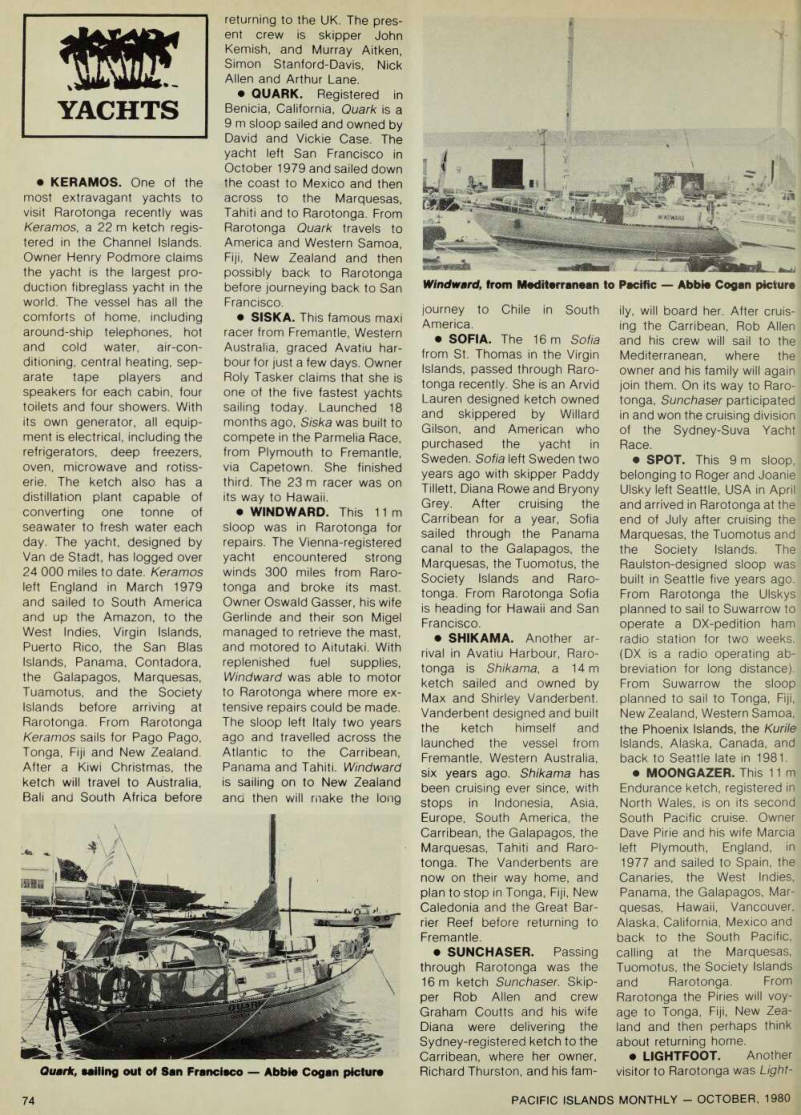
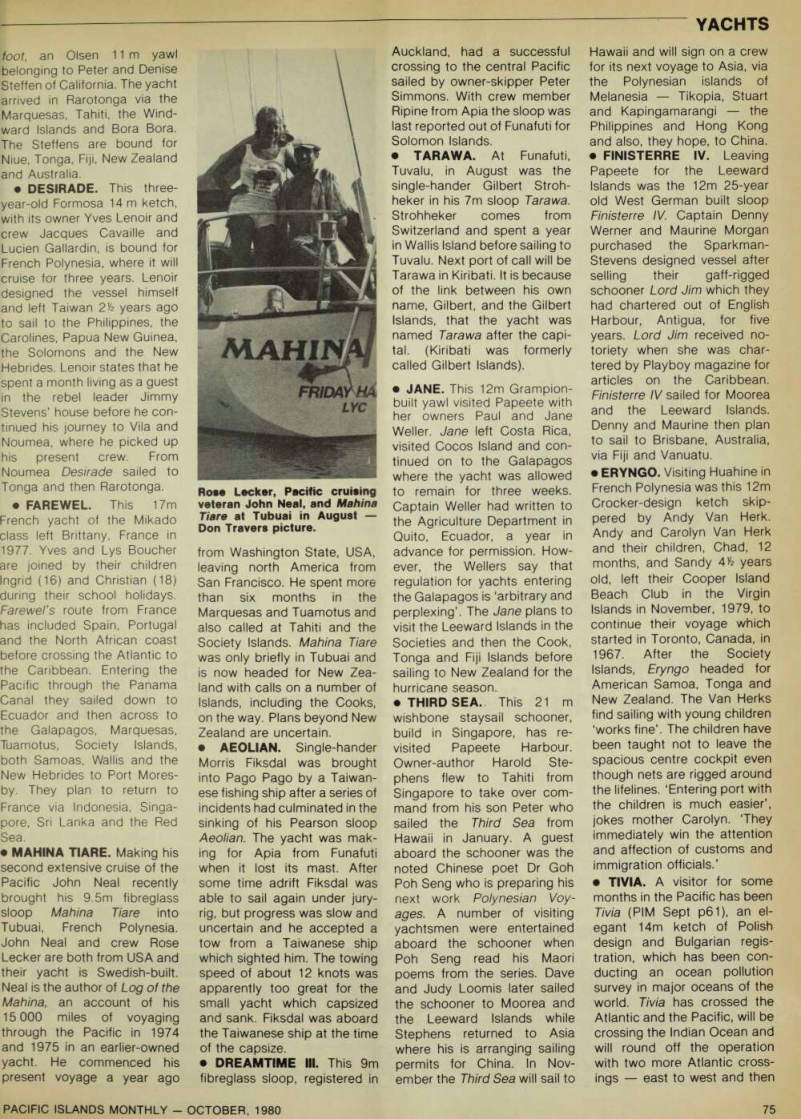
returning to the UK. The pres ent crew is skipper John Kemish, and Murray Aitken, Simon Stanford-Davis, Nick Allen and Arthur Lane. e QUARK. Registered in Benicia, California, Quark is a 9 m sloop sailed and owned by David and Vickie Case. The yacht left San Francisco in October 1979 and sailed down the coast to Mexico and then across to the Marquesas, Tahiti and to Rarotonga. From Rarotonga Quark travels to America and Western Samoa, Fiji, New Zealand and then possibly back to Rarotonga before journeying back to San Francisco. • SISKA. This famous maxi racer from Fremantle, Western Australia, graced Avatiu har bour for just a few days. Owner Roly Tasker claims that she is one of the five fastest yachts sailing today. Launched 18 months ago, Siska was built to compete in the Parmelia Race, from Plymouth to Fremantle, via Capetown. She finished third. The 23 m racer was on its way to Hawaii. • WINDWARD. This 11 m sloop was in Rarotonga for repairs. The Vienna-registered yacht encountered strong winds 300 miles from Raro tonga and broke its mast.
Owner Oswald Gasser, his wife Gerlinde and their son Migel managed to retrieve the mast, and motored to Aitutaki. With replenished fuel supplies, Windward was able to motor to Rarotonga where more ex tensive repairs could be made.
The sloop left Italy two years ago and travelled across the Atlantic to the Carribean, Panama and Tahiti. Windward is sailing on to New Zealand and then will make the long
• KERAMOS. One of the most extravagant yachts to visit Rarotonga recently was Keramos, a 22 m ketch regis tered in the Channel Islands.
Owner Henry Podmore claims the yacht is the largest pro duction fibreglass yacht in the world. The vessel has all the comforts of home, including around-ship telephones, hot and cold water, air-con ditioning. central heating, sep arate tape players and speakers for each cabin, four toilets and four showers. With its own generator, all equip ment is electrical, including the refrigerators, deep freezers, oven, microwave and rotiss erie. The ketch also has a distillation plant capable of converting one tonne of seawater to fresh water each day. The yacht, designed by Van de Stadt, has logged over 24 000 miles to date. Keramos left England in March 1979 and sailed to South America and up the Amazon, to the West Indies, Virgin Islands, Puerto Rico, the San Bias Islands, Panama, Contadora, the Galapagos, Marquesas, Tuamotus, and the Society Islands before arriving at Rarotonga. From Rarotonga Keramos sails for Pago Pago, Tonga, Fiji and New Zealand.
After a Kiwi Christmas, the ketch will travel to Australia, Bali and South Africa before
journey to Chile in South America. • SOFIA. The 16 m Sofia from St. Thomas in the Virgin Islands, passed through Raro tonga recently. She is an Arvid Lauren designed ketch owned and skippered by Willard Gilson, and American who purchased the yacht in Sweden. Sofia left Sweden two years ago with skipper Paddy Tillett, Diana Rowe and Bryony Grey. After cruising the Carribean for a year, Sofia sailed through the Panama canal to the Galapagos, the Marquesas, the Tuomotus, the Society Islands and Raro tonga. From Rarotonga Sofia is heading for Hawaii and San Francisco. • SHIKAMA. Another ar rival in Avatiu Harbour, Raro tonga is Shikama, a 14m ketch sailed and owned by Max and Shirley Vanderbent.
Vanderbent designed and built the ketch himself and launched the vessel from Fremantle, Western Australia, six years ago. Shikama has been cruising ever since, with stops in Indonesia, Asia, Europe, South America, the Carribean, the Galapagos, the Marquesas, Tahiti and Raro tonga. The Vanderbents are now on their way home, and plan to stop in Tonga, Fiji, New Caledonia and the Great Bar rier Reef before returning to Fremantle. • SUNCHASER. Passing through Rarotonga was the 16 m ketch Sunchaser. Skip per Rob Allen and crew Graham Coutts and his wife Diana were delivering the Sydney-registered ketch to the Carribean, where her owner, Richard Thurston, and his fam
ily, will board her. After cruis ing the Carribean, Rob Allen and his crew will sail to the Mediterranean, where the owner and his family will again join them. On its way to Raro tonga, Sunchaser participated in and won the cruising division of the Sydney-Suva Yacht Race. • SPOT. This 9 m sloop, belonging to Roger and Joanie Ulsky left Seattle, USA in April and arrived in Rarotonga at the end of July after cruising the Marquesas, the Tuomotus and the Society Islands. The Raulston-designed sloop was built in Seattle five years ago.
From Rarotonga the Ulskys planned to sail to Suwarrow to operate a DX-pedition ham radio station for two weeks. (DX is a radio operating ab breviation for long distance).
From Suwarrow the sloop planned to sail to Tonga, Fiji, New Zealand, Western Samoa, the Phoenix Islands, the Kurile Islands, Alaska, Canada, and back to Seattle late in 1981.
• Moongazer. This 11 M
Endurance ketch, registered in North Wales, is on its second South Pacific cruise. Owner Dave Pirie and his wife Marcia left Plymouth, England, in 1977 and sailed to Spain, the Canaries, the West Indies, Panama, the Galapagos, Mar quesas, Hawaii, Vancouver, Alaska, California, Mexico and back to the South Pacific, calling at the Marquesas, Tuomotus, the Society Islands and Rarotonga. From Rarotonga the Piries will voy age to Tonga, Fiji, New Zea land and then perhaps think about returning home. • LIGHTFOOT. Another visitor to Rarotonga was Light
Quark, sailing out of San Francisco - Abbie Cogan picture
Windward, from Mediterranean to Pacific - Abbie Cogan picture
foot, an Olsen 11 m yawl belonging to Peter and Denise Steffen of California. The yacht arrived in Rarotonga via the Marquesas, Tahiti, the Wind ward Islands and Bora Bora.
The Steffens are bound for Niue, Tonga, Fiji, New Zealand and Australia. • DESIRADE. This three year-old Formosa 14 m ketch, with its owner Yves Lenoir and crew Jacques Cavaille and Lucien Gallardin, is bound for French Polynesia, where it will cruise for three years. Lenoir designed the vessel himself and left Taiwan 2Vz years ago to sail to the Philippines, the Carolines, Papua New Guinea, the Solomons and the New Hebrides. Lenoir states that he spent a month living as a guest in the rebel leader Jimmy Stevens’ house before he con tinued his journey to Vila and Noumea, where he picked up his present crew. From Noumea Desirade sailed to Tonga and then Rarotonga. • FAREWEL. This 17m French yacht of the Mikado class left Brittany, France in 1977. Yves and Lys Boucher are joined by their children Ingrid (16) and Christian (18) during their school holidays.
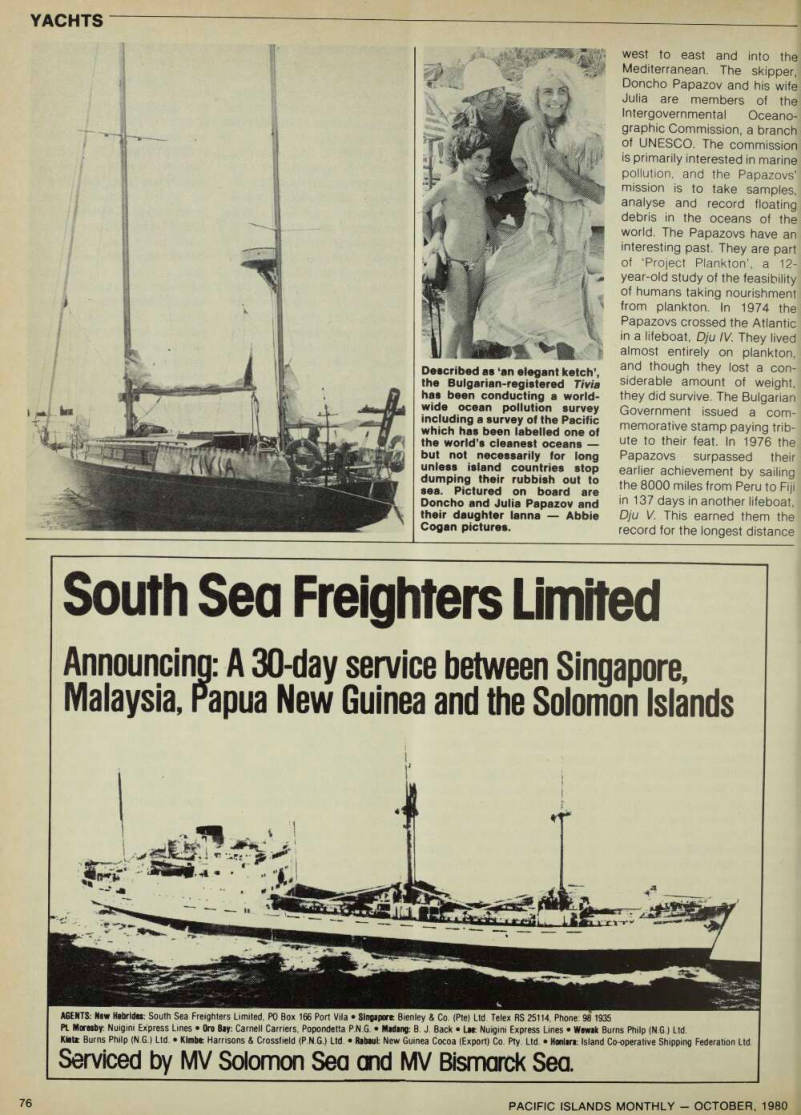
FareweTs route from France has included Spain, Portugal and the North African coast before crossing the Atlantic to the Caribbean. Entering the Pacific through the Panama Canal they sailed down to Ecuador and then across to the Galapagos, Marquesas, Tuamotus, Society Islands, both Samoas, Wallis and the New Hebrides to Port Mores by. They plan to return to France via Indonesia, Singa pore, Sri Lanka and the Red Sea. • MAHINA TIARE. Making his second extensive cruise of the Pacific John Neal recently brought his 9.5 m fibreglass sloop Mahina Tiare into Tubuai, French Polynesia.
John Neal and crew Rose Lecker are both from USA and their yacht is Swedish-built.
Neal is the author of Log of the Mahina, an account of his 15 000 miles of voyaging through the Pacific in 1974 and 1975 in an earlier-owned yacht. He commenced his present voyage a year ago
from Washington State, USA, leaving north America from San Francisco. He spent more than six months in the Marquesas and Tuamotus and also called at Tahiti and the Society Islands. Mahina Tiare was only briefly in Tubuai and is now headed for New Zea land with calls on a number of Islands, including the Cooks, on the way. Plans beyond New Zealand are uncertain. • AEOLIAN. Single-hander Morris Fiksdal was brought into Pago Pago by a Taiwan ese fishing ship after a series of incidents had culminated in the sinking of his Pearson sloop Aeolian. The yacht was mak ing for Apia from Funafuti when it lost its mast. After some time adrift Fiksdal was able to sail again under jury rig, but progress was slow and uncertain and he accepted a tow from a Taiwanese ship which sighted him. The towing speed of about 12 knots was apparently too great for the small yacht which capsized and sank. Fiksdal was aboard the Taiwanese ship at the time of the capsize.
• Dreamtime 111. This 9M
fibreglass sloop, registered in
Auckland, had a successful crossing to the central Pacific sailed by owner-skipper Peter Simmons. With crew member Ripine from Apia the sloop was last reported out of Funafuti for Solomon Islands. • TARAWA. At Funafuti.
Tuvalu, in August was the single-hander Gilbert Stroh heker in his 7m sloop Tarawa.
Strohheker comes from Switzerland and spent a year in Wallis Island before sailing to Tuvalu. Next port of call will be Tarawa in Kiribati. It is because of the link between his own name, Gilbert, and the Gilbert Islands, that the yacht was named Tarawa after the capi tal. (Kiribati was formerly called Gilbert Islands). • JANE. This 12m Grampion built yawl visited Papeete with her owners Paul and Jane Weller. Jane left Costa Rica, visited Cocos Island and con tinued on to the Galapagos where the yacht was allowed to remain for three weeks.
Captain Weller had written to the Agriculture Department in Quito, Ecuador, a year in advance for permission. How ever, the Wellers say that regulation for yachts entering the Galapagos is ‘arbitrary and perplexing’. The Jane plans to visit the Leeward Islands in the Societies and then the Cook, Tonga and Fiji Islands before sailing to New Zealand for the hurricane season. • THIRD SEA. This 21 m wishbone staysail schooner, build in Singapore, has re visited Papeete Harbour.
Owner-author Harold Ste phens flew to Tahiti from Singapore to take over com mand from his son Peter who sailed the Third Sea from Hawaii in January. A guest aboard the schooner was the noted Chinese poet Dr Goh Poh Seng who is preparing his next work Polynesian Voy ages. A number of visiting yachtsmen were entertained aboard the schooner when Poh Seng read his Maori poems from the series. Dave and Judy Loomis later sailed the schooner to Moorea and the Leeward Islands while Stephens returned to Asia where his is arranging sailing permits for China. In Nov ember the Third Sea will sail to
Hawaii and will sign on a crew for its next voyage to Asia, via the Polynesian islands of Melanesia Tikopia, Stuart and Kapingamarangi the Philippines and Hong Kong and also, they hope, to China. • FINISTERRE IV. Leaving Papeete for the Leeward Islands was the 12m 25-year old West German built sloop Finisterre IV. Captain Denny Werner and Maurine Morgan purchased the Sparkman- Stevens designed vessel after selling their gaff-rigged schooner Lord Jim which they had chartered out of English Harbour, Antigua, for five years. Lord Jim received no toriety when she was char tered by Playboy magazine for articles on the Caribbean.
Finisterre IV sailed for Moorea and the Leeward Islands.
Denny and Maurine then plan to sail to Brisbane, Australia, via Fiji and Vanuatu. • ERYNGO. Visiting Huahine in French Polynesia was this 12m Crocker-design ketch skip pered by Andy Van Herk.
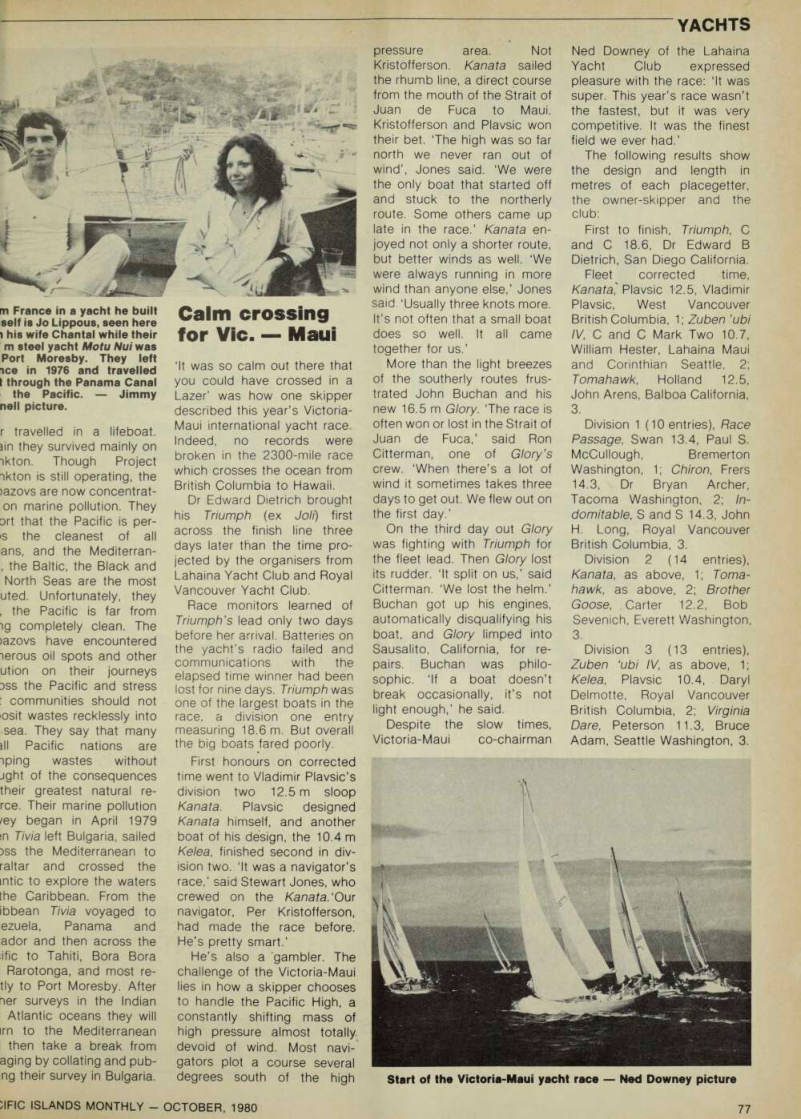
Andy and Carolyn Van Herk and their children, Chad, 12 months, and Sandy 4V2 years old, left their Cooper Island Beach Club in the Virgin Islands in November, 1979, to continue their voyage which started in Toronto, Canada, in 1967. After the Society Islands, Eryngo headed for American Samoa, Tonga and New Zealand. The Van Herks find sailing with young children ‘works fine’. The children have been taught not to leave the spacious centre cockpit even though nets are rigged around the lifelines. ‘Entering port with the children is much easier’, jokes mother Carolyn. ‘They immediately win the attention and affection of customs and immigration officials.’ • TIVIA. A visitor for some months in the Pacific has been Tivia (PIM Sept p6l), an el egant 14m ketch of Polish design and Bulgarian regis tration, which has been con ducting an ocean pollution survey in major oceans of the world. Tivia has crossed the Atlantic and the Pacific, will be crossing the Indian Ocean and will round off the operation with two more Atlantic cross ings east to west and then
Rose Lecker, Pacific cruising veteran John Neal, and Mahina Tiare at Tubuai in August - Don Travers picture.
west to east and into the Mediterranean. The skipper, Doncho Papazov and his wife Julia are members of the Intergovernmental Oceano graphic Commission, a branch of UNESCO. The commission is primarily interested in marine pollution, and the Papazovs’ mission is to take samples, analyse and record floating debris in the oceans of the world. The Papazovs have an interesting past. They are part of ‘Project Plankton’, a 12year-old study of the feasibility of humans taking nourishment from plankton. In 1974 the Papazovs crossed the Atlantic in a lifeboat, Dju IV. They lived almost entirely on plankton, and though they lost a con siderable amount of weight, they did survive. The Bulgarian Government issued a com memorative stamp paying trib ute to their feat. In 1976 the Papazovs surpassed their earlier achievement by sailing the 8000 miles from Peru to Fiji in 137 days in another lifeboat, Dju V. This earned them the record for the longest distance
Described as ‘an elegant ketch’, the Bulgarian-registered Tivia has been conducting a world wide ocean pollution survey including a survey of the Pacific which has been labelled one of the world’s cleanest oceans but not necessarily for long unless island countries stop dumping their rubbish out to sea. Pictured on board are Doncho and Julia Papazov and
their daughter lanna - Abbie
Cogan pictures.
r travelled in a lifeboat, lin they survived mainly on ikton. Though Project nkton is still operating, the >azovs are now concentrat on marine pollution. They art that the Pacific is per s the cleanest of all ans, and the Mediterran , the Baltic, the Black and North Seas are the most uted. Unfortunately, they , the Pacific is far from ig completely clean. The >azovs have encountered lerous oil spots and other ution on their journeys ass the Pacific and stress : communities should not osit wastes recklessly into sea. They say that many ill Pacific nations are aping wastes without jght of the consequences their greatest natural re rce. Their marine pollution began in April 1979 m Tivia left Bulgaria, sailed ass the Mediterranean to raltar and crossed the intic to explore the waters the Caribbean. From the ibbean Tivia voyaged to ezuela, Panama and ador and then across the ific to Tahiti, Bora Bora Rarotonga, and most re tly to Port Moresby. After her surveys in the Indian Atlantic oceans they will irn to the Mediterranean then take a break from aging by collating and pub ng their survey in Bulgaria.
Calm crossing
for Vic. Maui
‘lt was so calm out there that you could have crossed in a Lazer’ was how one skipper described this year’s Victoria- Maui international yacht race.
Indeed, no records were broken in the 2300-mile race which crosses the ocean from British Columbia to Hawaii.
Dr Edward Dietrich brought his Triumph (ex Joli) first across the finish line three days later than the time pro jected by the organisers from Lahaina Yacht Club and Royal Vancouver Yacht Club.
Race monitors learned of Triumph’s lead only two days before her arrival. Batteries on the yacht’s radio failed and communications with the elapsed time winner had been lost for nine days. Triumph was one of the largest boats in the race, a division one entry measuring 18.6 m. But overall the big boats fared poorly.
First honours on corrected time went to Vladimir Plavsic’s division two 12.5 m sloop Kanata. Plavsic designed Kanata himself, and another boat of his design, the 10.4 m Kelea, finished second in div ision two. ‘lt was a navigator’s race,’ said Stewart Jones, who crewed on the Kanata. 1 Our navigator, Per Kristofferson, had made the race before.
He’s pretty smart.’
He’s also a gambler. The challenge of the Victoria-Maui lies in how a skipper chooses to handle the Pacific High, a constantly shifting mass of high pressure almost totally devoid of wind. Most navi gators plot a course several degrees south of the high
pressure area. Not Kristofferson. Kanata sailed the rhumb line, a direct course from the mouth of the Strait of Juan de Fuca to Maui.
Kristofferson and Plavsic won their bet. The high was so far north we never ran out of wind’, Jones said. ‘We were the only boat that started off and stuck to the northerly route. Some others came up late in the race.’ Kanata en joyed not only a shorter route, but better winds as well. ‘We were always running in more wind than anyone else,’ Jones said. ‘Usually three knots more.
It’s not often that a small boat does so well. It all came together for us.’
More than the light breezes of the southerly routes frus trated John Buchan and his new 16.5 m Glory. ‘The race is often won or lost in the Strait of Juan de Fuca,’ said Ron Citterman, one of Glory’s crew. ‘When there’s a lot of wind it sometimes takes three days to get out. We flew out on the first day.’
On the third day out Glory was fighting with Triumph for the fleet lead. Then Glory lost its rudder. ‘lt split on us,’ said Citterman. ‘We lost the helm.’
Buchan got up his engines, automatically disqualifying his boat, and Glory limped into Sausalito, California, for re pairs. Buchan was philo sophic. ‘lf a boat doesn’t break occasionally, it’s not light enough,’ he said.
Despite the slow times, Victoria-Maui co-chairman
Ned Downey of the Lahaina Yacht Club expressed pleasure with the race: ‘lt was super. This year’s race wasn’t the fastest, but it was very competitive. It was the finest field we ever had.’
The following results show the design and length in metres of each placegetter, the owner-skipper and the club: First to finish, Triumph, C and C 18.6, Dr Edward B Dietrich, San Diego California.
Fleet corrected time, Kanata' Plavsic 12.5, Vladimir Plavsic, West Vancouver British Columbia, 1; Zuben ’ubi IV, C and C Mark Two 10.7, William Hester, Lahaina Maui and Corinthian Seattle, 2; Tomahawk, Holland 12.5, John Arens, Balboa California, 3.
Division 1 (10 entries), Race Passage, Swan 13.4, Paul S.
McCullough, Bremerton Washington, 1; Chiron, Frers 14.3, Dr Bryan Archer, Tacoma Washington, 2; In domitable, S and S 14.3, John H. Long, Royal Vancouver British Columbia, 3.
Division 2 (14 entries), Kanata, as above, 1; Toma hawk, as above, 2; Brother Goose, Carter 12.2, Bob Sevenich, Everett Washington, 3.
Division 3 (13 entries), Zuben ‘ubi IV, as above, 1; Kelea, Plavsic 10.4, Daryl Delmotte, Royal Vancouver British Columbia, 2; Virginia Dare, Peterson 11.3, Bruce Adam, Seattle Washington, 3.
[?]m France in a yacht he built [?] self is Jo Lippous, seen here [?] his wife Chantal while their [?] m steel yacht Motu Nui was
[?] Port Moresby. They left
[?] ce in 1976 and travelled
[?] t through the Panama Canal
[?] the Pacific. - Jimmy
[?] nell picture.
Start of the Victoria-Maui yacht race - Ned Downey picture