favour of the Islands world
pp. 39-41 · Read in the full issue


Fraser: Redressing the balance in favour of the Islands world
Australian Prime Minister Malcolm Fraser touched on important, and sometimes deli cate, issues in the Australia- Pacific Islands connection dur ing a July news conference in Suva on his way to the South Pacific Forum meeting in Tarawa (PIM Aug pi 7). Be cause some of the matters discussed rarely receive public airing, PIM reproduces below extracts from the conference transcript, which has been re leased by the Australian High Commission in Suva.
Mr Fraser: I welcome very much the opportunity that I’ve had this morning and over lunchtime for discussions with the prime minister of Fiji and with members of his govern ment. There is a very good and close relationship between Fiji and Australia, and the pro cedure we instituted at a special Forum meeting at Rotorua a number of years ago, by which officials of both countries meet as a matter of course at fre quent intervals, has been a very useful innovation in helping to resolve any difficulties or mis understandings that might arise from lime to lime. This means that the matters get resolved quickly and in a happy and acceptable manner.
Over the last five years, in the period of my government, Aust ralia has sought to place greater emphasis on relationships with the Pacific countries, and for very obvious reasons. It’s an important region and we have many interests in common in making sure that great-power rivalry docs not intrude into the area, and in the peaceful social and economic development of all countries concerned. We have sought to assist and co operate in aid and in trade matters, and the new trade agreement (the South Pacific Regional Trade and Economic Co-operation Agreement
Sparteca, Pim Sep P 53) Is
one which I hope will be of particular benefit to a number
of specific countries, including, of course, Fiji . . .
It’s probably because of the difficulties that there have been in South-east Asia off and on over I suppose the last 25 years, and Australia’s preoccupation with them, partly through a traditional relationship with Britain, and our own direct involvement in activities in South-east Asia from time to time Malaysia in particular in early days, and before inde pendence that much of our diplomatic effort has gone into that area, and also into Papua New Guinea, because of a traditional and different kind of relationship there.
I think these are the reasons why Australia in the past may not have paid as much attention to the countries of the Pacific as I and my government believe Australia should have paid. I started by saying that over recent years we have sought to redress that. The aid pro gramme has increased substan tially. But it’s not just a ques tion of aid, it’s the political involvement, the participation, communication, and the efforts to increase trade that are very important.
I also discussed the forth coming Commonwealth Heads of Government Regional Meet ing in India, and Fiji’s prime minister and I both regard this as an important innovation which ought to be continued, with every two years a regional meeting again, to maintain the links and the opportunities pro vided for regional members of the Commonwealth to concen trate on matters of particular concern to them matters that often they will find it very difficult to get on the agenda of the full Commonwealth Confer ence. . .
Question: On the wire service this morning it was reported that a New Caledonian mission has been to visit Mr Peacock (Australian minister for foreign affairs) pushing for indepen dence for New Caledonia. We didn’t have any suggestion of what Mr Peacock said, but I would like to ask where Aust ralia stands on the issue of independence for New Caledonia and other French territories in the Pacific.
Fraser: I've heard the presi dent of France saying that if countries wish to vote for their independence France will re-
sped that view, and I don’t want to say more than that I was glad to hear that statement because we do believe in the independence of peoples and the right of peoples to govern themselves and determine their own future without inter ference. That is a very passion ate belief on the part of Aust ralia.
Question: You mentioned that since your government has been in power, recognising that this area has been slightly neglected by your country, you have made efforts to increase trade between Australia and Fiji, and to help Fiji. Now a bone of contention meanwhile has been duty-free trade. Our local duty-free traders are screaming that their counter parts in Australia are just about cutting their throats. You are pushing to upgrade your duty free trade by, for instance, what you’ve got at your airports.
Fraser: 1 only heard about it this morning. It is not a pro posal of (the Fiji) government as I understand it. Whether our transport people have been examining this or not I’m not too sure, but I will look into that and see . . . I will examine (it) when I get back to Australia because I was only advised of it, and not by the (Fiji) govern ment but by one of my own people, this morning.
Question: There have been suggestions by Pacific leaders and people in Pacific countries
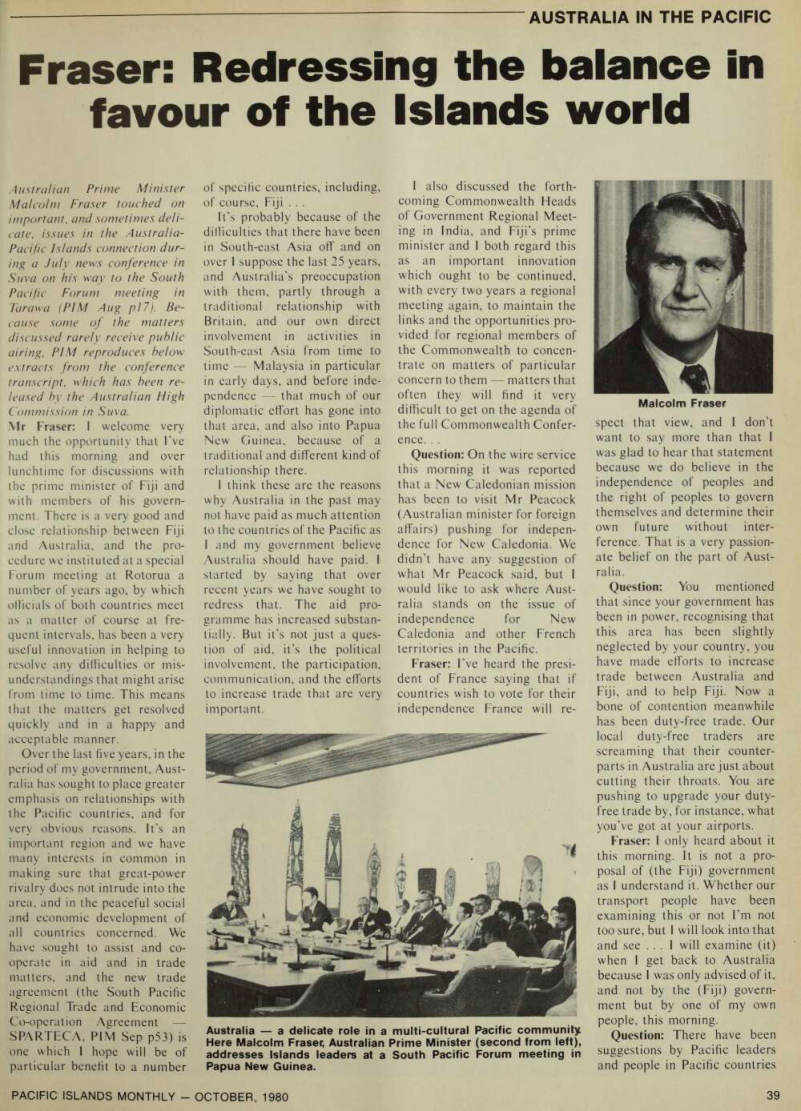
Australia - a delicate role in a multi-cultural Pacific community.
Here Malcolm Fraser, Australian Prime Minister (second from left), addresses Islands leaders at a South Pacific Forum meeting in Papua New Guinea.
Malcolm Fraser
in the past that if Australia really wants to help people of the region they should allow more people from the Pacific into Australia and help them to settle there and get jobs there rather than (inaudible) white immigration policy.
Fraser: Well, we haven’t got a white immigration policy. It is totally non-discriminatory and if you look at the figures for immigration over recent years that will be proved completely.
We've taken more refugees from South-east Asia than any other country in the world in relation to the size of our population, and we will be continuing to take large num bers of refugees. I think you’ll all regard that as a very signifi cant responsibility that we ought to fulfil. The refugee movement is larger than the refugee movement promoted by Vietnam, it’s larger than the refugee movement promoted by Nazi Germany in the 19305.
That gives the extent of the human problem that’s involved, and so we’ve been seeking very substantially to respond to that.
But we also need to note that what Australia can do is limited by the level of unemployment in Australia. It’s a question of all countries being able to lift their own standards of living and work for all the people of the country.
A number of people from many countries come to be educated in Australia because they want to, or because they come under an aid programme, and the numbers in that area will increase. Some restrictions that had operated on private students who wanted to come to Australia, especially in relation to secondary schools, are being lifted, and that might assist a significant number of people who would want to participate in the education process in Australia.
But I would also hope that the overwhelming majority of such people would then want to use their skills for the advan tage of their own countries, and help to lift the standard of life of all their own people. . .
Question: What are your feel ings on a migrant worker scheme similar to that which operates between New Zealand and us?
Fraser: I think there are some difficulties in that. I don’t think it could be restricted to one country. It's a policy that we have not adopted, and mi gration to Australia has either been on a ‘visitors’ basis or on a more permanent basis under which people settle and live in the country.
Wc haven’t so far adopted what has been a common Euro pean practice as they call it ‘guest workers’. There have been problems when the countries that have had guest workers have had economic downturns. It’s the guest worker who has been the first to suffer. He gets sent home, so it’s not all benefit.
Question: Would it be true to say that Australia is not con templating any kind of guest worker, or immigrant worker, scheme at the moment?
Fraser: Not at the moment, no. It has been examined from time to time, but we felt that there were a number of diffi culties with that sort of ap proach. It could not be restric ted to one or two countries.
Question: You mentioned earlier that one of your con cerns was super-power rivalry in the Pacific . . .
Fraser: Well, 1 said our objec tive was to prevent great-power rivalry in the Pacific. Fm not saying that it exists. I’m saying a broad national objective, which I’m sure is shared by all the countries in the region, is to make sure that super-power rivalry does not intrude into the affairs of the Pacific. . .
Question: My newspaper quotes you this morning as having said in Guam that Americans are now stationing aircraft carriers in Australia and there was a survey team (from the US) to look into a naval base somewhere in south west Australia. Can you elabor ate on this?
Fraser: Well, they’re not stationing anyone. What we have said is that to help to maintain their Indian Ocean commitment we are prepared to provide facilities at our own military bases. This could be staging facilities through some of our air bases.
We’ve also indicated that we would be prepared to allow the US to use Cockburn Sound,
which is a major naval base in Western Australia, and we would be prepared to allow them to homeport ships there if they wanted to do so. They sent a team out to examine it and I think they were impressed with the base and what it offered.
But no decision has been made.
Question: This is basically to utilise your facilities, not to bring their own.
Fraser: They wouldn’t be establishing separate American bases. No, there’s no question of that. If they were homeport ing some of their own ships there, there might be additional facilities that they would want to provide. But there is no suggestion that they are going to establish additional bases in Australia.
We’ve made the offer under our defence commitment under ANZUS, Australia, New Zealand, the United States. We would believe that this kind of co-operation is an important part of that treaty. . .
Question: What measure of success have you had in dealing with your trade unions, and
what lessons can we learn from your measure of success?
Fraser: It’s a continuing problem. It’s a battle or an argument that is never com pletely won. There must be no relaxation.
There need to be attempts in many countries to try to per suade trade union leaders to be responsible, and to recognise their obligations not only to their own members but to the wider national community of which they are a part. So often union leadership does not do this. They look at the narrow concerns as they see them of their own union members.
Desirably, industrial disputes should be settled by nego tiation. But in our own experi ence they cannot all be, and there does need to be a frame work of firm, just, but resolute law within which industrial negotiations and consultations can take place. That’s es pecially so because in a modern society trade unions exert sig nificant power, and cannot be allowed to operate, in the Aust ralian view, outside the law.