‘ADAB’ - initials that count in
pp. 29-35 · Read in the full issue


Australia in the Pacific ‘ADAB’ - initials that count in Australian aid to the Pacific
Australia provides bilateral aid to 10 countries in the South Pacific: Papua New Guinea, the Cook Islands, Fiji, Kiribati, Niue, Solomon Islands, Tonga, Tuvalu, Vanuatu and Western Samoa. PNG is a major recipi ent of Australian aid ($A234 million in 1980-81) but is not dealt with here; most of Aust ralia’s aid to PNG takes the form of direct budget support and is therefore not subject to the same form of adminis
tration as is aid to other South Pacific countries.
Australia accepts a particu lar obligation to aid the countries of the South Pacific because of its geographical proximity, its special relation ship with countries of the area, and its position as a developed country in a region of develop ing countries. Australia at taches a great deal of import ance to its relationship with its Pacific neighbours and the sub stantial aid flows to them are a reflection of this. Humanitarian considerations are paramount but political and strategic fac tors are also important.
On February 19, 1980, in a speech to the House of Rep resentatives, the prime minister said the government realised that measures taken in relation to the Soviet Union had ad versely affected the tourist in dustry of some South Pacific countries. The government pro posed, among other things, to increase the amount of aid to the region.
The majority of Pacific Island countries face special problems that disadvantage them. The smallness of countries and their populations, plus the remoteness of islands from one another within indi vidual countries, and their iso lation from other regions, are
smallness of internal markets and limited numbers of skilled people. Most countries in the region are dependent on the production and export of one or two primary products which are highly vulnerable to the vagaries of world markets.
South Pacific countries are also experiencing foreign exchange problems accentuated by their dependence on imported oil and by their limited export perform ance.
South Pacific islanders have different social customs, family obligations and material expec tations which will affect what
forms of aid are sought by and acceptable to them. Through its dialogue with the South Pacific countries, Australia attempts to be sensitive to these fundamen tal aspects when planning and administering its aid.
South Pacific countries, with their relatively small bureaucracies, sometimes do not have the capacity to admin ister effectively the aid given by Australia and other donors. For example, the Australian Devel opment Assistance Bureau (ADAB), which administers the aid programme, is aware that these countries often find it
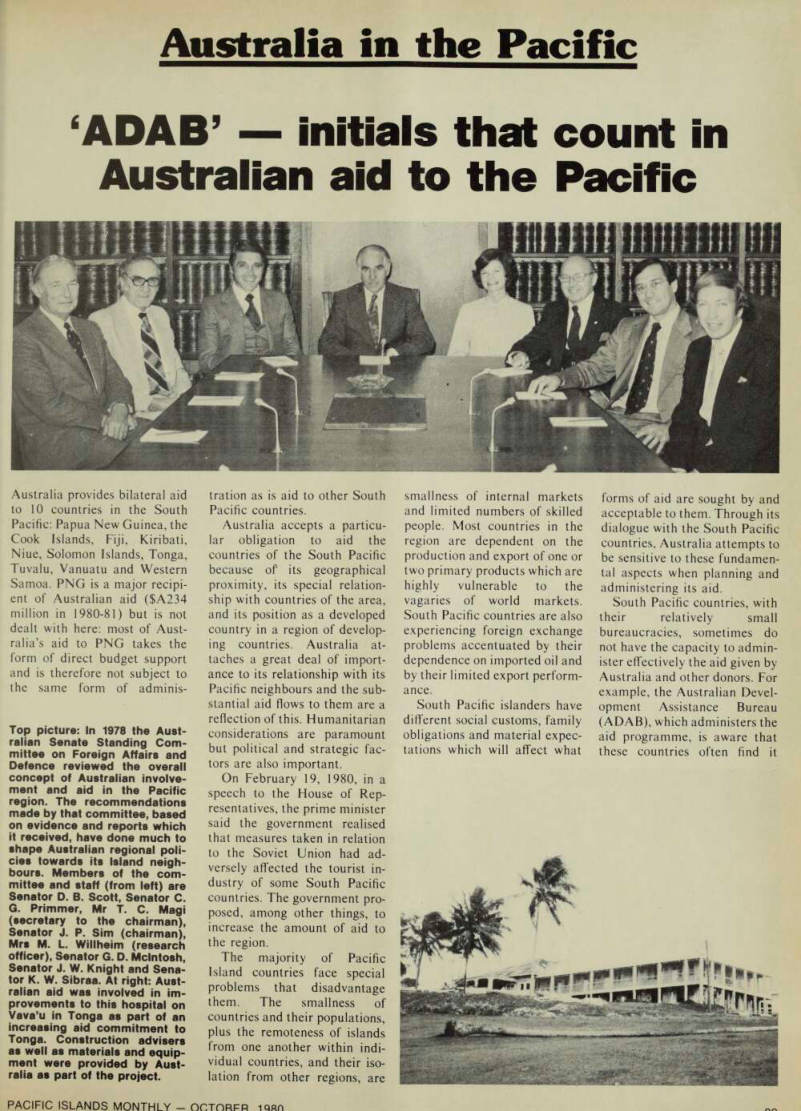
Top picture: In 1978 the Aust ralian Senate Standing Com mittee on Foreign Affairs and Defence reviewed the overall concept of Australian involve ment and aid in the Pacific region. The recommendations made by that committee, based on evidence and reports which it received, have done much to shape Australian regional poli cies towards its Island neigh bours. Members of the com mittee and staff (from left) are Senator D. B. Scott, Senator C.
G. Primmer, Mr T. C. Magi (secretary to the chairman), Senator J. P. Sim (chairman), Mrs M. L. Willheim (research officer), Senator G. D. Mclntosh, Senator J. W. Knight and Sena tor K. W. Sibraa. At right: Aust ralian aid was involved in im provements to this hospital on Vava’u in Tonga as part of an increasing aid commitment to Tonga. Construction advisers as well as materials and equip ment were provided by Aust ralia as part of the project.
difficult to do the detailed project preparation required to assess the feasibility of pro posals. Australian consultancies have therefore been funded to undertake these tasks, in conjunction with re cipient country officials.
The flexibility of aid, and its responsiveness to particular needs of the South Pacific, have been increased by the introduc tion of a number of initiatives designed to improve effectiveness. Local costs of projects, and in some cases their initial running costs, have been met from aid funds. De velopment Import Grants (DIGs) which provide for the importation of development goods and services from Aust ralia will be a continuing fa cility for a number of countries over the next three years.
DIGs are regarded as a satisfactory innovation, in that recipients have the freedom to determine the actual form of aid as long as it is for developmental purposes. Funds are also available for South Pacific governments to pur chase equity with Australian companies in joint business ventures.
Over the last eight years the level of Australian aid has risen rapidly. In 1972 $l5 million was allocated to cover a period of three and a half years.
During the three-year period 1976-77 to 1978-79 a total of $63,544 million was disbursed.
Expenditure for 1979-80 was $33,596 million. In February 1980 Prime Minister Malcolm Fraser announced that the level of aid would rise to $ 120 million for the three-year period 1980- 81 to 1982-83 which will pro vide for a small measure of real growth to the region. The funds allocated for 1980-81 are $36 million.
Aid takes broadly two forms: bilateral aid which is provided from Australia to individual countries and multilateral aid, where funds are allocated to international organisations and institutions which assist pro grammes in a number of countries. These include the United Nations Development Programme (UNDP), the World Health Organisation (WHO), and financial insti tutions such as the Asian Devel opment Bank (ADB) and the International Bank for Recon struction and Development (IBRD), which is part of the World Bank group. In addition, a number of ‘regional organis ations’ are supported, such as the South Pacific Commission (SPC), the South Pacific Bu reau for Economic Co
operation (SPEC) and the Uni versity of the South Pacific.
Project aid is given in accord ance with recipient govern ments’ own priorities. The range of projects is wide and spans the whole spectrum of development. For example, communications equipment for Fiji , a pilot launch for Vanuatu and bore-drilling equipment and pumps for Niue are being provided.
Emphasis is also placed on projects designed to strengthen the agricultural sector, either by improving the production of existing commodities or by ex panding into other areas. In the Cook Islands a project on the island of Aitutaki is designed to improve banana production.
The beef livestock industry is being assisted in Solomon Islands. Funds have been pro vided for the construction and equipping of a new desiccated coconut factory in Tonga. The bureau hopes that these proj ects will increase the ability of the South Pacific countries to generate more foreign exchange.
Grants to development banks and similar developmental funds acknowledge the need for augmenting sources of developmental capital in the South Pacific.
In response to the lack of skilled personnel in certain technical fields, experts may be
provided under the aid pro gramme. For example, the ser vices of a salt production ad visor have been provided for Fiji and a metrication expert for Solomon Islands. Other projects include training com ponents designed to improve the skills of local people in volved.
Training is a long-term answer to shortages of skilled personnel and approximately 291 people from the Pacific Islands (excluding PNG and the Trust Territory of the Pacific Islands) received train ing in Australia during 1979.
Training undertaken included formal academic studies in fields such as engineering, agriculture, public adminis tration and health services, attendance at Australian De velopment Assistance Courses in fields such as tropical fruit production and co-operatives management, and ad hoc prac tical training in fields such as health services and telecom munications. The latter courses are funded by ADAB and are designed to cater for the special
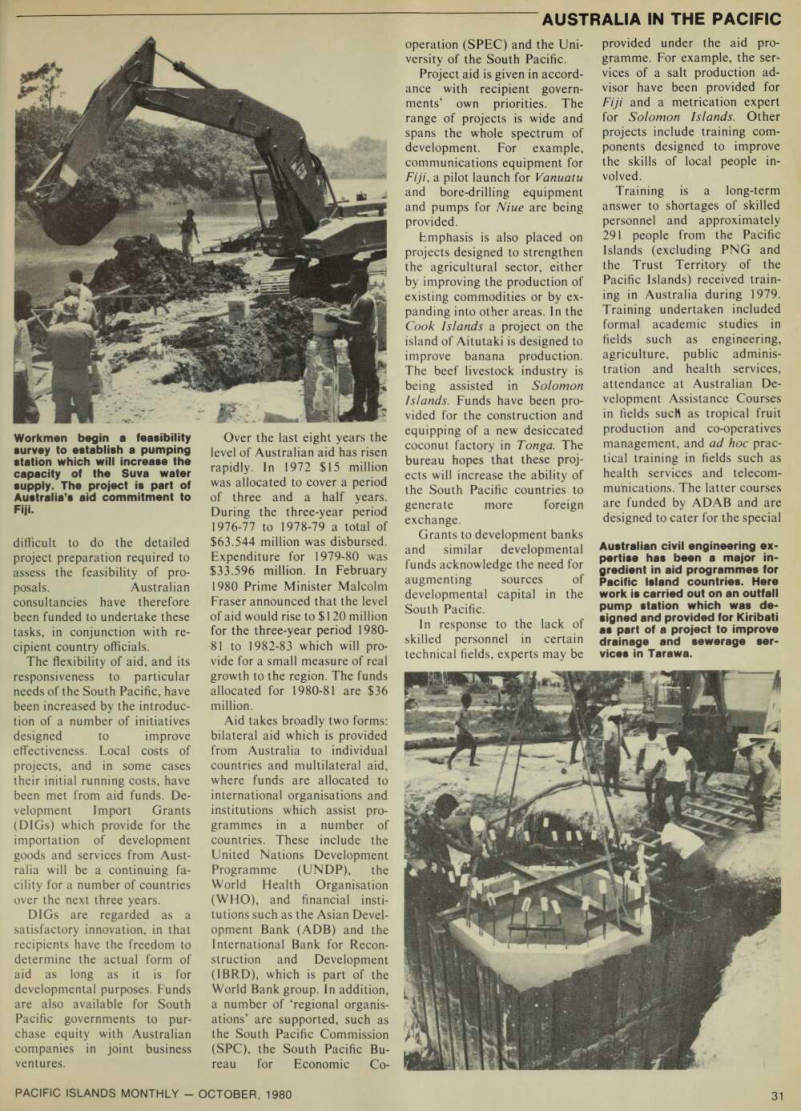
Workmen begin a feasibility survey to establish a pumping station which will increase the capacity of the Suva water supply. The project is part of Australia’s aid commitment to Fiji.
Australian civil engineering ex pertise has been a major in gredient in aid programmes for Pacific Island countries. Here work is carried out on an outfall pump station which was de signed and provided for Kiribati as part of a project to improve drainage and sewerage ser vices in Tarawa.
needs of developing countries in the region.
Other important features of training aid to the South Pacific are the availability of grants for training at a range of institutions in the region, including the University of the South
Pacific and the University of Papua New Guinea, and special training programmes conduc ted in the region either for one particular country or a number of countries, Staffing Assistance Schemes are operating in several South
Two aspects of Australian aid to Kiribati are shown in these pictures. Australia provided the fisheries training and extension vessel (top) which is part of an overall scheme in which Kiribati hopes to develop subsistence and commercial fishing ventures.
Two trainee teachers (above) are receiving in-service training at the Tarawa teachers college. Under earlier Australian policies training facilities were provided in Australia itself for Islanders, but the accent today is on making training available in the countries where the trainees live and work.
Pacific countries and are under consideration in others. Aust ralian nationals are recruited to fill a variety of professional, technical and administrative positions in South Pacific government public services and instrumentalities. Under the schemes Australia provides the funds to supplement local salaries paid by South Pacific governments.
Accountable cash grants are widely used in the South Pacific. These grants cover lo cal costs and the costs of importing goods and materials from Australia. They enable Australia to provide assistance for works that can be executed by the governments themselves and which would not be appro priate for the sophisticated management standards of large-scale project aid.
Australia is considering sup port for a pre-feasibility study into the need for further agri cultural research on basic food crops, such as taro and yams, as well as plantation crops with
export potential such as cocoa and coconuts.
ADAB, which is part of Australia’s Department of Foreign Affairs, has five officers at three posts in the South Pacific Suva, Apia and Honiara.
There are well over 200 projects in the region and officers at posts are required to undertake the preliminary ap praisal of proposed projects and the monitoring of existing ones.
Staffing constraints have meant many stages of aid delivery project appraisal, design im plementation and evaluation have been contracted out.
However, many of the staff in the South Pacific section in ADAB’s Canberra office have had first-hand experience of conditions in the region and the bureau as a whole is concerned that the aid it gives should be appropriately planned and im plemented. The evidence shows that it is constantly striving to improve its programmes and increase its responsiveness.
The newly-independent Republic of Vanuatu is receiving Australian aid for civil engineering construction works. Top picture shows an inspection of Moto Lava airstrip, one of the construction sites.
Picture above shows an Australian-financed survey on Niue Island, drilling for possible irrigation water supplies.