People
pp. 33-37 · Read in the full issue
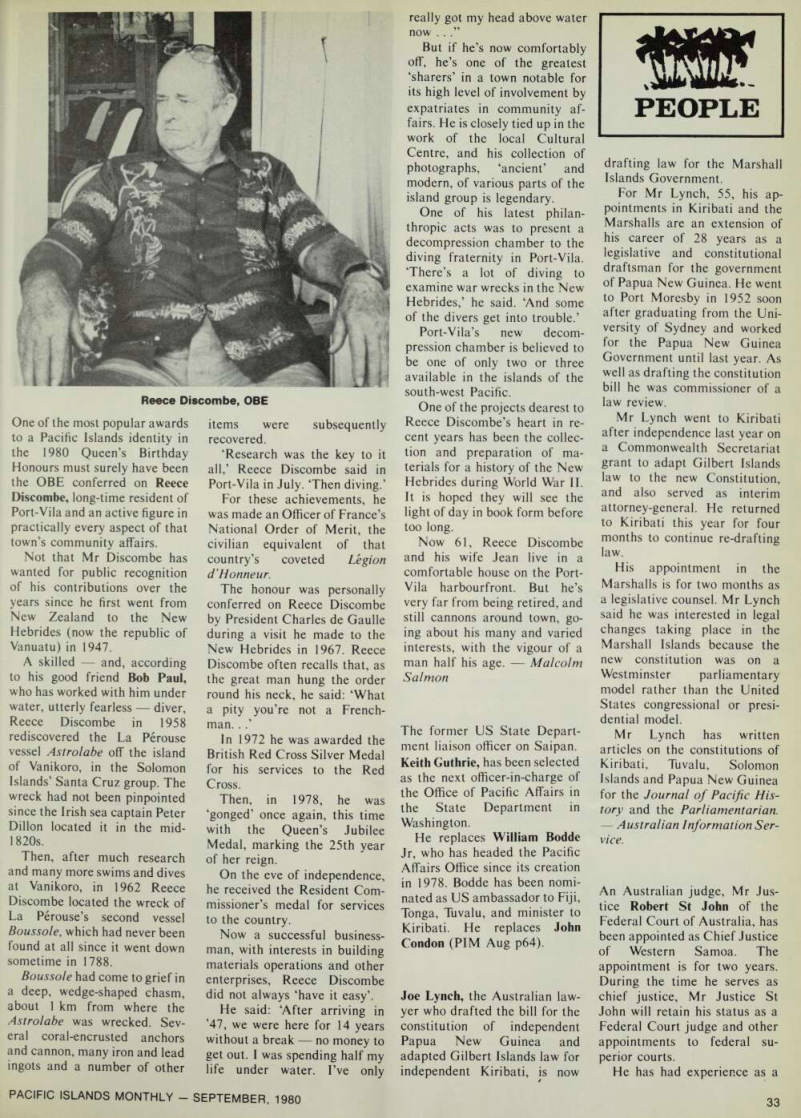

One of the most popular awards to a Pacific Islands identity in the 1980 Queen’s Birthday Honours must surely have been the OBE conferred on Reece Discombe, long-time resident of Port-Vila and an active figure in practically every aspect of that town’s community affairs.
Not that Mr Discombe has wanted for public recognition of his contributions over the years since he first went from New Zealand to the New Hebrides (now the republic of Vanuatu) in 1947.
A skilled and, according to his good friend Bob Paul, who has worked with him under water, utterly fearless diver, Reece Discombe in 1958 rediscovered the La Perouse vessel Astrolabe off the island of Vanikoro, in the Solomon Islands’ Santa Cruz group. The wreck had not been pinpointed since the Irish sea captain Peter Dillon located it in the mid 1820s.
Then, after much research and many more swims and dives at Vanikoro, in 1962 Reece Discombe located the wreck of La Perouse’s second vessel Boussole, which had never been found at all since it went down sometime in 1788.
Boussole had come to grief in a deep, wedge-shaped chasm, about 1 km from where the Astrolabe was wrecked. Sev eral coral-encrusted anchors and cannon, many iron and lead ingots and a number of other
items were subsequently recovered. ‘Research was the key to it all,’ Reece Discombe said in Port-Vila in July. ‘Then diving.’
For these achievements, he was made an Officer of France’s National Order of Merit, the civilian equivalent of that country’s coveted Legion d’Honneur.
The honour was personally conferred on Reece Discombe by President Charles de Gaulle during a visit he made to the New Hebrides in 1967. Reece Discombe often recalls that, as the great man hung the order round his neck, he said; ‘What a pity you’re not a French man. ..’
In 1972 he was awarded the British Red Cross Silver Medal for his services to the Red Cross.
Then, in 1978, he was ‘gonged’ once again, this time with the Queen’s Jubilee Medal, marking the 25th year of her reign.
On the eve of independence, he received the Resident Com missioner’s medal for services to the country.
Now a successful business man, with interests in building materials operations and other enterprises, Reece Discombe did not always ‘have it easy’.
He said: ‘After arriving in ’47, we were here for 14 years without a break no money to get out. I was spending half my life under water. I’ve only
really got my head above water now . . .”
But if he’s now comfortably off, he’s one of the greatest ‘sharers’ in a town notable for its high level of involvement by expatriates in community af fairs. He is closely tied up in the work of the local Cultural Centre, and his collection of photographs, ‘ancient’ and modern, of various parts of the island group is legendary.
One of his latest philan thropic acts was to present a decompression chamber to the diving fraternity in Port-Vila. ‘There’s a lot of diving to examine war wrecks in the New Hebrides,’ he said. ‘And some of the divers get into trouble.’
Port-Vila’s new decom pression chamber is believed to be one of only two or three available in the islands of the south-west Pacific.
One of the projects dearest to Reece Discombe’s heart in re cent years has been the collec tion and preparation of ma terials for a history of the New Hebrides during World War 11.
It is hoped they will see the light of day in book form before too long.
Now 61, Reece Discombe and his wife Jean live in a comfortable house on the Port- Vila harbourfront. But he’s very far from being retired, and still cannons around town, go ing about his many and varied interests, with the vigour of a man half his age. Malcolm Salmon The former US State Depart ment liaison officer on Saipan.
Keith Guthrie, has been selected as the next officer-in-charge of the Office of Pacific Affairs in the State Department in Washington.
He replaces William Bodde Jr, who has headed the Pacific Affairs Office since its creation in 1978. Bodde has been nomi nated as US ambassador to Fiji, Tonga, Tuvalu, and minister to Kiribati. He replaces John Condon (PIM Aug p 64).
Joe Lynch, the Australian law yer who drafted the bill for the constitution of independent Papua New Guinea and adapted Gilbert Islands law for independent Kiribati, is now /
drafting law for the Marshall Islands Government.
For Mr Lynch, 55, his ap pointments in Kiribati and the Marshalls are an extension of his career of 28 years as a legislative and constitutional draftsman for the government of Papua New Guinea. He went to Port Moresby in 1952 soon after graduating from the Uni versity of Sydney and worked for the Papua New Guinea Government until last year. As well as drafting the constitution bill he was commissioner of a law review.
Mr Lynch went to Kiribati after independence last year on a Commonwealth Secretariat grant to adapt Gilbert Islands law to the new Constitution, and also served as interim attorney-general. He returned to Kiribati this year for four months to continue re-drafting law.
His appointment in the Marshalls is for two months as a legislative counsel. Mr Lynch said he was interested in legal changes taking place in the Marshall Islands because the new constitution was on a
Westminster parliamentary
model rather than the United States congressional or presi dential model.
Mr Lynch has written articles on the constitutions of Kiribati, Tuvalu, Solomon Islands and Papua New Guinea for the Journal of Pacific His tory and the Parliamentarian.
Australian Information Ser vice.
An Australian judge, Mr Jus tice Robert St John of the Federal Court of Australia, has been appointed as Chief Justice of Western Samoa. The appointment is for two years.
During the time he serves as chief justice, Mr Justice St John will retain his status as a Federal Court judge and other appointments to federal su perior courts.
He has had experience as a
Reece Discombe, OBE
judge of the Supreme Court of the Australian Capital Territory and as a judge of the Supreme Court of Norfolk Island.
Lord Grey of Naunton has retired as chairman of the Commonwealth Development Corporation and Lord Kind ersley has been appointed as CDC’s new Chairman.
Lord Kindersley, born in 1929, is an executive director of Lazard Brothers & Co Ltd and has been deputy chairman of the Export Guarantees Advis ory Council since 1978. He is also on the boards of several companies including Witan In vestment Co Ltd, Sun Alliance & London Insurance Group and Swedish Match Company. He has been financial adviser to the Export Group for the Construc tional Industries since 1961.
In the Queen’s Birthday Honours, CDC chief executive Sir Peter Meinertzhagen was made a Knight Bachelor to mark his work for developing countries through the CDC.
Mr T. W. Star has been ac cepted by the US Government as ambassador of the Republic of Nauru to the USA.
Mr Star is also the Nauru Consul-General in Melbourne.
In the early 19305, a young German priest from the Ruhr Valley made a lifetime commit ment to serve in faraway and isolated Western Samoa.
After 47 years in the islands, 75-year-old Father Albert Merten is still going strong. He
was in New Zealand recently for a brief visit to replace his dentures and eye glasses unperturbed by the knowledge that he may soon become obsol ete.
When he first arrived at Western Samoa in a luxurious passenger liner, Father Merten was greeted by a people who bartered for goods and services, lived almost exclusively in small villages and worshipped their own gods.
The Catholic Church there was dominated by the French, but soon expanded to include English, American, German and Irish priests.
Now the tables have turned and the days of such European influence are numbered, with a Fijian seminary and a Samoan bishop who is also a cardinal.
Father Merten said this was the case in Samoa in all fields such as science, agriculture, government and the Church, but this did not bother the foreign priests because they went there knowing the success of their mission would be gauged by how soon they be-
John
Clarke in the New Zealand Herald.
Tonga’s only woman MP, Pap iloa Foliaki, visited Copenhagen in July to take part
in an international Women’s Conference.
She was invited to present papers and take part in panel discussions on the Child Care Needs of Low-Income Women in Developing Countries and on ways of involving such women in economic development and community betterment proj ects. She hopes to establish communication channels which will enable Tonga to learn about, and utilise, experience already gained in other parts of the world.
Her participation in the con ference was arranged by the Overseas Education Fund of the American League of Women Voters and funded by the Women in Development section of the US Agency for International Development. — Penny Hodgkinson in Nukualofa.
Michael Ovington presented his credentials as Australia’s first high commissioner to the newly independent republic of Vanuatu on July 31, one day after the country acceded to independence. Mr Ovington, 35, was Australian consul in Noumea from 1978-80.
A flurry of changes in Papua New Guinea’s diplomatic rep resentation was announced in August. Dr Alexis Sarei be comes high commissioner to the United Kingdom; Austin Sapias is confirmed in the post of high commissioner to Australia; and
Brian Amini becomes high com missioner to New Zealand.
Other appointments are; am bassador to the United Nations, Ilinome Tarua; ambassador to the USA, Kubulan Los; am bassador to Japan, Joseph Nombri; ambassador to Belgium, EEC/ACP, Joseph Auna; high commissioner to Solomon Islands, Jack Kairi; high commissioner to Fiji, Dr Ako Toua; ambassador to the Philippines, Thomas Ritako; and ambassador to Indonesia, Benson Gegeyo.
Meanwhile, the government has announced the appointment of eight new heads of public service departments. Among them are Paulias Matane, for merly ambassador to the UN,
who becomes head of the foreign affairs and trade depart ment; Frederick Reiher, former high commissioner to the UK, head of the prime minister’s department, and Rose Kekedo, former teaching service com missionV, head of the newly formed department of com munity and family services.
Rose Kekedo is the first woman to head a department in the PNG public service.
Prime Minister Sir Julius Chan had earlier foreshadowed ‘an overhaul of government and administration, and a massive clean-up of bureaucratic inefficiencies’.
Apology: PIM apologises to Pedro Fernandez de Quiros for disturbing his well-earned rest by reporting him as active on April 25, 1906 (PIM Aug p 69), becoming on that date ‘the first European to see the New Hebrides’. Actually the gallant Spanish navigator achieved the feat 300 years earlier to the day, in 1606.
Recently touring defence estab lishments in Australia was Garega Pepena, Papua New Guinea Defence Minister. Here he talks in Canberra with Mike Julien, acting controller of the Australian Coastal Surveillance Centre. - AIS photograph.
Major Hipo, Commander of the Defence Force of Tonga, who flew to Australia recently and met senior defence officials as part of diplomatic links be tween the two countries.
Paulius Matane