Nationhood comes to troubled Vanuatu
pp. 11-14 · Read in the full issue

No, No, Sir - It
Goes That Way
This Way, M’Sieu,
It Goes This Way
Vanuatu, 74 years a British-French condominium, became independent in July. But it entered nationhood with a secession rebellion on one of its biggest islands, Esplritu Santo, and had to call in troops from Papua New Guinea to deal with the continuing situation. Britain and France, with policies which sometimes conflicted, came under criticism for failing to end the rebellion before they left.
ANGUS SMALES, who was in Vanuatu for independence, writes this report:
Conch shells wailed eerie tra ditional music as the red, green, gold and black flag of the new Pacific nation of Vanuatu, for merly New Hebrides, was raised at Independence cer emonies on July 30.
It was an impressive cer emony at newly-named Inde pendence Park in Port-Vila. In brilliant sunshine it was watched by a crowd of 8000, there were military bands and ceremonial troops from seven nations, ships dressed in the harbour gave a gun salute and aircraft from Britain, France, Australia and Papua New Guinea provided a low-level fly past. At night there were danc ing, singing and string band concerts on the harbourfront, and a fireworks display spread the colours of the new flag across the town and harbour.
The Duke of Gloucester rep resented Britain and the Deputy Foreign Minister, Mr Olivier Stirn, represented I nance at the ceremonies wliich marked the end of 74 vears of u ni British and French ruie. i'u .. countries offered continu ing air! to the new nation, and Prime Minister Walter Lini confirmed that Vanuatu would retain government to govern ment finks with the former administering powers.
The joint background led to a unique arrangement in which Vanuatu will hold simultaneous membership of the Common
wealth of Nations and of the Association de Co-operation Culturelle et Technique.
But while the bands played in Port-Villa, while two Dakota transport aircraft of the Papua New Guinea Defence Force peeled off at near treelop height over Independence Park, and while delegations from 35 countries were paying their respects to the newly-born nation, a different story was unfolding on the island of Santo. The rebels there had warned they would oppose any attempt to raise the new flag on Santo.
Led by the secessionist Jimmy Stephens, a mixed-race man who has styled himself President Moly, they knocked down a number of flagpoles to prevent the new flag from being raised. But at Santo Town or what the French called Luganville in one of the many nuances of difference which had marked the joint adminis tration he rebels were stopped. A detachment of French paratroopers with auto matic lies guarded the liag poie and the flag was raised in a local ceremony. The guard re mained on duly to stop the hauling down of the flag The active rebellion on Santo goes back to last year when Stephens, unashamedly backed by the US-based Phoenix Foun dation of right-wing investors and new nation idealists, named
the island the Republic of Vemarana and began a cam paign for secession. He received some support from French descended settlers on the island who were concerned for their future when New Hebrides as a a hoie reached independence.
Splits between British inliuenced and French mliuenced sections 01 the popu lation became a significant issue in events, and the in coming democratically elected nation*?* government of Father Walter Lin* was distinctly pro- British.
Late last year unrest forced the evacuation of large num bers of islanders who opposed the secession campaign, but the
crisis came in May this year when the rebels look over Santo. Government officers were forced to leave the island and boats look off more islanders who feared for their safety. Some of the refugees were physically assaulted by the rebels. Using equipment u.ppiied trom private sources in USA the rebels set up a propa ganda radio. Radio Vanafo, and closed the airstrip. Britain and France each flew 300 troops to the New Hebrides, but the Lini government became in cieasingly critical of what it saw as lack of any conceded effort to pul down the rebellion.
The turn of events threw increasing doubt on whether
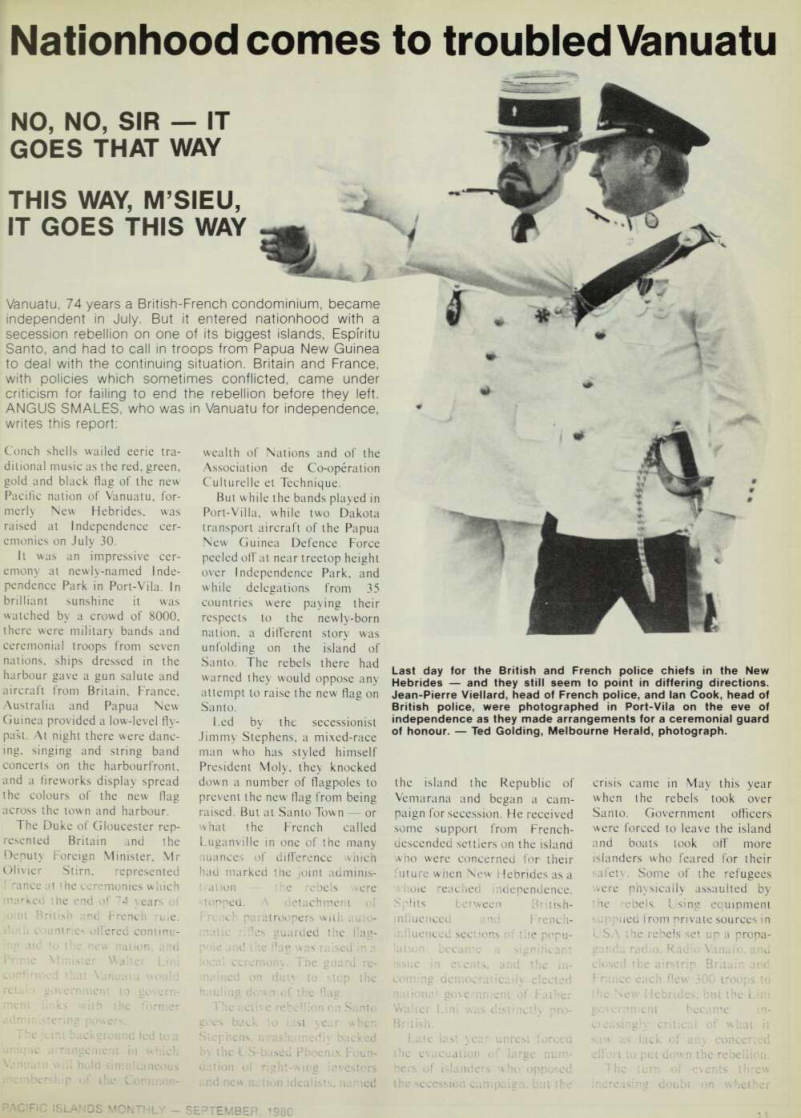
Last day for the British and French police chiefs in the New Hebrides - and they still seem to point in differing directions.
Jean-Pierre Viellard, head of French police, and lan Cook, head of British police, were photographed in Port-Vila on the eve of independence as they made arrangements for a ceremonial guard of honour. Ted Golding, Melbourne Herald, photograph.
the new nation would be able to adhere to its independence timetable, particularly as the Lini government insisted that Britain and France had a res ponsibility to end the rebellion before the emergence of the new nation. France in particu lar and Britain to some extent were criticised in a series of pro government demonstrations.
The demonstrations heartened the attitude of the Lini govern ment which affirmed it would stick to the timetable although for most of July two special envoys Mr Jean Arribaud (France) and Mr Alan Donald (Britain) were unable to make headway in attempted nego tiations with the rebels.
Throughout July, too, the pro tracted situation drew increas ing comment from Pacific Island nations, from Australia and New Zealand and from a meeting of the South Pacific Forum. All affirmed the legit imacy of the Lini government and called for active measures to ensure that the rebellion was ended.
Public opinion claimed that French attitudes were dictated by the ‘stay-put’ attitude of some French citizens, and that Britain was more concerned at getting out as quickly as poss ible without a fuss. With Vanuatu independence little more than a week away in July, detachments of French and British troops about 150 soldiers in each landed separately from transport air
craft and it was announced that the rebellion had been put down.
But as the following diary of events shows the trouble was far from over: July 25 and 26: Despite reports that the rebellion had ended, the rebel radio, Radio Vanafo, continued to broadcast propa ganda nightly with an increas ing note of rabble rousing and a claim that Jimmy Stevens had been responsible for calling in French troops to ‘save the people from their enemies, from fascists and from neo-colonial ists’. One of the catchcries, referring to the prime minister elect, was ‘Lini, Lini, friend of Mussolini'. By the night of the 26th it was obvious that despite the landing of the commando type troops, real control still rested with the rebels. Several aircraft were prevented from landing because of barricades on the airstrip. An Australian pilot Keith Barlow and three journalists who managed to land in one aircraft were told ‘Your bloody aeroplane will be burnt if you don’t get out of here’. Stevens held a rally at which he told about 1500 sup porters to prepare to ‘fight for freedom’. He announced that his supporters had modern weapons and explosives and were equipping themselves with traditional weapons and a type of powerful slingshot which will ‘kill men one at a time if they come to take us’. It was known that some of the modern weapons had been taken from government stores on the island and there was evidence that others had been brought in by a ship which had earlier been cleared from New Caledonia.
July 27: A British RAF Hercules transport aircraft landed at Santo with negotiat ing officials from the incoming Vanuatu government, Britain and France, but a former long time resident of Santo who travelled in the aircraft as a Red Cross official was pre vented from disembarking and was kept in the aircraft by a French guard. He was Mr Ken Hutton, an Australian, who had received British permission for the visit but was told by French officials that his presence would be embarrassing. Mr Alan Donald, member of a French- British team trying to settle the situation, obtained an interview
with Stevens but made no head way in resolving the affair.
In Port-Vila a spokesman for the British administration, Mr Tony Worner, denied allegations that the military presence on Santo was a cosmetic face saving device. Mr Worner said ‘lt is the British government’s intention to leave this country in a state of integrity and unity, and not to leave the duly elected legitimate government in the lurch.’
Meanwhile the first of a contingent of Papua New Guinea troops, including the Pipes and Drums of the Pacific Islands Regiment, were settling in to their quarters near Port- Vila. The Commander of the PNG Defence Force, Brigadier- General Dim, flew in at the same time and indicated that the presence of his troops was ‘more than ceremonial’. The PNG force, which included Australians on secondment, could well be on the scene for up to six months, he said.
On Santo Jimmy Stevens, learning of the arrival of the Papua New Guineans in Port- Vila, told an Australian journal ist ‘We will deal with these men’. And that night his rebel radio claimed that French troops on Santo were there for the Teal purpose of protecting us from the Australians and the Papua New Guineans’.
At a late afternoon press conference in Port-Vila Mr John Beasant, spokesman for the Lini Government, con firmed that the rebellion still existed. He described the on going situation as ‘the most shameful in the history of British relations with any of its territories’. As he spoke the first of the representatives of over seas countries were arriving for independence ceremonies only three days away.
July 28: Greeted by a mag nificent display of traditional dancing at Port-Vila airport the Duke of Gloucester arrived to represent the Queen at the independence celebrations. So troubled, however, had been the run-up to independence with its doubtful dates and troubled politics that the Duke’s name was not included in the pre-printed official pro grammes. Later the French Deputy Foreign Minister, Mr Olivier Stirn, was greeted by a similar display of dancing when
he arrived to represent France.
The bombshell of the day was the release by British officials of the English text of a speech allegedly given on Santo by the French Resident Commissioner Mr Jean-Jaques Robert on the eve of the previous week’s military operation. In it he accused Australia of ‘directing’ a South Pacific Forum decision to carry out ‘the reconquest of Santo to the profit of the government’. He claimed that the French were ‘intervening’ in the operation to ensure that it was peaceful and to avoid a massacre by 200 English com mandos supported by Papua New Guineans, Fijians, Aust ralians and other regional ex peditionary forces. According to the text Mr Robert had told the rebels that the South Pa cific Forum countries had a vested interest in the Santo struggle because many island nations realised that they would be faced with secession move ments at home if the Santo move succeeded. The reported text continued: ‘For this reason the island countries cannot ac cept any secession move and they have therefore decided to undertake on Santo a veritable war which we French do not wish because you would be the victims’. Mr Robert was re ported as having said that accordingly France had insisted that it should join Britain in the operation and that France should direct the operation in the interests of peace. ‘We have in fact transformed the operation into a French one for your protection’ he was reported to have said, adding that the rebels should accord ingly welcome the French forces as protectors.
The reported speech helped to explain why the rebels had hung flowers on the shoulders of the French troops on their arrival. British authorities had at first denied that such a welcome had been given but photographs of the welcome-by flowers were subsequently pub lished in the French press in New Caledonia.
The Lini government spokes man, Mr Beasant, described the text of the Robert speech as ‘unbelievable, extraordinary and unbecoming’. Publicity given to the speech led to rumours that Mr Robert had been dismissed from his post on
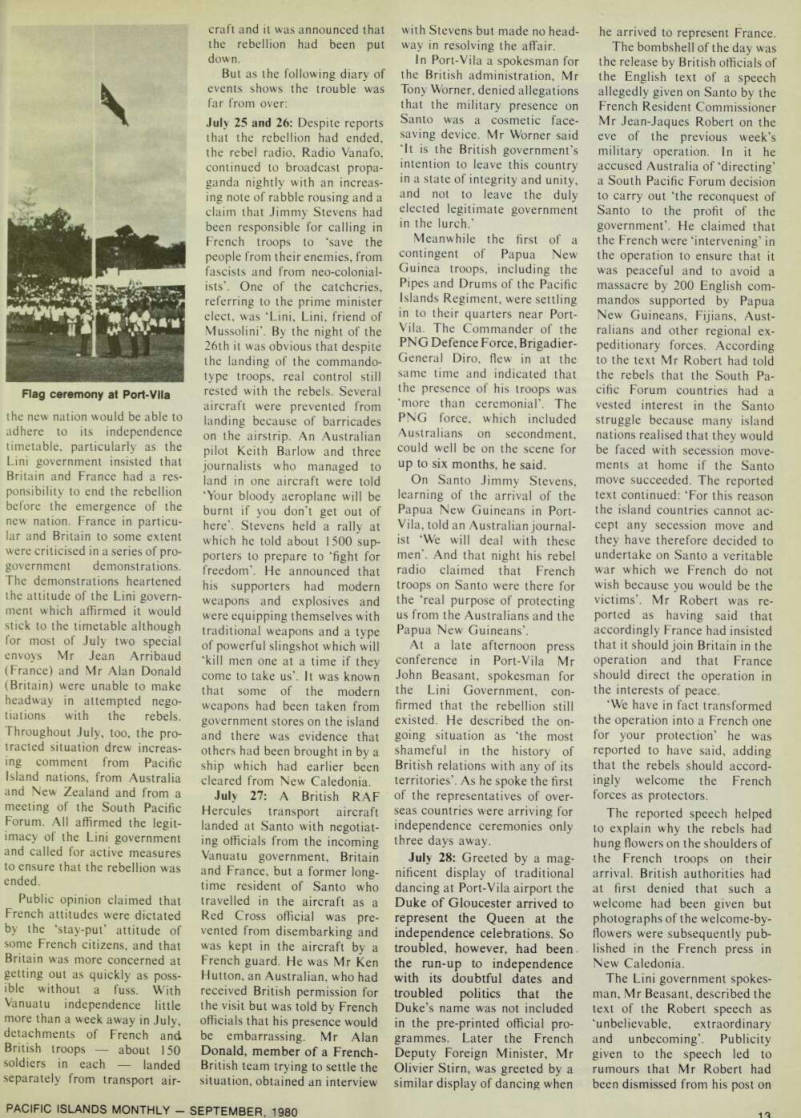
Flag ceremony at Port-Vila
the eve of independence, but the reports were unfounded. Mr Robert himself, questioned by journalists, neither denied nor confirmed the accuracy of his reported remarks.
Meanwhile the Lini govern ment was adamant that the rebellion had to be cleared up by independence although inde pendence was a mere two days away. The situation was more than disappointing, the rebels were criminals, and Britain and France had a responsibility to end the uprising, Mr Beasant said. He continued ‘These rebels are criminals. You can’t talk softly to criminals for long.
They have broken into build ings, they have stolen explosives and weapons, they have held hostages and they have made 1 500 people homeless. Despite the enormous pressures pul upon it our government will not abandon its people who have decided their future by demo cratic processes. This means we cannot allow a rebel group to seize power unlawfully. It is not in our interests or in the inter ests of the region. The govern ment believes it is necessary to act, and it is necessary for France and Britain to act, to re establish legitimate authority by July 30 despite the threats and intimidation of past weeks.’
Late in the day the govern ment announced it was recall ing all government officials who had been forced out of Santo and that it would send the officials back to Santo by char tered aircraft the following morning to re-establish normal services and authority.
July 29: Despite the strong line expressed by the govern ment the chartered aircraft flight of officials did not eventu ate, the rebels continued to control Santo, and the propa ganda broadcasts from Radio Vanafo continued. Rebel groups also moved round the island knocking down flagpoles which had been prepared to raise the new flag of Vanuatu. French and British troops on the island maintained routine patrols and concentrated on protecting the main flagpole at Santo Town.
For the first time it was officially announced that troops from Papua New Guinea were being sought for military rather than ceremonial purposes, but then a stumbling block was discovered constitutionally PNG could not supply troops for such a mission without parliamentary approval. In PNG the Prime Minister, Sir Julius Chan, was prepared to commit his troops but the opposition of Michael Somare was not so easily convinced. A special session of parliament was convened in Port Moresby to reach a decision and legal officials flew to Port-Vila to sort out the issues involved. Popular opinion grew in Port-Vila that France was interested only in protecting its own influence in the new nation, that Britain was interested only in getting out with a minimum of fuss and that ‘the fierce Papua New Guinean fighters will go through the rebels with blood and violence’. Scrawled notices appeared in Port-Vila ‘Kick out the French but keep their
women’. Displaced villagers from Santo, temporarily living in Port-Vila, were vehement in their anger at the apparent lack of strong-arm tactics against the rebels. Finally, with inde pendence only seven hours away the government conceded there was no hope of ending the trouble before the birth of the new nation. It was announced that the British and French troops had been requested to stay on for several weeks after independence and that their governments had agreed. It was announced too that, subject to their government’s approval, PNG troops would be flown to Santo after independence. The position of Australia, which has seconded personnel in the PNG defence force, became a sensi tive issue but the implications were dismissed by Mr Beasant on behalf of the Lini govern ment. He told newsmen ‘Any Australians with the PNG forces are, by virtue of their position, part of the PNG force and responsible to the PNG government. And Australia is not neutral in this situation.
The Australian Foreign Minis ter, Mr Peacock, has given sustained support to the legal government here. It is to the great credit of Australia that at the end of its trusteeship in PNG it left behind and sup ported an effective defence force which is now in a position to help a regional neighbour’.
Mr Peacock himself flew into Port-Vila later in the day but was non-committal on the mat ter of Australian presence, although he reaffirmed Aust ralia’s support for the Lini government and Australia’s commitment to support any international move to resolve the rebel situation.
Father Lini gave a press conference in which he ex pressed deep disappointment at failure by the metropolitan powers to end the rebellion, but was reluctant to criticise them out of hand. He said he looked forward to ‘an early successful solution’ and reaffirmed that his country would retain links with Britain and France ‘of a firm and friendly nature’.
There was a moving cer emony at night at the British Residency when the flag was hauled down for the last time at a ceremony attended by rep resentatives from all sections of
the community. A similar cer emony with much greater priv acy was held at the French Residency, annoying French newspaper photographers and Journalists who were not told about it until it was over.
Independence Day, July 30: In a simple midnight ceremony attended by several hundred people standing in the main street of Port-Vila Prime Minis ter Waller Lini and President George Sokomanu were sworn in. The President, formerly known as George Kalkoa, adopted the traditional titled name of Sokomanu which means ‘Leader of Thousands'.
Despite the troubled planning the main independence cer emony when the new day dawned was a colourful and highly organised event attended by representatives of nearly forty countries. Britain, France and Australia established for mal diplomatic links within 24 hours, and other countries fol lowed soon afterwards.
On Santo the flag was raised in the presence of armed troops who kept the rebels back. The only centre where the ceremon ies misfired was on Malekula Island where a non-political brawl erupted.
Subsequent events: In mid- August PNG approved the use of its troops and Australia cleared the way for 35 special ised support personnel to ac company the PNG presence.
Shortly before the arrival of the PNG troops there were fresh outbursts of rebel activity in cluding looting, the destruction of bridges and the shutting down of the airstrip again. The PNG troops, backed up by Vanuatu police, arrested more than 40 rebels in the first week of operations although the rebel radio continued to broadcast. In an incident in Port-Vila dis placed people from Santo as saulted rebel prisoners who were flown in under guard, apparently taking revenge for their own earlier treatment at the hands of the rebels. In a national radio broadcast Father Lini denied allegations of brut ality by police and PNG troops on the island. The forces had acted with remarkable strength and patience, he said, and were successfully tackling a situation which had apparently resisted the might of Britain and France.
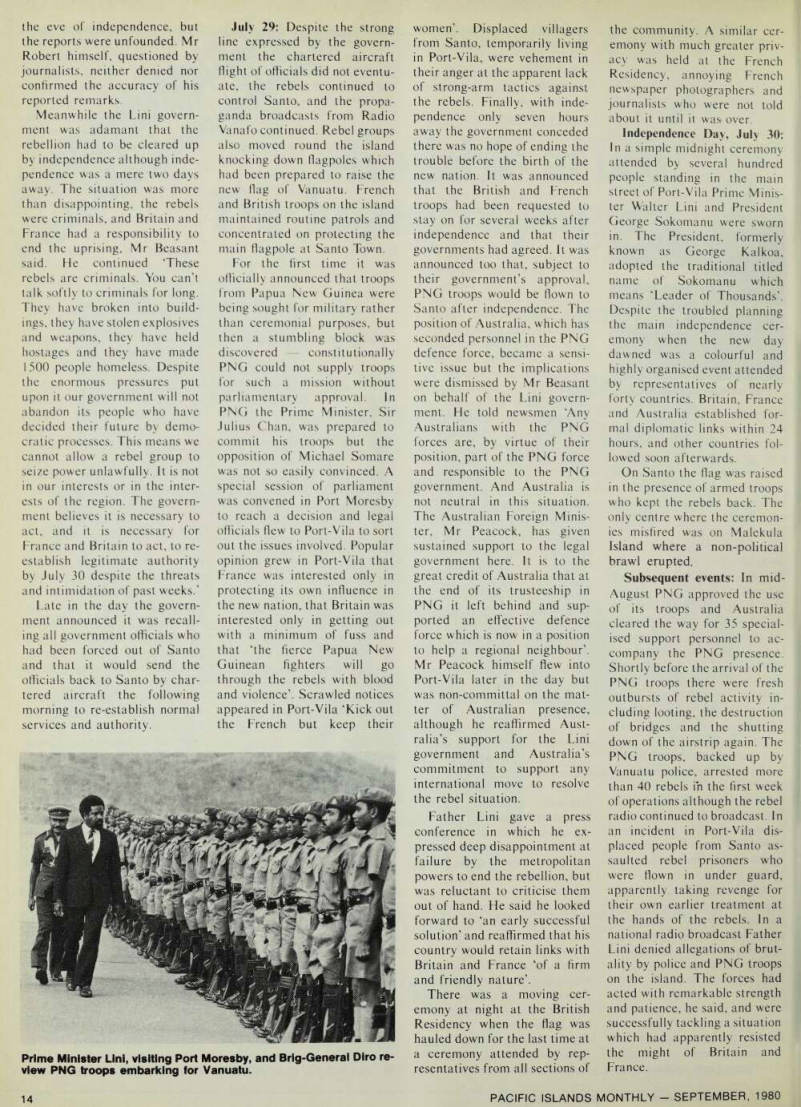
Prime Minister Lini, visiting Port Moresby, and Brig-General Diro re view PNG troops embarking for Vanuatu.