Who are the yachties? Don’t
pp. 174-177 · Read in the full issue
generalise, take ’em as you find ’em!
JIMMY CORNELL, who has been one of PlM’s most prolific sources of information on Pacific yachting movements over the past couple of years, is going home to Europe. In the article below he sets out to review his experience of three years of Pacific cruising, and to answer the question ‘Who are the yachties?’ His investigation, backed up by his own statistical data, is of great interest.
Ocean voyaging is no longer the privilege of the few and the extraordinary, as more and more people undertake ex tended cruises on small sailing boats across the oceans of the world.
Perhaps more than any other ocean, the Pacific has wit nessed a fantastic increase in the number of yachts plying fearlessly across the waves of the world’s greatest expanse of water. Those fortunate enough to have cruised in the South Pacific before the recent ex pansion recall with nostalgia the days when there were only two yachts moored in Papeete harbour, Vavau had not been discovered by the voyagers, the Royal Suva Yacht Club wasn’t charging its guests for use of the showers nor was the Solomon Islands government trying to make a few dollars out of those wishing to sail its waters. The good old days, these veterans sigh, have gone forever and only because the Pacific has been invaded by this huge number of yachts.
But is this the real cause, and how huge is huge?
While it is practically im possible to give an answer to the first question, one could nevertheless produce a fairly accurate estimate in answer to the second. One would only have to look at the number of yachts arriving each year in French Polynesia, that yacht ing gateway of the Pacific, add those who bypass it, those who cruise in the Western Pacific coming from New Zealand and Australia, and the amazing figure that one ends up with is that there is hardly more than a total of a thousand yachts cruising in the South Pacific at any one lime, and quite prob ably an even smaller number.
While not so much inter ested in the quantitative as in the qualitative aspects of the
Pacific yachting population, 1 carried out a survey among my fellow voyagers. Over a period of six months and 5000 miles spent cruising from New Zea land to Tonga, Samoa, Kiribati and Fiji, I interviewed every cruising boat that 1 came across. A minimum of 8000 miles and one year of continu ous cruising away from home were my criteria for inclusion in the survey, although 1 was fortunate to meet many sailors whose qualifications far ex ceeded these relatively modest standards. Five boats had at least one circumnavigation to their credit ( Wanderer IV, Merry Maiden, Diogenes, Fortuna and Gambol ), while the skippers of four other boats had covered well over 50 000 miles in their sailing careers ( Jellicle, Canard Laque, Duen and Telemark). The crews of such boats as Lou IV, Karak, Calao and Orplid had the sailing experience of a lifetime behind them, while the younger crews of Tehani 111 and Shangri-La had recently weathered the famous Cape Horn.
In the never-ending debate over the contribution of cruis ing yachts to the Pacific com munities, which has found its way more than once into the pages of this magazine, a point raised by one or the other of the arguing parties is that of the money spent by the yachts in the islands they visit.
The ‘Living Afloat’ section of my survey ran to some 60 questions concerning all practi cal aspects of day-to-day cruis ing, and I feel that some of the statistical conclusions 1 have drawn will shed some light on this matter. I should add that out of the total number of 50 yachts interviewed, only one crew declined to give me exact figures concerning their fin ances, while all others were
able to give precise details on their budgeting, expenditure, source of income and savings, as well as professional back ground.
To the crucial question of how much people spend each year, I received a wide range of figures, from as high as SUS 18 000 down to $l5OO per year per boat. (Both boats concerned were crewed by a couple.) To allow for different sizes of crew, I calculated the aver age yearly cost per crew mem ber, counting children under 10 as half, those over 10 as a whole, as eight of the 50 boats surveyed had children on board. I thus obtained the average cost of cruising per year as $2358 per person. The figure given by each boat for cost per year included all living expenses, maintenance and re pair costs, even the buying of souvenirs, but did not include insurance premiums. Due to the very high cost of insurance premiums for world cruising, I found that only 11 of the boats surveyed were insured.
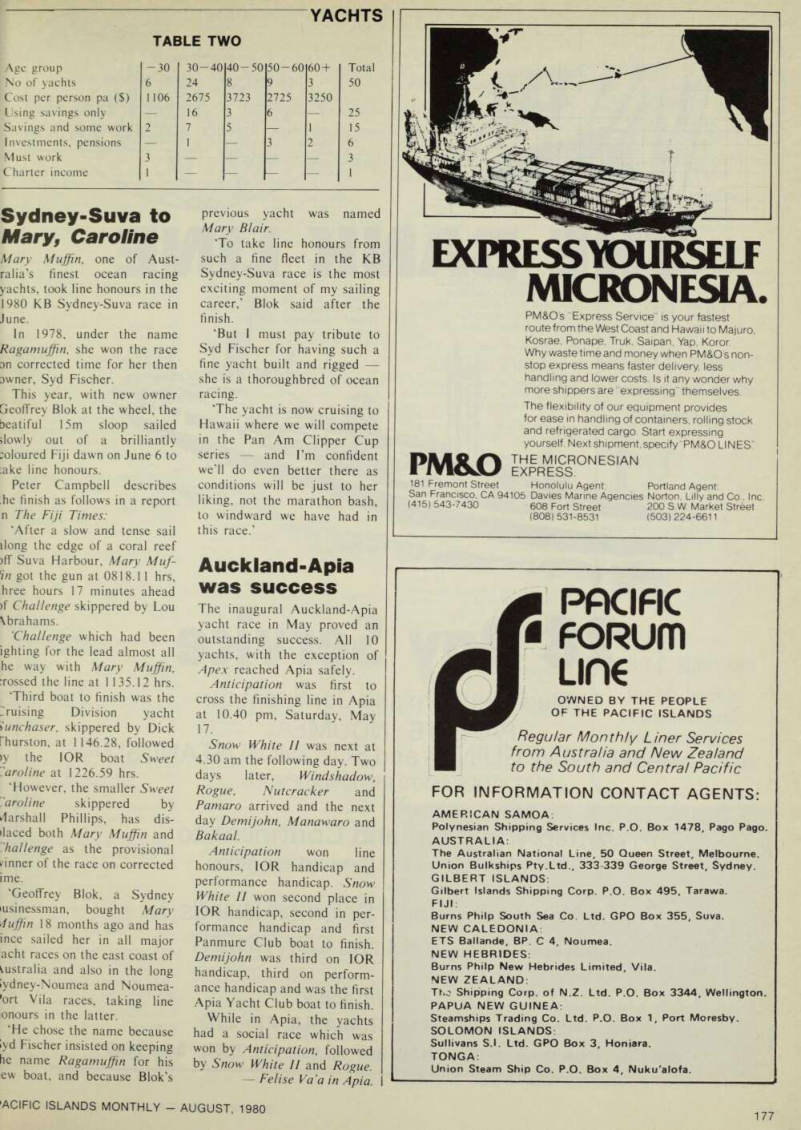
To investigate costing still more closely, I subdivided the crews into age groups, analys ing at the same time their source of income. The results are shown in Table 2. As might be expected, it was the youngest group which spent the smaller amount of money.
This was also the only group to include a number of boats which had left home with virtually no savings at all, their crews being forced to stop and work periodically to fund a continuation of their voyage.
As to professional back grounds of those interviewed, these varied enormously and included most professions and trades that one would find in an average city suburb, from doctors to carpenters, writers to nurses, teachers to engin
eers. Most were obviously re tired, even if not at the gener ally accepted retirement age.
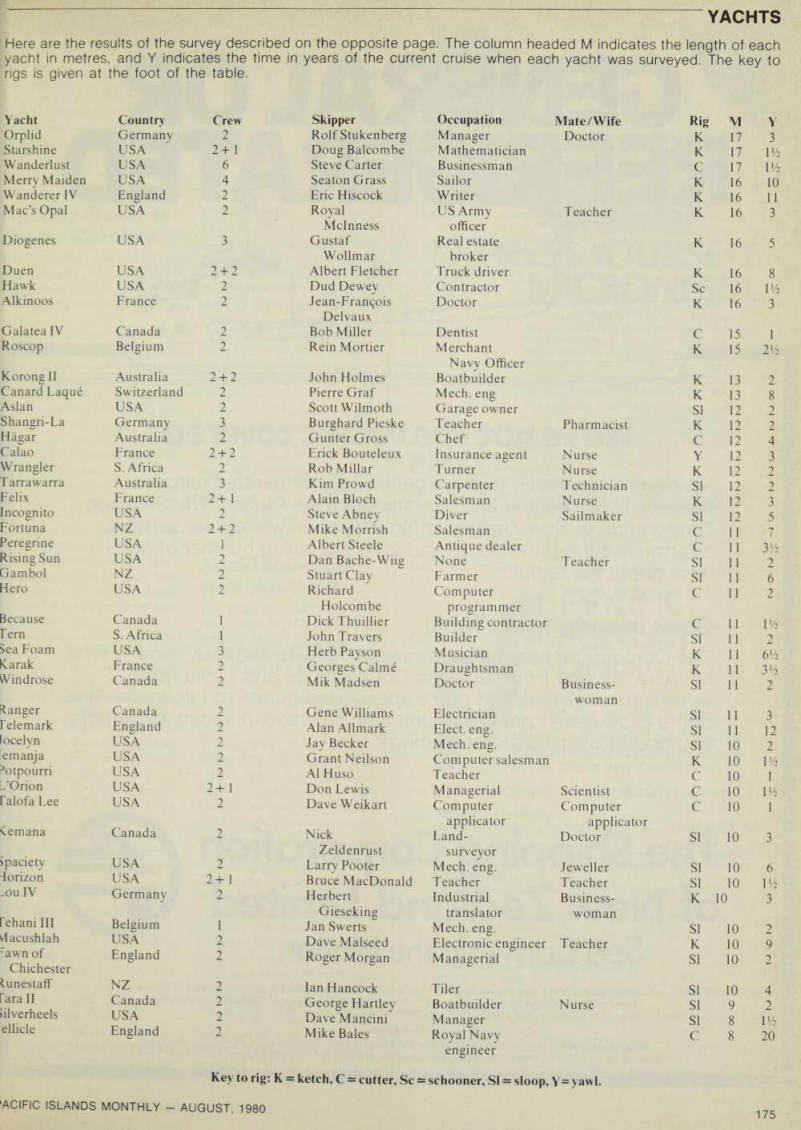
Significantly enough though, hardly any of those interviewed seemed to be the kind of use less bum ever ready to sponge a free meal from some poor islander, as yachties have been too often depicted. The pro fession of the skipper and, where stated, that of the mate/ wife appears in Table 1.
These findings may not prove much, especially to those people who seem to have made up their minds once and for all about yachts and yachties. I would even agree with those who argue that in the long run the financial contribution of the yachts does not justify the effects of a negative nature brought about by the presence of yachts in some of the islands.
Nevertheless one shouldn’t get things out of proportion.
Irreparable damage had been done to the islands by outsiders long before the appearance of the first yachts, and it is unfair to make scapegoats out of today’s yachtsmen.
It seems to me that it is generally the officials in the capitals, and the more privi leged islanders, many of whom have left their home islands long ago, who raise complaints about the effect of yachts on remote communities. Seldom, if ever, do such complaints come from the communities themselves. The overwhelm ingly friendly reception given to yachts by these communities speaks for itself.
I feel that my survey gives some idea of what kind of people the yachties really are, but even more it shows that they are a collection of differing individuals. Each should therefore be judged by his or her own actions and behaviour.
Here are the results of the survey described on the opposite page. The column headed M indicates the length of each yacht in metres, and Y indicates the time in years of the current cruise when each yacht was surveyed. The key to rigs is given at the foot of the table.
Yacht Country Crew Skipper Occupation Mate/Wife Rig M Y
Orplid
Germany
2
Rolf Stukenberg
Manager
Doctor K 17 3 Starshine
Usa
2+ 1 Doug Balcombe Mathematician K 17 Wi Wanderlust
Usa
6 Steve Carter Businessman C 17 IVi
Merry Maiden
Usa
4 Seaton Grass Sailor K 16 10 Wanderer IV
England
2 Eric Hiscock Writer K 16 11
Mac’s Opal
Usa
2
Royal
Mclnness
US Army
officer Teacher K 16 3
Diogenes
Usa
3 Gustaf Wollmar Real estate broker K 16 5 Duen
Usa
2 + 2 Albert Fletcher Truck driver K 16 8 Hawk
Usa
2 Dud Dewey Contractor Sc 16 IVi Alkinoos France 2 Jean-Fram;ois Delvaux Doctor K 16 3 Galatea IV Canada 2 Bob Miller Dentist C 15 1
Roscop
Belgium
2 Rein Mortier Merchant
Navy Officer
K 15 2 Vi
Korong II
Australia 2 + 2 John Holmes Boatbuilder K 13 2
Canard Laque
Switzerland 2 Pierre Graf Mech. eng K 13 8 Aslan
Usa
2 Scott Wilmoth
Garage owner
SI 12 2
Shangri-La
Germany
3
Burghard Pieske
Teacher Pharmacist K 12 2
Hagar
Australia 2 Gunter Gross Chef C 12 4 Calao France 2 + 2 Erick Bouteleux Insurance agent Nurse Y 12 3
Wrangler
S. Africa 2 Rob Millar Turner Nurse K 12 2 T arrawarra Australia 3 Kim Prowd
Carpenter
Technician SI 12 2 Felix France 2+1 Alain Bloch Salesman Nurse K 12 3
Incognito
Usa
2
Steve Abney
Diver Sailmaker SI 12 5 Fortuna NZ 2 + 2 Mike Morrish Salesman C 11 7
Peregrine
Usa
1 Albert Steele
Antique dealer
c 11 3 Vi
Rising Sun
Usa
2
Dan Bache-Wiig
None Teacher SI 11 2 Gambol NZ 2
Stuart Clay
Farmer SI 11 6 Hlero
Usa
2 Richard Holcombe
Computer
programmer c 11 2 Because Canada 1 Dick Thuillier
Building contractor
c 11 1 Vi Lem S. Africa 1 John Travers Builder SI 11 2 Sea Foam
Usa
3
Herb Payson
Musician K 11 6Vi K.arak France 2
Georges Calme
Draughtsman
K 11 3 Vi Windrose Canada 2 Mik Madsen Doctor Businesswoman SI II 2
Ranger
Canada 2 Gene Williams Electrician SI 11 3 Felemark
England
2 Alan Allmark Elect, eng.
SI 11 12
focelyn
Usa
2
Jay Becker
Mech. eng.
SI 10 2
emanja
Usa
2 Grant Neilson
Computer salesman
K 10 P/2
3 otpourri
Usa
2 A1 Huso Teacher c 10 1 L’Orion
Usa
2+ 1 Don Lewis
Managerial
Scientist c 10 P/2 falofa Lee
Usa
2 Dave Weikart
Computer
applicator
Computer
applicator
c 10 I <Cemana Canada 2 Nick Zeldenrust Landsurveyor Doctor SI 10 3
ipaciety
Usa
2
Larry Pooter
Mech. eng.
Jeweller SI 10 6 dorizon
Usa
2+1 Bruce MacDonald Teacher Teacher SI 10 P/2 _ou IV
Germany
2 Herbert
Gieseking
Industrial translator Businesswoman K 10 3 fehani III
Belgium
1 Jan Swerts Mech. eng.
SI 10 2 tfacushlah
Usa
2 Dave Malseed
Electronic engineer
Teacher K 10 9 -awn of Chichester
England
2
Roger Morgan
Managerial
SI 10 2 lunestaff NZ 2 Ian Hancock Tiler SI 10 4 Para II Canada 2
George Hartley
Boatbuilder Nurse SI 9 2 Jilverheels
Usa
2 Dave Mancini
Manager
SI 8 P/2 ellicle
England
2 Mike Bales
Royal Navy
engineer
c 8 20 Key to rig: K = ketch, C = cutter, Sc = schooner, SI - sloop.
V=yawl.
Sydney-Suva to
Mary, Caroline
Mary Muffin, one of Aust ralia’s finest ocean racing yachts, took line honours in the 1980 KB Sydney-Suva race in June.
In 1978, under the name Ragamuffin, she won the race an corrected time for her then awner, Syd Fischer.
This year, with new owner Geoffrey Blok at the wheel, the beatiful 15m sloop sailed dowly out of a brilliantly :oloured Fiji dawn on June 6 to ;ake line honours.
Peter Campbell describes he finish as follows in a report n The Fiji Times: ‘After a slow and tense sail dong the edge of a coral reef )ff Suva Harbour, Mary Muf in got the gun at 0818.11 hrs, hree hours 17 minutes ahead )f Challenge skippered by Lou Abrahams.
Challenge which had been ighting for the lead almost all he way with Mary Muffin, :rossed the line at 1135.12 hrs.
Third boat to finish was the bruising Division yacht iunchaser, skippered by Dick fhurston, at 1146.28, followed >y the lOR boat Sweet Caroline at 1226.59 hrs. ‘However, the smaller Sweet Caroline skippered by Marshall Phillips, has dis placed both Mary Muffin and Challenge as the provisional /inner of the race on corrected ime.
‘Geoffrey Blok, a Sydney
•usinessman, bought Mary duffin 18 months ago and has ince sailed her in all major acht races on the east coast of Australia and also in the long lydney-Noumea and Noumea *ort Vila races, taking line onours in the latter. ‘He chose the name because lyd Fischer insisted on keeping he name Ragamuffin for his ew boat, and because Blok’s
previous yacht was named Mary Blair.
To take line honours from such a fine fleet in the KB Sydney-Suva race is the most exciting moment of my sailing career,’ Blok said after the finish. ‘But I must pay tribute to Syd Fischer for having such a fine yacht built and rigged she is a thoroughbred of ocean racing.
The yacht is now cruising to Hawaii where we will compete in the Pan Am Clipper Cup series and I’m confident we’ll do even better there as conditions will be just to her liking, not the marathon bash, to windward we have had in this race.’
Auckland-Apia
was success The inaugural Auckland-Apia yacht race in May proved an outstanding success. All 10 yachts, with the exception of Apex reached Apia safely.
Anticipation was first to cross the finishing line in Apia at 10.40 pm, Saturday, May 17.
Snow White II was next at 4.30 am the following day. Two days later, Windshadow, Rogue, Nutcracker and Pamaro arrived and the next day Demijohn, Manawaro and Bakaal.
Anticipation won line honours, lOR handicap and performance handicap. Snow White II won second place in lOR handicap, second in per formance handicap and first Panmure Club boat to finish.
Demijohn was third on lOR handicap, third on perform ance handicap and was the first Apia Yacht Club boat to finish.
While in Apia, the yachts had a social race which was won by Anticipation, followed by Snow White II and Rogue.
Felise Va’a in Apia.
Table Two
Age group
-30 30-40 40-50 50-60 60 + Total No of yachts 6 24 8 9 3 50 Cost per person pa ($) 1106 2675 3723 2725 3250
Using savings only
— 16 3 6 25 Savings and some work 2 7 5 I 15
Investments, pensions
— I — 3 2 6 Must work 3 — — — 3 Charter income 1 — — 1