An Invisible Line on the Sea Is Not a Wall
p. 144 · Read in the full issue
The waters that wash the shores of Japan extend far south to the countries of the South Pacific. The oceans of the world are continuous.
In the past two or three years, however, 200-mile economic or fishing zones have been established, one after another, by many countries. From the standpoint of the world’s peoples, invisible boundary lines have been drawn on a sea which was originally indivisible. Many countries of the South Pacific as well as Japan have set up their own 200-mile zones.
Our understanding of these sea zones is that they have been proclaimed not only to conserve the fishery resources of each of these countries but also to utilize such resources effectively for the people who need them. For the nature of these resources is such that, given proper management and regeneration, they can be used in perpetuity; but, if neglected, they will only be wasted. Accordingly, we believe that the proper approach for countries whose vital interests are linked to these “invisible boundaries” is to cooperate closely in developing and utilizing their resources on the basis of mutual respect for their respective resources. The “invisible boundary” is not a solid wall; nor, in our view, should it become one.
Japan has in the past utilized the fishery resources of the South Pacific with full consideration for their conservation.
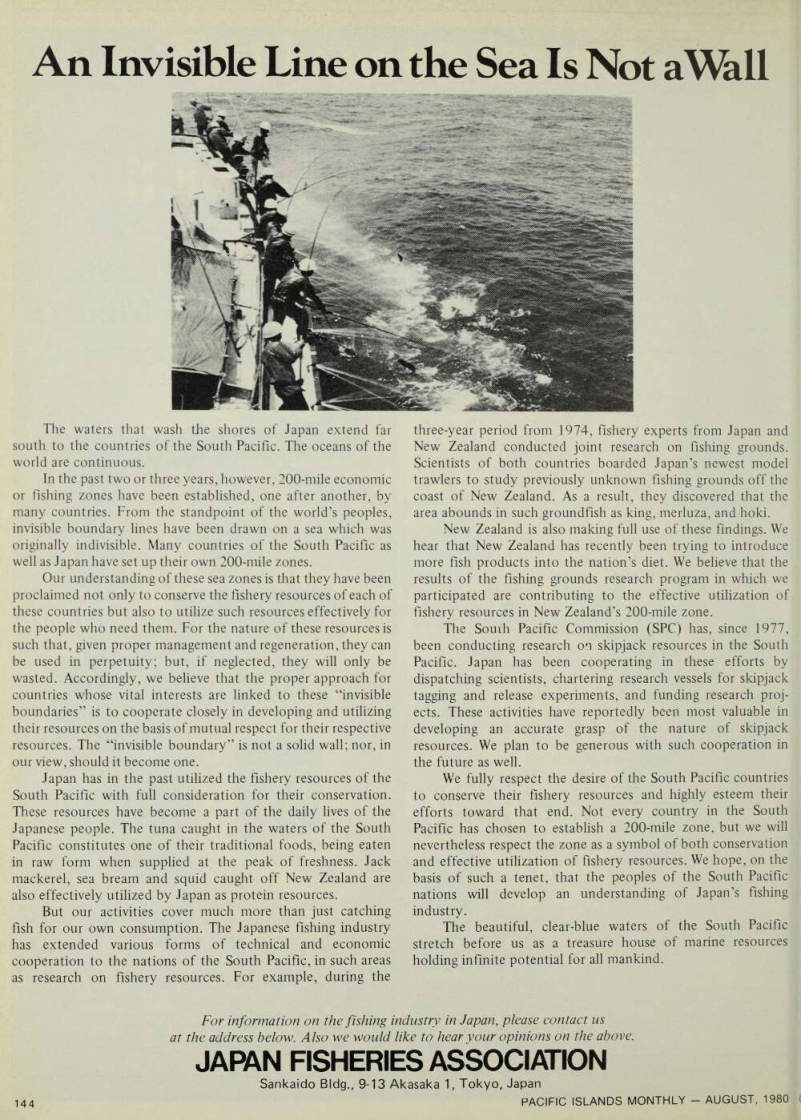
These resources have become a part of the daily lives of the Japanese people. The tuna caught in the waters of the South Pacific constitutes one of their traditional foods, being eaten in raw form when supplied at the peak of freshness. Jack mackerel, sea bream and squid caught off New Zealand are also effectively utilized by Japan as protein resources.
But our activities cover much more than just catching fish for our own consumption. The Japanese fishing industry has extended various forms of technical and economic cooperation to the nations of the South Pacific, in such areas as research on fishery resources. For example, during the
three-year period from 1974, fishery experts from Japan and New Zealand conducted joint research on fishing grounds.
Scientists of both countries boarded Japan’s newest model trawlers to study previously unknown fishing grounds off the coast of New Zealand. As a result, they discovered that the area abounds in such groundfish as king, merluza, and hoki.
New Zealand is also making full use of these findings. We hear that New Zealand has recently been trying to introduce more fish products into the nation’s diet. We believe that the results of the fishing grounds research program in which we participated are contributing to the effective utilization of fishery resources in New Zealand’s 200-mile zone.
The South Pacific Commission (SPC) has, since 1977, been conducting research on skipjack resources in the South Pacific. Japan has been cooperating in these efforts by dispatching scientists, chartering research vessels for skipjack tagging and release experiments, and funding research proj ects. These activities have reportedly been most valuable in developing an accurate grasp of the nature of skipjack resources. We plan to be generous with such cooperation in the future as well.
We fully respect the desire of the South Pacific countries to conserve their fishery resources and highly esteem their efforts toward that end. Not every country in the South Pacific has chosen to establish a 200-mile zone, but we will nevertheless respect the zone as a symbol of both conservation and effective utilization of fishery resources. We hope, on the basis of such a tenet, that the peoples of the South Pacific nations will develop an understanding of Japan’s fishing industry.
The beautiful, clear-blue waters of the South Pacific stretch before us as a treasure house of marine resources holding infinite potential for all mankind.
For information on the fishing industry in Japan, please contact us at the address below. Also we would like to hear your opinions on the above.
Jaran Fisheries Association
Sankaido Bldg., 9-13 Akasaka 1, Tokyo, Japan