Independence movements bred the new wave
pp. 140-147 · Read in the full issue
new wave of Pacific writers
For some years following World War 11, PlM’s pages included a regular smattering of Islands-flavoured fiction and poetry, almost all of it submitted by expatriate residents of the Islands with a literary bent. This innovation in what had been strictly a news magazine, resulted from the wide interests of the then Editor, Judy Tudor, and was popular with readers. But as the postwar Island development boom grew apace, with greater stress on political and economic happenings, PlM’s editorial space came under pressure, and the ‘literary’ material was squeezed out. We felt there were other, more specialised magazines available as outlets for expatriate writers of fiction and poetry. Then, in 1972, MARJORIE CROCOMBE of Suva, a Cook Islander closely involved with the arts, who as a schoolteacher had many years earlier lamented the lack of printed indigenous material, drew PlM’s attention to the fact that during the years we had dropped expatriate fiction a widely-dispersed body of indigenous writers had been developing, with no opportunity for publication. These, and others yet to be discovered, she argued strongly, would be encouraged by having their material published regularly in a special PIM section so they could compare their work with each other’s.
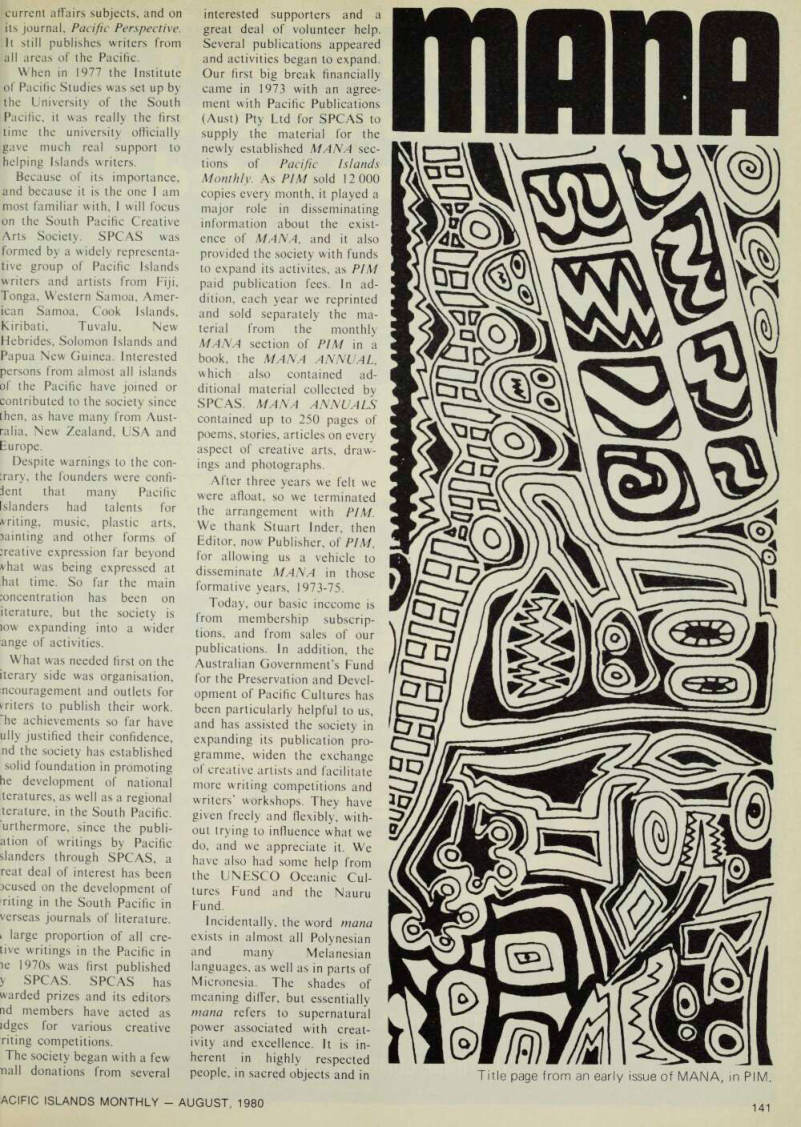
So was born, in 1973, the MAN A pages of PIM, their honorary editor being the indefatigable Marjorie Crocombe. Here Mrs Crocombe discusses the comparatively recent development of the creative arts in the Islands, and especially the impetus given by the establishment of the South Pacific Creative Arts Society, of which she was one of the founders.
A hundred years ago and more there were many Pacific Islands writers. They were almost all Polynesians, as writing was not yet well estab lished in Melanesia or Micronesia.
Most of the Polynesian writers were ministers of the church, because it was the only source of education and liter acy. Some of their books are in print and still selling well today especially those of the great Hawaiian writers of last cen tury like David Malo, Samuel Kamakau, John Papa Ei, and others.
But during the colonial era, even though much more formal schooling took place, the Pa cific Islands writers seemed to fade away. Even in my own small island of Rarotonga, many more of our people wrote between 1850 and 1900 than during the colonial period from 1900 to 1965. The new wave of writings by Pacific Islanders came with the independence movements. It seems to have grown from strength to strength.
Last century’s first wave of writing was initiated by the Christian churches, particu larly by missionaries of the London Missionary Society and the American Board of Commissioners for Foreign Missions. The recent revival of writing was stimulated in the universities.
Last century it all began in Polynesia. This century it got started in Melanesia. It began
at the University of Papua New Guinea when Ulli Beier joined the English Department there about 1967. The univer sity had been established only in 1965, taking its first students in 1966. Ulli Beier gave a great impetus to creative writing. I was then living in Papua New Guinea and was very fortunate to be able to join his writing group. Sir Maori Kiki’s book Ten Thousand Years in a Lifetime, Vincent Eri’s The Crocodile, the creative arts journal Kovave, the series of Papuan Pocket Poets and
many others were the result of Lilli’s encouragement and training, and his example.
He was not the only source of inspiration, but he was the main one, and it spread from there to other colleges and some government and religious bodies in Papua New Guinea.
In 1969, the University of the South Pacific was estab lished, with its main campus in Suva and a network of Exten sion Centres soon extending to Tonga, Western Samoa, Sol omon Islands, Cook Islands, Niue, Kiribati, Tuvalu and the
New Hebrides. But in its early days the university did not give much encouragement to Island writers, so two private groups were set up at the same time in 1972 by a few interested USP staff mainly.
The South Pacific Creative Arts Society (SPCAS) dealt with poetry, short stories, drama and other kinds of cre ative writing as well as with music, painting, dance, etc.
The South Pacific Social Sci ences Association (SPSSA) concentrated on books on social, political, economic and
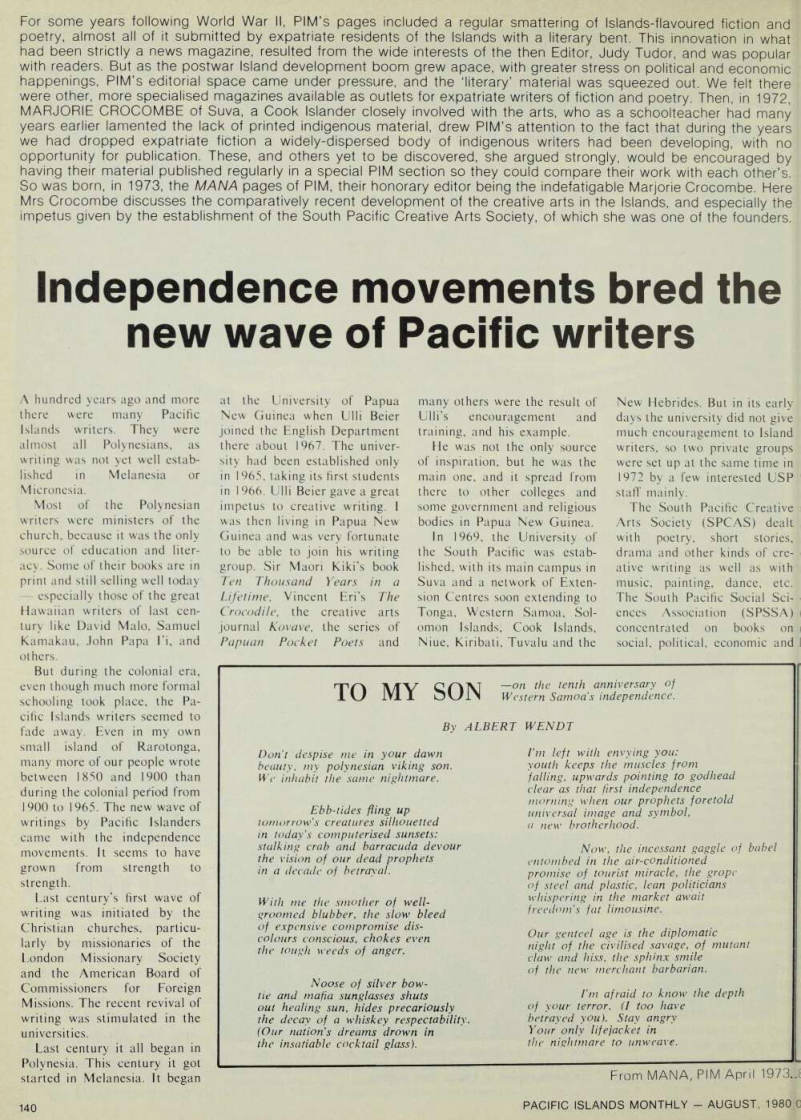
From MANA, RIM April 1973. J
current affairs subjects, and on its journal, Pacific Perspective.
It still publishes writers from all areas of the Pacific.
When in 1977 the Institute of Pacific Studies was set up by the University of the South Pacific, it was really the first time the university officially gave much real support to helping Islands writers.
Because of its importance, and because it is the one I am most familiar with, I will focus on the South Pacific Creative Arts Society. SPCAS was formed by a widely representa tive group of Pacific Islands writers and artists from Fiji, Tonga, Western Samoa, Amer ican Samoa, Cook Islands, Kiribati, Tuvalu, New Hebrides, Solomon Islands and Papua New Guinea. Interested persons from almost all islands of the Pacific have joined or contributed to the society since then, as have many from Aust ralia, New Zealand, USA and Europe.
Despite warnings to the con trary, the founders were confi dent that many Pacific Islanders had talents for writing, music, plastic arts, tainting and other forms of creative expression far beyond vhat was being expressed at hat time. So far the main concentration has been on iterature, but the society is low expanding into a wider ange of activities.
What was needed first on the iterary side was organisation, ncouragement and outlets for writers to publish their work, 'he achievements so far have ully justified their confidence, nd the society has established solid foundation in promoting
he development of national
teratures, as well as a regional terature, in the South Pacific, urthermore, since the publi ation of writings by Pacific slanders through SPCAS, a reat deal of interest has been reused on the development of Tiling in the South Pacific in verseas journals of literature, i large proportion of all ere live writings in the Pacific in
le 1970 s was first published
Y Spcas. Spcas Has
warded prizes and its editors nd members have acted as idges for various creative riling competitions.
The society began with a few nail donations from several
interested supporters and a great deal of volunteer help.
Several publications appeared and activities began to expand.
Our first big break financially came in 1973 with an agree ment with Pacific Publications (Aust) Pty Ltd for SPCAS to supply the material for the newly established MANA sec tions of Pacific Islands Monthly. As PIM sold 12 000 copies every month, it played a major role in disseminating information about the exist ence of MANA, and it also provided the society with funds to expand its activites, as PIM paid publication fees. In ad dition, each year we reprinted and sold separately the ma terial from the monthly MANA section of PIM in a book, the MANA ANNUAL, which also contained ad ditional material collected by
Spcas. Mana Annuals
contained up to 250 pages of poems, stories, articles on every aspect of creative arts, draw ings and photographs.
After three years we felt we were afloat, so we terminated the arrangement with PIM.
We thank Stuart Inder, then Editor, now Publisher, of PIM, for allowing us a vehicle to disseminate MANA in those formative years, 1973-75.
Today, our basic inccome is from membership subscrip tions, and from sales of our publications. In addition, the Australian Government’s Fund for the Preservation and Devel opment of Pacific Cultures has been particularly helpful to us, and has assisted the society in expanding its publication pro gramme, widen the exchange of creative artists and facilitate more writing competitions and writers' workshops. They have given freely and flexibly, with out trying to influence what we do, and we appreciate it. We have also had some help from the UNESCO Oceanic Cul tures Fund and the Nauru Fund.
Incidentally, the word mana exists in almost all Polynesian and many Melanesian languages, as well as in parts of Micronesia. The shades of meaning differ, but essentially mana refers to supernatural power associated with creat ivity and excellence. It is in herent in highly respected people, in sacred objects and in
spiritual forces. Superior lead ership or outstanding talents were manifestations of mana.
So were things with unique qualities, including works of creative expression like the composition of poetry, music, drama, painting, sculpture and dance. SPCAS aims for creat ivity and excellence, so we named our journal MANA.
With the discontinuation of the MANA supplement in PIM a new journal of South Pacific language and literature, which includes a creative writing component, replaced MANA Annual. This has appeared bi annually since 1976, first under the title MANA Review and subsequently as MANA.
To date, SPCAS has pub lished 806 different poems, short stories, plays, articles and literary reviews by 360 differ ent writers, most of whom first published in SPCAS publi-
From PIM, September 1975,
From RIM, April 1973.
cations. The writers are from almost every country and terri tory of the Pacific Islands plus a few from further afield. A lot of this material has been re printed. A check list of our publications is shown in the accompanying panel.
In addition to reprintings by SPCAS of its own materials, for which there has been strong demand, requests for reprinting of material from MANA have been received from all over the world since its inception and such requests increase each year. A record is kept of all requests, which are treated on their merits. Non profit organisations are allowed by the society to reprint with out charge, so long as the author agrees. Where the or ganisations intend to sell the publications they are asked to pay a royalty or fee to the author. Copies of their publi cations are also requested for our records. Regrettably, not all organisations honour their obligations.
Reprints so far from MANA include a lot of material for use in extension courses by the University of the South Pacific, for use in schools by the Fiji Ministry of Education (which purchased 12 000 copies of one of our special collections, and has ordered a further 15 000); for use by the New Hebrides (Vanuatu) Ministry of Edu cation; Deakin University, Melbourne; Queens University, Kingston, Canada; the New Zealand Department of Edu-
cation; the Papua New Guinea University of Technology Cre ative Arts Society; the Asian and Pacific Centre for Women and Development; the United Nations Economic and Social Commission for Asia and the Pacific; the South Pacific Social Science Teachers As sociation; the Australian Coun cil for Overseas Aid; the World Council of Churches, Geneva; the Missionary Sisters of the Society of Mary; the Indo- Fijian Centennial Celebrations Committee; the Pacific Voices Anthology, International pub lishing houses using this ma terial include Heinemanns, Longmans and Longman Paul; and such publications as the Development News Digest, English in New Zealand, Sea weeds and Constructions.
Dr Daniel Tumarkin of the USSR Academy of Sciences recently advised us that a new book in Russian (the English translation of the title is New Stories from the South Seas) contains reprints of writings by Albert Wendt, Vanessa Griffen, Kumulau Tawali, Marjorie Crocombe and Ruperake Petaia. We assume that these are reprints from SPCAS publications, but this is not yet certain. In addition, newspapers and magazines also reprint, sometimes without per mission. Most of the above reprinting was done by ar rangement and with approval, but we frequently come across illegal reprinting by people in other countries who use Pacific writers’ material without per mission.
Our plans for the future call for the MANA journal to con tinue to be published twice a year. It has become well estab lished and in demand as the leading literary journal in the South Pacific and Mana Publi cations will continue to publish small books of drama, poetry, short stories, etc. Single collec tions of poetry by Solomons poet Celestine Kulagoe, and Konai Helu Thaman of Tonga, are ready for the press and others are being prepared.
Exchange of creative artists in the region we feel is ex tremely important, and we would like this to occur more.
We would like to see Pacific artists and writers travelling between various countries of
the region to demonstrate their skills and encourage others.
There is also a growing interest in drama in the region and we would like to be able to take performances outside the urban centres. We have published drama, and sponsored performances in Suva, and we feel the time is opportune to organise a group of actors to travel more widely in the 1980 s.
Editorial/secretarial help
has been an entirely voluntary organisation up to now, but we have overstrained the sources and with the much increased load, we feel that provision for a part-time secretary is necess ary. Thus for 1980 we have arrangements with the South Pacific Social Sciences Associ ation to pay one third of the salary of their present sec retary.
Many other activities have been considered, but we have
Above, a carved fishing float from the Solomons.
Right, this carved figure from Santa Catalina in the Solomons depicts tattoo designs and facial engraving. Both items are reproduced from Grass Roots Art of the the Solomons (Pacific Publications).
decided to concentrate on what I have just outlined for the coming period. We believe that SPCAS has an important con tribution to make, and it has shown by its past record that it can achieve its goals. It is a regional organisation effectively serving the peoples of the Pacific Islands, drawing us closer together and building our confidence and integrity.
The best help we can get is by receiving subscriptions to SPCAS, which entitles the sub scriber to free copies of MANA, and through the sale of books by Pacific writers.
Membership costs SFS for one year but only SFB for two years and the address of SPCAS is Box 5083, Suva, Fiji.
We Islanders enjoy reading the writings of people from countries outside the Pacific, and some by other people about us. But most writing about the Pacific is still by outsiders and we want to en courage a balance. Because writing by Pacific people has grown tremendously in the last 10 years, our points of view are becoming better appreciated. 1 have been writing mainly about SPCAS and the Pacific region as a whole, but many national writers societies and related bodies have also been formed. They include the Tungaru Society (formerly Tungavalu Society) in Kiribati, Mai son de la Culture Polynesienne in Tahiti, Solomons Writers and Artists Association in Honiara, the Samoan Writers Association, Faikava in Tonga, Ta’unga Artists and Writers in the Cook Islands, and others in Papua New Guinea and other coun tries.
So many people have helped the development of Pacific writers that I cannot name them all. In creative writing, they include expatriates like Ulli Beier and Elton Brash, and Pacific islanders like Albert Wendt of Western Samoa, Konia Helu Thaman and Epeli Hau’ofa of Tonga, Makiuti Tongia of the Cook Islands, Celestine Kulagoe of Solomon Islands, Mildred Sope of New Hebrides and many more.
I would like to conclude by quoting from my editorial in the 1974 MANA Annual: The :anoe is afloat. The flow of :realivity in poetry, drama.
story writing, as well as other forms of creative expression from painting to wood sculp ture has expanded enormously since our society was launched.
Hidden talents are being devel oped, ideas are being ex pressed, confidence is growing.
MANA is just a vehicle to carry the rich cargoes of indi vidual talent from every part of the Pacific to every other part, both within and beyond the island shores. Seeing what one can do encourages others, and the volume and quality in creases all the time.
Perhaps the greatest result has been the pulling together of people from the most distant parts of the Pacific some times physically as at the very successful Regional Creative Writers Workshop which was financed by UNESCO and held in Suva with participants from all major island groups in 1974 (and in which people from MANA were deeply in volved), but more often just in the feeling of oneness that creative artists are getting with each other through reading each other’s work and reading of each other’s activities.
This is where more illus tration will help because we need to be able to see more of each other’s creative work other than writing, and we need to be able to get to know each other through pictures of the artists as well.
To all our contributors and all our readers, MANA and the band of people from many islands who keep it afloat by their participation of any kind, say faa fetai, mab, vinaka vakalevu, meitaki, thank yu tumas altogether. It’s all been well worthwhile.