by 'Morning Star’
pp. 59-61 · Read in the full issue
Through the Louisiades by 'Morning Star’
10 June: This evening the mission boat Morning Star rocks gently at anchor in a pale green lagoon in the Papua New Guinea island group of the Louisiades. It has just begun to rain. The greyness obscures even the horseshoe ribbon of
atoll surrounding us.
Water drums on the roof of
the aft cabin and drips through
the canvas awning over the deck where the crew, clad in sarongs and ragged shirts, are playing cards on the hatch :over. The cook puffs at a plug Df tradestore tobacco rolled in newspaper as he tends the ivoodstove. Blackened pots steam and hiss, a comforting
sound in this deluge.
A muttering Gardner has wrought us six hours from the sland of Sidea, next to
Samarai. After a long delay, we
lad left at noon with a cargo )f rice, timber, drums of diesel, md canned meat, plus four Dassengers: two month-old
twins and their mother, Julie, returning to their home island from the mission hospital; and myself, on my way to visit a friend in the village of Jelewaga on the island of Sudest.
We had chugged all day under a blazing sun past a con tinuous thread of small low islands, where brown-thatched pole houses are visible on the shore among the palms, and
sharp-prowed outriggers lie
pulled well up on to white beaches, beyond the reach of tides.
Twice the rumble of the
engine quietened as we paused
for the deck hands to haul in fish hooked on the long line trolling astern. First a large bullet-shaped tuna, then a sil very kingfish with its distinc tive V-shaped tail.
In mid-afternoon we had headed straight into a small bay and tied up alongside a
decaying timber jetty. The
whole village, about 100 people, turned out to enjoy the
occasion. They laughed and
shouted, showing teeth stained shiny black with betel nut.
Most of the women wore the traditional thick knee-length grass skirt, the men wore shorts, and the small children
nothing.
I went ashore with the cap tain, who sported a fine neck lace of dog’s teeth, and we traded sticks of tobacco for or anges and drinking coconuts.
While we chatted with a local patriarch, sacks of rice and cases of tinned meat were passed up out of the hold and
piled on the jetty.
Farewells were made as woven baskets of sweet po tatoes and bunches of bananas were handed aboard, then the lines were let go and we con tinued eastwards at full
speed.
The rain has increased, hold ing the smell of salt, fish, and
kerosene closer in the cabin.
The twins sleep. Julie offers them a large black breast whenever they wake up squall ing. I look forward to a meal of fresh-fried kingfish and white rice, and await darkness
and sleep.
11 June: We ride at anchor again under a lopsided moon.
The crew chant snatches of har mony and fling cards down on the hatch-cover, Julie nurses
her offspring.
Tuna steaks tonight for din ner. Caught this blustery morn ing, the victim slapped the deck angrily with his tail until the engineer whacked him over the head with the flat of a machete.
Outriggers tack past us, dim shadows in the deepening blackness. Glowing cheroots serve as riding lights. ‘Another 10 hours to Sudest,’ the captain tells me. We look forward to another pre-dawn start, and another full day roll ing over glistening blue swells, past reefs and islands.
I was wakened at sunrise by the clatter of the anchor chain, the whirring of the starter motor and the reluctant thumping of a cold diesel.
Today was a day of slow lazy idleness. I lay on the cabin roof and watched the flying fish leap from our path and skim away between the waves for what seemed an eternity before disappearing at last with a tiny
white splash.
When the sun neared its zen ith and the deck became unbearably hot, the cabin wel comed me with its coolness. A soft breeze blew through the open ports. 1 climbed into the top bunk with Lolita and dozed away the afternoon. We did not stop today. 12 June: Tagula Station, Sudest. I sit in the light of a
hurricane lamp, sipping sweet
hot tea, and listening to the
howling of dogs.
Today was a long one. We started before dawn as prom ised, and were well under way before the sky lightened, red dened, and finally burst into
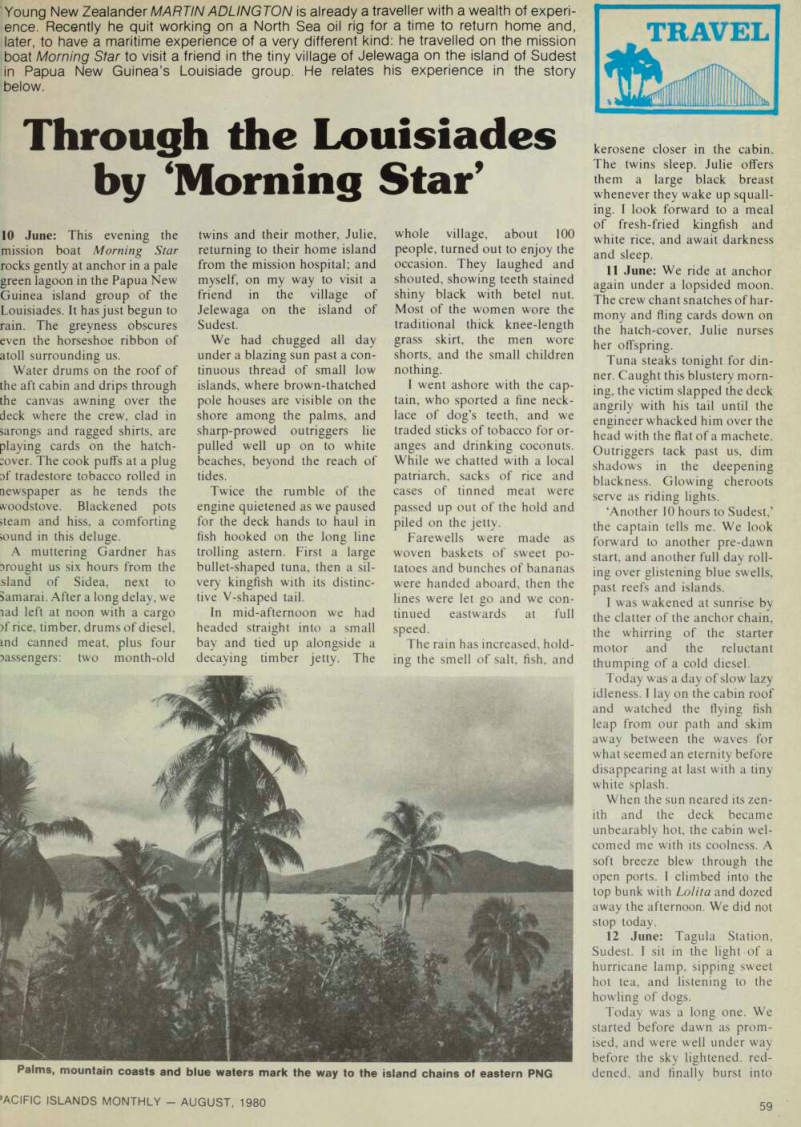
Palms, mountain coasts and blue waters mark the way to the island chains of eastern PNG
flame directly above the bows.
At mid-morning we ap
proached a conical shaped
island and hove to a couple of hundred yards offshore, opposite a village of woven houses on stilts. Several small
outriggers were already on
their way out to meet us. The sun flashed off paddles shaped like elongated hearts as the oarsmen bent their backs in a race to the Morning Star.
Brown arms ornamented with intricate tattoos lifted the twins into the dugouts. Several bundles of mats followed, then Julie seated herself in the last canoe and waved as our pro peller churned the water into white foam.
We stopped twice more at small wharves and unloaded the inevitable rice and ‘square meat’, and it was not until late afternoon that the captain stood beside me at the rail, pointed ahead at a vague blur on the horizon, and said ‘Sudest’.
I am comfortable now after a cold shower and a meal of rice and canned tongue. Some how, in an area of unscheduled
and infrequent shipping, the
Morning Star has landed me at Tagula Station with a mere night to wait before there is a connection available to
Jelewaga Village.
13 June: My trip with Joseph Polisbo was all too brief. While enjoying a succession of cold beers I was entertained with tales of crocodile hunting,
trading, and shipwreck.
Suddenly we were anchored
off from a nondescript clump of mangroves. ‘Jelewaga’, I was assured, although there was no
village in sight. But shortly
people began to gather at the
shore, and canoes came out they had heard the engine a good half hour before. I stag gered ashore through the shal lows to a smiling welcome from friends old and new. 14 June: An early awakening to the crowing of roosters and the snuffling of pigs. After lunch, an inspection of the veg etable garden with my host and namesake, Martin, then down to more serious matters: food for dinner.
It wasn’t easy hunting in the thick bush. Branches tugged at the gun, thorns dragged at exposed flesh and snagged in clothes. The way through the sago swamp was heavy going, and the persistent clouds of
mosquitoes became painful.
But the trade shotgun proved to be accurate it dropped the wild pigeon from its perch at the top of a tree as cleanly as one could wish.
We were caught in a down pour on our way back to the village, and sheltered under a lean-to at the sago-gatherers’ camp, where we smoked black stick tobacco rolled in Time magazine and waited for the rain to stop. It didn’t, so we continued on anyway before it became too dark, for the moon, although full, was rising late.
While the girls were busy in the cookhouse, we dried off, lay on the floor and smoked.
Just after dusk a neighbour appeared in the doorway. The
dim light from the hurricanes lamp reflected his betel-stained 1
grin and glinted on the long*
barrel of his gun. He dropped! a leaf-wrapped bundle to thes floor with a thump thatJ sounded like falling meat and!
disappeared. That evening wes
sat in a circle and dined onr crocodile haunch and pigeon,, with baked yams and sweetJ potato on the side.
After dinner, when the eas ing mat had been rolled up andf put away, the working bees arrived with much rustling ofi grass skirts, tapping of limes spatulas, and raucous laughter.. - The local girls had come toe help Nora, the lady of thes house, to finish the large matt she was weaving in honour ofi the opening of the new first aid post the nexti.
day.
The menfolk arrived in twossi and threes, and any gaps in thes large room were filled withrl children who wove feathers? and flowers into their hair.
One of the men leaned oven: to me and confided with rollings eyes that he was dying. I passedb him a twist of tobacco, saying,.* Tm sure Doctor Black Sticld will make you feel better’. Thes room hooted with laughter andb tobacco was passed all round..!
The mat-weaving, tobacco-(
smoking, betel-chewing, andb
story-telling went on for sev-\ eral hours. Around midnightfr the mat was finished andb everyone drifted off, staying inn small groups for fear of sor-i cerers. We closed the and doors, fastening them se-s
curely with twine against dogs*
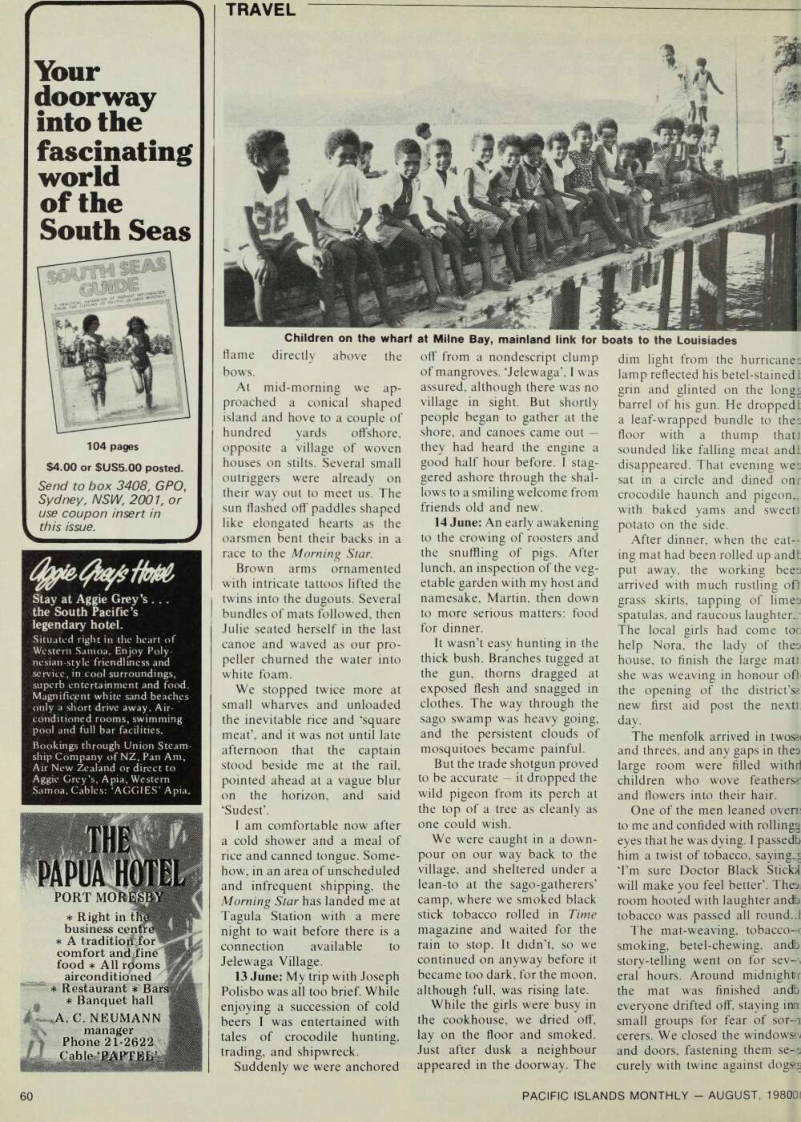
Children on the wharf at Milne Bay, mainland link for boats to the Louisiades
and magicians (not necessarily in that order), and retired to bed. 15 June: Early this morning the visitors began to arrive.
They walked in from outlying hamlets, paddled over from
neighbouring villages, and
sailed their outrigger canoes from across the horizon, blow ing deep blasts on conch shell trumpets as they came.
All the best cooking pots were lifted from their storage places and taken to the cooking compound, where noisy groups of women came and went with pots and buckets balanced on their heads.
Rocks were gathered for the earth ovens, a team of men scraped coconuts into carved wooden bowls a yard across, dogs fought over the shells, and
pigs grunted with excitement,
oblivious of the four large porkers trussed in a line, blink ing their eyes.
I smoked my pipe and
watched the piles of food being
sorted: yams, sago, sweet po
tatoes, pumpkins, cooking ba
nanas, taro, and cassava.
Several men gathered
around the unfortunate pigs
and despatched them with well placed spears. They were then singed to remove the hairs, and butchered with a messy but
effective machete. The lumps
af flesh were piled into black
ened clay cooking pots,
eovered with water, and set to
boil. The head of a pig sat at the top of each pot among bub bling fat and curling smoke.
In the late afternoon every one gathered at the new aid post compound and listened to the speeches of local and visit ing dignitaries. The new medic (Peter from Misima) was introduced, and then all were welcome to inspect the build
ing itself, built local-style by
volunteer labour on stilts with a slat floor, and with walls and roof of woven sago leaves.
Then the feast began. Two long tables had been erected with thatching over them to keep off the fierce sun, and on these were placed fresh banana leaves. Then the food was brought from the ovens in bas kets and simply piled in front of the celebrants. There were green coconuts to drink, and the smaller children shooed away the chickens and threw stones at the sly dogs which were stealing any morsel left unwatched.
The eating went on until all had had their fill of baked veg etables and the treat of fresh pork. The party slowly broke up as people drifted away to rest and digest.
When the day had faded and everyone had changed into their finery, we took lanterns to the compound and danced under the full moon to the strumming of guitars and the thumping of bamboo drums.
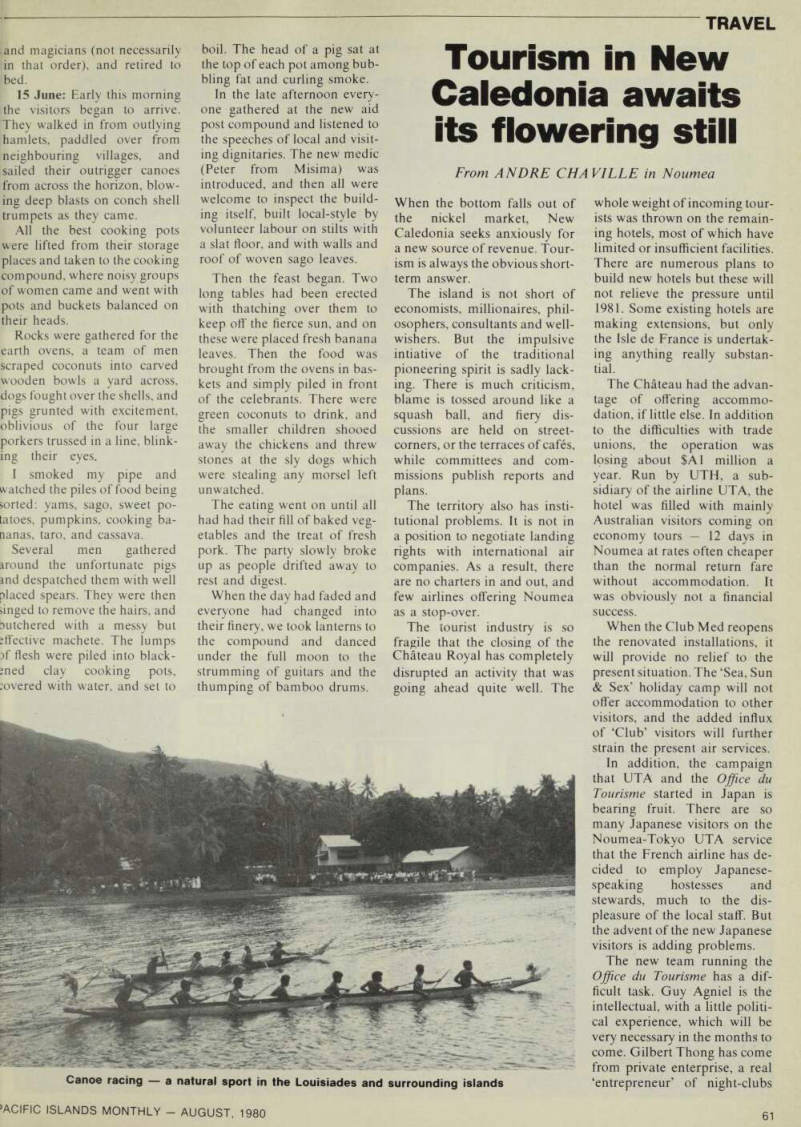
Canoe racing - a natural sport in the Louisiades and surrounding islands