Colourful dancers
p. 31 · Read in the full issue
launch festival
More than 1000 dancers from every province of the host nation, Papua New Guinea, poured into the Sir Hubert Murray Stadium in Port Moresby to launch the Third South Pacific Festival of Arts.
The festival began on the last day of June and continued into mid-July, drawing cultural groups and visitors from throughout the South Pacific.
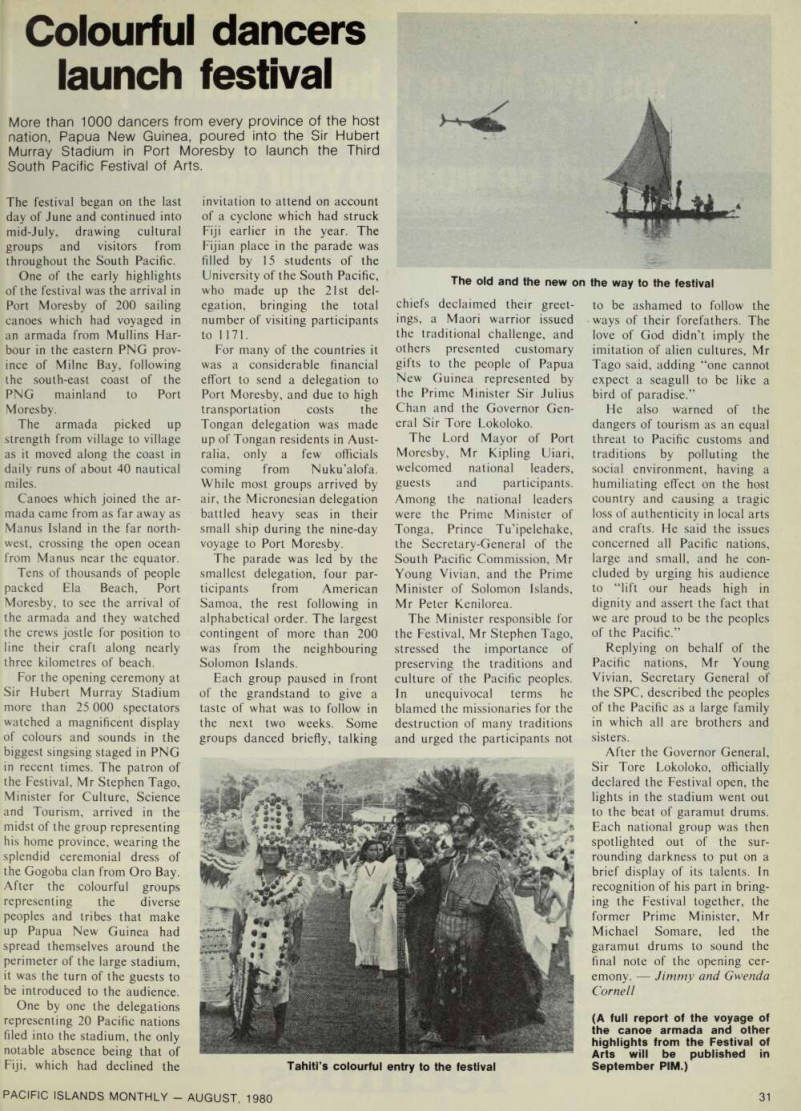
One of the early highlights of the festival was the arrival in Port Moresby of 200 sailing canoes which had voyaged in an armada from Mullins Har bour in the eastern PNG prov ince of Milne Bay, following the south-east coast of the PNG mainland to Port Moresby.
The armada picked up strength from village to village as it moved along the coast in daily runs of about 40 nautical miles.
Canoes which joined the ar mada came from as far away as Manus Island in the far north west, crossing the open ocean from Manus near the equator.
Tens of thousands of people packed Ela Beach, Port Moresby, to see the arrival of the armada and they watched the crews jostle for position to line their craft along nearly three kilometres of beach.
For the opening ceremony at Sir Hubert Murray Stadium more than 25 000 spectators watched a magnificent display of colours and sounds in the biggest singsing staged in PNG in recent times. The patron of the Festival, Mr Stephen Tago, Minister for Culture, Science and Tourism, arrived in the midst of the group representing his home province, wearing the splendid ceremonial dress of the Gogoba clan from Oro Bay.
After the colourful groups representing the diverse peoples and tribes that make up Papua New Guinea had spread themselves around the perimeter of the large stadium, it was the turn of the guests to be introduced to the audience.
One by one the delegations representing 20 Pacific nations filed into the stadium, the only notable absence being that of Fiji, which had declined the
invitation to attend on account of a cyclone which had struck Fiji earlier in the year. The Fijian place in the parade was filled by 15 students of the University of the South Pacific, who made up the 21st del egation, bringing the total number of visiting participants to 1171.
For many of the countries it was a considerable financial effort to send a delegation to Port Moresby, and due to high transportation costs the Tongan delegation was made up of Tongan residents in Aust ralia, only a few officials coming from Nuku’alofa.
While most groups arrived by air, the Micronesian delegation battled heavy seas in their small ship during the nine-day voyage to Port Moresby.
The parade was led by the smallest delegation, four par ticipants from American Samoa, the rest following in alphabetical order. The largest contingent of more than 200 was from the neighbouring Solomon Islands.
Each group paused in front of the grandstand to give a taste of what was to follow in the next two weeks. Some groups danced briefly, talking
chiefs declaimed their greet ings, a Maori warrior issued the traditional challenge, and others presented customary gifts to the people of Papua New Guinea represented by the Prime Minister Sir Julius Chan and the Governor Gen eral Sir Tore Lokoloko.
The Lord Mayor of Port Moresby, Mr Kipling Uiari, welcomed national leaders, guests and participants.
Among the national leaders were the Prime Minister of Tonga, Prince Tu’ipelehake, the Secretary-General of the South Pacific Commission, Mr Young Vivian, and the Prime Minister of Solomon Islands, Mr Peter Kenilorea.
The Minister responsible for the Festival, Mr Stephen Tago, stressed the importance of preserving the traditions and culture of the Pacific peoples.
In unequivocal terms he blamed the missionaries for the destruction of many traditions and urged the participants not
to be ashamed to follow the ways of their forefathers. The love of God didn’t imply the imitation of alien cultures, Mr Tago said, adding “one cannot expect a seagull to be like a bird of paradise.’’
He also warned of the dangers of tourism as an equal threat to Pacific customs and traditions by polluting the social environment, having a humiliating effect on the host country and causing a tragic loss of authenticity in local arts and crafts. He said the issues concerned all Pacific nations, large and small, and he con cluded by urging his audience to “lift our heads high in dignity and assert the fact that we are proud to be the peoples of the Pacific.”
Replying on behalf of the Pacific nations, Mr Young Vivian, Secretary General of the SPC, described the peoples of the Pacific as a large family in which all are brothers and sisters.
After the Governor General, Sir Tore Lokoloko, officially declared the Festival open, the lights in the stadium went out to the beat of garamut drums.
Each national group was then spotlighted out of the sur rounding darkness to put on a brief display of its talents. In recognition of his part in bring ing the Festival together, the former Prime Minister, Mr Michael Somare, led the garamut drums to sound the final note of the opening cer
emony.
Jimmy and Gwenda
Cornell
(A full report of the voyage of the canoe armada and other highlights from the Festival of Arts will be published in September RIM.)
Tahiti’s colourful entry to the festival
The old and the new on the way to the festival