Chapter and verse on outside
pp. 25-29 · Read in the full issue
meddling in the New Hebrides
A document released in Port-Vila on June 2 bearing the signature of Father Walter Uni, Prime Minister-elect of the independent New Hebrides, presented a case in support of the request made by his government on May 31 to the United Nations. The UN was asked to send a neutral military unit and military technical advisors to assist the govern ment ‘in protecting the people and land of the New Hebrides’. In view of its importance, PIM reproduces below the final section of the 19-foolscap-page document, which deals with outside interference in the country’s affairs.
Elected
Government
Outlines
Its Official
Attitudes
No government
military force in
New Hebrides
One of the areas that the Condominium powers failed to develop in the New Hebrides was the military, as well as a
strong police force. Only
enough police were trained and armed to exercise effective control over the New Hebrides
population.
Under the joint regulations
contained in the Protocol of 1914, the Condominium ‘Con stitution’, the sale or supply of firearms and ammunition to New Hebrideans is strictly prohibited, except for the sale
of breech-loading shotguns,
shotgun powder and cartridges.
In addition, a licence is re quired for the ownership and carriage of firearms, such li cences being for most New Hebrideans difficult, if not im possible, to get.
Hence the majority of New Hebrideans are defenceless
against firearms, and certainly
against explosives, in the event of an armed attack. With this
as a framework, it is easy to see how any armed attack would generally be effective since most New Hebrideans have never owned or used a fire arm.
Support for the
moderates on
Santo and Tanna
by outside influ
ences It is no secret in the New Hebrides that there has long existed the possibility of an attempt to separate Santo from the rest of what will become the Republic of Vanuatu. Off and on for at least 13 years some people have flirted with the idea of declaring Santo a Fed eration, a separate state. At first glance, there is little about the 80 islands of the New Hebrides to suggest that they have long been the focus of attention for a complex web of interests ranging from a self-styled New Hebridean named Jimmy Stevens of the Nagriamel Movement on Santo, to an American developer named
Harold Eugene Peacock from Hawaii, and to another American land developer, Michael Oliver of Carson City, Nevada.
Starting in 1967, Peacock bought large areas of land in the New Hebrides, mainly on the island of Santo at Hog Har bour, renamed Lokalee Beach, Cape Quiros and Palikula. He
operated together with other
businessmen through three
companies: Capital Guaranty
Ltd of Hong Kong, General Investment Corporation, and Amalgamated Land Inc. The latter firms were Hawaii based, but also had offices in Taiwan and South Vietnam.
Buying the land cheaply, Pea cock subdivided it into smaller lots ranging from one and a half to five acres, and then sold it mostly to Hawaii residents but also to military personnel fighting in Vietnam.
Peacock and his investors
made large profits: the Hog
Harbour property was bought for SUSB6 000, and after sub division the estimate was that, after expenses. Peacock and others would make $3 million.
At Cape Quiros, the gain was estimated at over SUS 2 million
(Honolulu Advertiser , Sep
tember 1970).
The New Hebrides was to be the ‘Last Paradise of the South Pacific modelled on Waikiki, Honolulu, and detailed plans were made which talked of golf courses, casinos, restaurants, boating clubs and even light industry. They also talked of new roads, hotels, air services and the extension of the Santo airstrip to 10 000 feet to accom modate the anticipated tourist boom to follow, with direct flights planned to Santo from Honolulu, Noumea and Syd ney.
Air transport was the key el
ement and major airlines joined the ‘tide of profits’.
UTA, the French Government airline, and Qantas started pool operations at the start of 1971, investing SUS 72 000 in the promotion of the New Hebrides in Australia.
However, on August 2, 1971, Joint Regulations Nos 15 and
22 were adopted concerning
the subdivision of land in New Hebrides. The Joint Regu lations taxed the added value arising from certain sub divisions of land. Their real effect, however, was their retroactivity to January 1, 1967, thus adversely affecting all of
Peacock’s companies.
The Joint Regulations had serious political repercussions, and divided the people into two camps. Many of the Europeans and French colons of New Hebrides had invested in the land subdivision projects with the Americans. The Europeans formed a citizens’ committee and protested
strongly against the Regu
lations. Because the Resident Commissioners agreed to meet with the citizens’ committee, New Hebrideans, who had dur
ing this time formally
organised a political organis
ation known as the New Hebrides National Party (later called the Vanuaaku Party), organised a demonstration in support of the Joint Regu lation. More than 500 people marched in Port-Vila to de clare the solidarity with the Resident Commissioners.
In March 1973 the six major subdivisions of Capita) Guaranty Ltd, one of Pea cock’s companies, were re
jected by the Resident
Commissioners, and overseas investors from Japan, Vietnam
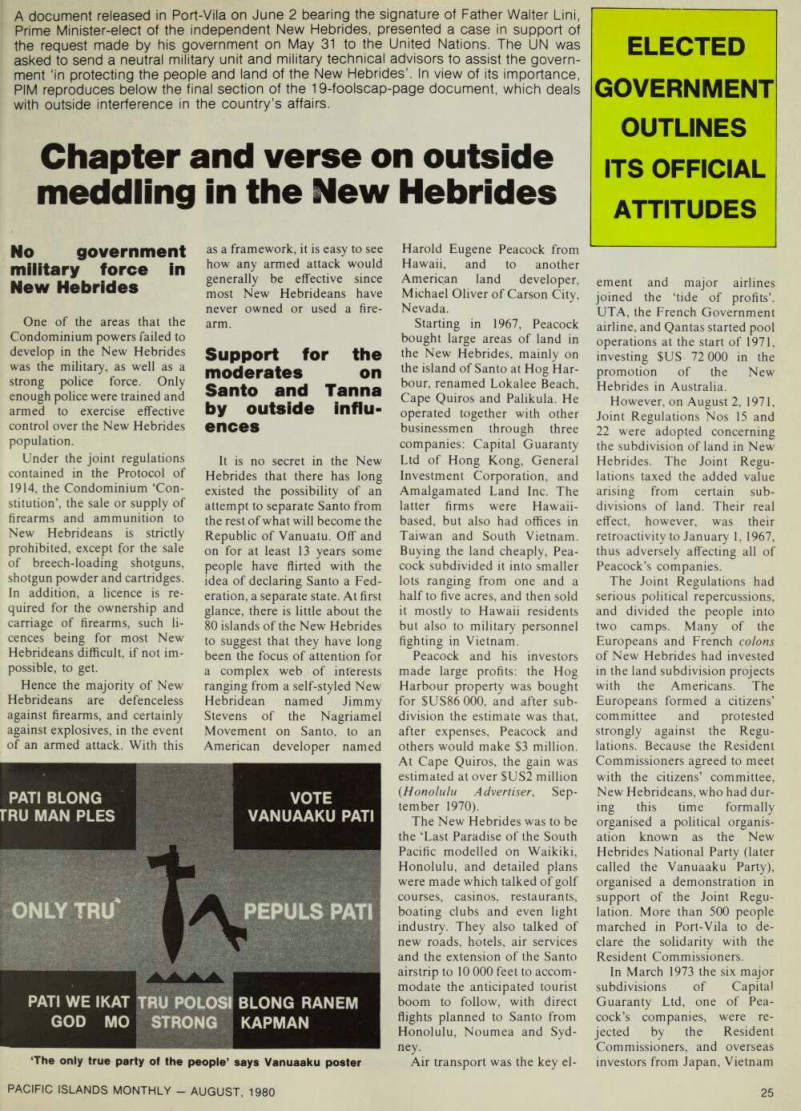
‘The only true party of the people’ says Vanuaaku poster
and the United States were
precluded from obtaining legal
title to their land blocks in the New Hebrides.
Peacock and his cohorts blamed the British solely for the laws preventing the land sales and, through his company, the Lokalee Co Ltd, he sued the former British Resident Commissioner and the then Acting Resident Com missioner personally for dam ages incurred by him as a result of the losses. Needless to say, these efforts failed, so Peacock and his investors sought to
reorganise.
Peacock and his investors realised that they needed wider
political support. After analys
ing and observing the situation, it must have become apparent to them that there were three political factions in New Hebrides the British, the French and the natives. It must also been clear that given the actions of the Con dominium regarding the land dispute, the granting of the vote to New Hebrideans, and the advent of more political organisations among New Hebrideans, independence at least seemed possible. In fact the attorney for Amalgamated Land (one of Peacock’s companies) indicated such an assessment in a statement he made to the Honolulu Star- Bulletin on June 1, 1975: ‘lf independence comes, the
native faction alone will speak for the government, and I think a lot of buyers would certainly be surprised if they have to deal with a whole new group of officials with a new philos
ophy.’
Hence, the task became to find a ‘native faction’ with a
philosophy compatible with
that of Peacock and other interested persons on Santo.
This native faction became the
Nagriamel Movement led by
Jimmy Stevens.
Nagriamel started in 1960 as Namele. In 1963 all the men with Namale leaves, and women with nagaria leaves brought them together to form
Nagriamel. It was begun by
Man Bush Chief Paul Buluk and his assistant, Jimmy Stevens, to stop attempts to ac
quire New Hebridean lands, as well as to reacquire lands
already taken by Europeans.
Originally the movement opposed the embrace of all outside influences, including the Condominium, the colons, the Church education system and anyone other than New
Hebrideans owning land. They
embraced ‘custom’ and tra ditionalism, and had what is known as a ‘cargo cult’ belief that through hard work one day an outsider, most often be lieved to be an American, would come to bring them riches and all good things so that there would be no need to work hard any more, and they would be able to rule them selves.
By 1975, the year in which the first municipal and national elections were held,
Nagriamel had already met
and formed a coalition with Peacock and his investors. In a letter written to Senator Daniel K. Inouye in May 1975 in sup port of Amalgamated Land subdivisions, Jimmy Stevens praised the ‘developments such as the Amalgamated Land sub divisions, and requested
Inouye’s help in resolving the
land problems. By this time Nagriamel had also become pro-French and anti-British,
coalescing with the political
parties which represented the interests of the planters, businessmen, French -colons and ‘half-caste’ persons of New Hebridean and French extrac tion. Naturally, Peacock found it in his interest to support
Nagriamel.
In addition to Peacock, how ever, another American land developer named Michael Oliver had similar designs to
make large profits in the New Hebrides. However, his designs were more far-reaching still.
While Peacock was buying
and developing land during
1967 to 1970, Oliver was writing a book called New Con stitution for a New Country, published in 1968.
Oliver, described by the American magazine Esquire (February 1975) as a ‘million aire, idealogue and philos opher’ made his first million by the age of 30 through real estate development and con struction. He was president of ‘several medium-sized corpor ations’, yet in the mid-60s was convinced that the US econ omy was headed for crises, in flation and dictatorship by ‘the fascist-socialist state.’ Totally committed to free, private enterprise, he sought to escape American and ‘complete tyr anny’. In his view human free dom and laissez-faire capitalism were one and the same thing, and his future revolved around finding a ‘New Country’ where he could establish his own kind of free dom - mainly freedom to make money.
According to his theory, once the right country had been found a constitution would be written anad a government established whose prime con cern would be ‘to prevent force and fraud’. The government was to be as limited as possible,
only existing to ‘protect the
rights of individuals’. It would do this with a system of courts, police and national defence, the crucial point being that
only those people paying for
the government services would receive them. So, for example, if you didn’t pay towards the
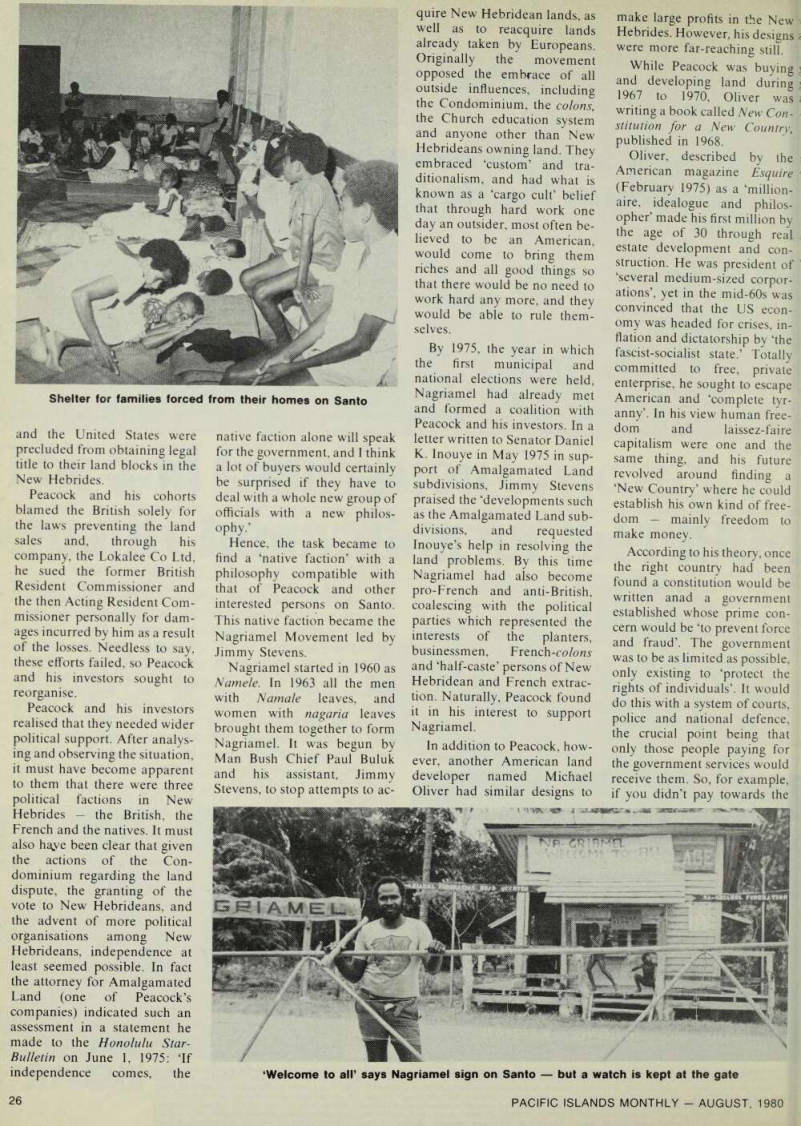
Shelter for families forced from their homes on Santo
‘Welcome to all’ says Nagriamel sign on Santo but a watch is kept at the gate
cost of the police, you wouldn’t
receive police protection; if
; you didn’t pay for the courts, you couldn’t use them. You could, however, be apprehen ded and tried by the courts for
violating someone else’s rights.
As Oliver was mainly con cerned with the interference of governments, most of the con stitution is devoted to outlining what the government may not do. It cannot issue money, levy taxes pass laws concerning marriage and divorce, or inter fere with relationships between
employer and employee, and
so on. All services such as posts, communications and roads would be privately operated, and the government would not be allowed to take any part in business or trade. All was to re volve around the individual businessman and how much money you had. In his ‘New- Country’ you were to be ‘free’ to be uneducated or to die if you couldn’t find the necessary cash to do other wise.
Oliver’s problem was where to find his ‘New Country’ and he spent much time and money covering thousands of miles in world travel before he came up with an answer: Minerva Reef, two hundred miles southwest of Tonga and four hundred miles southeast of Fiji. His attempts to create a concrete
paradise, ‘the Republic of
Minerva’ out of this dot in the Pacific, which lies four feet under water at high tide, were
countered by rapid action by
the King of Tonga. After the
flag of Minerva’s provisional
government’ had been planted on the rocks, the King per sonally proceeded to launch a coup d'etat in June 1972, tear ing down the Minerva flag and with it the hopes of success for Oliver and colleagues. Presum ably King Tupou IV had no de sire to be nearest neighbour to another great American revol ution.
However, Oliver is a deter mined man. In his book he sta ted that sovereignty was not a
pre-requisite for launching a
new country, and for his next attempt he chose one of the islands of the Bahamas - Abaco. It is the experience of Abaco which is so closely re lated to Santo and the New Hebrides, a relationship which might never have been appar-
ent without the exposure of Oliver’s Abaco plot by Andrew
St George, writing in Esquire
February 1975.
The Bahamas became inde pendent from Britain in 1973 and the new government under
Lindon Pindling quickly
brought in measures to ensure more equal distribution of wealth in the country, and re stricted immigration to ensure localisation of jobs. Oliver found that on the island of Abaco there was an unusually large proportion of white set tlers who opposed the policies of the government, and who had tried to separate from the rest of the group before independence. Most of the
indigenous 6000-7000
Abaconians live according to a traditional lifestyle of self
sufficiency. And, most import
ant, according to Esquire , there
were 300 000 acres of
‘undeveloped prime land,
potentially and by no means
unrealistically worth hundreds of millions of dollars, which
was government-owned.
Working throughout 1974
Oliver and friends carefully
planned the independence of
Abaco from their offices on the US mainland for January 1, 1975, when all that land would be ‘up for grabs’ and an
experimental ‘New Country’
begun. The indigenous
Abaconians, incidentally,
would each receive on
independence a gold-rimmed,
elaborately printed ‘Land
Entitlement Certificate’, guaranteeing ‘each native a one-acre homesite not so generous when it is worked out that this amounted to just 1% of their own land.
The plan was not simply to invade Abaco and take it over, but to ensure that the local people did the job for them.
Oliver was to advise. The first assault on Abaco was psycho logical. With great skill and ruthless persuasiveness, the citizens of Abaco were convinced, step by step, that they should become an inde pendent nation; that becoming an independent nation is the greatest, most rewarding thing
in the whole wide world; that it is they the citizenry of Abaco who most urgently need to demand and fight for status as a self-governing common wealth. The ‘Abaco Indepen dence Movement’ (AIM) was created, as were three other seemingly ‘local’ organisations, and ‘the operations required to seize control of the island were disguised as the uprising of an autonomous, locally organised independence movement’.
Working with former CIA agents, a ‘high-powered SSB radio station’ was set up as well as ‘a despatch centre for hand ling cargo traffic with Abaco via a small seaplane’. ‘Further, young independence activists were either enrolled in political indoctrination courses held in Miami ... or flown to a train ing base near Atlanta where they received . . . seven weeks of supersecret instruction in the use of small arms, demo lition devices and other com mando skills at the providing ground of Mitch Warbells arms company.’
According to Oliver, ‘the Pindling regime in Nassau will urge military intervention by the British when they realise that their constabulary is no match for our men’. It was Robert Hamilton, Lord Bel haven, who secured an assur ance from the British Govern ment through the House of
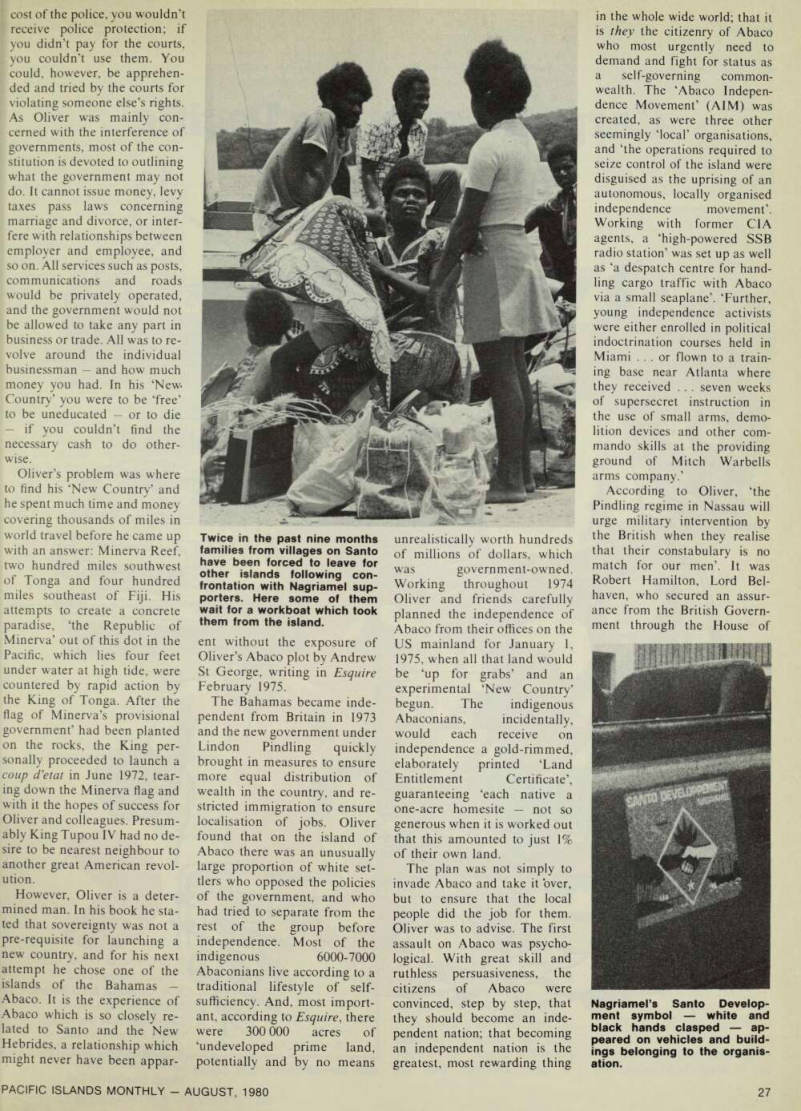
Twice in the past nine months families from villages on Santo have been forced to leave for other islands following con frontation with Nagriamel sup porters. Here some of them wait for a workboat which took them from the island.
Nagriamel’s Santo Develop ment symbol white and black hands clasped ap peared on vehicles and build ings belonging to the organis ation.
Lords, before January 1, 1975, that Britain ‘will not intervene in the internal affairs of the Bahamas’.
However, Operation Abaco failed. The central government in Nassau saw what was coming, that the movement was foreign-manipulated, and simply prohibited the immi gration of suspected stirrers, banned AIM, and also inter cepted a shipload of arms.
After the failure of Abaco, Oliver created the Phoenix Foundation in June 1975. The foundation published a regular newsletter to continue the good work in order to establish a free enterprise ‘New Country’.
In 1976, Oliver wrote in a Phoenix Foundation newsletter that he had not entirely given up with Abaco, and was confi dent that the island would obtain self-determination under free enterprise con ditions. ‘We are still helping the Abaconians,’ he stated, ‘but the reason for the delay is due to lack of adequate organ isation in Abaco’. He con tinued ‘it is difficult to assess ahead of time where our efforts would be most fruitful in the shortest time period and, in retrospect, it can be seen that we should have concentrated more on the South Pacific’. In
fact, the major subject of that newsletter was the Nagriamel Federation, announcing its ‘in dependence’ on December 27, 1975, and summarising the Oliver-written Constitution. ‘ln contrast to Abaco,’ he says, ‘we found that the people of Nagriamel have been excep tionally well organised.’
In 1971, Oliver bought land in the New Hebrides and, by 1975, he combined with Pea cock to launch a major offens ive through Nagriamel in Santo. Exploiting Stevens’ pre vious desire for independence (Nagriamel had called for New Hebridean independence in 1968), Oliver encouraged him to go it alone. The Nagriamel Movement became the Nag riamel Federation, a ‘feder ation of self-governing settle ments,’ on December 27, 1975, after a rally and demonstration through the streets of Santo town, and Stevens announced that all members of the Feder ation would be issued with Land Share Certificates. The demonstration had been visibly orchestrated by Oliver, who subsequently gained prohibited immigration status from the British administration.
In the May 1976 Phoenix Foundation newsletter, Oliver revealed; ‘Phoenix Foundation
has been helping Nagriamel to the maximum available extent .. . Nagriamel has no money and requires help before it can get on its way. Therefore our assistance is vital. The mini mum required is $250 000. If Nagriamel works out I’ll have a free enterprise place. That’s worth plenty. I wouldn’t give it up for a million dollars. In fact it’s worth more than that.’ {Barron’s February 16, 1976.) Intricate connections were forged linking Santo through Fiji, Tonga, and Samoa to the United States the route by which sophisticated broadcast ing equipment found its way to create Stevens’ Radio Vanafo early this year. ‘No troops have been sent to shut it off!’ announced a euphoric Oliver.
On Wednesday, May 28, 1980, at 3.00 am, Santo town was taken by Nagriamel. On that same day, Europeans re siding in Port-Vila received in their mail boxes a brochure offering ‘An Investment in the Vemarana Federation’, based on Santo. The brochure states that land development would be done by Vemarana Corpor ation based in Vemarana. It listed three directors and offi cers of the Corporation. They are: Mr F. Thomas Eck , who is described as an attorney in Carson City, Nevada, who acted as legal counsel for Vemarana and helped to draft the Vemarana Constitution.
Mr Michael Oliver , who is described as having been trained in electronics and as having engaged in land devel opments comprising substan tial sections of Carson City, Nevada, and large subdivisions in Henderson and Las Vegas.
He is also described as the owner of a research and devel opment company specialising in low-temperature energy con verters. In 1965, he is said to have advertised gold coins as a security investment in publi cations such as the Wall Street Journal and Barron’s.
Dr John Hospers, described as a well-known anti-collecti vist leader and professor of philosophy at the University of Southern California, and as the author of numerous books.
It is quite obvious that the takeover in Santo was man ipulated by outside influences for their capitalist ends.
British Information Service map