Walter Lini meets
pp. 21-23 · Read in the full issue

the press
There was an unusual air of expectancy and excitement about the press conference scheduled in the Government Building, Port-Vila, for 4 pm, Sunday, June 29: Chief Minis ter Lini was himself to appear to answer questions. Certain people no doubt hoped to be able to turn the occasion into a discomfiting one for him.
If so, they must have been disappointed. Fr Lini’s calm and dignity, and his patent sincerity, were acknowledged by all even those who most badly wanted to ‘get’ him.
What was also clear was that rumours that the pressures of his situation were ‘getting to him’, that he was ‘losing his cool’, were groundless or at least so they seemed on this occasion.
That day the air around Port-Vila had been thick with stories about a new ‘secession’ on the island of Malekula, to the south of Santo. Naturally, an early question focused on this.
Fr Lini replied that the government was in close touch with events there, and even knew the name of the Na- Griamel leader who had gone from Santo to north Malekula to organise the ‘secession’ but not those of the six mixed-race people who’d gone with him.
The ‘secession’ consisted of taking over the airstrip at
Norsup, running up a flag, and declaring north Malekula to be part of the Santo secessionist ‘state’ of Vemarana. The move, he added, had been timed to coincide with the Anglo-French mission which was expected next day.
He gave the impression that the government was not unduly worried by the Malekula events, pointing out that at a meeting of the island’s 24 customs chiefs during the pre vious week only eight had voted for secession. The movement lacked any centre such as the Santo secession had at Fanafo, and was generally much weaker than the Santo revolt. Furthermore, the resi dent commissioners had for once agreed on the immediate despatch of a police mobile unit (PMU) to the trouble spot.
Fr Lini was asked if this prompt joint action by the resident commissioners was due to pressure from his government. ‘No,’ he replied. ‘lt was due to the fact that the resident commissioners are embar rassed by what has happened over the past few weeks. These events, which have received worldwide publicity, reflect on their reputation as the powers responsible for keeping law and order. ‘They have tended to disbe lieve “rumours” in the past,
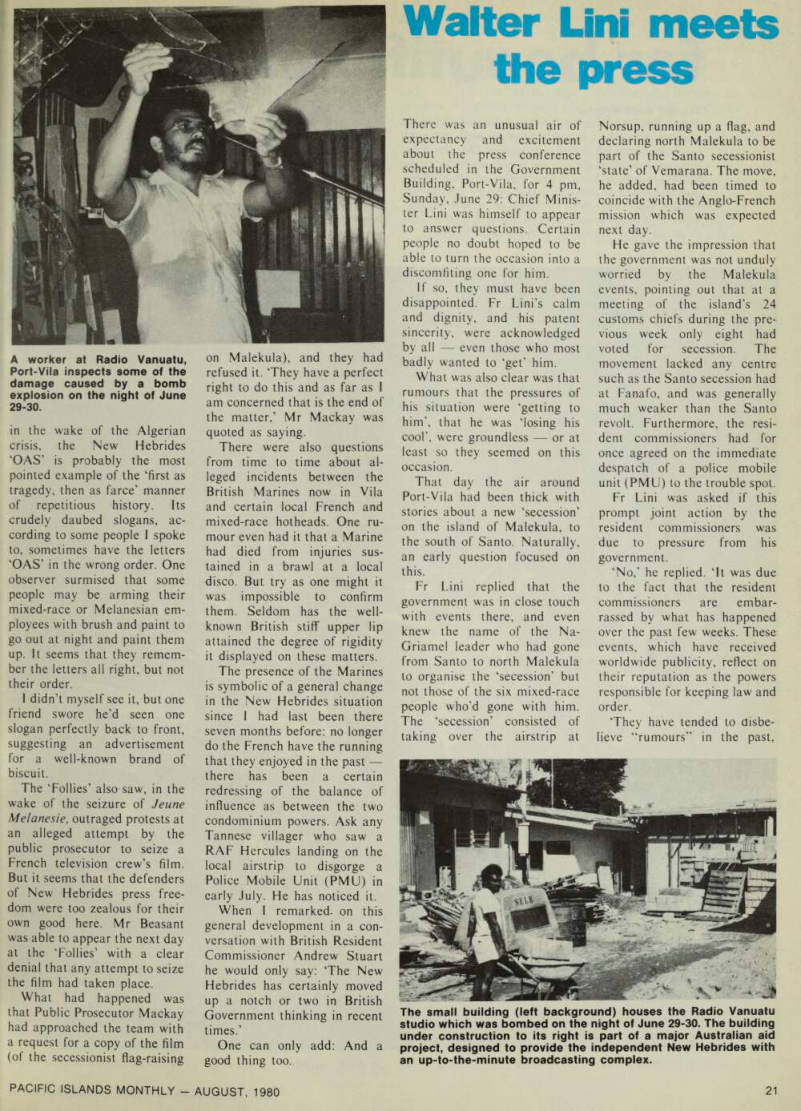
The small building (left background) houses the Radio Vanuatu studio which was bombed on the night of June 29-30. The building under construction to its right is part of a major Australian aid project, designed to provide the independent New Hebrides with an up-to-the-minute broadcasting complex.
but have later found that the “rumours” were true. ‘This experience too has helped them to come to the decision to intervene quickly on Malekula.’
The Chief Minister was per haps at his most impressive in responding to questions about the vexed problem of decentra lisation of powers, showing an appreciation of the problems of government in an archipelagic situation which should have put to shame those publicists of various stripes who have spent months of effort trying to de pict him as rigidly centralist in his approach to government.
He said: ‘I don’t think our government has ever said we don’t want island government.
The Vanuaaku Party has stressed this solidly since 1974. ‘But if we yield now to the pressures we’re under from every side, we would lay the groundwork for weak and inef fectual government in the fu ture. ‘Throughout its life, even after independence and well beyond, the government of this country will have to contend with pressures from islands trying to get everything they can from the central govern ment. That is a fact of life which we readily and freely acknowledge. These pro cedures will be an absolutely normal part of the govern ment’s existence. ‘But such pressures on a central government are one thing. Government by island alone is quite another, a recipe
for chaos in a situation such as ours.’
My own question to Fr Lini centred on a matter that has intrigued me for some time the idea of the inclusion in the government of members of the so-called Independent Oppo sition, in particular three lead ing French-speaking members of the Representative As sembly who, as distinct from the secessionist ragtag and bobtail, acknowledge the legit imacy of the present govern ment. Such a move, it has seemed to me, would tend to move the centre of gravity of New Hebrides politics in the direction of a broader unity, would broaden the base of the government. Half-facetiously, I presented my question concern ing Fr Gerard Leymang, Vincent Boulekone and Maxime Carlot not particu larly as my own idea, but as one entertained by ‘certain wise men sitting in Sydney’.
Fr Lini replied: ‘The govern ment approached these men at the beginning, before it was actually set up. We told them that we would be prepared to consider including some Francophone politicians either in the government, as head of state, or as ambassadors. All these things would be arranged before independence. ‘We told them that this was our intention, an intention formed in the interests of the unity of the country and the confidence of the population. ‘What has destroyed that confidence locally is some of the things that have happened recently. ‘lt is now very difficult for the government to consider such proposals. ‘To put forward such ideas now could even be unfair to the people concerned. It could ap pear that everything that has happened has been organised by them so that they could get these positions. ‘There can be very good philosophical ideas. But we have to develop ideas for the running of the government here on the ground, whatever “cer tain wise men sitting in Sydney” might think.’
It was not as complete a squelch as it might look: while it is true that a Vanuaaku Party man, the former Deputy Chief Minister and Minister for Home Affairs George
Kalkoa was elected on July 4 as future president of the re public, Fr Lini’s government has indicated that if a member of the opposition (probably, any one of the three men mentioned above) chooses to stand for election as Speaker of the post-independence Rep resentative Assembly, it would support his election.
This falls far short of what has been demanded with almost manic insistence by French Minister for Overseas Departments and Territories Paul Dijoud that Fr Leymang be president but, given the climate of opinion in the New Hebrides today, it is a substantial concession.
To a question on what was to be expected from the forth coming visit of an Anglo- French mission, Fr Lini answered blandly that his government would be willing to consider whatever would help to remedy the situation.
But he added that past ex perience had shown that the metropolitan governments tended to seek more con cessions from the government than from the opposition.
He then repeated his well known position that to make more concessions now would only lead to weak and unstable government in the New Hebrides in future.
I would happily wager that there was a higher proportion of the journalists present who saw the force of this viewpoint as Fr Lini’s press conference
ended than there had been when it began.
In a separate interview, Fr Lini gave the following reply to my question about the future relationships between an inde pendent New Hebrides and Britain and France: ‘lf the French and British Governments are sincerely dedicated to their professed intentions in finding a solution to the present difficulties then the relationship between an independent Vanuatu and France and Britain will be both strong and meaningful. ‘This is most certainly the circumstance my government has a preference for. The ties of history are most compelling, and while Vanuatu, as a Pacific Island state, will work towards establishing a strong regional identity with its neighbours, it is not practical or indeed desir able for 80 years of history to be denied. ‘However, if the present cir cumstance continues into in dependence, whereby France and Britain fail to uphold their moral and legal duty under the 1914 Protocol to maintain law and order, and fail to support the lawful government elected under arrangements and a con stitution they were responsible for and to which they agreed, then this will adversely and fundamentally affect the post independence relationship be tween us. ‘We are noting with particu lar care who our true friends are at this time.’
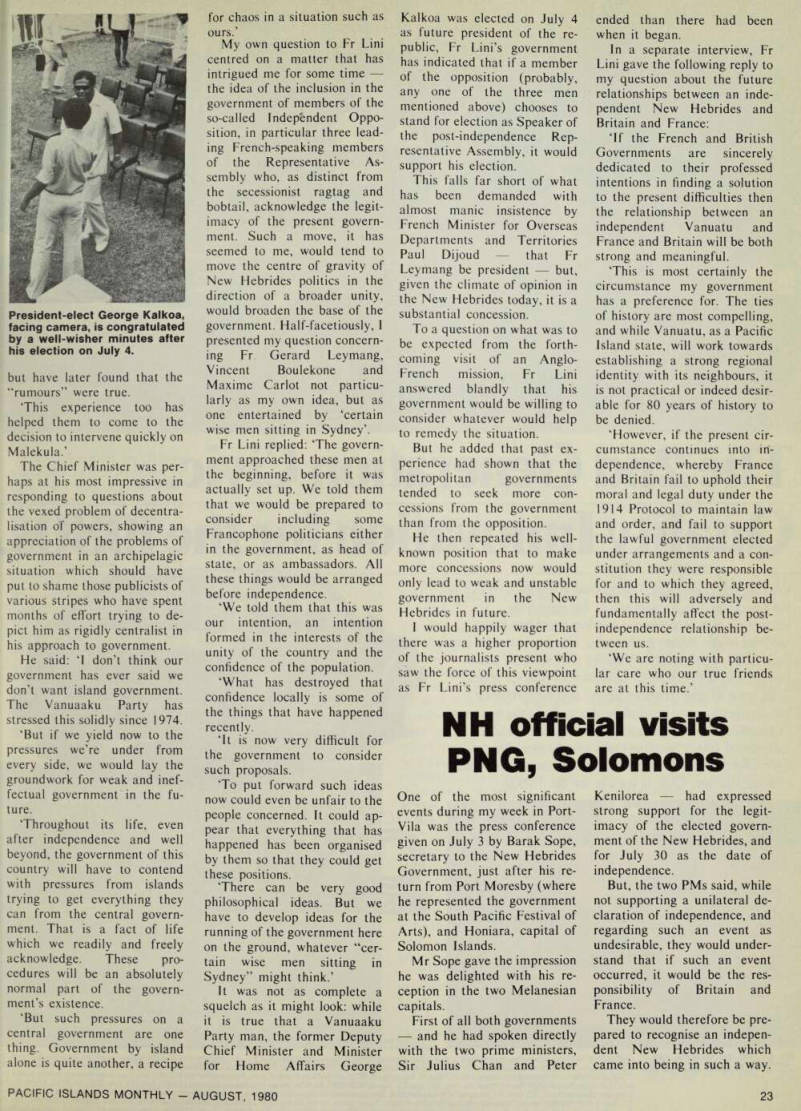
President-elect George Kalkoa, facing camera, is congratulated by a well-wisher minutes after his election on July 4.