‘Four O’Clock Follies’
pp. 18-21 · Read in the full issue

A close look at Port-Vila’s ‘Four O’Clock Follies’
PlM’s Associate Editor MALCOLM SALMON was in hv ■ i llno oq i iiK/ r ,
It didn’t take long for the daily press conferences put on by the New Hebrides Govern ment to cope with the influx of foreign journalists in Port-Vila in June to be dubbed the ‘Four O’Clock Follies’.
This echo of the Vietnam war, during which the press briefings given daily by the US military in Saigon were gener ally known as the ‘Five O’Clock Follies’, irresistibly brought to mind the old adage about ‘history repeating itself - first as tragedy, then as farce.
During the week June 28- July 5 that I was in Port-Vila, apart from two conferences at which representatives of the New Hebrides Government ap peared (Chief Minister Fr Walter Lini on June 29, and Secretary to Government Barak Sope on July 3), all the rest turned out to be jousting matches between the New Hebrides Government’s newly appointed press officer John Beasant (see People), and the motley array of French, English, German, Australian and New Zealand slaves of the media who happened to be present on the given day. There were often some Melanesians present, but at least in my time there they didn’t ask questions.
At the week’s end it seemed that honours were about even between the slightly schoolmasterly Mr Beasant and the journalists, most of whom showed they had absol utely nothing to learn about the ‘adversary’ role of the media when it comes to dealing with government spokesmen.
Two issues dominated the week; the seizure by police on the preceding Friday of issue No 8 of the French-language publication Jeune Melanesie, and the report by Public Pros ecutor Graeme Mackay into the death of Alexis Yolou on Tanna on June 11 (PIM Jul pi 3). The two matters were in
any case closely related, since the paper was seized because of a report it carried on the killing of Yolou in which Vanuaaku Party supporters on Tanna were virtually accused of having assassinated him.
Mr Mackay, with his own judicial inquiry into the affair not yet completed, no doubt felt, with his British legal train ing, that the article represented a pretty solid example of ‘con tempt’. But in true condo minium fashion, he had to look at ‘Joint’ statutes. Jeune Melanesie was seized under a Joint Public Order Regulation, which concerns the ‘spreading of false rumours which tend to cause public alarm, anxiety or public detriment’. Mr Mackay said he acted in his capacity as public prosecutor without ref erence to government.
There was an immediate out cry in Port-Vila’s French language press, which was taken up with minimum delay
by such Noumea organs of opinion as the weekly Corail.
In its July 3 issue it carried the page 5 headline ‘No freedom of press or information in the Hebrides’, and in an accompanying item repeated the bald claim that Vanuaaku Party supporters had ‘deliberately murdered’ Yolou.
When, later in the week, the Mackay report was made pub lic, it drew no firm conclusions about responsibilities for the killing, but made the following observations: ‘Both sides were armed. Fire arms were carried by between 15 and 20 Vanuaaku Party supporters, others having clubs and bows and arrows. Many “Moderates’’ carried guns and were armed with clubs, slings, and bows and arrows.’
It added: ‘Warrants of arrest will be issued to those against whom there is evidence in relation to the dynamiting of the airfield.’ (This was an ac
tion of the ‘Moderates’.) But it also foreshadowed; judicial action againsa Vanuaaku Party people, ing: ‘Permission was not given; to Vanuaaku Party supporter;! to carry guns. This was a loca£ party decision.lt is doubtfuu that these firearms were useo: in self-defence. Vanuaaku: Party members with guns ar the time after the “Moderates”; arrived would seem to be guilty; of unlawful assembly and an rests and charges will follow.’' In a general comment whicff: pointed to a measure of rese ponsibility residing consider-! ably to the north of Tanna, thei Mackay report noted: ‘The en-r tire problem which arose om June 11, 1980, might have' been better contained if adt ditional police from the PMU had arrived when requested) earlier on June 10 by Minister; (Willie) Korisa’ (who was orr Tanna at the time).
Meanwhile, a fullscale at-] tempt is under way to make as martyr of Yolou. Typical is the decision by the Santo separ-i atists to rename Santo Town’s* Boulevard Higginson, Boul-I evard Alexis Yolou. No doubt( this campaign will have some success, and embarrass tho
Vanuaaku Party government for some time to come.
But if a cause may be judged by the quality of its martyrs, this one is not off to a brilliant start. By any standards Yolou was a violent fanatic. He met his death in incidents instigated by himself and his supporters designed to ‘spring’ a number of prisoners from the government prison at Isangel.
The prisoners were in gaol because of their involvement in attacks on British police, involving dynamite and firearms, in May (PIM Jul plO). Yolou himself took part in these attacks. After his death, the rucksack next to his body was found to contain a veritable arsenal of destructive materials, ranging from sticks of dynamite to rounds of ammu-
nition. His was a typical case of living and dying ‘by the sword’.
French Resident Com missioner Inspector-General Jean-Jacques Robert must be credited with two initiatives which to some extent enlivened the lugubrious affairs of the death of Yolou and the seizure of Jeune Melanesie.
On a visit to Tanna on June 24 he formally presented to Yolou’s widow a sum of NFHIOO 000 (about $1300) in order to ‘help her raise her family’. The gift was made formally in the name of Minis ter Dijoud. What M Robert probably did not foresee is that in terms of Tannese custom the gift seemed to be a French acknowledgment of respons ibility for the death of Yolou, a compensation for a loss caused by them.
Then, at the ‘Four O’Clock Follies’ on July 1, M Robert made a surprise appearance in the body of the hall in the Government Building (actu ally, the chamber where the Representative Assembly meets), and instead of taking his place in the public gallery, as might be expected of a man in his exalted position, sat himself down in the journalists’
section, bang alongside Philippe Delacroix, the ‘printer’ of Jeune Melanesie, and acknowledged author of the offending article. MM Robert and Delacroix then en gaged in the friendliest of conversations, but not before Inspector-General Robert had demonstratively donned his in terpretation earphones with the jocular remark; ‘l’m here for the cinema’. (One of the many near-riots at the ‘Follies’ en sued next day in the course of a debate over whether the inspector-general had said ‘cir cus’ or ‘cinema’, but that’s by the way.) M Robert’s July 1 sally into the press conference, and his fraternisation with the main protagonist in the Jeune Melanesie matter, aroused the obvious chagrin of his compatriot Jean Massias, di rector of Nabanga, the French residency-sponsored weekly newspaper in Port-Vila. M Massias sal through the inci dent, it is true, but not without much muttering and grinding of teeth.
M Robert’s counterpart, British Resident Commissioner Andrew Stuart, meanwhile, had also gone to Tanna.
His contribution to the gai ety of nations in those dark days was to present to the villagers at laknanan in the south of the island a portrait of
Prince Philip (to whom they have taken a great fancy) with a nal-nal (ceremonial club) from Tanna in his hands. The incident caused one visiting British scribe to wonder whether, in the event that New Hebridean villagers ever offer Prince Philip a penis gourd, he would ever get to see a ‘Chang ing of the Gourd at Bucking ham Palace’. . .
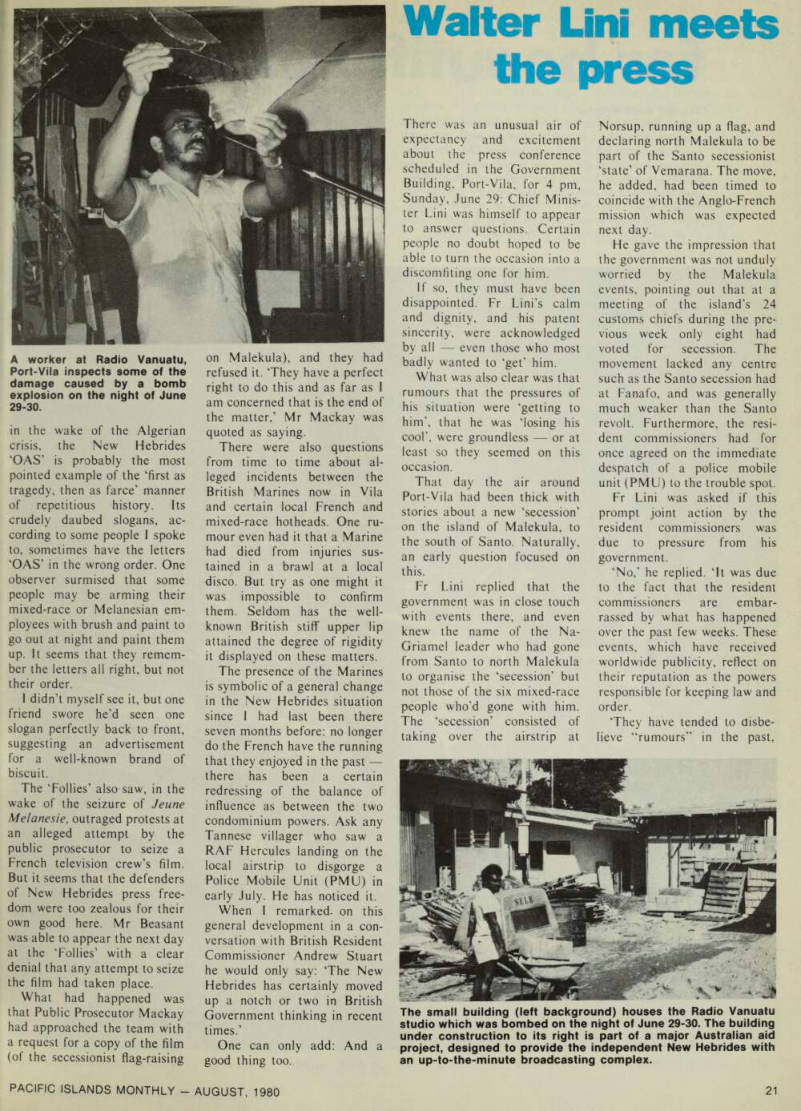
There were various sub themes to the ‘Follies’: one was the attempt to blow up the studio of Radio Vanuatu on the night of June 29-30. When Mr Beasant raised the matter on June 30, treating it in a serious manner as might be expected, he was rebuked by a young French journalist, a fair-haired, blue-eyed representative of Jeune Melanesie. He said that not too much should be made of the matter as very little damage had been done, and the station had been back on the air at the due time of 11.30 am that morning. Dynamiting radio stations, according to this reasoning, is pretty much in order provided the place isn’t blown to smithereens.
The radio bombing gave rise to renewed talk about the so called ‘OAS’, the shadowy body which had spread leaflets in Port-Vila threatening the Vanuaaku Party leaders.
Taking its name from the Or ganisation de I’Arm'ee Secrete. which spread terror in France
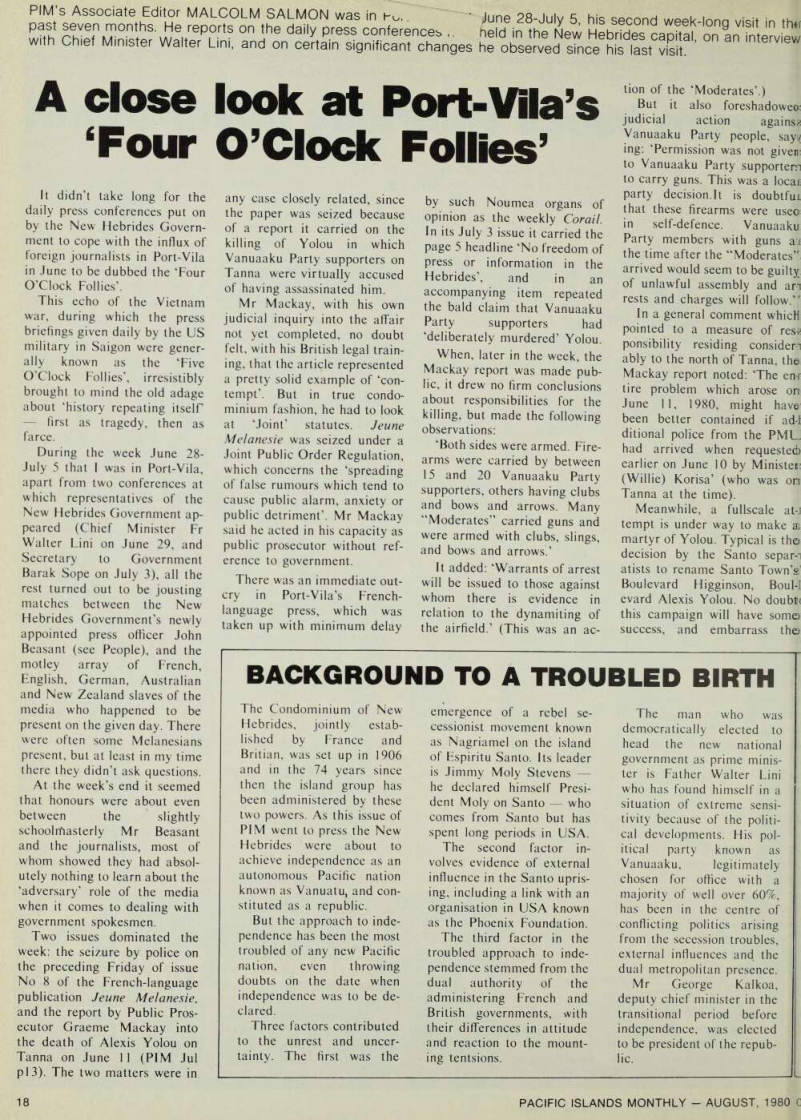
A rare - and happy - example of harmony between the New Hebrides Government and a French-sponsored institution: Chief Minister Walter Lini (left) officially inaugurates a mural on the front wall of the Government Building in Port-Vila. The mural was painted by students at a French-run technical high school. At right: Some of the young artists. Centre: Pastor Fred Timakata, Speaker of the Representative Assembly.
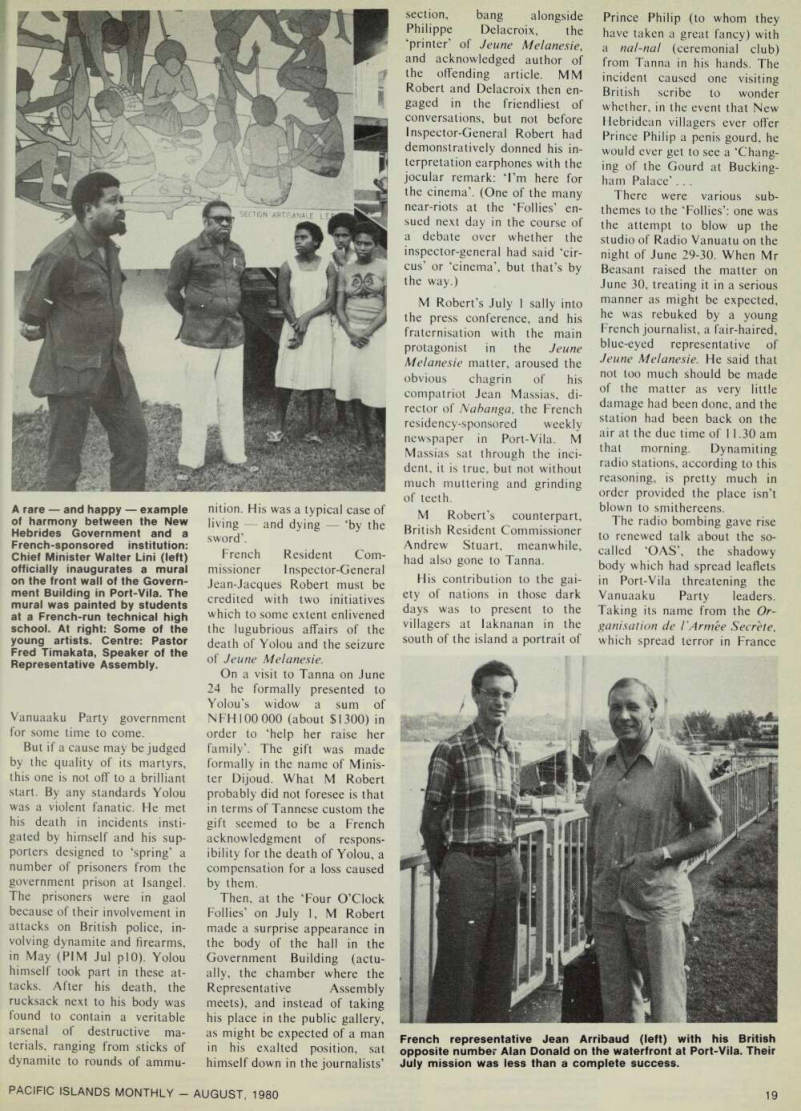
French representative Jean Arribaud (left) with his British opposite number Alan Donald on the waterfront at Port-Vila. Their July mission was less than a complete success.
in the wake of the Algerian crisis, the New Hebrides ‘OAS’ is probably the most pointed example of the ‘first as tragedy, then as farce’ manner of repetitious history. Its crudely daubed slogans, ac cording to some people I spoke to, sometimes have the letters ‘OAS’ in the wrong order. One observer surmised that some people may be arming their mixed-race or Melanesian em ployees with brush and paint to go out at night and paint them up. It seems that they remem ber the letters all right, but not their order.
I didn’t myself see it, but one friend swore he’d seen one slogan perfectly back to front, suggesting an advertisement for a well-known brand of biscuit.
The ‘Follies’ also saw, in the wake of the seizure of Jeune Melanesie, outraged protests at an alleged attempt by the public prosecutor to seize a French television crew’s film.
But it seems that the defenders of New Hebrides press free dom were too zealous for their own good here. Mr Beasant was able to appear the next day at the ‘Follies’ with a clear denial that any attempt to seize the film had taken place.
What had happened was that Public Prosecutor Mackay had approached the team with a request for a copy of the film (of the secessionist flag-raising
on Malekula), and they had refused it. ‘They have a perfect right to do this and as far as I am concerned that is the end of the matter,’ Mr Mackay was quoted as saying.
There were also questions from time to time about al leged incidents between the British Marines now in Vila and certain local French and mixed-race hotheads. One ru mour even had it that a Marine had died from injuries sus tained in a brawl at a local disco. But try as one might it was impossible to confirm them. Seldom has the well known British stiff upper lip attained the degree of rigidity it displayed on these matters.
The presence of the Marines is symbolic of a general change in the New Hebrides situation since 1 had last been there seven months before: no longer do the French have the running that they enjoyed in the past there has been a certain redressing of the balance of influence as between the two condominium powers. Ask any Tannese villager who saw a RAF Hercules landing on the local airstrip to disgorge a Police Mobile Unit (PMU) in early July. He has noticed it.
When 1 remarked, on this general development in a con versation with British Resident Commissioner Andrew Stuart he would only say; ‘The New Hebrides has certainly moved up a notch or two in British Government thinking in recent times.’
One can only add: And a good thing too.
A worker at Radio Vanuatu, Port-Vila inspects some of the damage caused by a bomb explosion on the night of June 29-30.