hope of growing
p. 49 · Read in the full issue
Books
The pain and the hope of growing up in Polynesia
Growing up in Polynesia. By Jane and James Ritchie. Pub lished by George Allen and Unwin, Sydney. $A5.95 The natives have been reading accounts of themselves for years. Jane and James Ritchie, however, intend Growing up in Polynesia to be a book not only about the peoples of those islands, but for that developing
population.
Fourteen chapters, 176 pages, but (pity) no illus trations, briefly outline what it is (and was) to grow up in the Polynesia of today and yester day. Along the way, the Ritchies pause for comment on what they have just described, recommending one course of action or one type of behaviour over others.
They are not merely making
the old plea that peoples whose circumstances and cultures have changed should return to an idealised past. Their advice is, on the contrary, thoughtful and measured, keenly aware as they are of how things, in their view, have gone so wrong for
Europeans.
The Ritchies are anthropol ogists, teachers in New Zealand as well as Pacific universities. Both bring to their work a history of personal in volvement and interest in Pa cific matters. Much of this
knowledge is displayed by the
husband and wife team in their competent quoting of numer ous sources.
I said that the book was writ ten as much for outsiders as it was for the Polynesians them selves. Emphasising this, the Ritchies begin each of their chapters with a few quotes from their Islander students.
These highlight modern Polynesian concerns and pro vide keynotes for the more
objective analyses that follow.
At one point, one of their indigenous critics remarks:
‘Perhaps only a few
Polynesians are conscious of the various themes that are
raised in this book. Most Polynesians are proud of the fact that they are Polynesians, but what they are adopting does not seem to promote the Polynesian way of life.’
The Pacifican readers of the manuscript, it seems, are harsh critics of themselves and their cultures, their shared and learnt patterns of behaviour.
Speaking about childhood, the Ritchies quote one of their students: ‘I can just about feel the pain that befalls the young
sters growing up.’
The Ritchies believe that Polynesian parents do not
praise their offspring suf
ficiently and at a number of points mention this as a fail
ing.
However, Polynesians share some of the problems faced by us in the European world, and their complaints often seem like echoes of distant shouts and muffled groans such as that against the tendency of Fiji parents to want schools with a strong academic orien tation and a heavy stress on examinations.
Jane and James Ritchie have taken their quotes from a var
iety of Polynesians, living both
in their own communities and far away. Some remember with
nostalgia their happy child
hood, while others bemoan the changing times, their forever
changing homelands.
‘New changes have brought
loose morals and a breaking
away from the disciplined upbringing of children. New influences challenge the tra ditional values of education and child rearing and place greater emphasis on a money economy.’
Ethnocentrism, the belief that one’s own way of life is the measure of all others, is central to most societies. Europeans have been practising it for years, in their colonial adven tures, in their imposition of foreign law on local popu lations, in their justifications for brutality and murder.
Ethnocentrism is rarely a
conscious act people just
assume that their own customs and conventions are the most correct, the most natural. The Ritchies believe that European psychology, like other brands of faith and belief, represents too heavily its native culture.
That is, when Swiss psychol ogist Jean Piaget writes about the early development of chil dren, he is writing about European infancy, as a cultural, not a biological fact.
In the last chapter of the book, ‘Human development in a Pacific perspective’, the
anthropologists gather together
the threads of their arguments to present us with their insights into both Polynesian and European cultures. The Ritchies believe- that human beings can learn from one another, empathise and under stand the divergent exper-
iments in living that our species has tried (or is trying).
In its concluding remarks, the book is frankly optimistic, hopeful that in spite of the dif ficulties of the last two cen turies, Polynesians can again regain their dignity, their eth
nic pride.
The most interesting things
in this book, this litany of recommendations for living (and loving) are the insights provided into how the ordinary Islander in the street is likely to react in given situations, and what he or she feels about the
future.
Grant McCall.
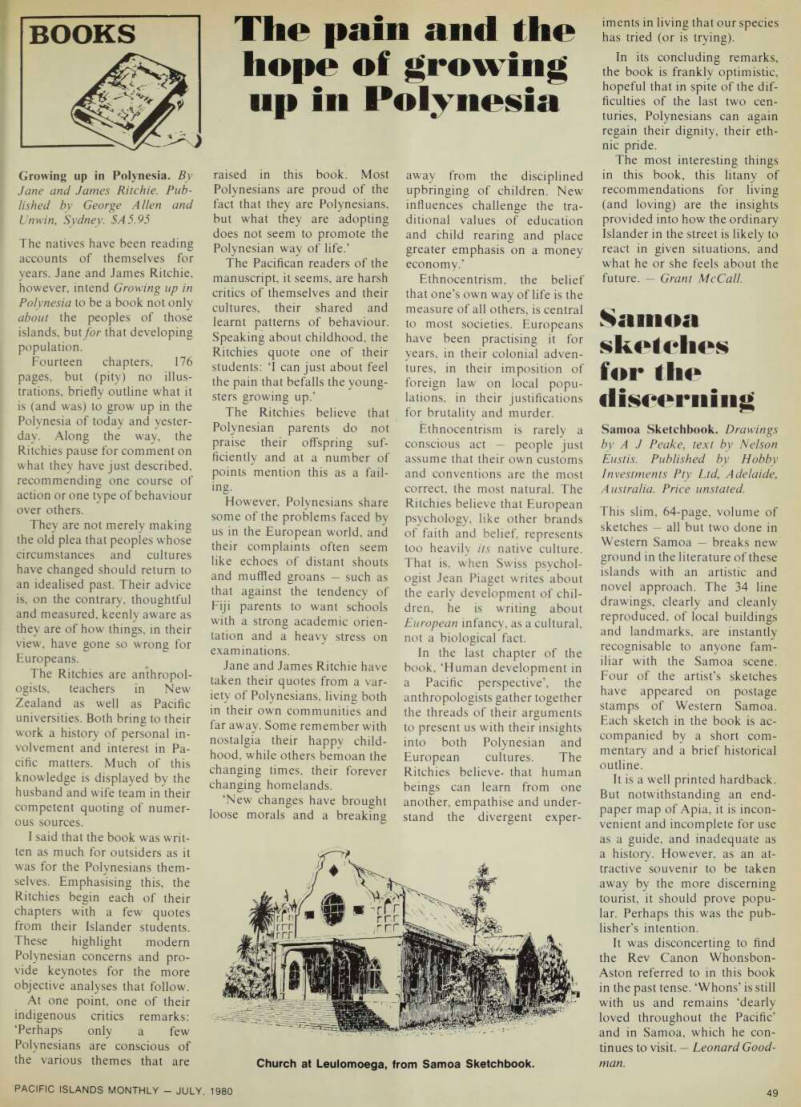
Church at Leulomoega, from Samoa Sketchbook.