Pacific Island Aviation
pp. 35-47 · Read in the full issue

Island operators take new role in regional air routes
Since the days when Charles Kingsford Smith crossed the Pacific by air, civil aviation has become a vital part of the transport and the economy of the Pacific, and today the newer operators are coming into their own.
Australia and New Zealand were the first true Pacific based operators, with influ ences coming into the Pacific from USA, the UK and France.
Papua New Guinea became the first air-minded Pacific Island country, largely through Australian air development, with services going back to the
1920 s and developing on a
major scale in the 19305.
The Island-based airlines which now operate their own domestic services, which oper ate regional links and which fly alongside major international operators on trunk routes in the Pacific have developed from this background.
There are now at least 30 substantial third-level oper ators engaged in reliable and continuous passenger and freight services in the Island countries of the Pacific. One of these alone Talair in Papua New Guinea has a fleet of 65 aircraft making it one of the world’s biggest third-level op erators.
Seven new nations in the Island countries of the Pacific are now involved in govern ment international airline op erations. Some of these airlines
so far fly only comparatively
small regional links, but as the flag carriers for their countries they are entitled to negotiate rights across their borders and have been doing so. Three sig nificant operators which have emerged from this new crop of international airlines are Air Pacific (Fiji). Air Niugini (Papua New Guinea) and Air Nauru. The three span the entire Pacific and the main gateways to South-east Asia.
Of the original international operators based in the Pacific, Qantas and Air New Zealand now play a reduced regional role as the Island countries de velop their own services. In ad dition, eight international airlines from Europe, USA.
Asia and South-east Asia make direct calls at one or more Pa cific Island countries.
The following survey looks at the new nation airlines which are writing a new chap ter in the history of Pacific air links:
Air Pacific
goes back
30 years
Air Pacific is the national air line of Fiji and traces its origin back nearly 30 years when it was formed as a domestic air line operating De Havilland aircraft (Drovers and Dragon Rapides) over internal island routes.
One of the most interesting aspects of its history is that it was the first Pacific Island air line to conceive the idea of forming an Islands airline for a group of Islands countries.
The projected scheme worked well for several years but it be came politically outdated as individual countries became independent or approached independence and began to ex press their nationalism through their own institutions. The con cept of a Pacific-wide Islands airline with governments in partnership now seems to have been forgotten, although to some extent the situation is
being reflected in shipping ser vices with the establishment of the Pacific Forum Line.
After its formation as Fiji Airways in 1951 the young company went through a num
ber of operational problems,
including lack of capitalisation
to modernise or at least to in crease the efficiency of its fleet.
This led to a 100% takeover of the airline in 1958 by the Australian airline Qantas, and whatever may have been the political connotations this period stabilised the airline and laid foundations for its viability. Within seven years Qantas had farmed out some of its interests and the airline still known as Fiji Airways became a consortium involving Qantas, British Overseas Air ways Corporation. TEAL (which later became Air New Zealand) and the Fiji govern ment.
Soon afterwards the exper iment in Islands partnership began, with Tonga, the Gilbert and Ellice Islands, Solomon Islands, Nauru and Western Samoa joining the consortium.
But with the coming of independence in Fiji the airline was renamed and reorientated as Air Pacific and by 1974 the
airline was majority-owned by
the Fiji government. Qantas has continued to operate the airline's ground-handling ser vices but this, too, is being
phased out following alle
gations by the Fiji government
that the present costs are ex cessive.
The airline has been flying on international routes (the first was a short hop across the ocean to Tonga) for 21 years.
Today Air Pacific flies dom estic routes within Fiji, and op erates out of Nadi and Suva with an extensive South Pacific network. It flies to Sydney and Brisbane in Australia, to Auckland in New Zealand, and to French Caledonia, New Hebrides, Tonga, Western Samoa, American Samoa, Tuvalu and Kiribati. It is also negotiating to fly to Tahiti in conjunction with UTA French Airlines.
The Air Pacific fleet consists of two Hawker Siddeley 7485, three BACI-1 Is and four Ban dierante EM 110 s. The airline is looking at a US reciprocal
rights proposal to fly into
Hawaii and the US mainland.
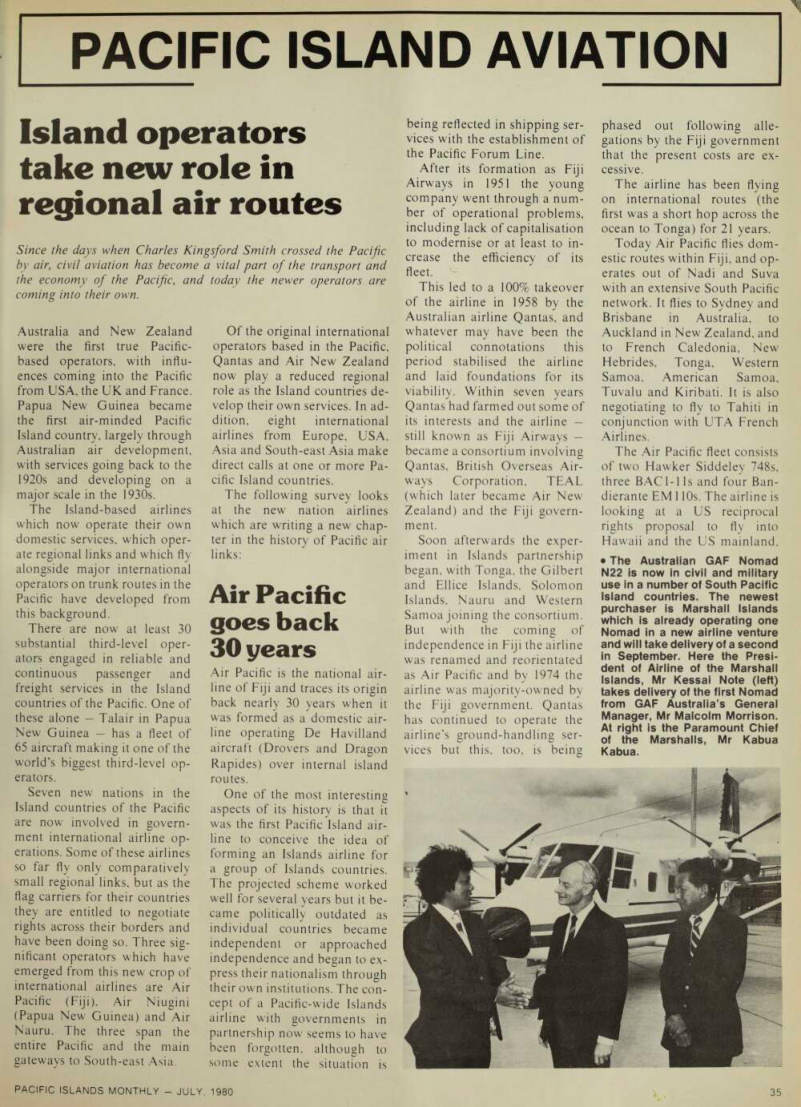
The Australian GAF Nomad N22 is now in civil and military use in a number of South Pacific Island countries. The newest purchaser is Marshall Islands which is already operating one Nomad in a new airline venture and will take delivery of a second In September. Here the Presi dent of Airline of the Marshall Islands, Mr Kessai Note (left) takes delivery of the first Nomad from GAF Australia’s General Manager, Mr Malcolm Morrison.
At right is the Paramount Chief of the Marshalls, Mr Kabua Kabua.
but re-equipment with larger
aircraft would be necessary be fore this route could be con sidered.
The airline’s head office is in
the Fiji capital, Suva.
Smallest in
world was
Nauru boast
Nauru, the little island country only 30 km south of the equator, uses the catchy adver
tising slogan today that it once
operated the smallest inter national airline in the world.
That was back in 1970 soon after the achievement of
independence and naturally
enough with nationalism running high at the time there was no reference in those days to ‘the smallest inter national airline’.
But 10 years of successful op eration and the expansion of routes in the south-west Pacific and to Asia have made Nauru indulgent towards its small start, and what was once some thing of a secret has become a commercial boast. There’s little doubt that the claim of being the smallest in 1970 would take
some beating.
The airline started in 1970 with a Falcon Fan-Jet and its sole route was a hop across a corner of the Pacific to Bris bane on the Australian east coast and then back home
again.
On the way there was a stop at Honiara in Solomon Islands, but even this was only a tech nical stop because of the re
quirements of fuelling. “The
Pacific never looked so big as it did in those days” the air line’s Melbourne agents reported in Australia recently.
The airline now flies to 19
ports, including Hong Kong
and Japan in the west and Aus tralia and New Zealand in the south.
Air Nauru was an early re gional operator of Fokker Fel
lowship F2B jets, selling its two
units to Air Niugini when it
began its major period of
expansion just over two years ago. The airline now has an all- Boeing fleet - two 727 s and two 7375. Its head office is in Nauru.
N. Hebrides
has change
in airline
A major deal negotiated by
Australian-born Dennis Buchanan of Papua New Guinea has brought a substan tial change in the ownership of Air Melanesiae, the New Hebrides domestic airline which operates out of Port-Vila servicing 18 ports on 12 New Hebrides islands.
The deal has also put Buchanan right at the top as the operator behind a diversified South Pacific airline and third level air network which takes in Papua New Guinea. Solomon Islands and the New Hebrides and which could now be sitting on the edge of going inter national out of the region depending on what the New Hebrides decides to do after
gaining its independence
shortly. The operation could also possibly extend to New Caledonia.
Until recently Air Melanesiae has represented a partnership between UTA French Airlines and a New Hebrides company New Hebrides Airways Ltd. The four major shareholders in New Hebrides Airways have been Mr Bob Paul - an Aus tralian living in the New
Hebrides the UK airline Bri tish Airways, the Australian airline Qantas and the Australian-based Islands company Burns Philp. How ever Qantas relinquished its shares earlier this year, and under the new ownership deal a Buchanan company has bought out the shares of Bob Paul, Burns Philp and British
Airways.
The Buchanan company taking up the shares is American Pacific Tours which is based in Port-Vila and which was established to tap the North American market by bringing travellers to Melanesia after their arrival in Fiji. American Pacific Tours is now the majority shareholder in Air Melanesiae and is in partnership with UTA in run ning Air Melanesiae.
Buchanan’s founding
company is Talair, based at Goroka in Papua New Guinea.
It has a fleet of 65 aircraft mak ing it the biggest third-level op erator in Australasia and the South Pacific. Buchanan has operated it since 1957, and he also has a 51 per cent interest
in the Solomon Islands airline, Solair, which operates within Solomon Islands and has re gional services to Santo in the New Hebrides and Bougain ville Island in Papua New Guinea.
A minority ownership of up to five per cent in New Hebrides Airways is held by New Hebrides nationals and Buchanan has not touched this shareholding and does not intend to.
Coming originally from Syd
ney, Buchanan has been a resi dent of Papua New Guinea since November 1949. He served as a member of parlia ment there from 1968 to 1972.
Besides building up an elabor ate airline network, Dennis Buchanan, together with his wife Della, have established a fine line of young Buchanans - four sons and five daugh ters.
Talking recently in Sydney
of future plans in the New Hebrides, Buchanan said ‘We want a close association with Talair and Solair. These are all Melanesian people and we would like to help them.’
Asked to give the latest tally on his air fleet, Buchanan said Talair had 65 aircraft two Bandeirantes, six Twin Otters, 10 Barons, 11 Cessna 4025, 20 Britten-Norman Islanders and
various single-engine planes.
In the Solomons, Solair oper ates eight aircraft three Queenairs, two Islanders, two Barons, one amphibian and a Metro II which was scheduled
for delivery in early July.
New Hebrides Airways has a Trislander and an Islander, and the joint company Air Melanesiae has ordered a new
What we looked like in 1970 - Air Nauru draws comparisons to show its expansion.
Metro II - delivery this month
Buchanan - empire builder
300-series Twin Otter from Canada, scheduled for delivery in Port-Vila by October.
From PNG through Solomon Islands to the New Hebrides, the next hop for Buchanan could possibly be into neighbouring New Caledonia. Buchanan said that, subject to the willingness of the French, ‘We would like to be involved in New Caledonia.’
The history of New Hebrides Airways goes back to the early Sixties when it was founded by Australians Bob Paul and Paul Burton. Burton, a pilot, lost his life in a flying accident in the early days of the airline, and Paul would have been on the same flight but had given up his seat to another passenger.
The Burns Philp, British Air ways and Qantas shareholding was established in 1968, about the same time that the part nership was formed with UTA to operate Air Melanesiae.
The 57-year-old Paul orig
inally settled as a trader and planter on Tanna at the end of the Pacific war. and his name became synonymous with the island of Tanna where he has operated tourist bungalows and treks to the Yasur volcano crater for over 20 years. How ever he and his wife Katherine
have recently been considering
returning to live in Sydney.
Air Tungaru
youngest
in Pacific
The youngest Pacific airline
now operating on regional
flights outside its own borders is Air Tungaru. the airline of
the newly-independent
Kiribati. Air Tungaru gets its name from what the islanders claim was the original name of the country at the dawn of Pa cific history. The airline is wholly owned by the govern ment and was established in April 1978 although it did not begin flying until this year.
The only international link at present flown by Air Tun garu it also flies domestic services is a weekly return
flight to Hawaii through
Christmas Island.
The airline operates two Britten-Norman Trislanders on
its domestic services based out of Tarawa, and it wet-leases a
Boeing 727-100 C from Air
Nauru for its weekly flight to Hawaii.
The airline’s head office is at Bairiki, Tarawa.
Tuvalu given
stamp and
its seaplane
Sea Bee Air, a New Zealand company, is behind a recent South Pacific Island air oper ation a seaplane service link ing the islands of the
recently-independent Tuvalu.
Stamp collectors in many countries already have in their possession a cover which announces Tuvalu Internal Air Service and which shows a sea plane flying over the atolls of Nukulaelae, Vaitupu. Nui and Funafuti and which is dated May 16, 1979.
From this kind of publicity
one might reasonably suppose
that the service has now well and truly celebrated its first birthday. But that is not so. A good 12 months elapsed be tween the issue of the stamps and the day on which the ser vice at last got off the ground - or more accurately, got off the water.
A five-passenger Widgeon
amphibian is now linking six ports in the islands of Tuvalu, and if the service is a success a larger 10-seater Goose will be brought in to replace the Widgeon. The service is being conducted as a contract ar rangement between the oper ators and the Tuvalu government.
To be fair, it was not the fault of the government or the op erators themselves, for that matter that so much time elapsed between the issue of the stamps and the start of the service. When the stamps were designed it was generally be lieved that May 1979 would in fact see the service flying. But as a correspondent in Funafuti points out cynically, ‘in this part of the world you believe
things when they actually hap
pen, not when some one influential says they are going
to happen’.
Progress was hampered by
‘unexpected delays’ in shipping
building materials from over seas, mainly for the construc tion of the hangar alongside the runway at Funafuti. There were initial mistakes, too, in the laying of the foundations for the building. It was not until late in September that things took a turn for the better with the arrival of a warrant of ficer from the British Royal Engineers to supervise the con struction.
By the middle of November the framework of the building was complete, but there was no sign of an aircraft to be housed in it. Meanwhile in the outer islands to which the service would be linked there was con siderable delay in marking out
alighting areas, blasting out
coral heads and felling palms.
The lagoon at Nui required a fair amount of blasting work and the services of a New Zealand reef blasting team were employed on this during its enforced stay on the island due to the inordinate time taken to overhaul the country’s only inter-island vessel. Sites for non-directional beacons were plotted on maps.
The months passed. Then, at the end of February, came the rumour that a plane was to arrive early in March. Much to everyone’s surprise it did! On March 6 a team from Sea Bee Air arrived on the weekly Air Pacific flight, to be followed six
days later by the plane itself.
Not many people were aware that it was due to arrive, but by the time it had flown at low level the length of the runway and circled to land there was an interested crowd of onlookers
by the airport buildings to greet
pilot Norman Sanson and
engineer Peter McCarty.
Rumours abounded as to when the first flight would take place first it was to be on Friday morning, then it was ‘virtually certain’ that it would
be Saturday morning. So
strong was that rumour that the manager of the Philatelic Bu reau had his staff prepare a considerable number of covers to go on the ‘first flight’. At a
Friday afternoon meeting,
however, the acting minister for communications and trans port stepped in and refused to let the flight take place. It was
felt that certain contractual problems should be sorted out before official permission could be given for carrying passengers and freight.
A number of test flights were conducted, but by the end of March the only passenger who had flown in the Sea Bee was the pastor from Nukulaelae, brought to Funafuti for hospi tal treatment in a medical emergency flight. The first time Pilot Sanson was briefed to land at Nui on a check flight he refused to complete the landing because he claimed 20 coral heads still constituted a hazard. This also affected flights further afield because a Nui landing was necessary for
fuelling.
Although the test flights
proved very popular - they
attracted big crowds of people who had never before seen an aircraft at close quarters the wisdom of the entire operation
was being questioned by the
time it became a reality. It’s still too early yet to measure the potential of the service, but the prospects appear to be
good.
Air Niugini
is biggest
flag carrier
Air Niugini is the Papua New
Guinea flag-carrier, operating
domestic trunk routes as well as overseas. It was formed in November 1973, on the eve of self-government and two years before PNG became fully independent from Australia.
The airline grew n an amal gamation of Austrian and domestic airline interests and the four shareholders at Ts for mation were the Papua New Guinea government. Qantas, Ansett Transport Industries and Trans Australia Airlines.
The airline is now owned 89 per cent by the government through a national airlines commission under a structure which gives it commercial autonomy but an ultimate re sponsibility to the government through the commission and transport minister. The remaining 11 per cent is still owned by Ansett who provide some technical services in Aus
Nomad 22 into service, using the aircraft’s small strip capabilities for small unsealed airstrips. A Nomad and a Hawker Siddeley 748 are used
to provide four flights a day
now into the adjoining Samoa.
Other destinations served by Polynesian are Cook Islands, New Zealand, Niue, Tonga, Fiji and Wallis. The main fleet consists of a Boeing 737, two Hawker Siddeley 7485, a Nomad 22 and two Britten- Norman Islanders. A Cessna 172 is used for general aviation work.
VIP jet on
government
order in PNG
Purchasing its most sophisti
cated VIP aircraft to date, the Papua New Guinea govern ment is to spend SA7.B million on a Grumman Gulfstream II jet for use on government business by the Prime Minister,
Sir Julius Chan, other political leaders and senior officers.
The move follows intense lobbying by European and US manufacturers who knew that the government was consider
ing replacing its turbine
powered Beechcraft Kingair
which does not have the range and payload which the govern ment believes are required. For a number of recent overseas flights the PNG government has leased one of the four
Fokker Fellowship jets oper
ated by its national airline Air
Niugini.
There is some speculation in technical circles that even now the government will still have to fall back on airliner leasing for the type of trunk flights which may be required by government delegations. The Kingair itself has been in ser vice for less than two years, replacing one of the Cessna top lines. The Grumman is due for delivery in September, and is being bought from the execu tive fleet owned by the UK firm Rolls Royce.
The PNG government is
already on the defensive over the purchase of the Grumman, and has faced a number of political attacks alleging waste of funds. The attacks have been made all the more bitter by the fact that the government recently had to guarantee several million dollars to bail out Air Niugini from financial difficulties (see Pacific Report).
Announcing the purchase of
the Grumman. Sir Julius said the aircraft was a long-range medium-size unit with what he called ‘world-wide capabilities’. He said it had been selected only after considerable research the same terms which were used by the previous Prime Minister. Mr Somare, and earlier transport ministers when announcing the purchase of the earlier Cessna and Beechcraft.
Twelve types of aircraft were investigated, and the Grumman was found to be the most suitable for the government’s requirements, the Prime Minister said, it’s not the Prime Minister’s aircraft, and it’s not the ministers’ aircraft it’s a
government aircraft,’ Sir Julius said, and added ‘ln the end. officials will use it more than ministers.’ Sir Julius said that to be effective. Papua New Guinea’s government had to be both efficient and fast.
He said ‘Our country is deal
ing with large multi-national
companies and consortiums and we must be in a position to deal as an equal. At the mo ment, these companies are more mobile. Many of them have their own aircraft. In view of the multi-million dollar investment proposal for PNG over the next four years, the government cannot afford to operate at such a disadvan
tage.’
Sir Julius also justified the purchase on the grounds of se curity. He said it would save government officials from
being exposed to ‘hijackings,
bombings and things like
that.’
Sir Julius said the cost of the aircraft and spares would be about $7.8 million, but a sig nificant amount of this would be saved in travel expenses.