Hokule’a
pp. 91-93 · Read in the full issue
Yachts
Hokule’a in Tahiti
Kamehameha’s Hawaiian Studies Institute in Hawaii, is well-versed in the demands of open ocean sailing. He gradu ated from the California Mari time Academy and sailed on vessels ranging from a 52-foot schooner out of Lahaina to 50 000 ton freighters sailing between Japan, Hong Kong, Anchorage and th£ Carib bean. Pi’ianai’a also has a long-standing knowledge of Hokule’a. He served as first mate aboard the canoe on her return voyage from Tahiti in 1976 and has been instrumen tal in utilising the Hokule’a as a floating classroom for school children throughout the Hawaiian Islands. According to Pi’ianai’a, the voyage was a test of ancient navigational skills and human endurance.
He said ‘Our primary goal was to rely on nature for deter mining our position at sea rather than modern day equip ment like the sextant, compass, chronometer or charts. During the day the crew used ocean currents, sea swells and the flight pat tern of birds to steer the canoe towards Tahiti. At night the stars were our guide.’
Pi’ianai’a said that birds were a good indicator of nearby islands, and species like the tern or noddy rarely flew more than 25 km from land. ‘Spot a tern and land can’t be far off,’ he said.
Most night-time navigation was the responsibility of
Nainoa Thompson, another veteran of the first voyage.
Thompson’s knowledge of the navigational use of stars was developed through his tutelage under Mau Pialug, the Micronesian who served as navigator on the Hawaii to Tahiti leg of the 1976 voyage, and a great deal of self-study.
The canoe’s name, Hokule'a, refers to one of the most im portant stars that Thompson has learned to recognise. It refers to the zenith star of the Big Island (Arcturus in con stellation Bootes) which ancient Polynesian sailors used as a guide for sailing from Tahiti to Hawaii.
Since the capsize off Molokai in 1978, Hokule’a has undergone considerable re pair and re-designing to ensure its seaworthiness and safety. The canoe’s bamboo deck was replaced with plank ing, more than five miles of lashing were inspected and repaired, the canvas sails were increased in size and three coats of sealant were ap plied to protect the fibreglass hulls from barnacles.
Sixty people, ranging in age from 20 to 65 years, applied to be crew members but only 22 were selected. Although they came from diverse social and economic backgrounds, the crew shared the common bonds of Hawaiian ancestry and experience at sea.
Life aboard Hokule'a is not easy. Harsh wind, rain, sea
» HOKULE’A, the Hawaiian- Duilt double-hulled canoe nade on the pattern of ancient 3 olynesian voyaging canoes, :ompleted its third open- Dcean crossing in the Pacific n April (see cover picture). It crossed from Hawaii to Tahiti, employing the systems of /vinds, currents and navigation Dy the stars pioneered thou sands of years ago by long distance Polynesian seamen.
The 20-metre canoe which Hawaiian builders called Hawaii’s bicentennial gift to he nation’ and ‘the spaceship Df our ancestors’ made its first Dcean crossing in 1976 on a ound voyage of 6000 nautical niles between Hawaii and the Society Islands. Its second /oyage from Hawaii ended in disaster off the Hawaiian sland of Molokai when heavy seas swamped the canoe with he death of one crewman.
For the April crossing to' Fahiti the US Coast Guard Ser /ice insisted that the Hokule’a :arry safety flares, life preser vers, radio beacons, medical <its and communications radio Dut these were essentially a Dack-up and the voyage was sompleted using the methods Df the early voyagers.
Scientifically, the voyage /vas regarded as a ‘giant step jack in time’. It not only Droved the seaworthiness of a 3 olynesian-designed canoe, Dut provided evidence that the ancient sailors who settled the 3 acific islands were capable Df making deliberate long dis :ance voyages using only their finely honed knowledge of the stars, sea and winds to chart a precise course.
Gordon Pi’ianai’a captained Hokule’a for this year’s voy age. Pi’ianai’a, Director of
swells and boredom can take a heavy toll from the most ex perienced sailor. Food can help build the strength and morale needed to endure the many hardships. Pi’ianai’a said that poi, dried fish, ba nanas, coconuts and other traditional Hawaiian food were taken on the journey, but the bulk of the crew’s diet con sisted of canned fish, meat, vegetables, biscuits, and 200 gallons of water for cooking and drinking. ‘After our first voyage in 1976, one crew member joked that he was thinking of writing a book enti tled A Thousand Ways of Cooking Corned Beef,' he said.
The crew made one con cession to modern ways by carrying a portable gas stove to guarantee at least one hot meal a day. Fish were caught during the voyage to sup plement the diet. Ointments and oils were used to prevent skin trouble from exposure to wind and sun. Salt water was used on board for baths.
Swimming overboard was
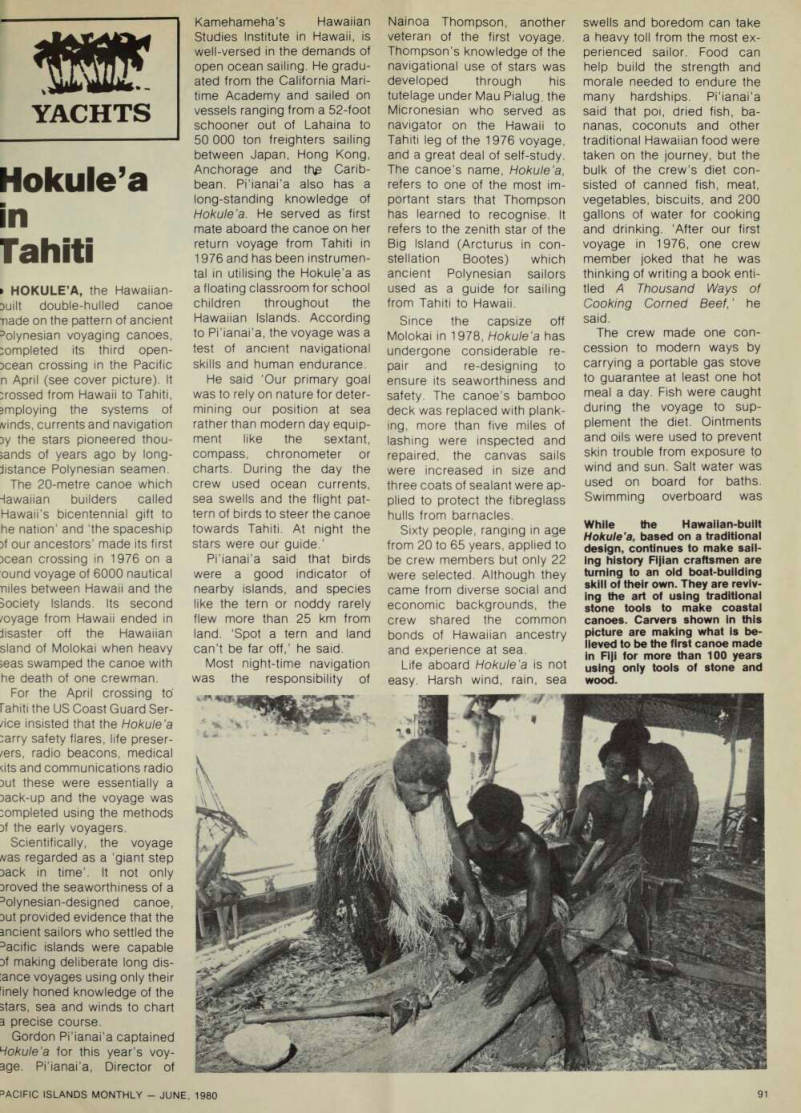
While the Hawaiian-built Hokule’a, based on a traditional design, continues to make sail ing history Fijian craftsmen are turning to an old boat-building skill of their own. They are reviv ing the art of using traditional stone tools to make coastal canoes. Carvers shown In this picture are making what is be lieved to be the first canoe made in Fiji for more than 100 years using only tools of stone and wood.
generally banned because of the danger of shark attack or the possibility that wind gusts could separate swimmers from the canoe. Dennis Olkowski in Honolulu. • JOKER. The 9.2-metre yacht Joker, owned by Bill Webb of Port-Vila in the New Hebrides, has hit a partly submerged object in Mele Bay and is now beyond salvage, sunk in deep water.
Weoo, who is manager of the Hotel Rossi in Port-Vila, was on board with his daugh ter Georgina and Ashley Springer when the accident occurred. A tug attempted to tow the yacht which sank soon after the rope was taken on board. • MONI. The Pacific voyage of lone Japanese yachtsman Hireaki Narusi ended abruptly on April 13 when his luxury yacht Moni ran aground on Caulekaleka reef at Beqa Island. After arrival in Suva and reporting to the authori ties, Mr Narusi flew home to Japan, leaving his yacht on the reef. Since his departure, il legal boarders have stripped the Moni which was believed to have been worth between $7O 000 and $lOO 000.
• Colonial Boy. The
17-metre yacht crewed by five Australians ran aground on the reef off Beqa early in May on a voyage from Lord Howe Island. The crew took to the life raft and were picked up by the government launch Ra Marama. Four members of the crew are Cherie Murray-Lee (23), Jack Pemberton (55), Gerard Cardalliaguet (32) and
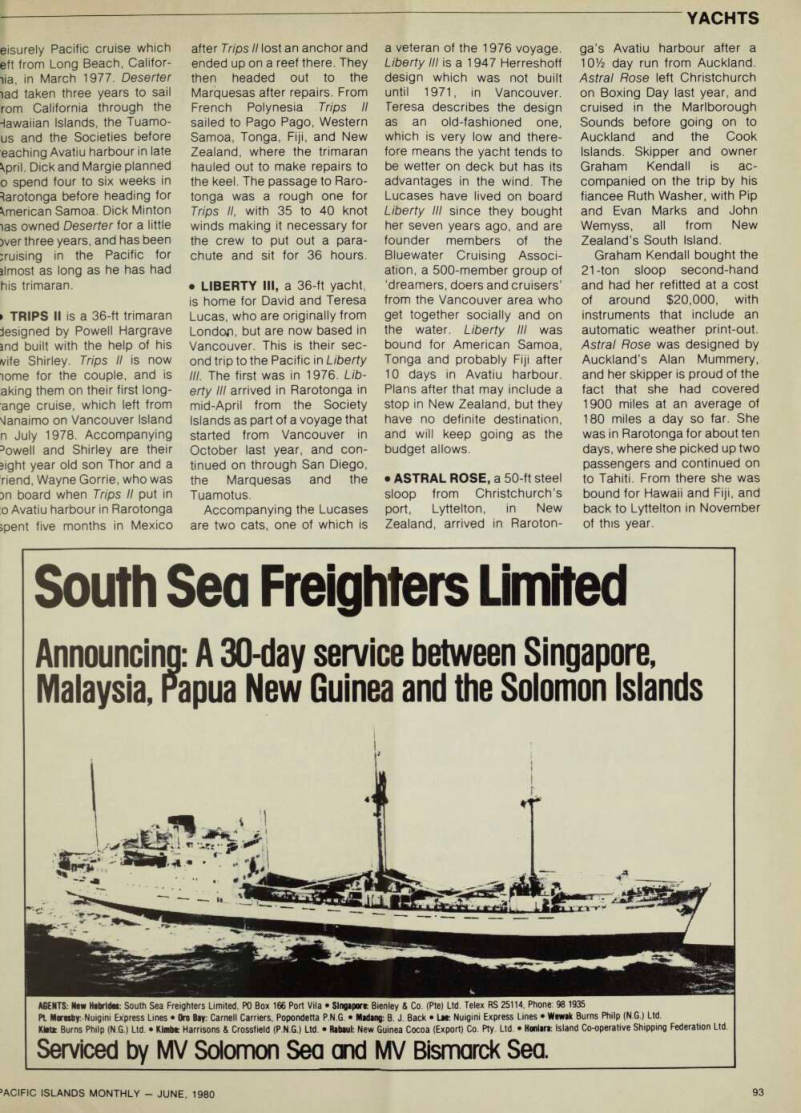
Carl Pemberton (32). The name of the fifth crewman was unavailable. • CAPELLA, a 40-ft fibre glass sloop arrived in Tubuai, French Polynesia, after a 20-day crossing from Auckland with co-owners Steve Rose and Curt Hallam and crew Bill Shofstall. Rose and Hallam left California two years ago with their wives on a voyage to Australia via Hawaii, Christmas Island, Samoa, Tonga, Fiji and New Caledonia but the two women are island-hopping by jet while the men begin their uphill sail back home. • ATCHIN is the name being used at present for a 40-ft tra ditional ocean-going canoe which a crew from the New Hebrides hopes to sail to Papua New Guinea for the South Pacific Festival of Arts late in June. The canoe is being built on Atchin Island in the New Hebrides on a spot which the islanders say is sacred ground and has been used over several hundred years for the construction of important sailing canoes. A bird with an open beak is being carved for a figurehead follow ing an old custom on the island which claims that this will ensure the craft is never off course. The mast is more than 25 feet high and the tree from which the canoe was carved was felled on the mainland of Malekula Island and towed be hind a workboat to Atchin. • MAIA. This Spencer 53 yacht, from Mercer Island near Seattle in Washington State, USA, arrived in Rarotonga’s
Avatiu harbour in mid-April with owners Don and Betty Miller on board. Maia had come from Borabora after a journey down the West Caost of the United States and Mex ico, followed by a 21-day passage from Acapulco to the Marquesas and stops in the Tuamotus and Society Islands.
Maia has belonged to the Millers for the past six years and they have done a lot of work on her themselves, including the ketch rigging.
Long-range cruising is a relatively new experience for the Millers. Before they bought Maia they were ardent racers for some 25 years, participat ing in many major regattas on the West Coast of the US and internationally. From Raro tonga, Maia was bound for Niue where the Millers were to visit friends, and then on to the two Samoas, Tonga and Fiji. Maia will probably spend the 1980/81 cyclone season in New Zealand, but her desti nation after that is uncertain, although the Millers would like to cruise in the Mediterranean.
This yacht takes her name from a star one of the seven sisters in the Pieiades constel lation who was also the mother of the god Hermes in Greek mythology, although according to sources the Millers met in the Societies, Maia is a variety of banana in their language. • DEERFOOT. Rarotonga was the first port of call on the maiden voyage of Deerfoot, A 22-metre luxury cruiser which was built in New Zealand and will be promoted on the West Coast of the United States as a prototype of its class and the
first of a series of fast cruising yachts which will be marketer: world wide. Designed b> Peterson of Honolulu from s basic concept by New Zealand boat-builder Bob Salthouse, Deerfoot was fin ished in October 1979 after a construction period of 18 months. The fibreglass cruiser with balsa core is owned by American Stanley Dashen,, who was accompanied on the yacht’s first voyage by saill master Pony Moore, elec tronics technician Tom Wees,, chief cook John Vause and! deck hand Jim Boyd.
The electronics features of this remarkable cruiser in clude radar, satellite navi gation system, an automatic radar warning system incor porated in an automatic depth finding system for navigation in shallow waters, amateur HP, HP and VHP radio systems, a complete electronic burglar alarm system, automatic weather print-out, and a Loran Rayner 3000 Mark II navi gation system at a total value of over $3O 000.
Decorative details on board this spacious eight-berth cruiser include leadlight win dow panels custom designed by Holly Sanford, original prints and etchings, shag-pile carpet in the double-berth stateroom and a microwave toaster and oven in the gal ley.
Deerfoot will eventually be based in Grand Cayman Island in the Caribbean, but was built in New Zealand. • DESERTER. This is a 36-ft Cross design trimaran taking Dick Minton and Margie Morris, plus one cat, on a very
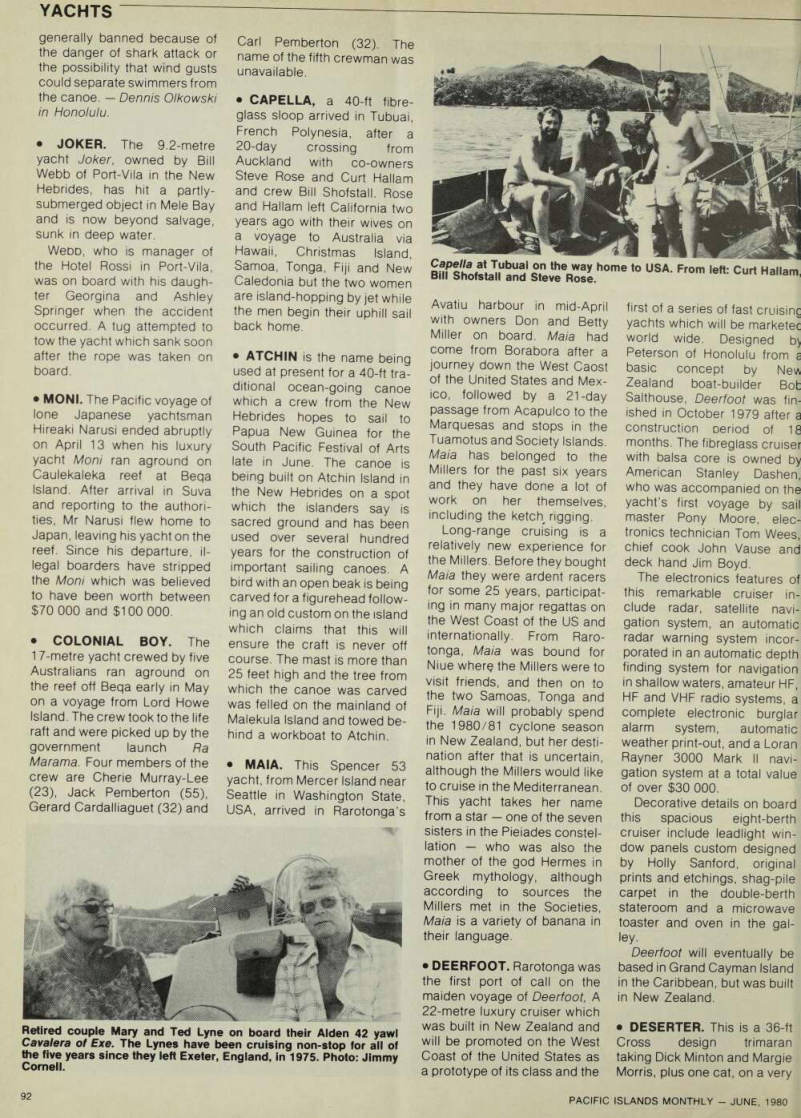
Retired couple Mary and Ted Lyne on board their Alden 42 yawl Cavalera of Exe. The Lynes have been cruising non-stop for all of the five years since they left Exeter, England, in 1975. Photo: Jimmy Cornell.
Cape lla at Tubuai on the way home to USA. From left: Curt Hallam, Bill Shorfstall and Steve Rose.
eisurely Pacific cruise which eft from Long Beach, Califor lia, in March 1977. Deserter lad taken three years to sail rom California through the Hawaiian Islands, the Tuamo us and the Societies before caching Avatiu harbour in late \pril. Dick and Margie planned o spend four to six weeks in Harotonga before heading for \merican Samoa. Dick Minton las owned Deserter for a little )ver three years, and has been cruising in the Pacific for almost as long as he has had his trimaran. » TRIPS II is a 36-ft trimaran jesigned by Powell Hargrave and built with the help of his vife Shirley. Trips II is now iome for the couple, and is aking them on their first long ange cruise, which left from slanaimo on Vancouver Island n July 1978. Accompanying 3 owell and Shirley are their sight year old son Thor and a riend, Wayne Gorrie, who was Dn board when Trips II put in o Avatiu harbour in Rarotonga spent five months in Mexico
after Trips II lost an anchor and ended up on a reef there. They then headed out to the Marquesas after repairs. From French Polynesia Trips II sailed to Pago Pago, Western Samoa, Tonga, Fiji, and New Zealand, where the trimaran hauled out to make repairs to the keel. The passage to Raro tonga was a rough one for Trips 11, with 35 to 40 knot winds making it necessary for the crew to put out a para chute and sit for 36 hours. • LIBERTY 111, a 36-ft yacht, is home for David and Teresa Lucas, who are originally from London, but are now based in Vancouver. This is their sec ond trip to the Pacific in Liberty 111. The first was in 1976. Lib erty 111 arrived in Rarotonga in mid-April from the Society Islands as part of a voyage that started from Vancouver in October last year, and con tinued on through San Diego, the Marquesas and the Tuamotus.
Accompanying the Lucases are two cats, one of which is
a veteran of the 1976 voyage.
Liberty 111 is a 1947 Herreshoff design which was not built until 1971, in Vancouver.
Teresa describes the design as an old-fashioned one, which is very low and there fore means the yacht tends to be wetter on deck but has its advantages in the wind. The Lucases have lived on board Liberty 111 since they bought her seven years ago, and are founder members of the Bluewater Cruising Associ ation, a 500-member group of ‘dreamers, doers and cruisers’ from the Vancouver area who get together socially and on the water. Liberty 111 was bound for American Samoa, Tonga and probably Fiji after 10 days in Avatiu harbour.
Plans after that may include a stop in New Zealand, but they have no definite destination, and will keep going as the budget allows. • ASTRAL ROSE, a 50-ft steel sloop from Christchurch’s port, Lyttelton, in New Zealand, arrived in Raroton
ga’s Avatiu harbour after a lOV2 day run from Auckland.
Astral Rose left Christchurch on Boxing Day last year, and cruised in the Marlborough Sounds before going on to Auckland and the Cook Islands. Skipper and owner Graham Kendall is ac companied on the trip by his fiancee Ruth Washer, with Pip and Evan Marks and John Wemyss, all from New Zealand’s South Island.
Graham Kendall bought the 21-ton sloop second-hand and had her refitted at a cost of around $20,000, with instruments that include an automatic weather print-out.
Astral Rose was designed by Auckland’s Alan Mummery, and her skipper is proud of the fact that she had covered 1900 miles at an average of 180 miles a day so far. She was in Rarotonga for about ten days, where she picked up two passengers and continued on to Tahiti. From there she was bound for Hawaii and Fiji, and back to Lyttelton in November of this year.