Ships
pp. 87-89 · Read in the full issue

Mew Png Run
Ro Us Ports
fhe Papua New Guinea Ship
ping Corporation has an
nounced the start of a new service linking PNG to Darwin ind the west coast of North America. The service, to com mence in mid-May, will be operated by the line’s semi :ontainer vessel Forum Niugini vhich will be renamed Niugini
Chief
The new service will provide sailings every two months link ng the PNG ports of Rabaul, Kdeta, Lae and Port Moresby ivith Darwin in Northern Aus :ralia and San Francisco and Los Angeles on the west coast nf the United States. The ser vice will take over the PNG Shipping Corporation’s exist ing service from PNG to Dar-
win which started in September last year.
The Corporation believes the new service will greatly en hance PNG’s export oppor tunities. The timber trade to Darwin has steadily built up, and there are now also pos sibilities for the export of manufactured goods. It is expected the new line will carry substantial quantities of coffee, tea, cocoa, timber and frozen sea foods to the United States.
On the return run, great interest has been shown for
importing heavy equipment
including mining equipment,
consumer goods and news print. The line is currently negotiating to export frozen beef from Darwin to the United States.
Niugini Chief is a modem semi-container vessel, of 5200
tonnes deadweight carrying ca
pacity. She is capable of carry ing up to 60 refrigerated containers and has for the past 10 months operated a New Zealand-PNG service under charter for Pacific Forum line.
Her place on that service will be taken by two custom-built vessels.
Tonga Gets
Ro-Ro Ship
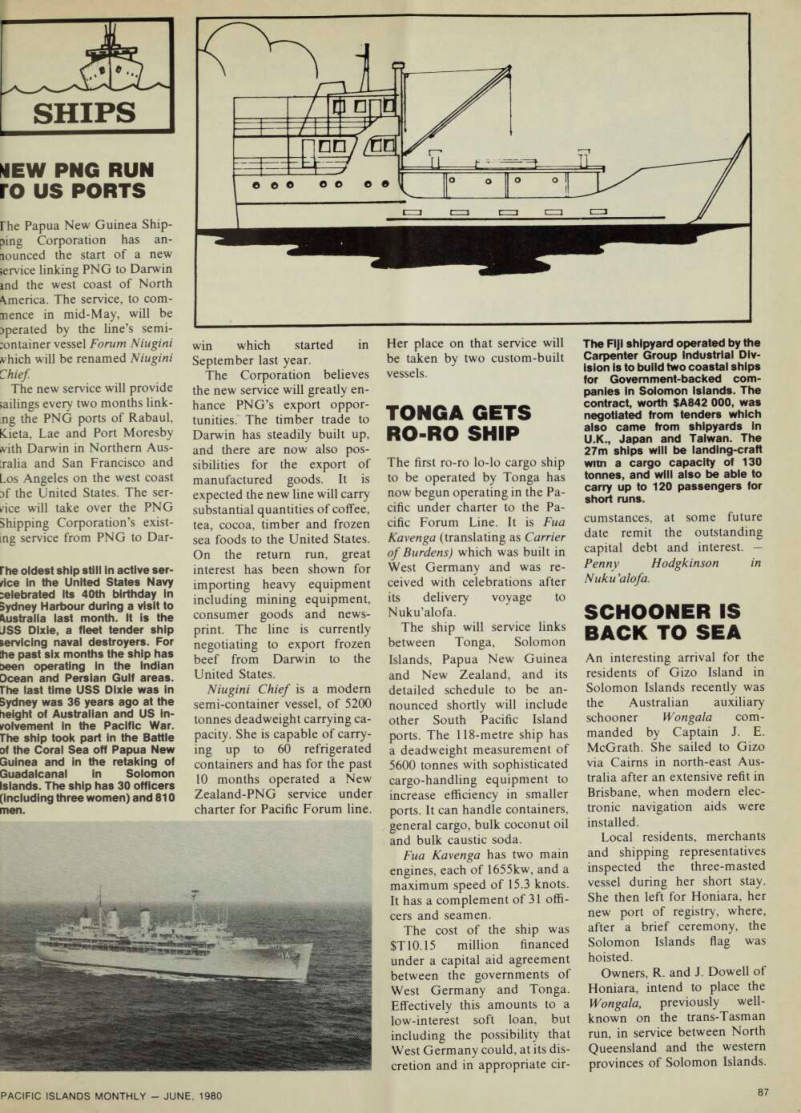
The first ro-ro 10-lo cargo ship
to be operated by Tonga has
now begun operating in the Pa cific under charter to the Pa cific Forum Line. It is Fua Kavenga (translating as Carrier of Burdens) which was built in West Germany and was re ceived with celebrations after its delivery voyage to Nukualofa.
The ship will service links between Tonga, Solomon Islands, Papua New Guinea and New Zealand, and its detailed schedule to be an nounced shortly will include other South Pacific Island ports. The 118-metre ship has a deadweight measurement of 5600 tonnes with sophisticated
cargo-handling equipment to
increase efficiency in smaller ports. It can handle containers, general cargo, bulk coconut oil and bulk caustic soda.
Fua Kavenga has two main engines, each of 1655 kw, and a maximum speed of 15.3 knots.
It has a complement of 31 offi cers and seamen.
The cost of the ship was 5T10.15 million financed under a capital aid agreement between the governments of West Germany and Tonga.
Effectively this amounts to a low-interest soft loan, but
including the possibility that
West Germany could, at its dis cretion and in appropriate dr
cumstances, at some future date remit the outstanding capital debt and interest.
Penny Hodgkinson in
Nuku ’alofa.
Schooner Is
Back To Sea
An interesting arrival for the residents of Gizo Island in Solomon Islands recently was the Australian auxiliary schooner Wongala com manded by Captain J. E.
McGrath. She sailed to Gizo via Cairns in north-east Aus tralia after an extensive refit in Brisbane, when modern elec tronic navigation aids were installed.
Local residents, merchants
and shipping representatives
inspected the three-masted vessel during her short stay.
She then left for Honiara, her new port of registry, where, after a brief ceremony, the Solomon Islands flag was hoisted.
Owners, R. and J. Dowell of Honiara, intend to place the
Wongala, previously well
known on the trans-Tasman run, in service between North Queensland and the western provinces of Solomon Islands.
The oldest ship still in active ser vice in the United States Navy Celebrated its 40th birthday in Sydney Harbour during a visit to Australia last month, it is the USS Dixie, a fleet tender ship servicing naval destroyers. For the past six months the ship has been operating in the Indian Ocean and Persian Gulf areas, The last time USS Dixie was in Sydney was 36 years ago at the height of Australian and US in volvement in the Pacific War.
The ship took part in the Battle of the Coral Sea off Papua New Guinea and in the retaking of Guadalcanal in Solomon Islands. The ship has 30 officers (including three women) and 810 men.
The Fiji shipyard operated by the Carpenter Group Industrial Div ision is to build two coastal ships for Government-backed com panies in Solomon Islands. The contract, worth SA842 000, was negotiated from tenders which also came from shipyards in U.K., Japan and Taiwan. The 27m ships will be landing-craft with a cargo capacity of 130 tonnes, and will also be able to carry up to 120 passengers for short runs.
Wind Power
Experiment
A world-wide trend to recon sider the possibilities of wind power for working ships has led to the construction of a new type of sailing schooner in New Zealand. The schooner is the 146-ton Manutea, built by Kumeu Engineering Ltd in Auckland, and soon to go into service between New Zealand and Pacific Island ports.
The schooner was ordered by a newly-formed company known as South Pacific Wind power, backed by a group of US technicians now based in New Zealand’s Bay of Islands.
The company is designing,
manufacturing and marketing
pumps and electrical gener
ators driven by wind-power
and has committed itself to its
own principles by deciding to
use a sailing ship for exporting the equipment. The company also makes solar panels for generating power from sun
light.
Manutea is more than a modern copy of an old design.
Most of its power supplies for navigation equipment, deck equipment and other auxiliary use will come from wind and solar sources. The rigging has
also been specially designed sc that a crew of up to eight wil be able to handle the 550 C square feet of sail. The schooner is 112 ft overall, ha; a beam of 25 ft and a 500( cubic-ft cargo capacity.
If the experiment is success ful, the owners plan to com mission a bigger schooner buili on similar lines.
China Links
In Agency
A joint Pacific shipping ven ture is to be established be tween the Australian firm Bums Philp and Company Ltd and the Chinese company COSCO (China Ocean Ship
ping). COSCO vessels already
operate from China to Aus tralian and Pacific Island ports but the new combined venture will create a specialised South Pacific joint agency. It is the first venture to be established in partnership for South Pacific shipping operations between an Australian company and a Chinese State-owned organis ation.
Executives of Bums Philp visited China over a period of three months to negotiate the arrangements, and the final agreement was signed in Syd ney recently between the
Deputy General Manager of
COSCO, Mr Zhou Qiuyan and the Chairman of Bums Philp, Mr J. D. O. Bums.
The agreement will come into force in July, and will take over from existing COSCO ar rangements in the South Pa cific.
COSCO ships which already visit Australia and the Pacific Islands include a big pro-
Blsh Limited of Fiji, general and
marine engineers, have begun a drive to develop ship repair and survey work in Fiji rather than see the work going to Australian and New Zealand workshops.
Members of a new top manage ment team to achieve this are (left) Mr Colin Wieff who was re cruited from Australia as engin eering manager and Mr John Watson who was recruited from New Zealand as general man ager.
portion of bulk carriers hand ling sugar, wheat and iron ore.
The company operates nearly 500 ships on its world routes, and had 300 movements in and out of Australia last year.
Capital for the new venture will be contributed equally be tween COSCO and Burns Philp.
Tuna Survey
Goesahead
A South Pacific Commission
research project into skipjack
tuna resources is now well ad vanced following the continu ing operations of the chartered research ship Hatsutori Maru.
Since late in 1977 the ship has
caught, tagged and released
114 000 tuna. About 4000 of the tagged fish have since been caught in countries over a wide region of the South Pacific, and the date and location advised to the research project.
The operation is part of a wide-ranging survey which will provide information about the migratory habits of tuna, and will assist in arrangements for the planned South Pacific fish ing agency, as well as providing international scientific infor mation.
Hatsutori Maru, which has
recently been operating in
Fijian waters and carries a number of Fijian crewmen, has operated in the waters of 19 Pa cific Island countries and terri tories during the present programme.
One of the research scientists involved in the project, Mr Robert Gillett, reported that a considerable amount of im portant information had been gained. He said that islander fishermen had generally been
co-operative in returning
details of tagged fish they had
caught.
He said it was interesting to note that of 9000 skipjack and
yellowfin tuna tagged in Fiji
waters early in 1978, 950 had since been caught by fishermen as far apart as Fiji, Tonga, Tahiti, Samoa, Tuvalu and New Zealand.
The ship will shortly begin a
tagging programme in waters of Wallis Island and Solomon Islands. Before the end of the year taggings will also be extended to the Philippines
and Japan to determine mi gration movements towards the South Pacific.
The migration habits of tuna are one of the principal issues
causing disagreement between
South Pacific countries and USA towards the proposed fisheries agencies involving South Pacific governments.
The South Pacific governments claim absolute right to all tuna in their marine resource limits,
but the general principle
adopted by USA is that tuna should be considered a ‘free’ resource because of their extensive migration move ments.
. . . Butthese
Tuna Escape
In Western Samoa a commis sioning exercise for a new tuna fishing ship was a failure when
handling equipment did not
operate correctly. The ship
Austin Bernicke is one of two
purse-seiners bought by the
local Nauru Local Govern ment Council for a tuna fishing project in Nauru. Officials from the council were on board for the commissioning exercise which was operated out of the port of Apia.
About a mile of nets had been laid in a circle and the lower rim at 500 metres was being tightened when a steel cable broke. What appeared to have been a heavy catch then escaped, and the net brought to the surface only seven tuna and one other fish which was not identified. The ship returned to Apia where new and heavier
equipment is being installed.
Austin Bernicke and a sister ship Victor Eoaeo were built for a French company which encountered financial difficult ies, and were recently acquired from a shipyard in Peru for the
Nauru project.
Yap Service
Philippines, Micronesia &
Orient Navigation Company
(PM and O Line) has an nounced the addition of Yap as a port of call in its Micronesian service. PM and O vessels are now calling on a regular basis at Majuro, Kosrae, Ponape, Truk, Saipan and Koror.