death in
pp. 61-62 · Read in the full issue
Traditional life and death in the Cooks
Cook Islands Customs. By William Wyatt Gill Published
by the Institute of Pacific
Studies, University of the South Pacific, in association with the Ministry of Education, Raro tonga. No price given.
Several of the London
Missionary Society mis
sionaries deserve continued credit for the way in which they recorded in written form their observations of the way of life of the peoples of the Cook Islands in the early days of
European contact.
Perhaps the most observant and certainly the most prolific writer among these mis sionaries was the Rev William Wyatt Gill, who was stationed on both Mangaia and Raro tonga, and who was deter mined to establish an anthropological record of the
lifestyle of the Polynesians
among whom he worked.
There is a growing urge among the peoples of the Pa cific to regain credible knowl edge of the customs of their ancestors, and they are now turning for evidence to the
writings of the early European
visitors and residents. Unfor
tunately, the volumes prepared
by these authors are now collector’s items and are there fore not easily accessible to the
indigenous people who would
much prefer to pass them from hand to hand and to spread them as widely as possible.
It is therefore most satisfying
to see the reprint recently pub
lished by the Institute of Pacific Studies, University of the South Pacific, in association with the Ministry of Education, Rarotonga, of part of the paper presented by Gill at the World’s Columbian Expo sition, 1893. The original paper was entitled The South Pacific and New Guinea: Past and Pre sent and the present facsimile version of the section dealing with the Cook Islands is illus trated with reproductions of the engravings from Gill’s Jot
tings from the Pacific and Life
in the Southern Isles.
The 28 pages of Cook Islands Customs are crowded with an amazing wealth of detail about customs relating to birth, mar riage, death, the spirit world, tribal structure, warfare, food,
clothing .. . More importantly,
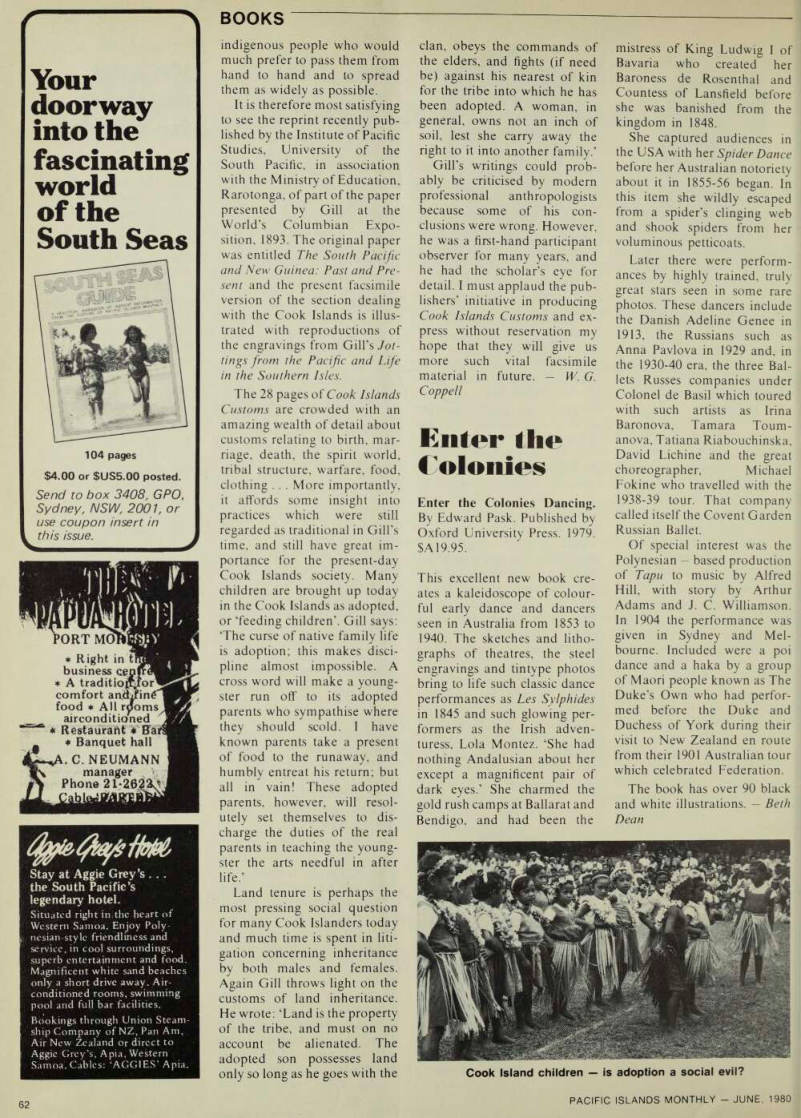
it affords some insight into practices which were still regarded as traditional in Gill’s time, and still have great im portance for the present-day Cook Islands society. Many children are brought up today in the Cook Islands as adopted, or ‘feeding children’. Gill says: ‘The curse of native family life is adoption; this makes disci
pline almost impossible. A
cross word will make a young ster run off to its adopted parents who sympathise where they should scold. I have known parents take a present of food to the runaway, and humbly entreat his return; but all in vain! These adopted parents, however, will resol utely set themselves to dis charge the duties of the real parents in teaching the young ster the arts needful in after life.’
Land tenure is perhaps the
most pressing social question
for many Cook Islanders today and much time is spent in liti
gation concerning inheritance
by both males and females.
Again Gill throws light on the customs of land inheritance.
He wrote: ‘Land is the property of the tribe, and must on no account be alienated. The adopted son possesses land only so long as he goes with the
clan, obeys the commands of the elders, and fights (if need be) against his nearest of kin for the tribe into which he has been adopted. A woman, in general, owns not an inch of soil, lest she carry away the right to it into another family.’
Gill’s writings could prob ably be criticised by modern
professional anthropologists
because some of his con clusions were wrong. However, he was a first-hand participant observer for many years, and he had the scholar’s eye for detail. I must applaud the pub lishers’ initiative in producing Cook Islands Customs and ex press without reservation my hope that they will give us more such vital facsimile
material in future.
Coppell
W.G.