Papua New Guinea
pp. 60-61 · Read in the full issue
Books
Aids to understanding Papua New Guinea
Papua New Guinea: A Political History. By James Griffin, Hank Nelson, Stewart Firth.
Published by Heinemann Edu cational Australia. Cloth $17.50, paperback $8.95.
Development and Dependency: The Political Economy of Papua New Guinea. By Azeem Amarshi, Kenneth Good, Rex
Mortimer. Published by Oxford
University Press. Cloth $17.50,
paperback $8.95.
These two recently published
books were written by previous members of the academic staff of the University of Papua New Guinea. Griffin, Nelson and Firth were among the uni versity’s foundation members.
Amarshi, Good and Mortimer could be said to have belonged to a ‘second generation’. Rex Mortimer died at about the time of publication of Develop ment and Dependency. He was a man of academic merit, and those who knew him found him a skilful and trusted con ciliator. Griffin and his col leagues are historians.
Mortimer was professor of pol itical studies, and Amarshi and Good were political scientists.
Because of the recent changes in the political scene in PNG these books are essential reading for those who would try to understand it.
The constitution of PNG was
‘home-grown’. It was Papua
New Guineans who deter mined to continue with a West minster system of government, which Australia had imported and imposed. Australia can take pride that the members of the House of Assembly be haved with commendable re straint, as did the people in the streets, when on March 11 1980 the House voted no confidence in Michael Somare and elected Sir Julius Chan as prime minis ter. Under the constitution any motion of no confidence must also nominate the alternative prime minister. It is note worthy that Chan was nomi
nated and not lambakey Okuk, the leader of the opposition.
The motion of no confidence had been well canvassed and
clearly predicted, but there
were no mass rallies, no stone throwing. Sir Julius took power with six months before he can be challenged. He may well need all of it to mould his disparate group of supporters into a workable coalition.
A Political History gives a full and very readable account of how Michael Somare formed a coalition that brought PNG to self-government in December 1973 and indepen dence in September 1975. The book’s title may be a misnomer - it is an ambitious one. It might have been better to have concentrated on the develop ment of a national political structure, which would include the parts played or not played
by the administering authority.
More space might have been given to the Highlands. The chapter on the Highlands con centrates mainly on the Eastern Highlands and Goroka. Much more space seems to have been given to the turmoil on
Bougainville (now the province
of the Northern Solomons) than to any discussion of the
continuing mayhem in the
Highland provinces, especially
lambakey Okuk’s Simbu. (see Whither the Provinces? PIM, Feb p 27). Papua Basena is
growing not as a political phil
osophy as Josephine Abaijah
saw, it is now an active disrup tive party. It must be disruptive if it is to gain its ends; its poli ticians must have compro mised their demands to support the national Chan.
These are continuing, and, indeed, in the Highlands, fes tering sores. It can be antici pated if the Ok Tedi copper mining venture goes ahead there will be special demands from the Western Province.
However if we look on A Pol itical History as portraying Bougainville as an example of
the kind of difficulties a prime minister in a country of 700 tongues and 700 cultures will have, and how he settled them, it is splendid. There is one other criticism that seems reasonable: the space given to PNG’s relations with Indonesia is just half that given relations with Australia over the Torres Strait Islands. Surely no one can envisage the armies of Aus tralia and PNG facing each other across the strait, yet el ements of the Indonesian and PNG armies have had a con frontation, of sorts, along their border!
A Political History doesn’t go beyond 1978. It could not anticipate Somare’s downfall, which some people think was finally brought about by what has become known as the ‘Rooney affair’. Nahau Rooney is an intelligent, well educated Manus woman who was minister for justice. All
newly independent democratic
governments will accept the need to ensure that the execu tive may not interfere with the judiciary. But they will at times want a dialogue with a court; and no matter if one’s edu cation was in English, it is the most natural thing in the world for those for whom English is a second language to resort to writing. Mrs Rooney was guilty of contempt. The way she was tried allowed her no recourse of appeal. Her offer to apolo
gise was rejected. This reviewer is prepared to say that no other PNG bench since 1945-46 would have sentenced her as the 1979 bench did, and this re viewer is prepared to go so far as to say that Mrs Rooney would not have been ar raigned. Somare had a number of alternatives. He acted with precision and released Mrs Rooney after she had spent only a few hours in gaol.
Although there was a public outcry, and Okuk made as much political as he could, there was no defection from
Somare’s ministry.
Development and Depen
dency saw the writing on the wall for Somare after he failed in 1978 to get the parliamen tary support he needed to
strengthen the leadership code,
requiring ministers and senior public servants to give details of their assets and business activities, and also those of their families. Somare’s deputy Julius Chan opposed what Somare was trying to do, as did Okuk.
The authors of Development and Dependency call their re view a preliminary one and admit they have no quick pana ceas. They also admit that they selected those authors who from their theoretical stand point produce data which are crucial in determining PNG’s present situation and potential.
This reviewer gets the im-
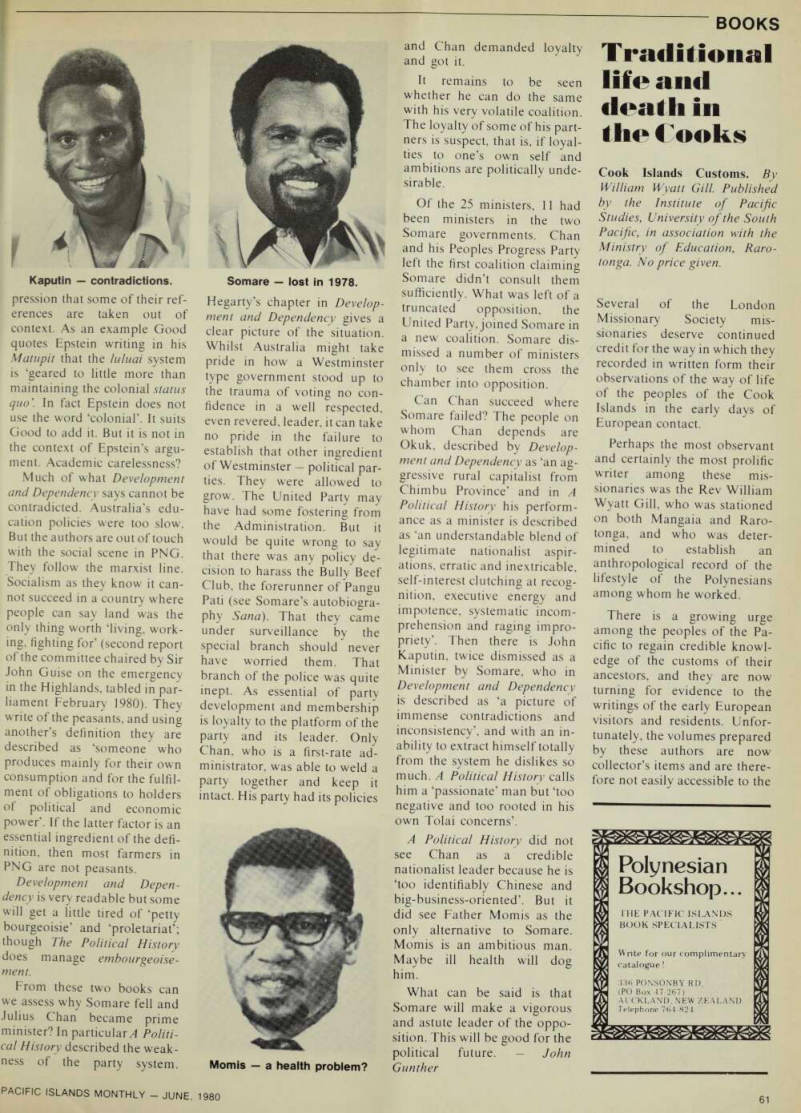
Chan-demanded loyalty.
Okuk rural capitalist?
pression that some of their ref erences are taken out of context. As an example Good quotes Epstein writing in his Matupit that the luluai system is ‘geared to little more than maintaining the colonial status quo’. In fact Epstein does not use the word ‘colonial’. It suits Good to add it. But it is not in the context of Epstein’s argu ment. Academic carelessness?
Much of what Development and Dependency says cannot be contradicted. Australia’s edu cation policies were too slow.
But the authors are out of touch with the social scene in PNG.
They follow the marxist line.
Socialism as they know it can not succeed in a country where people can say land was the only thing worth ‘living, work ing. fighting for’ (second report of the committee chaired by Sir John Guise on the emergency in the Highlands, tabled in par
liament February 1980). They
write of the peasants, and using another’s definition they are described as ‘someone who produces mainly for their own consumption and for the fulfil ment of obligations to holders of political and economic power’. If the latter factor is an essential ingredient of the defi nition, then most farmers in PNG are not peasants.
Development and Depen dency is very readable but some will get a little tired of ‘petty bourgeoisie’ and ‘proletariat’;
though The Political History
does manage embourgeoise ment.
From these two books can we assess why Somare fell and Julius Chan became prime minister? In Politi cal History described the weak ness of the party system.
Hegarty’s chapter in Develop ment and Dependency gives a clear picture of the situation.
Whilst Australia might take pride in how a Westminster type government stood up to the trauma of voting no con fidence in a well respected, even revered, leader, it can take no pride in the failure to establish that other ingredient of Westminster - political par ties. They were allowed to grow. The United Party may have had some fostering from the Administration. But it would be quite wrong to say that there was any policy de cision to harass the Bully Beef Club, the forerunner of Pangu Pati (see Somare’s autobiogra phy Sana). That they came under surveillance by the special branch should never have worried them. That branch of the police was quite inept. As essential of party
development and membership
is loyalty to the platform of the party and its leader. Only Chan, who is a first-rate ad ministrator, was able to weld a party together and keep it intact. His party had its policies
and Chan demanded loyalty and got it.
It remains to be seen whether he can do the same with his very volatile coalition.
The loyalty of some of his part ners is suspect, that is, if loyal ties to one’s own self and ambitions are politically unde sirable.
Of the 25 ministers, 11 had been ministers in the two Somare governments. Chan
and his Peoples Progress Party
left the first coalition claiming Somare didn’t consult them sufficiently. What was left of a truncated opposition, the United Party, joined Somare in a new coalition. Somare dis missed a number of ministers only to see them cross the chamber into opposition.
Can Chan succeed where Somare failed? The people on whom Chan depends are
Okuk. described by Develop
ment and Dependency as ‘an ag
gressive rural capitalist from
Chimbu Province’ and in A Political History his perform ance as a minister is described as ‘an understandable blend of
legitimate nationalist aspir
ations, erratic and inextricable, self-interest clutching at recog nition, executive energy and impotence, systematic incom
prehension and raging impro
priety’. Then there is John Kaputin, twice dismissed as a Minister by Somare, who in
Development and Dependency
is described as ‘a picture of immense contradictions and inconsistency’, and with an in ability to extract himself totally from the system he dislikes so much. A Political History calls him a ‘passionate’ man but ‘too negative and too rooted in his own Tolai concerns’.
A Political History did not see Chan as a credible nationalist leader because he is ‘too identifiably Chinese and big-business-oriented’. But it did see Father Momis as the only alternative to Somare.
Momis is an ambitious man.
Maybe ill health will dog him.
What can be said is that Somare will make a vigorous and astute leader of the oppo sition. This will be good for the
political future.
John
Gunther
Kaputin-contradictions.
Somare-lost in 1978.
Momis - a health problem?