Whether Peacock or
p. 18 · Read in the full issue
New Hebrides: Whether Peacock or Phoenix, a bird of ill omen ...
‘The Vanuaaku Party calls for strong action against the American “mafia” business men who use violence to pro mote their interests in Vanuatu, especially on Santo and Tanna.’
So reads the final paragraph of a statement issued at the end of a meeting of the ‘political commissars’ of the New Hebrides’ ruling Vanuaaku Party held at Tagabe, Port- Vila, in April.
The reason for their concern was plain: on the eve of the
country’s independence
(scheduled for July 30) there are clear signs of a revival of interest in the New Hebrides by such figures as the Hawaii based real estate developer Eugene Peacock, who made a packet in the late ’6os out of buying land on Santo and sell ing it to Americans captivated by the idea of living on a Pa cific Island. Peacock’s scheme was finally squashed when the condominium government in 1971 made it illegal to sub divide land and profit from it.
Peacock, interviewed early
this year by English journalist
Christopher Dobson his articles were published in an
English weekly news magazine
and an Australian daily said he is ‘awaiting the opportuni ties of independence’. ‘At least, this year I shall know what I can do with the land. There is no doubt in my mind that San to’s future lies with tourism.’
Also showing renewed signs
of activity is the so-called Phoenix Foundation, an or
ganisation animated by
extreme private-enterprise
fundamentalism based on con cepts of ‘no government’, ‘voluntary taxes’, and untram melled free enterprise.
According to Dobson, the chief fount of its ideas is Dr John Hospers, a professor of philosophy at the University of South California. Dr Hospers stood for the presidency of the
United States in 1972, as a can didate of the Libertarian Party.
He won one vote from the
Electoral College.
The Phoenix Foundation was set up in the ’7os by Michael Oliver, who looks upon Hospers as his ‘guru’.
Oliver is of Lithuanian Jewish origin. For a while dur ing World War II he was an inmate of a Nazi concentration camp, but has since done hand somely as a real estate devel oper in Carson City, Nevada.
The foundation is well known in the Pacific for its 1972 ex ploits on Minerva Reef be tween Fiji and Tonga (the idea was to build a concrete city on stilts on the usually submerged reef)- The venture came to grief when Tonga’s king arrived in the royal yacht, tore down the Minerva ‘flag’, and claimed the reef for his kingdom. There was a later, similar attempt on Abaco, one of the major islands in the Bahamas. It too failed.
But Oliver sees new oppor tunities on Santo, where he once owned considerable real estate. Long a patron of Santo’s Jimmy Stevens, leader of the Na-Griamel movement on Santo (he admits paying the fares for Stevens’ visit to the US last year), Oliver told Dob
son; ‘I want Jimmy Stevens to become independent. I said to him that he must have real democracy on Santo.’
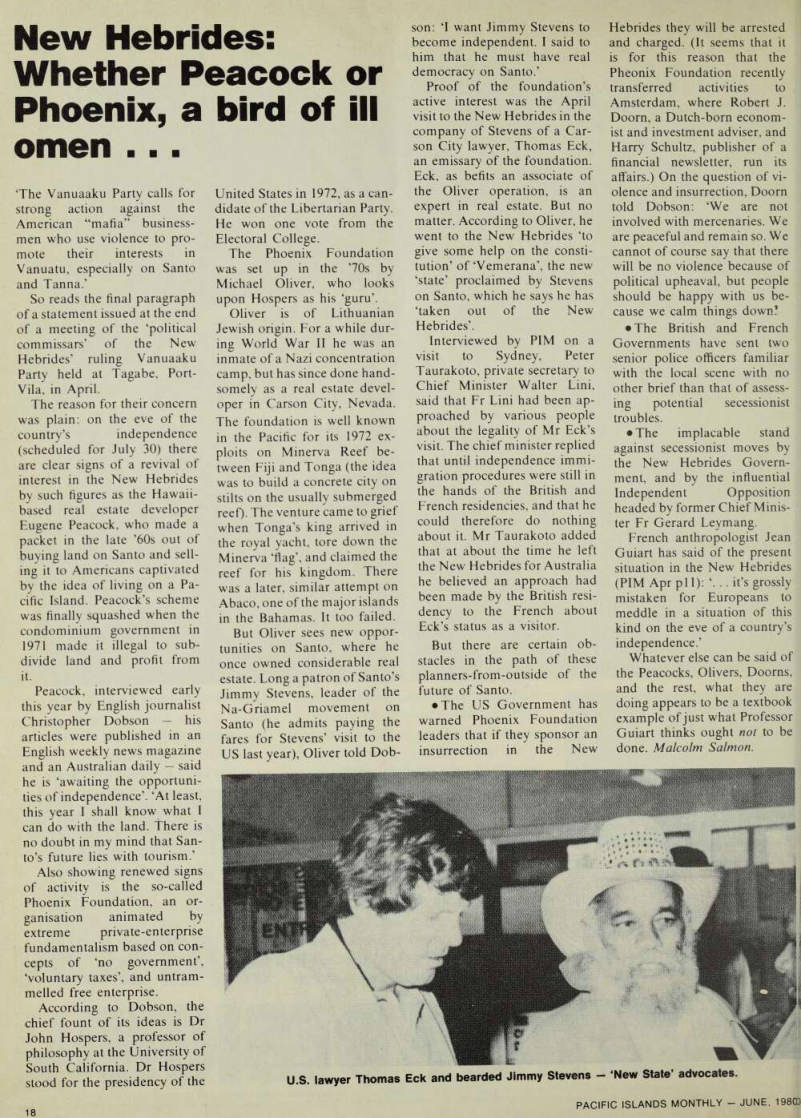
Proof of the foundation’s active interest was the April visit to the New Hebrides in the company of Stevens of a Car son City lawyer, Thomas Eck, an emissary of the foundation.
Eck, as befits an associate of the Oliver operation, is an expert in real estate. But no matter. According to Oliver, he went to the New Hebrides ‘to give some help on the consti tution’ of ‘Vemerana’, the new ‘state’ proclaimed by Stevens on Santo, which he says he has ‘taken out of the New Hebrides’.
Interviewed by PIM on a visit to Sydney, Peter Taurakoto, private secretary to Chief Minister Walter Lini, said that Fr Lini had been ap
proached by various people
about the legality of Mr Eck’s visit. The chief minister replied that until independence immi gration procedures were still in the hands of the British and French residencies, and that he could therefore do nothing about it. Mr Taurakoto added that at about the time he left the New Hebrides for Australia he believed an approach had been made by the British resi dency to the French about Eck’s status as a visitor.
But there are certain ob stacles in the path of these planners-from-outside of the future of Santo. • The US Government has warned Phoenix Foundation leaders that if they sponsor an insurrection in the New
Hebrides they will be arrested and charged. (It seems that it is for this reason that the Pheonix Foundation recently transferred activities to Amsterdam, where Robert J.
Doom, a Dutch-born econom ist and investment adviser, and Harry Schultz, publisher of a financial newsletter, run its affairs.) On the question of vi olence and insurrection, Doom told Dobson: ‘We are not involved with mercenaries. We are peaceful and remain so. We cannot of course say that there will be no violence because of
political upheaval, but people
should be happy with us be cause we calm things down? • The British and French Governments have sent two senior police officers familiar with the local scene with no other brief than that of assess
ing potential secessionist
troubles. • The implacable stand
against secessionist moves by
the New Hebrides Govern ment, and by the influential
Independent Opposition
headed by former Chief Minis ter Fr Gerard Leymang.
French anthropologist Jean Guiart has said of the present situation in the New Hebrides (PIM Apr pi 1): ‘... it’s grossly mistaken for Europeans to meddle in a situation of this kind on the eve of a country’s
independence.’
Whatever else can be said of the Peacocks, Olivers, Dooms, and the rest, what they are doing appears to be a textbook example of just what Professor Guiart thinks ought not to be done. Malcolm Salmon.
U.S. lawyer Thomas Eck and bearded Jimmy Stevens - ‘New State’ advocates.