Race relations in the Pacific
pp. 13-15 · Read in the full issue
under the microscope
A book recently published in Sydney Race, Class and Rebellion in the South Pacific * k QPiiinn , n ■ countries, and exerting some influence. Professor RON CROCOMBE of the University of the Ro h p nUm °' ' Sland at,on of the book and found, by and large, that its success is far from being fullyßeserved C made a " eVa ' U '
Race, Class and Rebellion in the South Pacific, is a short book, of only four chapters. It takes its title from the lead chapter written by Dr Alex Mamak.
This chapter tells somewhat more about Mamak than about race or class or rebellion or the South Pacific. To make his case sound plausible, he gives the key words new meanings.
I think any objective descrip tion of racial tensions in the Pa cific would show that the most serious are between Indonesians and Melanesians in Irian Jaya, the next most serious between Indians and Fijians, and the next between Melanesians and Europeans in New Caledonia. But facing facts seems not to be Dr Mamak’s purpose so he says that (p4l) ‘according to our usage of the race concept, re lations between members of a non-white population who come from distinct racial back rounc*s ( e S- Indo-Fijians and Fijians) are not race relations • Likewise (pi 4) ‘...the :oncept of race is solely used in he context of black-white reg ions.’
Class is defined as ‘relation ship to the means of pro luction and/or such factors as ncome level, education or oc upation, (p 14). This is reason
ed 6 enough, except that
/here, for example, this defl ation would place the Indian 'usiness and professional com lunity in Fiji, the equivalent hinese community in Tahiti, olomons or Papua New ruinea, or the Vietnamese in le New Hebrides, in the same
itegory as the European
usiness and professional corn ice, Class and Rebellion in ( e South Pacific. Edited by lex Mamak and Ahmed Ali.
Jblished by George Allen &
nwin, Sydney. Hardback
13.50, paperback $6.95.
munity, he later defines the
similarity away.
Rebellion, according to my dictionary and to my under standing, is ‘rising in arms against’ an established govern ment. There has been relatively little rebellion in the Pacific.
But rebellion can be manufac tured to suit the taste by redefining the term, which Or Mamak does (p 13) as the willingness of a group to use or threaten to use, force ‘ in the sense of political struggle, not necessarily armed struggle . . .’
According to this defini tion, opposing political parties of every independent democ racy in the world are in a con stant state of ‘rebellion’.
The chapter carries on to convey an impression of every one else in the Pacific in an almost constant state of re bellion against Europeans. I think Dr Mamak believes it.
A reader is left with the im pression that rebellion first entered the Pacific as a reaction against Europeans. A well documented article by Gunson in the Journal of Pacific History (vol 14, pp2B-49), taking the example of Tonga, shows that rebellion i.e., actual
overthrowing of the existing
government by physical viol ence - ‘was rather a natural se quence in the political life of Tonga’. Tracing the known his tory of the Tongan kings over 200 years before European contact, he shows that ‘in each case the hau or paramount ruler of Tonga was overthrown and replaced by another hau
■ ■ The overthrowing was
usually by warfare, assassina tion or exile. The last successful rebellion in Tonga was that by the man who, when his re bellion succeeded, called him
self King George Tupou.
Thereafter, with the use of
imported weapons, imported
organisational technology and
more effective means of com
munication, King George
Tupou was able to put down rebellions against him (with heavy loss of life), and to establish an effective cen tralised government which has lasted to this day. Opposition and ‘action in order to counter act the effects of domination and exploitation’ in the in terpretation of the persons taking the action (which is Dr Mamak’s definition) has con tinued in Tonga in the modern era as Dr Gunson’s article de scribes, though the opposition certainly does not meet my definition of rebellion.
The Tonga case is common.
In Fiji, classic rebellion fighting the rulers to the death was common. Any objective study of the history of the Pacific would show that the extent of rebellion against col onial governments was rela tively small. I do not think that this is due so much to the good ness or badness of the govern ments concerned, but to the effectiveness of their control.
We need serious study of the circumstances under which such populations showed evi dence of dissatisfaction, resist ance, rebellion or revolution.
Implications
Dr Mamak implies that the more there is ‘oppression’ (which he does not define but implies as differences in income, privilege, etc) the more the likelihood of re bellion. I would not have thought this was necessarily so.
To return to the Tonga.case, those who suffered most, the lowest class of society, were not those who rebelled it was people of the higher social strata who felt they were miss ing out. Likewise, in many parts of the world it is the upward aspiring sub-elite who rebel. There is no point in re belling unless you think you
have some chance of winning and feel a right to win.
In terms of gaps of income,
privilege and dignity. New
Hebrideans were vastly worse off than Samoans. But New Hebrideans were divided among themselves by language, culture and geogra phy. The so-called Mau Re bellion against New Zealand authority in Western Samoa this was really an attempted revolution which sought to do away with colonial govern ment, rather than a rebellion which simply seeks to replace the incumbent in the same form of government oc curred because of Samoa’s cul
tural and linguistic uniformity
and geographical compactness, and the incompetence of the New Zealand colonial admin istration.
Samoans, I would think, were by most criteria among the ‘best off Pacific people at that time. But they had good reason to revolt: they had the prerequisites to govern them
selves effectively (which highly
fragmented communities like the New Hebrides did not have at that time), and they were
understandably offended by a
third-rate administration. This administration was not gener ally oppressive in the usual sense it wasn’t competent enough to be so even if it had wanted to.
A similar New Zealand ad ministration in the Cook Islands did not meet that reac tion, not because it was vir tuous, but because the population was small and scat tered and in most of the islands tended to regard itself as rather lucky to be a colony. The short lived Returned Soldiers protest movement in Rarotonga in the 1920 s was action by those who were better off than most, but who had seen much better still overseas.
This tendency to express
gratitude towards or accept ance of the dominant power is common in small isolated com munities who have few material advantages whether Niuatoputapu in Tonga, or the isolated islands of any of the Pacific colonies or independent states.
Industrial relations in the South Pacific are described as ‘a long history of continuous reaction on the part of labour and the use of various forms of
protest’ (p 26). Australia and
New Zealand must have been in a constant state of civil war, with workers suffering from massive oppression, if we are to interpret the meaning of strikes the way Dr Mamak does.
The strikes quoted as
examples of oppression are
certainly not where wages and conditions were worst. They are just where we would expect them and where they are found in industrialised socie ties in those places where wages and conditions are best, and the pressure points where
opportunities to improve them
further are greatest the air lines, wharves, mines, etc.
We are told (p 32) that ‘in general, trade unions did not originate directly from outside pressures but emerged spon taneously out of the common needs and interests of South Pacific labour’. This is simply not true. Apart from influences from India in the case of Indian workers in Fiji, the Labour government in the United Kingdom in the immediate post-war period sent trade union specialists to Fiji. The unions in the Cook Island were
set up as the result of activity by New Zealand unions, which also attempted without success to establish unions in Western Samoa. Even today unionism hardly exists there or in Tonga and many of the smaller coun tries. In New Caledonia, the unions have close linkages both in origin and action with those in France. ‘Today there is little evi dence of ethnic exclusiveness
in Fiji’s trade unions’ (p 35),
and ‘the major occupational
categories are ethnically mixed
and the new work setting helps to make ethnicity irrelevant’
(p 27). The implications of such
a statement, without further explanation, are inexcusable.
Everybody knows that the Fiji
shipping industry, the water
side workers, the army, the Native Lands Trust Board and a variety of other fields are dominated by Fijians; and that the transport industry, small businesses and professions, the
Sugar Corporation and tertiary
education, are all dominated
by Indians. Fijian school
teachers and Indian school teachers actually have separate trade unions. One should not overstate differences, but Dr Mamak grossly understates them.
Carrying on his image, he
lumps ‘Fijians and Indo-
Fijians’ together in all cases and contrasts them with the ‘whites’ (p3O). This is really too simplistic; he is simply avoid ing the truth. The word ‘white’ is spelt with a small ‘w’ but islanders’ and any other non white category are spelt with capital letters. To bolster a
crease in the size of white workforce in some industries like mining. In Nauru, for example, over 60% of the work force in 1978 was expatriate’.
The clear implication is that it was white, but as Dr Mamak knows (but does not say), it is
mainly Micronesian, Poly
nesian and Chinese. Nor does he relate such things as, for example, that work undertaken by a Nauruan (in 1978 cer tainly) and paid for at $1.40 per hour, was paid for at only 42 cent per hour if done by a fellow Micronesian from neighbouring Kiribati. The whole subject merits honest analysis, rather than distor tion.
Dr Mamak quotes his own doctoral thesis as showing that
‘no outright opposition to
physical or cultural differences such as religion, language or
dietary habits were expressed
by either Indo-Fijians or
Fijians towards each other ...’
Not to Dr Mamak, understan dably. Given the differences of
language, culture, religion and
so on, relations between Fijian and Indian people have been much more cordial than for communities of equivalent de grees of difference in most other parts of the world. But the implications of closeness and harmony that Dr Mamak suggest are simply naive.
Extensive and widespread
exploitation of workers (paying
much below award wages, requiring extensive overtime without any payment, substan dard conditions and so on) are common in Fiji. But they are not generally associated with white employers. No mention of such realities is made.
Inaccurate generalisations;
abound. It is said, for example,, that ‘racial pervasiveness tends; to override ethnicity’ in the; South Pacific (p3B). Given hi& definition this means that the; gap between whites and non whites overrides differences between non-white workers.
This would be true in Fiji and Papua New Guinea (though much less true in relation tc
Koreans and Filipinos working
in those places than in relation] to different Melanesian ethnic groups), not true in the mining industry of West New Guinea/ substantially untrue for New Caledonia (where white French, Asians ano
weak case with loaded ter minology, he uses the term Indo-Fijian to refer to the Indian people of Fiji but does not use the equivalent term
Sino-Fijian, (though relations
between Chinese and Fijians have generally been more har monious than those between Indians and Fijians), or Euro- Fijian. The image is furthered
by quoting derogatory terms
such as ‘coon’, ‘nigger’, etc, which some whites used in re spect of non-whites, but not
quoting the equivalent equally
derogatory terms used, for
example, by Fijians and
Indians to describe each other, or by various islanders to de scribe Europeans, and so on.
Conveying the same image
(p 29) he says the Bougainville
Mungkas Association was founded on the ethnic distinc tiveness of Bougainvillean workers, in ‘contradistinction’ to other ethnic groups
employed by the company.
Most readers will interpret from his wording that it was vis-a-vis Europeans, though in fact it was vis-a-vis other Melanesians.
Wide differences existed be tween whites and islanders in pay and conditions. It is a very important topic, there is dis crimination, and it merits honest discussion and presen tation of facts. He presents some facts in relation to white and indigenous staff at Bougainville Copper, but then goes on to speak of ‘... the in-
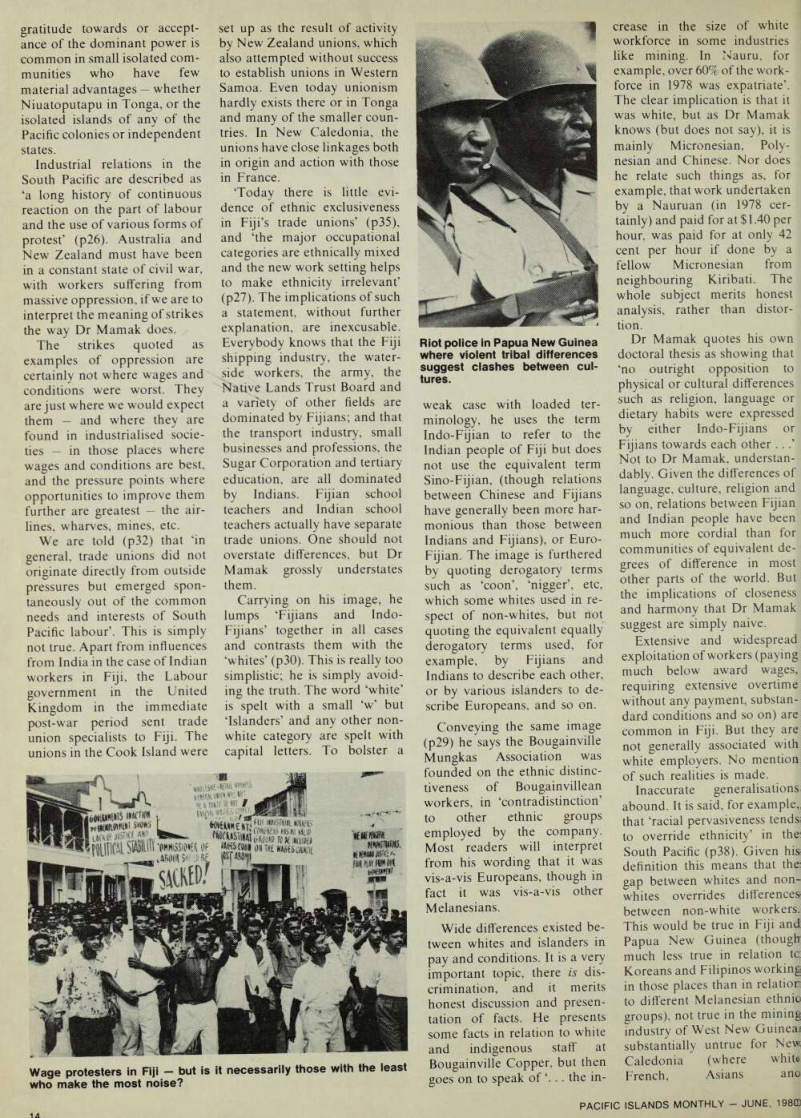
Wage protesters in Fiji - but is it necessarily those with the least who make the most noise?
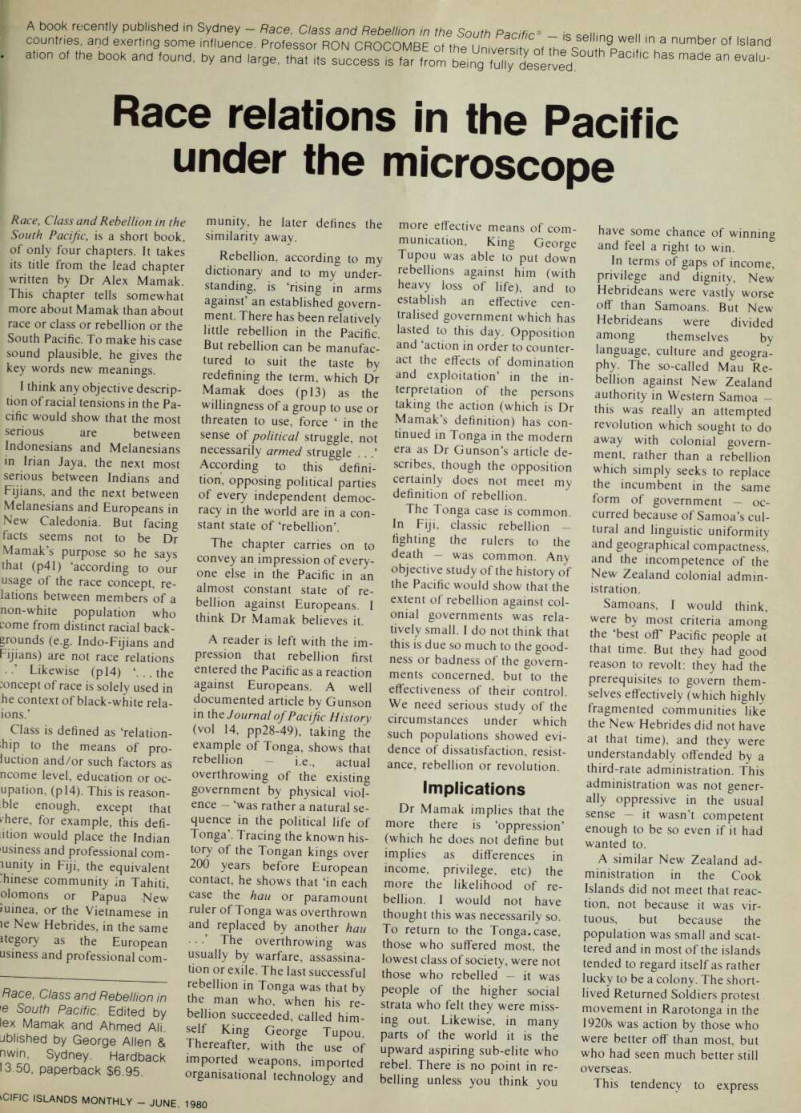
Riot police in Papua New Guinea where violent tribal differences suggest clashes between cul tures.
Polynesians are at times closer to each other than any of them are with Melanesians), partly true for Nauru (where the social gap between Nauruans and others is just as wide as that between Europeans and others I think Chinese would be at least as socially distinct not only from Nauruans but also from Gilbertese or Tuvaluans, as from Europeans or the Nauruans themselves). And re lations between Korean or Taiwanese workers in the fish ing industry in a number of Pa cific countries seem to me to do little to support his thesis.
There are just so many of these hack generalisations which do not bear serious examination.
His relationship between race, class and ethnicity is made easy (p 39) by having only two categories - ‘whites’ and ‘lslanders’. Fijians and Indians, Melanesian New Caledonians and Vietnamese, Chinese and Nauruans are all lumped together as ‘lslanders’. This may well be Dr Mamak’s per ception, but few Pacific islanders would see it that way.
There is an almost total ignor ing of the major cultural div isions between Asian and
indigenous people in Fiji,
Nauru, New Caledonia, American Samoa, Tahiti, Papua New Guinea, Solomons, Guam or elsewhere. ‘Ethnicity may be emphasised by whites as a diversionary tactic - that is, to prevent antagonism from being directed solely at them’ (p 43). He is right. But in this
case ethnicity is played down
by an Asian author as a diver sionary tactic to imply that there is not indigenous antag onism to his category.
By the end of the first chap ter, any dislike, discrimination )r social distance has come to
imply ‘rebellion’, though the
word itself has gone except in the title.
The next two chapters pre :ent five case studies. The cases ire very interesting and well
nerit study. The only gross
naccuracy is the title, ‘Re union in the South Pacific : ive case studies’. The studies re that of the Bougainville opper miners’ strike in 1975 y Alexander Mamak and dchard Bedford, the Indian workers’ strike in Fiji in 1920, ie Maasina Rule in Solomon
Islands by Hugh Laracy, the Parihaka movement in New Zealand from the late 1860 s to the 1880 s by Daniel Lyons, and the resistance of the Australian
Aboriginal Gurindji at Wattie
Creek by Hannah Middleton.
Alas, there is not a rebellion among them they are two strikes and three protest move ments. This is a pity, because there have been some real re bellions in the history of the Pacific, including its colonial history, which is what the authors wish to highlight.
The greatest rebellion in the Pacific in the last 100 years is the Free Papua Movement against Indonesian colonialism in Irian Jaya. It still leads to many deaths and much suffer ing. The Mau in Western Samoa against New Zealand, particularly in the 19305, and against Germany the gener ation before, was a strong and effective movement. The re bellion of the Leeward Islanders in French Polynesia in the 1880 s, the rebellion of Melanesians in New Caledonia against French colonial rule particularly in 1878 - and the New Zealand race wars in the 1860 s and 1870 s all merit examination. The case study they present of New Zealand is
particularly interesting, though
they were more a protest move ment than a rebellion.
Readers are told (p 44) that ‘rebellions occur because of basic social transformation such as the introduction of a capitalist economy and the breakdown of traditional socio-economic and political life’. The rebellions in Tonga, where they are best documented, had nothing to do with the capitalist economy, nor with the breakdown of tra ditional, socio-economic and political life they were an established part of it. Nor is the continuing rebellion in Irian Jaya caused by either ‘the introduction of capitalist econ omy’ or ‘the breakdown of tra ditional socio-economic and political life’. This is sociology at its sloppiest.
The case studies are gener ally excellent, but the one by Mamak and Bedford on the Bougainville strike does not reach the level of accuracy of the others. They rightly show the major differences in income levels between Papua
New Guineans and expatriates for the same work in Papua New Guinea, but imply that this is because of the wicked ness of the company. They need to add two riders (i) that the independent government of Papua New Guinea asked the company to hold down its local rates so as not to put pressure on the overall Papua New Guinea salary structure; and (ii) the Papua New Guinea Government will not allow ex patriates security of tenure,
equality of opportunity, the
right to buy land, right of em ployment for their children, or various other privileges which
Papua New Guineans enjoy.
What they are discussing is one of the most serious problems facing the Pacific today but distorting it does not help the search for a solution.
The final chapter, by Dr Ahmed Ali, is generally a good summary, though it too makes maximum mileage out of
European/non-European con
flict, clearly implying, for
example, that ‘greed for econ omic gain’ is something exclus ively associated with
Europeans. Not everybody in
Fiji would agree with that! And we are told (p 133) that most Pacific people ‘constitute a vi able group of wage earners, plantation workers, dock hands and communal land owners who at various times have made up a single revolutionary class’. Really? Or again (pi 34) ‘the dehumanising aspect of
colonial society oppression contrasts dramatically with the egalitarianism of traditional societies .. There were some very egalitarian societies in the Pacific, but they were the exception rather than the rule.
Likewise we are told that the Maoris are ‘engaged in a national liberation movement’ but no mention is made of the much more significant Fijian Nationalist Party, the Kanak Liberation Front, the Free Papuan Movement, and so on.
A much more accurate description of rebellions comes on the last page, where Dr Ali says *... rebellions must be viewed in the context of a struggle for power between various groups. This normally develops from a perceived sense of relative deprivation and frustration, and the belief that desired change can come about through collective effort’. This indeed is true.
But the final paragraph, say ing that ‘in the South Pacific re gion rebellion has been the major aspect of group relations ever since the beginning of contact with Western culture’ is not really accurate. If one de fines rebellion as broadly as that, it is true for everywhere in the world and for all phases of history. An accurate and objective study of race, class and rebellion in the Pacific
would be particularly timely,
but it has yet to be written.
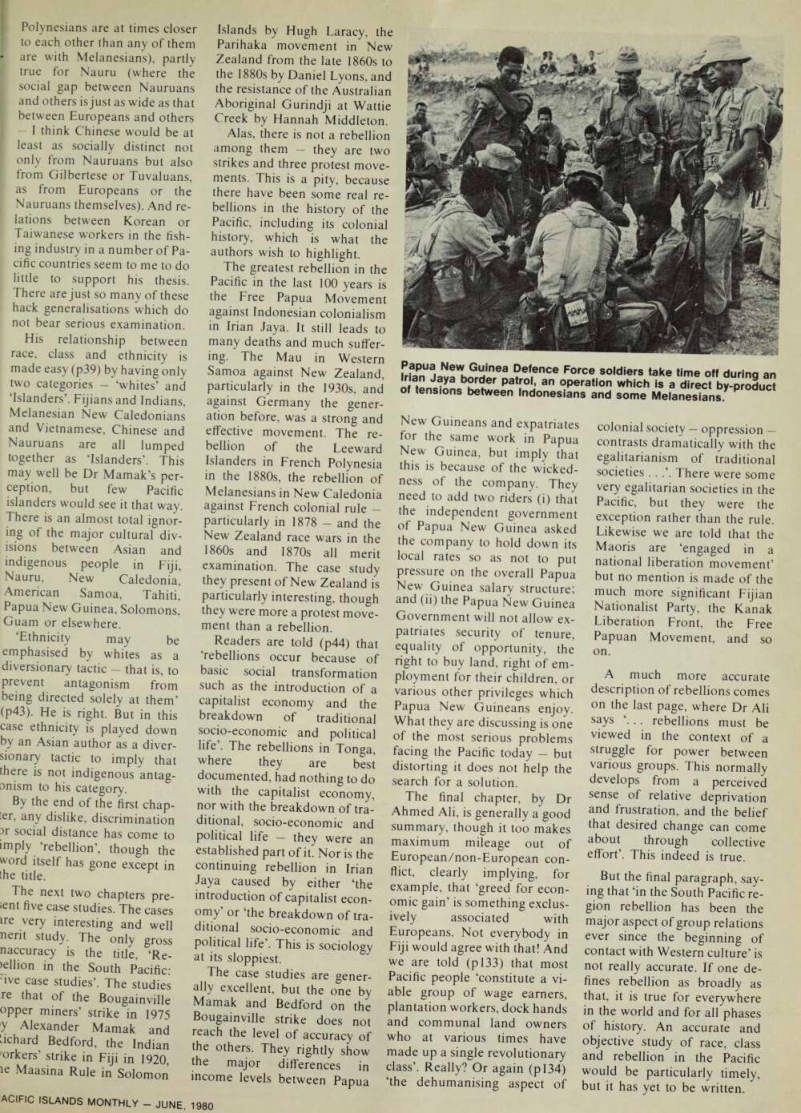
Papua New Guinea Defence Force soldiers take time off duaring an Irian Jaya border patrol, an operation which is a direct by-product of tensions between Indonesians and some Melanesians