shipping run
pp. 70-73 · Read in the full issue

Improved cargo services on PNG Australia shipping run
By Captain Vic Sanderson
New efficiencies and new tech
niques have restructured shipping
services on the important cargo routes between the Australian east coast and Papua New Guinea ports.
Four operators are now trading regularly on these routes, and depending on the season they use up to 12 ships and provide an aver age tum-around of 26 days. A PNG importer can now order stock lines and can expect to have them on his shelves within any period of three weeks.
The two major ports of Port Moresby and Lae in PNG are now getting one vessel from the Aus tralian run every three or four days a particularly good service for Lae which imports only 10% of the tonnage. The transit period from Melbourne to Port Moresby,
including laytime in Sydney and
Brisbane, is only about nine days.
Like all other trades there is a peak and trough situation about eight months peak and four months trough. This means that during the slack season the trade is overton
naged, but this is a worldwide
phenomenon. In the peak trading
season there is only a surplus of about 2%, indicating that the trade is ideally tonnaged, and as in all trades one has to carry surplus tonnage during the slack period.
Because of the lack of south bound cargoes, when cargoes fill ing only 15 to 20% of capacity can be expected, the freight rates are said to be somewhat high, but if we compare them with the Australia - South-east Asia trade they are pretty much lined off.
The volume of trade is largely controlled by the coffee season in the Highlands. A good coffee season generates trade. It puts more cash into the pockets of the people who then buy luxuries like beer, cigarettes, canned foodstuffs and frozen pies. When there are beer bans in the Highlands, the people tend to eat more, which in turn gen erates more northbound cargo.
However, the base cargo is rice which accounts for approximately 20% to 25% of the trade and all
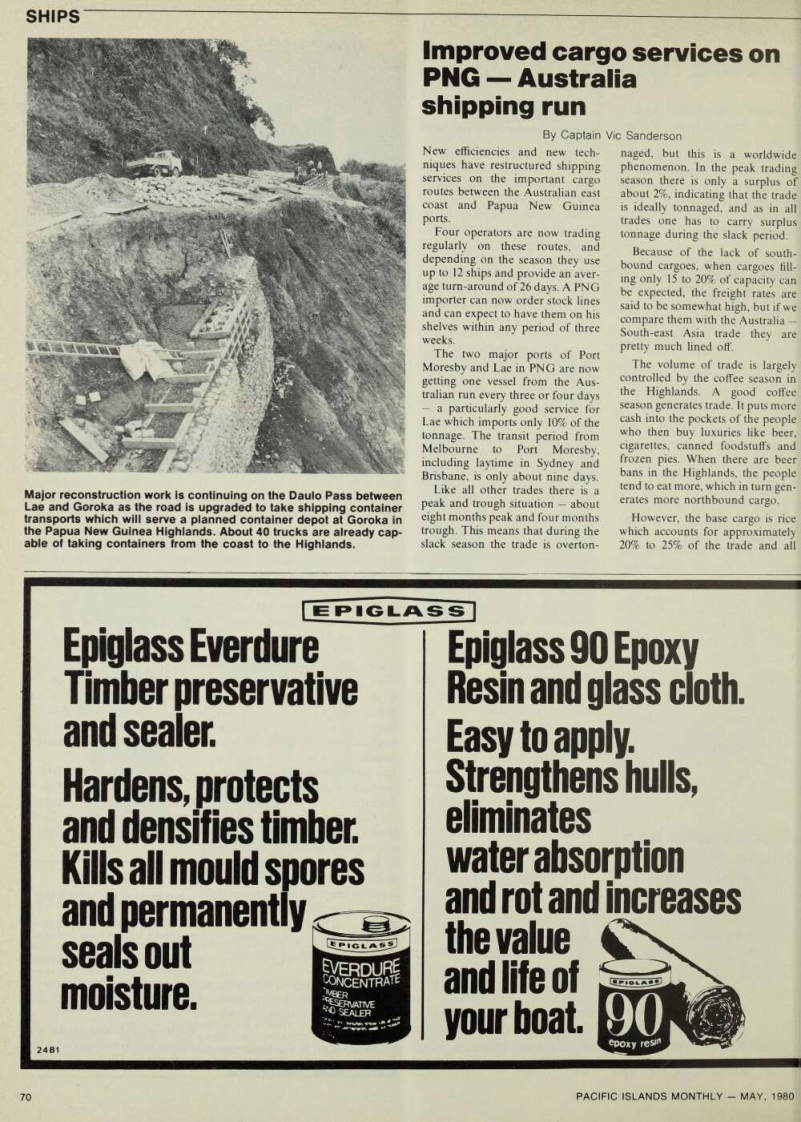
Major reconstruction work is continuing on the Daulo Pass between Lae and Goroka as the road is upgraded to take shipping container transports which will serve a planned container depot at Goroka in the Papua New Guinea Highlands. About 40 trucks are already cap able of taking containers from the coast to the Highlands.
shipping lines are competing for I Other foodstuffs, including
I frozen poultry which is extremely
popular, canned meat, canned fish, frozen pies, and frozen meat, make up the real general cargo trade.
Another base cargo is steel, including billets and sheeting, but this is mostly carried by one company still using conventional ships. The other companies use cellular container vessels.
Although most cargoes are car ried on contract with individual
shipping companies, machinery is
usually shipped by first available
vessel because it is often required
urgently.
The main commodities exported from PNG are plywood, sawn tim ber, coffee, cocoa, tea and personal effects.
Substantial quantities of ply
wood are produced in Bulolo, which is about 100 km southwest of Lae, and exported principally to Japan. The secondary market is Australia. PNG can produce ply wood more cheaply than the Philip pines and Malaysia who have to import the timber, letting PNG compete successfully with Korea, Japan and Taiwan where prices are
constantly rising.
Until recently the Port Moresby wharf was unable to cope with the tonnage put through it, and it was
obvious that a container station was required. Now a container depot in Port Moresby is well developed and a second depot has been established at Konedobu about 1.5 km from the wharf. This has cleared the congestion on the
Moresby waterfront.
Another interesting development
will be the establishment by a con sortium of all major shipping companies of a depot at Goroka in the Highlands, to also serve Mount Hagen. The road leading to this depot and to Mount Hagen is not good, but it is being improved and
containers are already going
there.
The road operators, especially over the past 18 months, have
gradually upgraded their equip
ment and are replacing their exist ing fleets with vehicles capable of taking containers into the High lands. Now there are about 40 trucks capable of doing this.
For firms wishing to trade with PNG there is a large market with enormous potential. It is a matter of going there and selling the pro duct, but it has to be done across the table. The Australian Trade Commissioner is trying to get the message to exporters that no longer can one sell by telephone, telex, or telegram. Merchants have to get off their tails and go there if they want to do business.
Tahiti Line
Has Its Say
PIM has received the following official comment from the Tahiti Line (Compagnie Tahi tienne Maritime SA) on our re port ‘A modern Bounty mutiny troubles NZ export link’ (PIM Dec 1979 p 61): It must be the fate of any ship named Bounty to have troubles with story-tellers.
Life aboard the first one has become, through popular tales, a hard-life sentence, and her captain a stone-hearted brutal beast of a shipmaster. In fact, life aboard the Bounty wasn’t any better or worse than on any ship of that time, and Captain Bligh became a rear-admiral, a tribute to his competence and
seamanship.
The troubles of the second Bounty were very different, as unions did not exist in the 18th century. But what writers of books and moviemakers did to the old Bounty newsmen have done to the new one.
Pacific Islands Monthly and
Nautical News mentioned in their issues of December 1979
and January 1980 respectively the difficulties met by today’s Bounty in New Zealand as if they had just happened, and would put the whole operation
in jeopardy.
We, as proud owners of the ship, would like to emphasise that these problems occurred in July 1979 and have long since been settled. For many months now the modern Bounty has been plying a very successful and busy trade. She has proven to be a rewarding link between Tahiti and New Zealand.
So please Messrs Newsmen, keep up with the Bounty and write about Rear-Admiral Bligh and his successful career instead of his past troubles with Fletcher Christian.
Seven ships
for the FSM
Seven US Trust Territory government ships and two fish ing vessels were transferred to the Federated States of Micronesia government on April 1. The seven ships are Micro Glory, Micro Trader, Micro Spirit, Micro Dawn, Yap Islander, Kaselehlia and
Caroline Islands and the fish ing vessels are Kacho and Morkorkor. Two additional fishing vessels at present in Palau will also be turned over to the FSM government when their existing charters are expired or terminated.
Under an agreement signed by the President of the FSM Government, Tosiwo Naka yama, and High Commissioner Adrian P. Winkel, the FSM government will assume the
administration, operation and management of the vessels, but title of ownership will remain with the Trust Territory government.
Operating funds for the ships for the rest of 1980 will be turned over to the FSM Government, which will also be responsible for main
tenance, dry docking, collec
tion of revenues, shipboard personnel, contractual obli gations and insurance.