The '50s: A loss of innocence
pp. 51-57 · Read in the full issue

as politics hit the road
In her survey of PlM’s 50 years, JUDY TUDOR this month analyses the decade of the 1950 s which, she says, came into being like a ‘puling infant’ but went out like a ‘snarling tiger’. The difference? ‘By then politics were on the march in the once gay and feckless islands, portents of things to come.’ Her area-by-area study of the decade only underlines this basic point. But there are many lighter sides to this highly readable account of PIM, and the islands it serves, in the 19505.
If the decade of the 1950 s had come in like a puling infant, whimpering still at the postwar problems that took so long to solve in some of the territories and islands of the South Pa cific, it went out like a fully adult and snarling tiger. By then politics were on the march in the once gay and feckless islands, portents of things to come. We’ll survey the Pacific
piece by piece:
Papua-New Guinea.
In P-NG, the Liberal
Government’s Percy Spender
lasted barely a year as External Territories Minister before being sent to Washington as Australian Ambassador which was, so the story went, Prime Minister Menzies’ way of getting rid of a potential rival.
His place was taken by Paul Hasluck and he, in time, be came as controversial a figure as Labor’s Eddie Ward. The idea that a Liberal government in Canberra would reverse the
direction already taken by
Labor died hard and the death was made even more pro tracted by the fact that the Lib erals had initially announced that development of the Terri tory by Europeans (later called expatriates) was part of their policy and this many took to
mean that European develop
ment would be paramount.
Mr Hasluck’s most vocifer ous critics (apart from PIM) were those anxious to settle on the land and grow something but were then forced to wait for years, or even in vain, before the cumbersome land-leasing machinery delineated cocoa blocks, coffee blocks, tea estates, pastoral leases and so forth, and put them up for ten der. In the light of events, 15 or 20 years on, when the Terri tory of Papua-New Guinea be came the independent country
of Papua New Guinea, without
the hyphen, it might be thought
that land settlement for non indigenes was a wasted effort.
However, without white pioneering effort and know how, the country would not have been the going concern that it was at the time of
change-over.
Although a Legislative
Council had been provided for in the Papua-New Guinea Act of 1949, the first council was not set up until 1951. It con sisted of the Administrator as President, 16 official members, six European nominated members representing min ority groups, three nominated native members and three elected European members.
Although its composition was
criticised, Canberra remained unmoved, the election of the European members Don Bar rett (NG Islands), C. M. Jacob son (NG Mainland) and E.A.
James (Papua) duly took place
and council met for the first time at the end of 1951.
The venue was the old Red Cross Hall at Ela Beach but Canberra made up for the paucity of facilities with the at tendance of VIPs from South.
The ‘speech from the throne’
was read by Sir John Northcott, acting Governor-General of Australia, and Paul Hasluck and entourage were also there.
The show was impressive enough to have some formerly
cynical Territorians declaring
that it just might provide a ‘new
channel for reaching Moresby
or Canberra’.
They soon changed their
minds. The council was later declared to be just a glorified debating society, put there so that official members, against their own best interests, could force through ideas dreamed up in the back rooms of the
Canberra bureaucracy.
Two months earlier, Briga dier Donald M. Cleland had been appointed Assistant Ad ministrator. He was already known in the Territory, having been chairman of the wartime Production Control Board although in the interim he had been director of the Federal Secretariat of the Australian
Liberal Party.
Nine months later the Ward appointed Administrator, Co lonel J. K. Murray, retired, two years before his term of office was to expire. ‘Forced out of office’ was a more accurate way of putting it. At the time PIM
was as anti-Murray as it was anti-Ward and attributed his retirement to his being a stum bling block to the Liberal government’s desire to get on with developing land in the Territory. In view of the Hasluck regime’s later dila toriness over land develop ment, land obviously wasn’t the only bone of contention.
Although Murray might
have agreed with Ward over native policy, there all resem blance between the two men ceased. Ward was a ranting Trades Hall socialist of the old school, and probably was motivated more by a desire to get after private enterprise in P-NG the ‘exploiters’ than he was to better the lot of the indigenes. Murray was an aca demic and a gentleman and, in the Territory, a man before his time.
After a decent period as Act
ing Administrator, Brigadier
Cleland became Administrator and until the council took its next step towards democracy in 1964, sat impassively as its President while his Assistant Administrator, Dr John Gunther, with Machiavellian glee, fired the Canberra bullets that stung the private members and the private individuals
they represented.
In early 1959 it became obvious that Canberra was contemplating the introduction of income tax in Papua-New Guinea. A delegation was sent to Canberra to ask the minister for an examination of all as pects of tax in the Territory be
fore introducing something
which, it was plain, would be disastrous to development.
This was ignored and at the March session the income-tax bill was introduced without
warning, creating such violent
reaction that Administrator
Cleland adjourned the meeting
and flew to Canberra himself.
To no avail.
The bill reappeared at the resumed meeting; P-NG was to have Australian-type tax from July 1. complete with double taxation on company profits, pay-as-you-earn tax, deducted at source by em ployers, for wage and salary earners, and provisional tax for the rest. The official members
obediently voted it through
and the three elected members walked out of the building and
resigned.
An application for an injunc
tion restraining the Legislative
Council from passing the bill soon followed on the grounds that the resignation of the elected members made it unconstitutional. This unex
pectedly developed into an
attack on what was the P-NG ‘constitution’, the Papua-New Guinea Act itself, and the chal lenge went to the Australian High Court which was expected to hear it in August 1959. The case, in fact, did not come up for over a year and, in the interim, tax duly became
payable from July 1, a by
election was held for the three vacant seats, and these were won by anti-tax candidates, who took their seats and then
immediately resigned.
The Administration, not to
be caught again, simply did
without elected members until after the next council was installed in 1960. Income tax of course had continued to go
merrily on.
Fiji
Fiji’s problems were quite
different. Largely they hinged
on the fact that the land was secured to the native Fijians who were slow to develop it, while a larger, thrusting, more
enterprising migrant popu
lation of Indian stock, with a phenomenal birth-rate, hungered for and demanded access to what they believed was their fair share of it.
Fiji’s most important indus
try, the growing and processing of sugar cane, was moreover almost entirely in the hands of Indians who carried into the
1950 s the industrial disputation
that had bedevilled the indus
try during the war.
Trouble between the Col onial Sugar Refining Co and growers and/or mill workers was a continuing saga during the decade, not made easier by the CSR announcement in January 1957 that after the 1959-crushing season it would close its Nausori mill on the banks of the Rewa River which it had built shortly after it established itself in Fiji in 1880.
The cane grown in wet Nausori was poor in sugar con tent in comparison with the sugar processed in the company’s other four mills in the dry zones of Fiji. The Nausori land, argued the company, could be put to bet
ter use, including large-scale
rice growing. As events turned out rice also had its problems.
But in the interim, cane growers in the Rewa area were thrown into some panic and for a while Indian entrepreneurs had hopes that they could take over the mill and carry on where CSR left off.
Because of these problems of population and land, the col
ony ended the decade with a flurry of imported experts try ing to get to the bottom of it all and chart a course for the future that would be to the benefit of all communities.
By mid-1959, G. G.
Honeyman, QC, of the United Kingdom, was almost ready to release his report on the sugar
industry, following an inquiry
that had begun the previous year. Professor O. H. K. Spate, of the Australian National
University, had already
presented his monumental re port entitled The Fijian People Economic Problems and
Prospects although it was only
part of the basic material to
background the Burns Inquiry
which had been set up at the end of 1958 by the UK govern ment.
Under the chairmanship of Sir Alan Bums a panel of experts had the job of consider ing the future economic and social needs of Fiji, and to sub mit a programme for develop ment. Sir Alan and his associates arrived in Fiji in mid-1959 and released an exhaustive report in March
1960. The adoption of many of its findings, along with the re forms suggested by the Honeyman inquiry, smoothed the Fijian path in the following K decade and led to a reasonably
; painless progress towards
; independence.
Netherlands New Guinea The Dutch had bowed out of Indonesia in November 1949 leaving the question of Netherlands New Guinea un settled, but with Soekarno pos turing that he would go to war to get it if it were not handed over by December 1950. That date came and went but there was no settlement and no war, except of words, for the next 10 years.
Nonetheless, it was becom
ing increasingly evident by
1959 that the Dutch in the Netherlands, if not in Netherlands New Guinea, wanted to be rid of their still
largely undeveloped territory if
they could do so with some honour and could, at the same time, prevent Indonesia from
getting it.
In October 1958 NNG and P-NG representatives met in Canberra. The Dutch no doubt, hoped for better things.
But Australia, by this time
already foreseeing the time
when it would be rid of its own territory, was in no mood to do anything much to help the Dutch in their predicament.
The NNG delegates suggested a ‘consultative union’ with P-NG but no one seemed to know what that meant and in the inevitable showdown with
Indonesia, practical help from
the Australian side was vir tually nil. The Dutch began a crash course of bringing their people to a stage where they might be able to look after themselves, but it was a case of too little too late, as the early years of the 1960 s were to show.
Western Samoa Further east, at the end of 1954, the 170 delegates to the Western Samoan consti tutional convention indulged n six weeks of oratory (90 made speeches) as they tried to lammer out a blueprint for
ndependence. All except High
Chief Mata’afa agreed with the end result when it was decided hat High Chiefs Tamasese and
Malietoa would be Joint Heads of State. In fury at what he felt was a slight to his royal title, Mata’afa threatened to with draw from public life and not participate in the future government. The convention broke up on this note. But Mata’afa later reconsidered his
position.
The resolutions of the con vention were forwarded to New Zealand and indepen dence seemed just around the corner. The United Nations Trusteeship Council had other ideas no matter whether all parties agreed or not. Western Samoa must jump through the necessary hoops. It was, as well, sold on the idea of universal suffrage and had never heard of the Samoan matai system. It was not until mid-1958 that the three High Chiefs went to the Trusteeship Council in New York to explain why the Samoans preferred matai (i.e. heads of families) suffrage rather than the one-man/
woman-vote variety.
In early 1959, Dr J. W.
Davidson of the Australian National University was in Apia to assist the Working Committee to draft a consti tution. Later that year a visiting Trusteeship mission pressed the Samoans into agreeing on a ‘yes’ or ‘no’ plebiscite for
independence, conducted
according to their rules. The plebiscite was set for May 1961 then, unless the whole popu lation performed a political volte face and voted no, which
was unlikely, independence
could be celebrated on January 1, 1962.
Western Pacific High Commission The first High Com missioner of the Western Pa cific to have separate responsibility was R. C. S.
Stanley (later Sir Robert). Up to 1952 the High Com missioner was also the Gover nor of Fiji, and WPHC headquarters was in Suva. It moved to Honiara in 1952, and its province included the over sight of the Gilbert and Ellice Islands Colony and the British part of the New Hebrides, as well as the Solomons.
Within a few months of the start of the new set-up, it was facing a challenge from irate residents on its income-taxing laws. Eminent Australian con stitutional lawyers were of the opinion that as the British Solomon Islands Protectorate was a protectorate and not a
fullblown colony (apparently
an oversight of 1893) the five articles of the Order-in- Council setting up the protec
torate did not give it
income-taxing powers.
The case was heard before the local Judicial Com missioner and the plaintiffs lost. An appeal was lodged but then withdrawn and at a later stage revived. Nonetheless, as in P-NG, tax was there to stay.
France in the Pacific Meantime politics in the French territories seemed to be as schizophrenic as those in the mother country. In 1952 France introduced what amounted to common rolls for election of Deputies from New Caledonia and French Polynesia. As a result, French Polynesia sent a Left wing, nationalistic Tahitian, Pouvanaa a Oopa, to sit in the Chamber of Deputies in Paris; and New Caledonia elected Maurice Lenormand, also to the Left of what New Caledonia had previously had.
Once in Paris, Lenormand was able to enlist the support of like-minded citizens and de manded a common roll for the New Caledonia Territorial As
sembly, hitherto dominated by
official members and con servative elements. However, France was going through a series of crises of its own and when the term of the NC As sembly expired it was left in limbo.
In February 1953, when New Caledonia did go to the polls again, it did vote on a common roll and half those on it were native New Caledonians.
Lenormand’s party won 15 of the 25 seats.
In May 1953, French Polynesia held its first Legislat ive Assembly election and though Alfred Poroi’s con servatives won all the seats in Tahiti, Pouvanaa’s radicals won all those in the other islands. In the assembly, some thing like civil war raged at times, and at one stage Poroi and a man named Noel Ilari arranged to fight a duel over one hotly disputed matter. The Governor put a stop to it and the political situation remained finely balanced for some years.
Assembly elections were held again in early 1958 and this time the majority of seats
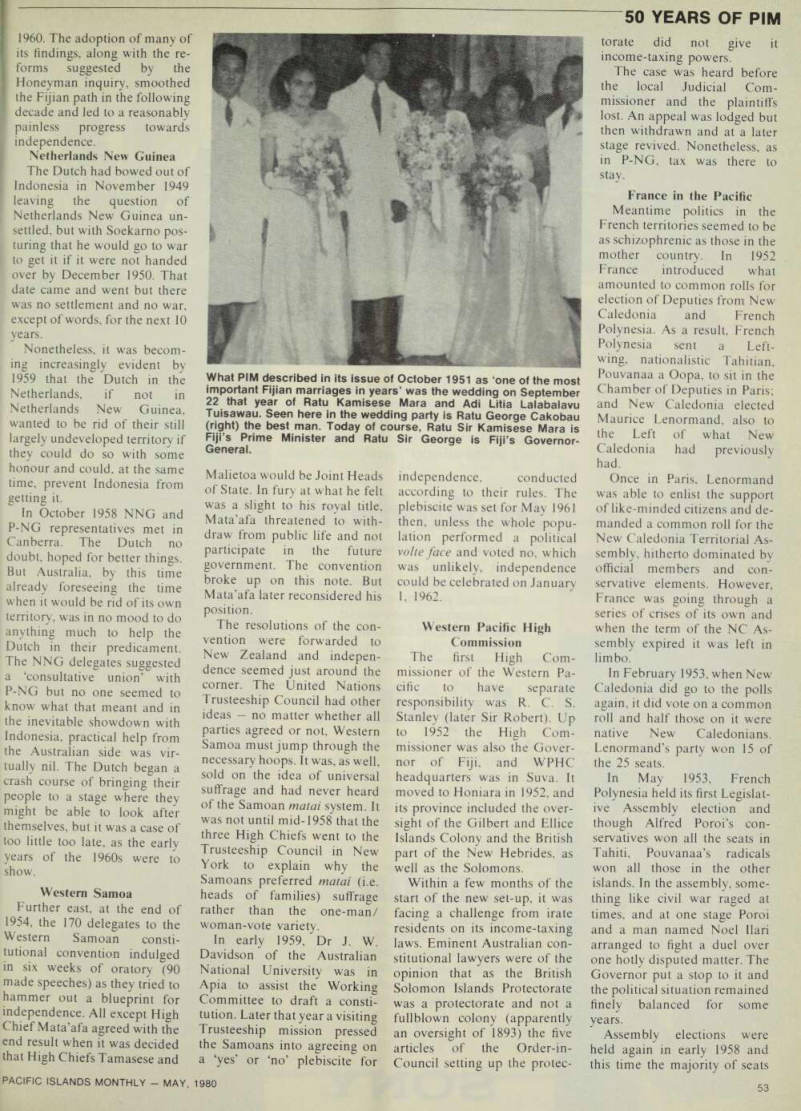
What PIM described in its issue of October 1951 as ‘one of the most important Fijian marriages in years’ was the wedding on September 22 that year of Ratu Kamisese Mara and Adi Litia Lalabalavu Tuisawau. Seen here in the wedding party is Ratu George Cakobau (right) the best man. Today of course. Ratu Sir Kamisese Mara is Fiji s Prime Minister and Ratu Sir George is Fiji’s Governor- General.
in both Tahiti and outer islands I went to Pouvanaa, although
public euphoria lasted only
until April when an attempt i was made to introduce income tax.
As a protest, shops and offices closed in Papeete and hundreds gathered at the as sembly building. Gendarmes failed to control the mob which began to throw stones and other missiles, while members cowered inside. The fire brig ade then dispersed the protes ters with their hoses. The assembly soon met and hur
riedly repealed the tax.
Meantime in New Cale donia trouble was brewing be tween Left and Right wing el ements, and when it came to the crunch the Governor sus pended the assembly and assumed responsibility while he consulted Paris.
Paris was in no mood for New Caledonia’s petty troubles the assembly would remain suspended until at least the end of the year while France and all its appendages voted oui or non to de Gaulle’s new consti tution.
New Caledonia voted over
whelmingly oui , but although
oui also won in French Polynesia, 9000 voters were for non and, furthermore, were resentful of what they alleged were the difficulties put in their
way during the campaign.
On October 10, 1958, the dis senters threw bottles of burn ing petrol into the house of a political opponent, the Gover nor ordered the arrest of Pouvanaa, whose house, when searched, was allegedly found to have an arsenal of so-called Molotov cocktails. Pouvanaa was held in gaol for a year without trial, then sentenced to eight years gaol and banish ment to France for 15.
It might be said that he went out with France’s Fourth Re public, except that he was feted when he was released from gaol many years later, and was eventually elected to the French Senate.
Prosperous ’Sos
In spite of troubles over land and taxes, most islands terri tories ended the decade more prosperous than they had
begun it. Even allowing for in flation, export figures showed this clearly. The value of P-NG exports rose from£s million in 1950 to £l9 million in 1959-60.
New industries, including cocoa, coffee, timber, cattle,
passionfruit, joined the old
standbys of copra and rubber to get a result that was con tributed to in an increasing de
gree by the indigenous
population. In Papua, how
ever, two promising industries failed. One was kenaf fibre, an alternative to jute, killed by government indifference. The other was cutch, a tanning agent extracted from mangrove bark. Its demise was the result of isolation in Papua’s Gulf
country, plus the inexperience
of those sent to do the job.
The value of Fiji’s exports doubled (from £7 million in 1950 to £l5 million at the end of the decade), and so did those of Western Samoa, providing the prosperity on which independence came with much greater ease.
Even Tonga, Cook Islands and the Solomons did better, and New Caledonia, through its nickel, outdid all others, boosting the value of exports from 519 million Pacific francs in 1950 to 4603 million by 1960.
In the British territories par
ticipating in the UK Ministry of Food’s nine-year agreement to purchase all copra, great dis content manifested itself among planters in the early ’sos, as free world price was double what they received. By the middle of the period, how ever, all was silence on the planting front as world price dropped steadily. As December 31, 1957, ap proached, marking the end of the agreement, something like apprehension gripped the erst while protesters.
They need not have worried.
A devastating and fortuitous drought in the Philippines af fected copra prices and by the end of 1958 they were around £Stg 100, cif, Europe.
Of the old industries that had kept P-NG and Fiji afloat in the 19305, only goldmining was in decline. Bulolo Gold Dredg ing, which had won fortunes in New Guinea for its share holders, began the decade working eight dredges and fin ished with three. New Guinea Goldfields took 13 years to pay its first postwar dividend of 3d a share. In Fiji, Loloma was almost worked out, although prospects for Emperor were reasonable.
At the root of the trouble was the US price of SUS3S per ounce of gold (£l5/12/2, in
Australian currency). It had been fixed in 1946 and was to continue without increase until the 19705. Between 1946 and 1959 the cost of production had risen about 500% and goldmin
ing remained a proposition
only with government assist ance and diversification into other industries.
Tourism, which was to loom large in the 60s and 70s in most
territories, had scarcely begun
in the 50s and where it had been recognised as a potential revenue earner Fiji. Tahiti and American Samoa it was
hamstrung through lack of
hotels.
In Suva the Grand Pacific continued as the only tourist hotel. The hurricane of 1952 had damaged others and demolished the old Club at the corner of Victoria Pde and Gordon St. In 1953, Morris Hedstrom Ltd, which owned the site, announced that a mod ern multi-storey hotel would be built and work soon com menced. It reached ground floor level, and the old Club Hotel licence providing a reason for reopening the bar, there all effort ceased for four years.
Building recommenced in 1957 when Northern Hotels undertook to run the hotel on completion. But the new Club stopped far short of original plans and provided Suva with only 18 more rooms for
clamouring tourists.
By the end of 1958 the GPH was also heading for reorganis ation. Back before World War I the Union Steam Ship Co of New Zealand had obtained the lease of a Suva harbourside swamp, reclaimed the land, and built on it its famous GPH.
The company paid no rent to government and, under the original agreement, govern ment was required to take over the hotel at an agreed valuation should the USS Co require it.
In December 1958 the com pany decided to call in its
option by announcing that it
would not seek a renewal of the original lease. The hotel was
subsequently dropped in the
government’s lap, tenders were
called for it as a going concern, and in 1959 it went to Cathay Hotels of Singapore who undertook to build a new bed
room block, renovate the exist-
I ing building and build a
swimming pool.
In the meantime, Korolevu remained the only resort hotel I on the Coral Coast; and Mr Barry Philp was running the old Mocambo, the cane and thatch ex-US officers’ club on Nadi Airport, as the only hotel in that area although, as the
new jet airport began to en
croach upon it, his thoughts turned to the idea of a new Mocambo on a nearby hill.
Papeete had a couple of modest hotels that provided stopgap accommodation until the real tourist boom began, but it suffered from lack of an airport. Not until 1959 did serious work begin on Faaa air port, built partly along an off shore reef.
American Samoa was also in process of upgrading Tafuna airport and made do with a
boarding house masquerading
as the Rainmaker Hotel. For all these territories it was a Catch 22 situation: What came first, the tourists or the beds to put them in?
Elsewhere tourism was ignored or, as in parts of
Polynesia, deliberately dis
couraged for fear that it might interfere with local customs.
By the end of the decade few islands were without air con nections to the outside world, either by flying boat or 2
increasingly, by land planes.
Jet airports were being built in Tahiti and American Samoa; Biak in NNG already had one and at Nadi, Fiji, the jet run way, new terminal building and control tower were ready when Qantas began the first
San-Francisco-Sydney Boeing
707 service in early July 1959.
For those who liked to travel by ship, the late ’sos had it all.
The two Matson vessels Mon terey and Mariposa provided monthly trans-Pacific services.
P&O 30 000-tonners sailed fre
quently from Sydney via
Islands ports to US West Coast ports, or through Panama to
Europe. Shaw Savill ships
Southern Cross and (later) Northern Star also played their part as did Messageries Mari times along with less frequent Italian and Dutch services. The Norwegian Pacific Islands
Transport Line ships carried passengers and freight between North American ports and the Islands. All, alas, are now de parted.
Burns Philp and New Guinea Australia Line ships kept communications open be tween Australia and the SW Pacific, as did the Union Co vessels between New Zealand,
Fiji and Polynesia. China
Navigation Line and Australia- West Pacific Line provided for passengers and freight between the Islands and the Far East.
There were direct cargo ser vices from London and Europe, while Bank Line vessels picked up copra and coconut oil.
Death And Disaster
The Pacific had its fair share of disasters during the decade. On January 21. 1951, after three days of rumbling, the whole northern side of Mt Lamington in the Northern District of Papua blew out horizontally in violent eruption, the lateral
blast killing everything and
everyone in its eight-mile path.
About 4000 Papuans and 30
Europeans perished including
the local District Com missioner and the Director of Native Labour. The head quarters station of Higatura was literally wiped off the map.
Rescue teams flew in from Moresby and government took over the relief and evacuation of the danger area.
Mt Lamington is a peak in
the Hydrographers Range. It
had apparently been dormant for centuries; not even local folklore had recorded past eruptions.
In late January 1952 the most destructive hurricane ever to hit Fiji cut a swathe 30 miles wide from Viti Levu Bay to Suva. Winds of up to 150 mph were recorded.
The city had almost no warn ing due to the swiftness of the storm itself and some foul-up in reports. For two hours it lashed the city after leaving a trail of ruin across the big island of Viti Levu, through the banana plantations on the rivers and the dairying country of Tailevu. Suva buildings that had weathered decades of
other storms were unroofed and some were demolished.
From that date, the face of the
city slowly changed to take on
a more modern look.
Just over a year later, on Sep tember 14, 1953, Suva and ad jacent areas were shaken by the strongest earthquake ever recorded there and this was fol lowed by a tidal wave that swept in over the reef that en closes Suva harbour, rose above the sea wall and flooded reclaimed land where many of
the city’s important buildings
stand.
The worst affected area was the NE corner of Kadavu, to the south, where a wave 15 ft high swept into a narrow bay, demolishing 40 houses and
drowning two people. Total
death toll was eight, five of
them through drowning.
The origin of the ’quake was not volcanic but subsidence or earth adjustment about 12 miles SW of Suva something that can be expected once in a few hundred years.
Nor was the South Pacific without its unpleasant scandals and murders that aroused the morbid interest of others far from the Pacific scene. On August 15, 1953 the Resident Commissioner of Niue, Mr C.
H. W. Larsen, was brutally murdered and his wife
seriously injured when three
men using machetes attacked them while they slept. The two Larsen children were un harmed and gave the alarm.
Mr Larsen was able to identify one of the men before he died and after five days of intensive activity, three men were
charged.
Defence counsel was sent from NZ but the men admitted their crime and remained
unrepentant. They alleged that
they had been badly treated by
the RC and considered that they had done Niue a good turn. They were sentenced to hang, but when an appeal was made to the NZ Full Court they were shuffled off to New Zealand. The appeal failed and they were on their way back to Niue when an appeal was made to the Privy Council. The prisoners were therefore diverted to Apia Gaol. The PC
also turned the appeal down.
Nonetheless the sentence was eventually commuted to life imprisonment in Auckland.
The Larsen murder by these
much-travelled prisoners
started a controversy as to whether the administration of Niue had been too harsh.
People also asked what part the
London Missionary Society,
which regarded Niue as a closed preserve, had played in local affairs, religious and otherwise.
In the Solomons the indiscreet silence of the BSI government and the Melanesian Mission over the murder of a 12-year-old
Malaita boy by an Englishman
named Reginald Poole ex ploded in January 1956 and newspapers in Australia and elsewhere were in full cry.
‘Hysteria in Sydney and
Honiara has been the keynote’, said PIM when some papers al leged that the murder, which had occurred on November 17, 1955 had been hushed-up.
Poole was tried by the Ju dicial Commissioner and three assessors. Rabaul lawyer Dudley Jones defended and a NSW government psychiatrist flew up to examine Poole. He had been a lay teacher with the Mission, first at Pawa, then at Maravovo. Before he left Pawa, two Solomon Islanders had told the headmaster that Poole was homosexual, but nothing was done about it. At Maravovo, on November 17, Poole had lunch with the Rev.
D. Hoey and ‘appeared quite
normal’. After the meal he went to his house, called out for the boy and almost within min utes rushed back to Hoey to say he had killed him. The young ster was found with a pickaxe sticking out of his side and bat tered about the head.
Poole was found guilty and sentenced to death. Some resi dents in BSI, including Mission personnel, believed that Poole should hang forthwith in case Solomon Islanders got the idea that there was one law for them, another for whites. Poole did not hang he was flown to the UK and committed to Broadmoor Asylum for the
criminally insane.
• See page 59 for further items from PlM’s 50 Years.