Exhilaration of a Milne Bay scuba safari
pp. 35-39 · Read in the full issue

Milne Bay scuba safari
Milne Bay Province is well known for two main things.
The Trobriand ‘islands of love,’ famous for their lovely island lasses who still adorn them selves in little else but sexy grass miniskirts, the shortest in the Pacific, and the Battle of Milne Bay, where American and Australian forces first defeated the Japanese on land in World War 11.
We know Milne Bay as our home and to explore some of its reefs was our aim on a new type of holiday in a country where adventure is a way of life. We had been doing it our selves for years, just for fun.
We sailed Solatai from its base in Port Moresby to Alo tau, the provincial capital of Milne Bay Province, where it was only necessary to fill up with fuel and water and top up all the dive tanks before we met Air Niugini’s F 27 Bird of Para dise from Port Moresby with our 12 adventurers. Within minutes all were aboard and we set off for East Cape, the eastern extremity of the Papua New Guinea mainland. Solatai
is diesel-powered, fibreglass,
equipped for up to 20 divers.
No luxury hotel or even humble guest house was wait ing for us. We were on safari.
In the hold were tents and camping gear to enable us to live on the beach if necessary, but we hoped to stay in the vil lages and add the rich experi ence of living in another culture to our underwater adventures.
We need not have worried, wherever we went we were wel comed with open arms. Free of the hardships faced by less for-
tunate villagers in the more
rugged and climatically inhos
pitable parts of Papua New
Guinea, Milne Bay people
have abundant natural re sources and a generous, friendly nature to go with their attractive features.
At East Cape, they soon organised a traditional dance for us while we set up camp in an old mission house.
The next two days were
spent exploring the nearby
reefs and islands. This was a rewarding time for us, for although the visibility was not as good as usual varying around 20m it was good to watch the excitement gener ated as the divers saw their first shark, manta, turtle or giant clam. In these untouched waters the marine life is pro
lific, and every dive produced new sights and experiences and rare shells for the several collectors in our group.
After two days we moved on to Nuakata Island two hours
away, catching a good kingfish
and a couple of tuna for supper en route. Here we camped in the village church, and as the village was full of youngsters we had a continuous giggling and singing audience, with gasps and ‘oohs’ as our various
contraptions appeared. Filling
the air beds with a low pressure inflator attached to a scuba
bottle proved especially fas
cinating.
Here we were treated to a
magnificent display of drum
ming on a large drum carved from a tree trunk nearly a metre in diameter and played
by three drummers at once.
The leader, a highly energetic village girl, would have put any rock drummer to shame.
There was already great ex citement in the village as to night was New Year’s Eve and a feast is held on New Year’s Day. Now they had some extra guests. We decided to have our own celebration and see in the New Year underwater.
There was a pretty coral reef just where we anchored the boat 50 metres from shore in six metres of water, so at 11.45 pm we kitted up and in we went, armed with a supply of wine in a flexible container.
We all knew that drinking be fore diving is strictly out, but, as one of the divers pointed out, we hadn’t read anywhere about drinking while you are diving and we figured that one mouthful in six metres of water
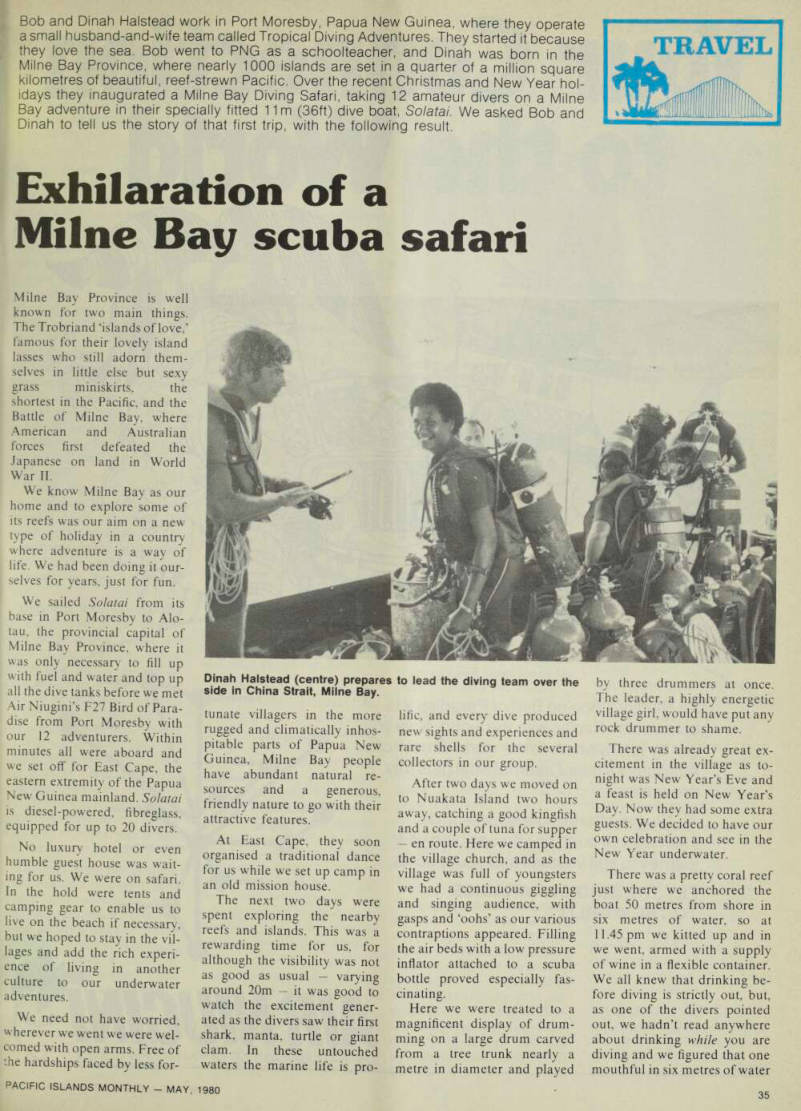
Dinah Halstead (centre) prepares to lead the diving team over the side in China Strait, Milne Bay.
wasn’t going to do us any harm.
‘ Actually as midnight arrived
mouthpieces were coming out
for reasons other than a squeeze from our flexible wine cask as traditional greetings
were exchanged.
The dive itself was good fun, f for we played with an enor mous lump-headed wrasse, and also a pair of epaulette sharks who were obviously also celebrating the New Year.
As divers emerged into the New Year they were greeted aboard with champagne and we partied on until 2.30 am when our group of weary but happy divers finally hit the sack. Unfortunately we were not to get much rest, as at 5.00 am we were unexpectedly awakened for the traditional village celebration. Dozens of strong young men suddenly appeared, and the conversation went like this, ‘Excuse us please but we will now throw you in the water!’
Firmly but gently everyone
was removed from their snug sleeping bags, carried to the beach, and tossed into the sea.
Even babies in the village were carried to the water’s edge and splashed in this traditional ‘rite’.
Only one dive was decided for that day, but before the eve ning feast in the village we were to visit the skull caves, where ancestors’ skulls can be seen hidden in ledges. A guide took us along a path bordered by the ocean on one side and the remains of an ancient wall on the other side until we arrived at the place. Here, rest ing in rocky cracks and crev ices, were dozens of skulls. We were told various stories to ex plain their presence, but no one appeared to be really sure who put them there or why.
The next day, after planting some coconuts on a sandy islet whose reef abounded with giant sea fans, black coral and spiny lobsters, some of which ended up in our cooking pot, we sailed down a chain of deserted islands towards Tube Tube, our next camp site.
Diving at these islands is exciting for the shark action. As soon as we reached the edge of the drop-off 10 metres below the boat, reef sharks appeared
from every direction. Not ag gressive and all under two
metres long, they were
nonetheless very curious and would take turns to swim close and look at us intruders.
Although we felt perfectly safe and not threatened at all, it was quite a ‘buzz’just to sit on the reef admiring these beautiful animals.
Tube Tube (pronounced
too-bey too-bey) is utterly idyl
lic. We were greeted by chil dren who paddled out to us in their outrigger canoes and wel comed us to their beautiful carved and woven houses.
There were no signs here of corrugated iron or ugly West
ern junk, just things as they
have been for hundreds of years well almost, for we dis covered one Western intruder apart from ourselves, an
anthropologist who was living
with the villagers. Anthropol
ogists are a common species in this remote part of the world!
She was glad to see us, as her cigarettes had long been fin ished and she couldn’t quite adjust to the stick tobacco the villagers smoke. We were also able to help her in another way as we had various books on marine life aboard and she was able to point to the pictures and find out which creatures the villagers were familiar with and their names for them.
Diving here was a delight.
The reefs were not deeper than 35 metres but covered with beautiful technicolour sea fans, sponges and crinoids. We saw manta rays, kingfish and more sharks, including a very con fused wobbegong who swam into the middle of a group of divers before realising that we
were something strange. Rely
ing on his camouflage he froze in mid-swim to sink to the bot tom, but his head just caught on a coral branch as he was
sinking, arching his body in a
ridiculous and very exposed position, much to our amuse ment.
Visibility here was better, with up to 25 metres at times but still disappointing, as this was a place Dinah and I had dived before, and we had much better than 35 metres then.
While based at Tube Tube
we made an excursion to Shortland Reef to dive the big drop-off. Here turtles were particularly common and we chased several in shallow water on top of the reef after our
deep dive.
Shortland Reef has a large lagoon in its centre and with the tide coming in we decided to have a look at one of the channels. When we got there the current was filling the la goon, so special precautions were required for the dive. We streamed lines astern with their forward ends tied to the anchor chain and took turns for buddy pairs to dive to the anchor.
While the first divers were down, snorkellers hanging on the line astern could see sharks, groper and eagle rays swim ming over the reef 12 metres below. A dive to the anchor might not sound like much, but the first group returned with eyes wide open raving about the things that they had seen while the creatures investigated them.
Soon it was time for our next departure and sadly we left these islands for the historic island of Samarai, catching tuna and a shark on our trolling lines on the way. Once, when
adventurers seeking gold and
pearl flocked to Papua New Guinea, Samarai was its largest town, even though you can walk around the island in half an hour.
Now that the government centre has moved to Alotau on the mainland, Samarai, its gar dens overgrown and grand
tropical houses decaying, has
become a sleepy and rather scruffy reminder of its grand past. But the magic somehow remains and the setting, sur rounded by the beautiful islands and swirling currents on China Strait, has to be one of the most incredible tropical views on this earth.
We camped on nearby Pearl Island, guests of Denis and Yulie George, operators of
Papua New Guinea’s only
pearl farming industry. Here
we were able to admire and
purchase exquisite gold, black
and silver pearls right at their source. You can even grow your own pearl by personally seeding an oyster the pearl to be sent to you when fully formed and crafted.
In China Strait we were to have some of our most exciting dives. Through this narrow passage, a kilometre or so across, the pent-up tides blocked by the mainland of the world’s second largest island finally get a chance to pour through. The charts show depths of about 40 metres and currents up to six knots not a spot for novices!
We chose a likely spot in mid-channel giving a depth of 36 metres on the echo sounder, then, with every one kitted up and ready to go, we lowered a
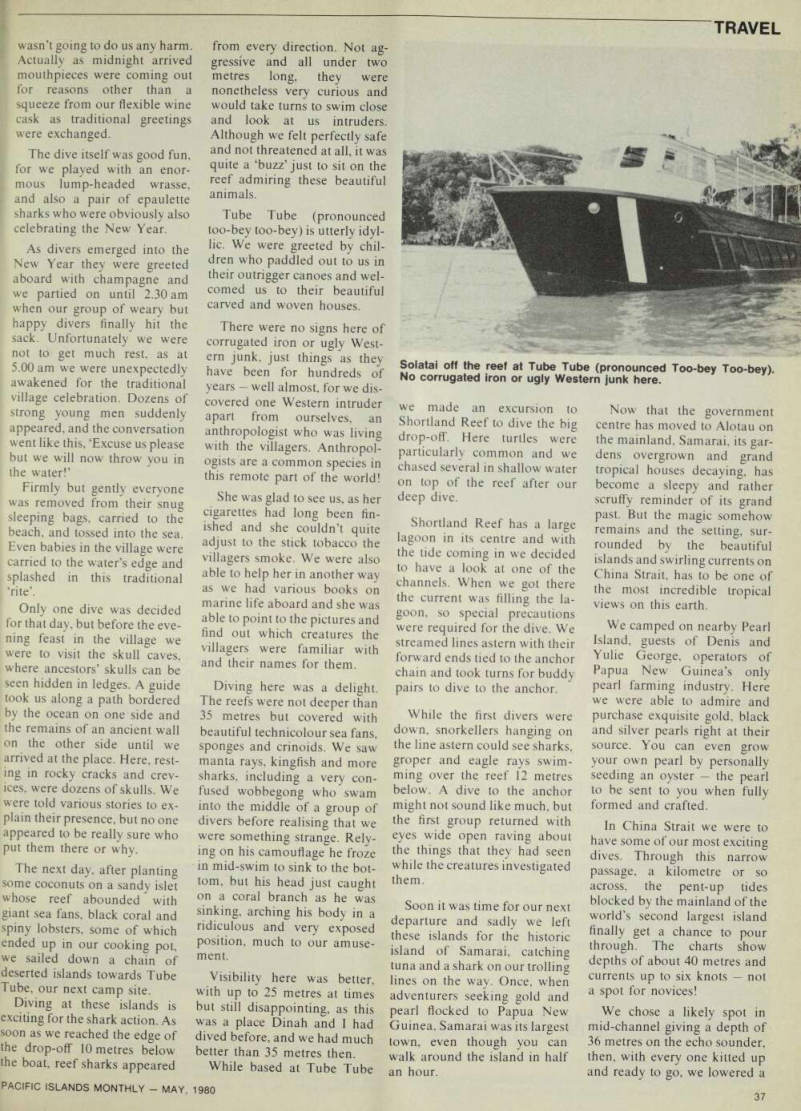
Solatai off the reef at Tube Tube (pronounced Too-bey Too-bey) No corrugated iron or ugly Western junk here.
heavy line with a hefty lump of scrap-iron tied on with a thin cord. We felt the iron bump the bottom, hoisted it a metre or so and led the first group of seven down to the bottom as we drifted on. It was a parachute
entry go! go! go! over the
stern platform, onto the line and down to the bottom.
The bumping and dragging
of the weight attracts sharks and each time the lead diver descended he was greeted by an active large whaler but on seeing us crazy mob of divers appear, each time the shark, with a sharp flick of its tail, vanished. Every diver attached himself to the main line with a quick release loop on a shorter length so that he could swim clear and fly!
And fly we did! The drag caused by the slight difference in speed of Solatai in the sur face current and us at the bot tom meant we could stretch out our arms and soar and zoom on our individual lines. The bot tom ripped by. With 12 metre
visibilitiy we gasped as ledges
and gullies full of fish and thick with strange, stunted corals appeared and, in a flash, disap peared.
Occasionally we would run into turbulence and be bumped and thrown around like a small plane in a storm, but all the time rushing on, hanging in effortless motion, merely angling our fins and arms to lift over the next ledge. At 36 metres we had decided on 15 minutes bottom time, for the lead diver, then all would ascend to the surface after a five minute safety stop at three metres under the boat. On sur facing we could see that we had travelled well over a nautical mile, giving nearly five knots speed.
This was such an exhilarat ing experience that a repeat performance was demanded for the next day, and it was then, as the second group started to ascend, that our one fear materialised. The scrap stuck in a coral ledge, anchor ing us in this massive current.
Hanging on and trying to keep
your mask in place wasn’t easy!
The lead diver had to cut the thin cord holding the scrap and once again we were all on the move and ascent was effortless.
Although our safety factor was good, everyone had five min utes on the oxygen rig just to make sure the extra effort of hanging on in the current hadn’t produced any bends bubbles. But no one had any
problems.
This time we kept going with the current and were soon through China Strait and head ing into Milne Bay. Here in 1943 a furious battle was
fought as Japanese invaders
tried to gain a stepping stone to Port Moresby, but failed.
Fighting in the appalling mud and rain of the wet season, Australian and American troops for the first time stopped the Japanese advance.
Milne Bay itself is very deep, with only a very narrow coral ledge around its shores so that many of the wartime wrecks are impossible to dive. Dinah and I not long ago very sadly watched small oil drops surface and spread from a wartime wreck we had researched, but although we were only 30 metres or so from shore the echo sounder was reading 200 metres. At other times we had dived on the many small land ing barges and even a tractor dumped down the reef
slopes.
Now we were heading for the wartime wreck of a large coal refuelling barge sunk in a sheltered anchorage near
Waga Waga village directly
across the bay from Alotau.
The wreck has its bow out of the water and its stern in about 30 metres. Near the stern a tall lattice gantry reaches past the surface, its above-water part a rusty eyesore, its underwater frames festooned with clams, gorgonians and black coral. A huge groper lives on the wreck, but he avoided us this trip as we explored the holds still partly filled with coal, and admired corals on large winches and cables that had been used to transfer coal to the hungry warships. The same night we returned to the wreck to hunt for shell, but spent most of the time weaving our way
through the towering iron
framework of the gantry ad miring the blaze of colour in our torches.
We had been out for 12 nights and the tour was over.
Our adventurers informed us that they couldn’t possibly go back yet, and would be quite content to spend another week or so if that was all right with us. Why, we hadn’t even looked for the sunken Zero reported just a few kilometres up the coast, or dived the USS President Grant on the reef a few hours south of Samarai!.
But next year! Next year!
Samarai in China Strait, now a sleepy and rather scruffy reminder’ of a grand past. It was spic and span when this photograph was taken in 1966, but it is still a South Seas jewel, worth a visit for those wanting to get off the beaten track. You take a launch from the mainland at Alotau.