How Somare lost his leadership
pp. 10-13 · Read in the full issue

in the political numbers game
By Angus Smales
In eight years leading his country Michael Somare fashioned a stability envied by a large part of the Third World and gave Papua New Guinea a reputation for political and
economic integrity.
Until the vote of 57 to 49 which brought him down in March Mr Somare had earned the title of the Great Survivor,
for easily withstanding three
no-confidence motions in two years. The numbers game in the PNG National Parliament has always been vague because of an extremely fluid party sys- . . . / \ J J tern m which casual voting . across party lines is not unusual / r J . ... , , (or even reprehensible) and . y party affiliations are as uncerf J x-f o tain as a lottery. Mr Somare , , .1 .. knew how to play the game, , . .u u relying on people rather than J . ° r r P . * , e .
Only three weeks before the ..•u j r . j vote which defeated the ... government a senior public ser- ° , t , r vant said you know what the , Chiefs like he sees the num- , , . bers come and go, he sees new . .. . 5 r , , parties and he hears of changed i w tu u . . ■ loyalties. Then he mst steps m, puts on a bit of a celebration, talks to a few people, and there he is - still in the chair’.
But this time it didn’t work.
What went wrong in a system
which had demonitrated politi-
cal stability and which had brought PNG from the heady days of independence to a respected position in the Pacific community?
To a large degree the change
was wrought not by matters of policy but by matters of per sonality. Mr Somare’s opponents have made much of the need for a change in out look, but their own attitudes since taking office do not
suggest significant change.
PNG politics have never been
steeped in marked divergences
of doctrine and except for a few issues which are now largely historical all parties have shown remarkably similar out looks and goals.
AliU , . ...
Although the politicians c v would never admit it them , . selves it is hard to escape the , . K conclusion that the real div . . ... , , 4 isions m PNG politics don t ... . . , , concern what tune should be . , , . . , , , „ .. played, but who should call it. £,, • r.u . , The irony of the recent change, too, is that the power figure , , , r „ who worked for the downfall r . u c of the Somare government was . n P X 4. . . c . not the new Prime Minister, Sir , , Julius Chan, but the new . n • . . , T Deputy Prime Minister, lum- U 1 rM 1 T . 1 . \A bakey Okuk. Late last year Mr .i .
Okuk resigned himself to the , , • , fact that , h f e ," ll g ht not have tha Pf rsonal followm S l u ° ca [ r >' ° ff the P nn \ e -"imstership but he co " tl " ued ‘° make the bullets \ nd bre the ammunition to shoot down Mr Somare ’
In earlier votes of no confidence Mr Okuk had been named as the incoming prime minister (the naming of a sue cessor is a constitutional re
quirement in any PNG vote of no-confidence), but for the March vote he courted the sup port of Sir Julius to take the top post. The reputation held by Sir Julius was undoubtedly a factor in the way the vote went, and it is doubtful if any other single figure could have com manded the appeal to defeat Mr Somare.
In assessing what went wrong with Mr Somare’s popu lar and parliamentary appeal many commentators have made much of the contentious Rooney affair last year and of the fact that early this year Mr Somare lost the support of two charismatic ministers, Father John Momis and John Kapu tin. (In the Rooney affair Mr Somare backed his Justice Minister, Mrs Nahau Rooney, in a constitutional contempt of court situation which led to the resignation of five judges who said they could no longer serve with honour in a country con temptuous of its courts).
However the real turn in Mr Somare’s fortunes can be traced back much earlier, and the recent loss of Father Momis and Mr Kaputin was a symptom rather than a cause.
The two developments which started the train of events leading to Mr Somare’s eclipse were the departure from the government of Sir Julius Chan’s Peoples Progress
Party in 1978 and the earlier sacking of Mr Okuk, Minister for Transport and Civil Avi ation.
The full story of Mr Somare’s dissatisfaction with Mr Okuk will probably never be told, but officially Mr Okuk was accused of not heeding government policies in his management of the important transport portfolio at the sensi tive time when Air Niugini, the national airline, was being con solidated.
In basic political terms Mr Somare’s action was probably unlucky rather than unwise, but the fact remains that the dismissal has rankled with Mr Okuk ever since. It led to the almost crusading manner in which Mr Okuk, normally an easy-going person with a dry sense of humour and a flexible approach to his politics, pur sued his goal of trying to bring down the Somare govern ment.
But even more significant was the situation which Mr Somare himself created in allowing Sir Julius and the
Peoples Progress Party to split
from the government on November 7, 1978.
The PPP had been a loyal partner to Mr Somare’s Pangu Party right back to self government days, and it was indeed only this support that had given Mr Somare the num bers to govern. Throughout
self-government and into independence this alliance ; continued although Sir Julius played very much second fiddle to the coalition heavies.
Press reports of the change of government made much of a claim that Sir Julius had been ‘Mr Somare’s deputy for seven I years’ but this was not so. The original Deputy Chief Minister [ was Sir John Guise who be came Governor-General at independence, and the first Deputy Prime Minister was Sir Maori Kiki who lost his seat at the 1977 general election.
Not until after the 1977 elec tion did Sir Julius negotiate a new coalition under Mr Somare and gain recognition as Deputy Prime Minister. The two leaders smiled and put their arms on each others shoulders as they made the an nouncement and posed for photographs on the lawns of the Prime Minister’s house.
The Chan breakaway came only 15 months later. After a series of late night emergency meetings with his party and in the wake of a spate of rumours he stood up in parliament and in a matter of fact statement with little apparent emotion announced the withdrawal of his party’s support. This took away 18 members from the government, including a hand ful of key ministers.
Sir Julius gave three main reasons for his move. He said his party was no longer being allowed to play a role in government, it was being de nied a voice in helping to man age the coalition to which it belonged, and it was concerned at ‘a dangerous brand of per sonalised control which has taken national management out of the cabinet room’.
Taken in isolation the PPP attitude was not immediately branded as a condemnation of Mr Somare’s style of manage ment. The attitude could well
have stemmed from political
jealousies or from an inflated idea of how much power the PPP believed it should exer cise. Accordingly there was a general belief Mr Somare
would strongly deny the accu
sations as a matter of political principle, no matter how well 3r how weakly the accusations night have been founded.
But Mr Somare astounded
his interviewers by saying flatly
that he had, indeed, kept the PPP out of some policy consul tations. ‘l’m the Prime Minister and leader of the government, it’s my responsibility to make decisions when they have to be made, and I make them,’ he said. Exactly why Mr Somare, whose entire political career had been built on the principle of consensus, should suddenly have adopted this line is dif ficult to understand.
There is no doubt that he had been under pressure from an extraordinary degree of irri
tation, intrigue, fluctuating
loyalties and political frus
trations. The final issue was his contentious personal code
proposition in which political
leaders were expected to rid themselves of property, invest ment and commercial involve ment. The PPP saw this as idealistic nonsense and be lieved that existing codes
safeguarded political probity,
but Mr Somare decided to push ahead. It may well be he felt himself so morally secure that dynamic unilateral action would entrench his leadership, but whatever the reason he acted out of character and made an error of judgment which in the long run was to cost him dearly.
Initially Mr Somare staved off the immediate challenge by enlisting the support of the United Party or more accu
rately by accepting a United
Party offer to join him.
This was a flattering development at the time and in terms of numbers he lost
nothing by the exchange. The
PPP took 18 men into oppo sition, and the United Party brought 18 men into govern ment. But in terms of quality and stability it became increasingly obvious in the ensuing months that for once in his political career Michael Somare had picked up the wrong end of the stick. In one way or another the mounting frustrations which plagued him until his defeat can all be traced to the situation in which he allowed the PPP to with draw its support.
Despite its name the United Party was anything but united in the events which led to the final confrontation in parlia ment and it eventually con solidated itself into two distinct
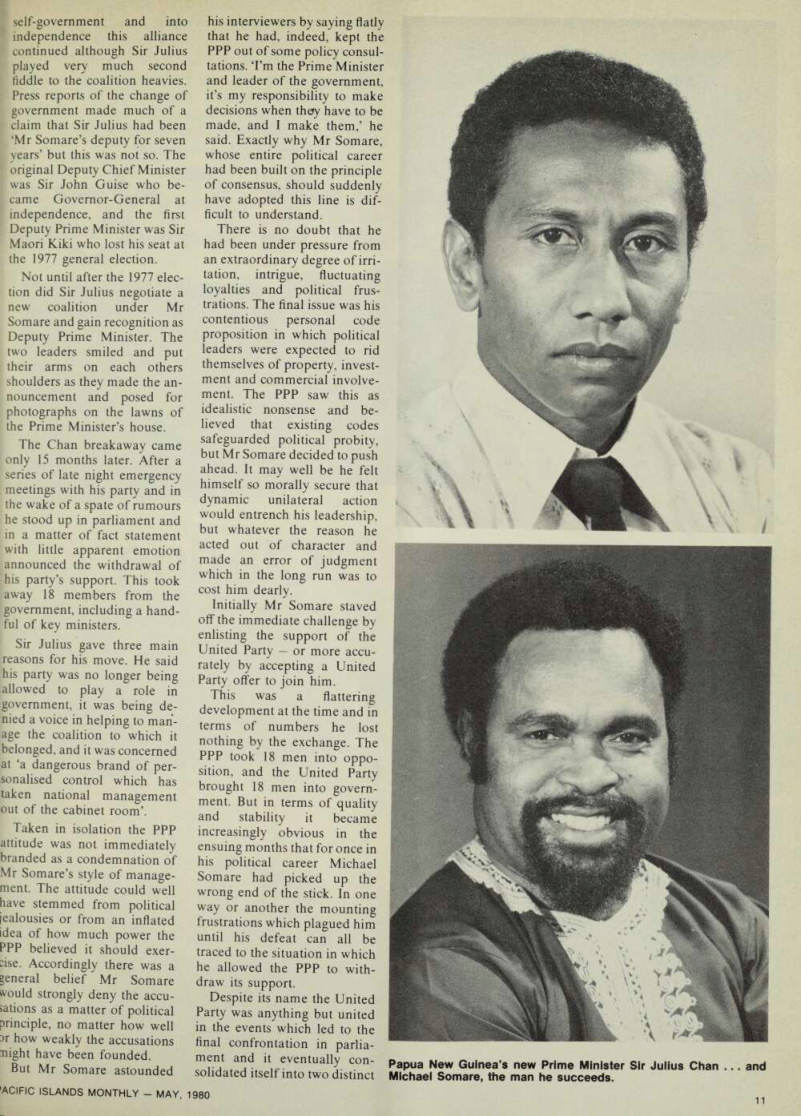
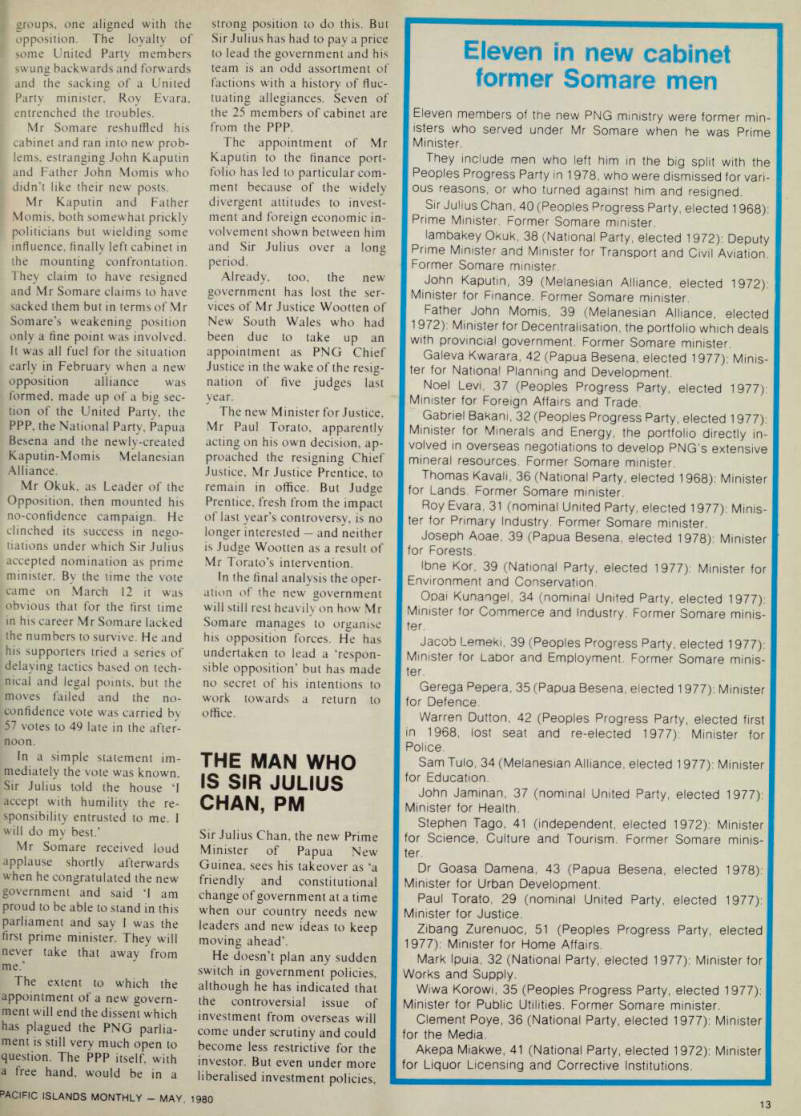
Papua New Guinea’s new Prime Minister Sir Julius Chan ... and Michael Somare, the man he succeeds.
groups, one aligned with the I opposition. The loyalty of I some United Party members I swung backwards and forwards \ and the sacking of a United Party minister, Roy Evara, [ entrenched the troubles.
Mr Somare reshuffled his [ cabinet and ran into new prob-
I lems, estranging John Kaputin
I and Father John Momis who \ didn’t like their new posts.
Mr Kaputin and Father ' Momis, both somewhat prickly politicians but wielding some influence, finally left cabinet in the mounting confrontation.
They claim to have resigned and Mr Somare claims to have sacked them but in terms of Mr
Somare’s weakening position
only a fine point was involved.
It was all fuel for the situation early in February when a new opposition alliance was formed, made up of a big sec tion of the United Party, the PPP, the National Party, Papua Besena and the newly-created Kaputin-Momis Melanesian Alliance.
Mr Okuk, as Leader of the Opposition, then mounted his no-confidence campaign. He clinched its success in nego tiations under which Sir Julius accepted nomination as prime minister. By the time the vote j came on March 12 it was I obvious that for the first time in his career Mr Somare lacked the numbers to survive. He and his supporters tried a series of delaying tactics based on tech nical and legal points, but the moves failed and the no confidence vote was carried by 57 votes to 49 late in the after noon.
In a simple statement im mediately the vote was known.
Sir Julius told the house ‘I accept with humility the re sponsibility entrusted to me. I will do my best.’
Mr Somare received loud applause shortly afterwards when he congratulated the new government and said ‘I am proud to be able to stand in this parliament and say I was the first prime minister. They will never take that away from me.’
The extent to which the appointment of a new govern ment will end the dissent which has plagued the PNG parlia ment is still very much open to question. The PPP itself, with a free hand, would be in a
strong position to do this. But Sir Julius has had to pay a price to lead the government and his team is an odd assortment of factions with a history of fluc
tuating allegiances. Seven of
the 25 members of cabinet are from the PPP.
The appointment of Mr Kaputin to the finance port folio has led to particular com ment because of the widely divergent attitudes to invest ment and foreign economic in volvement shown between him and Sir Julius over a long
period.
Already, too, the new government has lost the ser vices of Mr Justice Wootten of New South Wales who had been due to take up an appointment as PNG Chief Justice in the wake of the resig nation of five judges last year.
The new Minister for Justice, Mr Paul Torato, apparently acting on his own decision, ap proached the resigning Chief Justice, Mr Justice Prentice, to remain in office. But Judge Prentice, fresh from the impact of last year’s controversy, is no longer interested and neither is Judge Wootten as a result of Mr Torato’s intervention.
In the final analysis the oper ation of the new government will still rest heavily on how Mr Somare manages to organise his opposition forces. He has undertaken to lead a ‘respon sible opposition’ but has made no secret of his intentions to work towards a return to office.