Kevin Egan
pp. 5-7 · Read in the full issue
Letters
hits back
Tired as I am of the ‘Rooney Affair’ and its whole distasteful aftermath, your editorial com ment — ‘Strange ways of Mr Kevin Egan’ (PIM, Feb. p 9), forces me once again to raise my weary pen for the sake of your, and your readers’ enlight enment.
I sent you a copy of my annual report, with a short covering note, out of a sense of balance, everyone else with an interest in the Pacific having either requested or been sent one. I anticipated some criti cism of either the viewpoint that I put forward or the fact that I put forward a viewpoint at all. I did not, however, expect the fatuous trivia that you dished out in February by way of substitute for genuine, red-blooded criticism.
You made two points. The first related to the paper on which the covering letter was typed, full of pregnant refer ences to ‘xed’ out ‘Secretary For Law, Port Moresby’ head notes and national crests. Let me put your tender sensitivities to rest. That paper, far from
representing purloined
national property (heaven for bid) was part of a stockpile of identical paper previously used
by the last pre-independence
secretary forjustice. The paper, just like the office which used it, ceased to have any relevance
after mid-night on September
15 1975 (Independence Day)!
Rather than throw it away my officers and I have used it as scrap paper since then. So much for your first point.
Your second point related to Somare’s allegation, made after I left, that whilst overtly stating that I was leaving, covertly I was attempting to obtain a reappointment. What rot!! At the same time I believe he was also telling eager lis teners ‘Egan wanted to stay
but we didn’t want someone like him as Public Pros ecutor’.
It is noteworthy that you neglected to tell your readers that in a letter to the editor, published in the PNG Post- Courier on January 28 1980, page 4, I accused Somare of misleading the public in re spect of this matter, an alle gation to which that gentleman has never replied. Nevertheless his statements and reactions to the release of my report and my
departure, a departure which
has coincided with a general
exodus of long-serving expatri
ate lawyers in the country, are not without their significance.
For a start, my report con tained 33 pages of trenchant,
though objective, criticism re
lated to PNG’s present, un questionable, law and order crisis. To date Somare has not denied a single syllable of what I had to say. Rather predict ably, the only comment that has emanated from him is the one that you reported in Pacific
Report concerning my alleged
quest for reappointment. Even were it true, the question that
then immediately must spring
forward is ‘Well, so what?’
Quite clearly, finding himself
in a situation from which he could not extract himself with facts, the honourable gentle man has chosen to revert to a combination of two classic pol itical manoeuvres the red herring and the smear tactic.
Secondly his reactions
demonstrate quite clearly that
‘politically insensitive’ pros ecutions in PNG, regardless of their legality and merit, may well lead to censure in the form, effectively, of dismissal, under the present regime. For
tunately, those responsible for
drafting the Constitution fore saw the potential for such a cynical misuse of executive power, and for that reason the appointment of Judges and the Public Prosecutor is not the re sponsibility of the Executive but rather the Judicial and Legal Services Commission, consisting of the Chief Justice, Deputy Chief Justice, Chief Ombudsman, Minister for Jus tice and one other parliamen tarian.
That Somare is not prepared to pay even lip service to this enshrined constitutional tenet became obvious however in
November when he an nounced. in answer to a ques tion in parliament that ‘the government (emphasis mine) intended to appoint two more National Judges in February’.
This was said when the Com mission had not even con sidered the matter, and was a blatant attempt to coerce the Commission in futuro.
The truth concerning myself
is quite simple. In May, whilst
in Hong Kong, being con
cerned over recent trends in PNG, I raised the question of my appointment as Crown Counsel in the Colony with the
Assistant Attorney-General,
indicating then verbally, and a fortnight later in writing, that I would not be seeking reap pointment as Public Prosecutor in PNG at the expulsion of my term on November 23.
After Rooney’s release from
prison after serving only 24
hours I made a public state ment to this effect. This was in September. On October 19 I confirmed this decision, in writing, to the Judicial and Legal Services Commission.
Between September and October, however. I was ap proached by two members of the Judiciary, a number of senior police officers and others to reconsider my de cision. I communicated the fact of this approach to the Sec retary for Justice who offered to assist me if I wished to change my stance. I did not.
Having already resolved to go in May, is it at all likely that with the massive trauma caused after Mrs Rooney’s let ter to the Chief Justice in July I would be still actively seeking reappointment in November?
Kevin B. Egan
(Former) Public Prosecutor of Papua New Guinea Brisbane, Qld, Australia •In April, PIM published the full text of the annual report to which Mr Egan refers in his let ter. We made the space available because we considered the report to be of such importance. This decision was made before we received Mr Egan’s letter, but we are happy to publish his re marks. PIM apologises for the error in the published report in which Mr Egan’s name was given as Brian instead of Kevin.
Editor.
No ‘oddballs’
after all
Write in haste, repent at leisure. Sorry, Yanks, for my reference to ‘oddball chicken farmers’ in my article (PIM Mar p 17) It is not my style to denigrate the efforts of any individual, and I don’t like it myself when my own achievements are
denigrated.
Therefore I apologise most humbly to my Yank friends in Port-Vila who number among themselves 1) a manager of a very efficient frozen chicken operation 2) a manufacturer of household goods who is imparting his skills to New Hebridians 3) a new tourist complex operator 4) a superb
agriculturalist 5) a four-ring
Captain US Navy 6) an ex- Coastguard commander, etc.
All are doing their bit to de velop the New Hebrides.
So to Hank, Hoff, Chuck, Guv, Gus, Tom and Mack I say let’s call the dogs off and begin
again.
Ken Hutton
Santo New Hebrides
Levuka: An exciting
new project
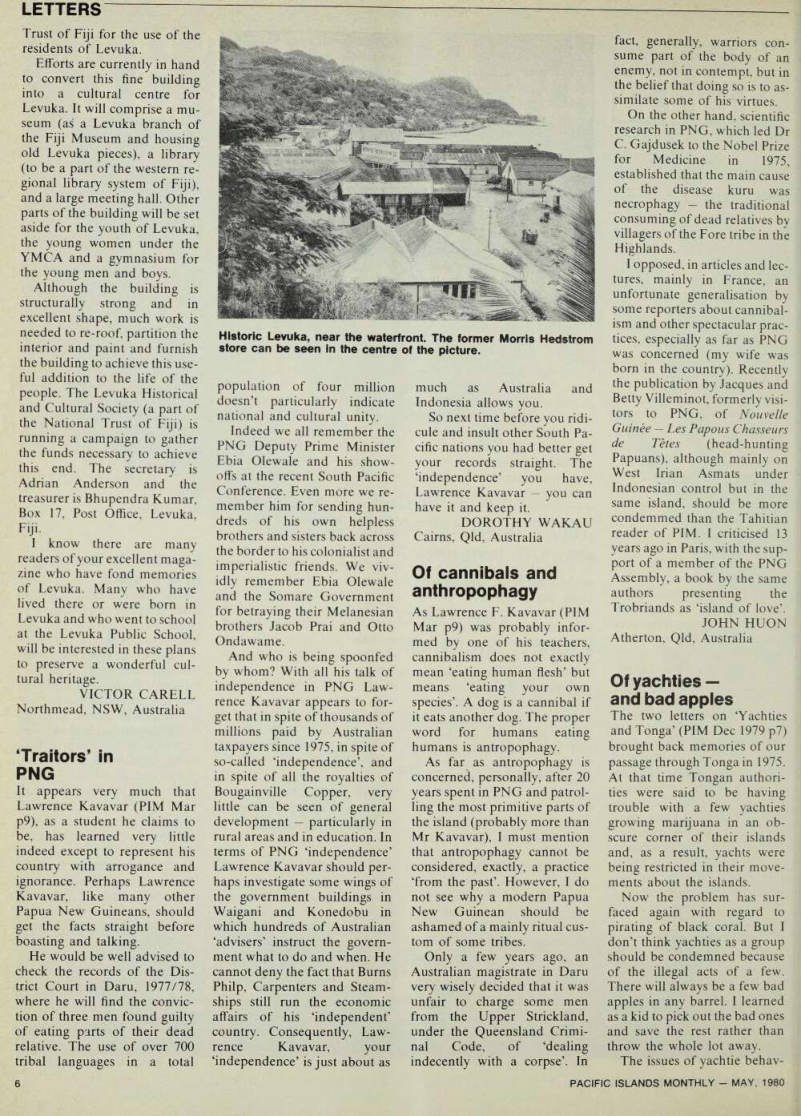
Levuka, the old capital of Fiji, is the centre of an exciting new South Pacific project. In the long term it is planned to dedi cate the whole of Levuka, this fine historical gem, as an his toric site. The town is ideal for this. It is unique in this part of the world with almost all of its buildings dating back to the 19th century and with its his torical importance as the scene of the signing of the cession deed that joined Fiji with Great Britain. Here, the first school in Fiji began in 1879, the first town council was incor porated over 100 years ago and the first newspaper, the Fiji Times , began publication. The large Pacific business of Morris Hedstrom, now a part of the
Carpenter chain, began here
100 years ago.
In the plans it is hoped that the original old governor’s resi dence will become part of the National Trust. The big and
imposing building of the orig
inal Morris Hedstrom store, now also 100 years old, has been given to the National
Trust of Fiji for the use of the residents of Levuka.
Efforts are currently in hand to convert this fine building into a cultural centre for Levuka. It will comprise a mu seum (as a Levuka branch of the Fiji Museum and housing old Levuka pieces), a library (to be a part of the western re
gional library system of Fiji),
and a large meeting hall. Other parts of the building will be set aside for the youth of Levuka, the young women under the YMCA and a gymnasium for the young men and boys.
Although the building is
structurally strong and in excellent shape, much work is needed to re-roof, partition the interior and paint and furnish the building to achieve this use ful addition to the life of the people. The Levuka Historical and Cultural Society (a part of the National Trust of Fiji) is
running a campaign to gather
the funds necessary to achieve this end. The secretary is Adrian Anderson and the treasurer is Bhupendra Kumar, Box 17, Post Office, Levuka,
Fiji.
I know there are many readers of your excellent maga zine who have fond memories of Levuka. Many who have lived there or were born in Levuka and who went to school at the Levuka Public School, will be interested in these plans to preserve a wonderful cul
tural heritage.
Victor Carell
Northmead, NSW, Australia
‘Traitors’ in
Png
It appears very much that Lawrence Kavavar (PIM Mar p 9), as a student he claims to be, has learned very little indeed except to represent his country with arrogance and
ignorance. Perhaps Lawrence
Kavavar, like many other Papua New Guineans, should get the facts straight before
boasting and talking.
He would be well advised to check the records of the Dis trict Court in Daru, 1977/78, where he will find the convic tion of three men found guilty of eating parts of their dead relative. The use of over 700 tribal languages in a total
population of four million doesn’t particularly indicate national and cultural unity.
Indeed we all remember the PNG Deputy Prime Minister Ebia Olewale and his show offs at the recent South Pacific Conference. Even more we re member him for sending hun dreds of his own helpless brothers and sisters back across the border to his colonialist and imperialistic friends. We viv idly remember Ebia Olewale and the Somare Government for betraying their Melanesian brothers Jacob Prai and Otto Ondawame.
And who is being spoonfed by whom? With all his talk of independence in PNG Law rence Kavavar appears to for get that in spite of thousands of
millions paid by Australian
taxpayers since 1975, in spite of so-called ‘independence’, and in spite of all the royalties of
Bougainville Copper, very
little can be seen of general
development particularly in
rural areas and in education. In terms of PNG ‘independence’
Lawrence Kavavar should per
haps investigate some wings of
the government buildings in Waigani and Konedobu in which hundreds of Australian ‘advisers’ instruct the govern ment what to do and when. He cannot deny the fact that Burns
Philp, Carpenters and Steam
ships still run the economic affairs of his ‘independent’ country. Consequently, Law rence Kavavar, your ‘independence’ is just about as
much as Australia and Indonesia allows you.
So next time before you ridi cule and insult other South Pa cific nations you had better get your records straight. The ‘independence’ you have, Lawrence Kavavar you can have it and keep it.
Dorothy Wakau
Cairns, Qld, Australia
Of cannibals and
anthropophagy
As Lawrence F. Kavavar (PIM
Mar p 9) was probably infor
med by one of his teachers, cannibalism does not exactly mean ‘eating human flesh’ but means ‘eating your own species’. A dog is a cannibal if it eats another dog. The proper word for humans eating humans is antropophagy.
As far as antropophagy is concerned, personally, after 20 years spent in PNG and patrol ling the most primitive parts of the island (probably more than Mr Kavavar), I must mention that antropophagy cannot be
considered, exactly, a practice
‘from the past’. However, I do not see why a modern Papua New Guinean should be ashamed of a mainly ritual cus tom of some tribes.
Only a few years ago, an Australian magistrate in Daru very wisely decided that it was unfair to charge some men from the Upper Strickland, under the Queensland Crimi nal Code, of ‘dealing indecently with a corpse’. In
fact, generally, warriors con sume part of the body of an enemy, not in contempt, but in the belief that doing so is to as similate some of his virtues.
On the other hand, scientific research in PNG, which led Dr C. Gajdusek to the Nobel Prize for Medicine in 1975, established that the main cause of the disease kuru was necrophagy - the traditional consuming of dead relatives by villagers of the Fore tribe in the
Highlands.
I opposed, in articles and lec tures, mainly in France, an unfortunate generalisation by some reporters about cannibal ism and other spectacular prac tices, especially as far as PNG was concerned (my wife was bom in the country). Recently
the publication by Jacques and
Betty Villeminot, formerly visi
tors to PNG, of Nouvelle Guinee Les Papous Chasseurs de Tetes (head-hunting
Papuans), although mainly on
West Irian Asmats under Indonesian control but in the same island, should be more condemmed than the Tahitian reader of PIM. I criticised 13 years ago in Paris, with the sup port of a member of the PNG Assembly, a book by the same authors presenting the Trobriands as ‘island of love’.
John Huon
Atherton, Qld, Australia
Of yachties
and bad apples
The two letters on ‘Yachties and Tonga’ (PIM Dec 1979 p 7) brought back memories of our passage through Tonga in 1975.
At that time Tongan authori ties were said to be having trouble with a few yachties growing marijuana in an ob scure corner of their islands and, as a result, yachts were being restricted in their move ments about the islands.
Now the problem has sur faced again with regard to pirating of black coral. But I don’t think yachties as a group should be condemned because of the illegal acts of a few.
There will always be a few bad apples in any barrel. I learned as a kid to pick out the bad ones and save the rest rather than throw the whole lot away.
The issues of yachtie behav
Historic Levuka, near the waterfront. The former Morris Hedstrom store can be seen In the centre of the picture.
iour, need for better communi cation between yachties and officials, and the question of how much yachties contribute to the local economy are not new. They are not much dif ferent from those we encoun tered when we enjoyed the hospitality of the Tongan islands five years ago. At that time (PIM Feb 1976 pp 23-25) I wrote to you explaining the yachties’ side, in hopes of promoting a better understand ing of both sides of the issue cutting enclosed. Those obser vations are still valid.
I believe the general situ ation has now improved, and some long-term benefits of yachties’ visits are now evident.
I refer to the recently established yacht charter business at the Port of Refuge Hotel on Vavau.
If it hadn’t been for the many yachties bringing back home their true-life experiences of visiting and sailing the waters of Tonga, that charter business would not exist. The hundreds of people who now charter those boats would not spend their vacation dollars in Tonga but probably would stay home or sail the Caribbean waters instead.
We cannot kill the goose that lays the golden egg. Instead, let’s lower the boom on the miscreants who make life bad for all of us.
Earl R. Hinz
Huntington Beach,
Calif. USA
Suwarrow as
she is
I just read ‘Problems in Tom Neale’s Paradise’ (PIM Feb Pl 4). I was greatly surprised that Mr Syme interpreted what he saw there as a problem rather than a blessing.
As I was on one of the yachts referred to I feel responsible to set the story straight.
First of all both yachts sailed from Pago Pago, not Western Samoa as claimed. Both were en route to Hawaii, but due to an extensive calm they took anchorage at Suwarrow and were there three days, not two months as claimed.
The Cook Islands Premier Dr Tom Davis did not show an noyance about the yachts. On the contrary he wrote three
pages in Tom Neale’s log book expressing gratitude and com mending the yachters for ‘mak ing Suwarrow a national
park’.
Also Tom Neale’s son, who was with the visiting party, wrote his thanks to the yachters for preserving his father’s house and grounds.
This log book was left by Tom Neale for entries from visiting yachts and is a tes timonial to the service they have done to his estate.
Premier Davis was so impressed with what he saw and read that he wrote in the back of the log book to send it to him when it was full of entries and he would put it in a museum as a tribute to Tom Neale. One of the girls on the yachts actually burst into tears
after reading the eloquent
message of Premier Davis. She had just spent three days dust ing and keeping house for Tom Neale.
If one were to land on this tiny island (only a few hundred metres long) one would find a well manicured pathway lead ing up to a group of shacks.
Pots and pans are neatly stacked, a bookshelf has a selection of books and ornaments, the dinner table is practically set for guests, even the bed is made. You’d find the
tool shed perfectly organised with a large variety of tools
(not just junk). The yards look
cleared, even the garden fence is repaired and standing up right. Yet you’d be the only person there.
Contrary to what Mr Syme appears to think, yachters would not steal Tom Neale’s cats, or chickens (it’s written in the log book ‘feed, don’t eat the chickens’), or anything from that place. If they did they’d be cast out by their own kind.
Is Mr Syme so naive as to think that if Tom Neale’s place was left to nature the buildings and water tanks would be in good repair, or that one could even find the path? As for the damaged trees, send a botanist and you’d get a different
opinion.
Fortunately, Premier Davis is more perceptive. The proof is in the log book which is now at Tom Neale’s shack awaiting the next yachter’s entry. For it is they who are the caretakers of this unique museum.
Larry Potter
Pago Pago
American Samoa
Historic issue of
Rabaul Times
I have a copy of the single sheet, special edition of The Rabaul Times dated Monday, September 4, 1939, which tells of the declaration of World War II the previous day. It is
in good condition, though
becoming brownish in colour because of its age of 40 years.
I bought it in Rabaul when I was a government clerk there.
I am wondering if PIM readers know of any other cop ies still in existence? There might be a few, but almost cer tainly not many. Most would have been destroyed during the invasion and occupation by the Japanese.
G B. Black
Nambour, Qld A Pacific Maths,
Logic contest
I refer to PIM Pacific Report (Mar p 7) where you call on young mathematicians to par ticipate in the 1980 Australian
Mathematics Competition.
Readers may be interested to learn of another such compe
tition in the Pacific region; the South Pacific Mathematics and Logic Competition which has been operating since 1972 (its Australian counterpart has been going for two years).
Our Maths and Logic Com petition started in Lae, Papua New Guinea, in 1972 but rap idly spread throughout the Pa cific. It is now operated from the University of the South Pa cific in Suva and from the Ministry of Education and Training in Honiara. If readers would like to have further in formation about our compe tition they may contact either myself at the address below or Richard Wah at PO Box 2393, Suva, Fiji.
Colin Meek
(Co-organiser)
PO Box 729 Honiara Solomon Islands
Help with the
Induna Star
As a survivor of the ill-fated garrison at Rabaul in 1942, the Committee of Lark Force As sociation, have charged me with the task of raising a Mem orial Book to all who were con cerned in the operations in the area.
One chapter has been given over to that of the Ist Indepen dent Company, stationed in Kavieng, with sections scat tered north and south of that point. The company had as its seagoing transport the Induna Star of 81 tons, which on
February 4 was captured by the
Japanese off Gilingil, New
Ireland; and from that time on lost sight of. Who the previous owner was we likewise do not know, and the Canberra War Museum is unable to help.
However, we have every reason to believe the vessel did operate out of Rabaul, and would have been fairly well known at the time; but with the passage of time there are fewer and fewer people to whom one can turn for the information.
Has anybody got a photograph of the Induna Star ? Could I also ask if somebody has a snap of Peter Harbour (Peterhafen) in the Witu Islands.
Douglas A. Aplin
17 Tyrall St, Box Hill N.
Victoria 3129
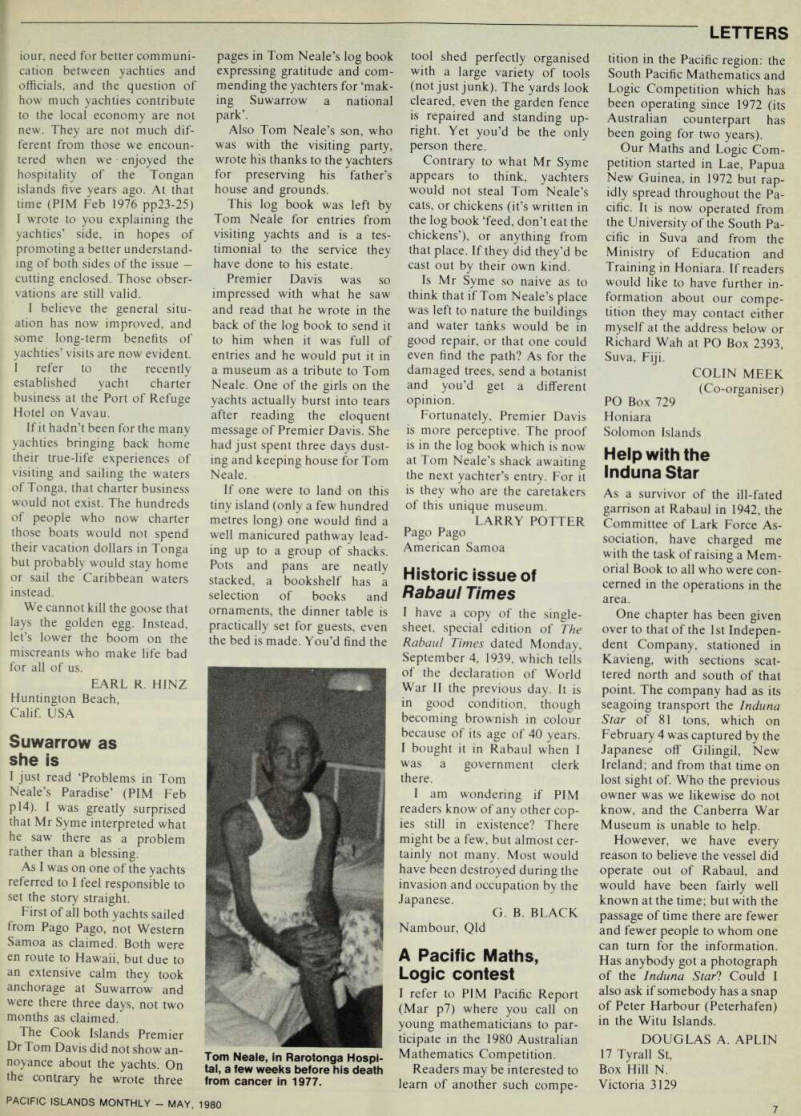
Tom Neale, in Rarotonga Hospi tal, a few weeks before his death from cancer in 1977.